

We are now going to take a little trip through the Bible while looking at the symbolic meanings within these stories. What I am attempting to do is show them in a way that allows us to see ourselves in these stories at particular times in our own lives. These ancient accounts may describe people who lived thousands of years ago, but perhaps they also describe experiences taking place within us today.
My hope is that this journey not only opens your mind to another way of looking at Scripture, but also assists you in seeing yourself more clearly. We are not trying to take anything away from the Bible or say that its traditional meanings have no value. We are simply asking whether there may be another layer beneath the surface—a layer that turns Scripture from something we merely read about into something we can recognize and experience within ourselves.
The Bible, a Story About Us
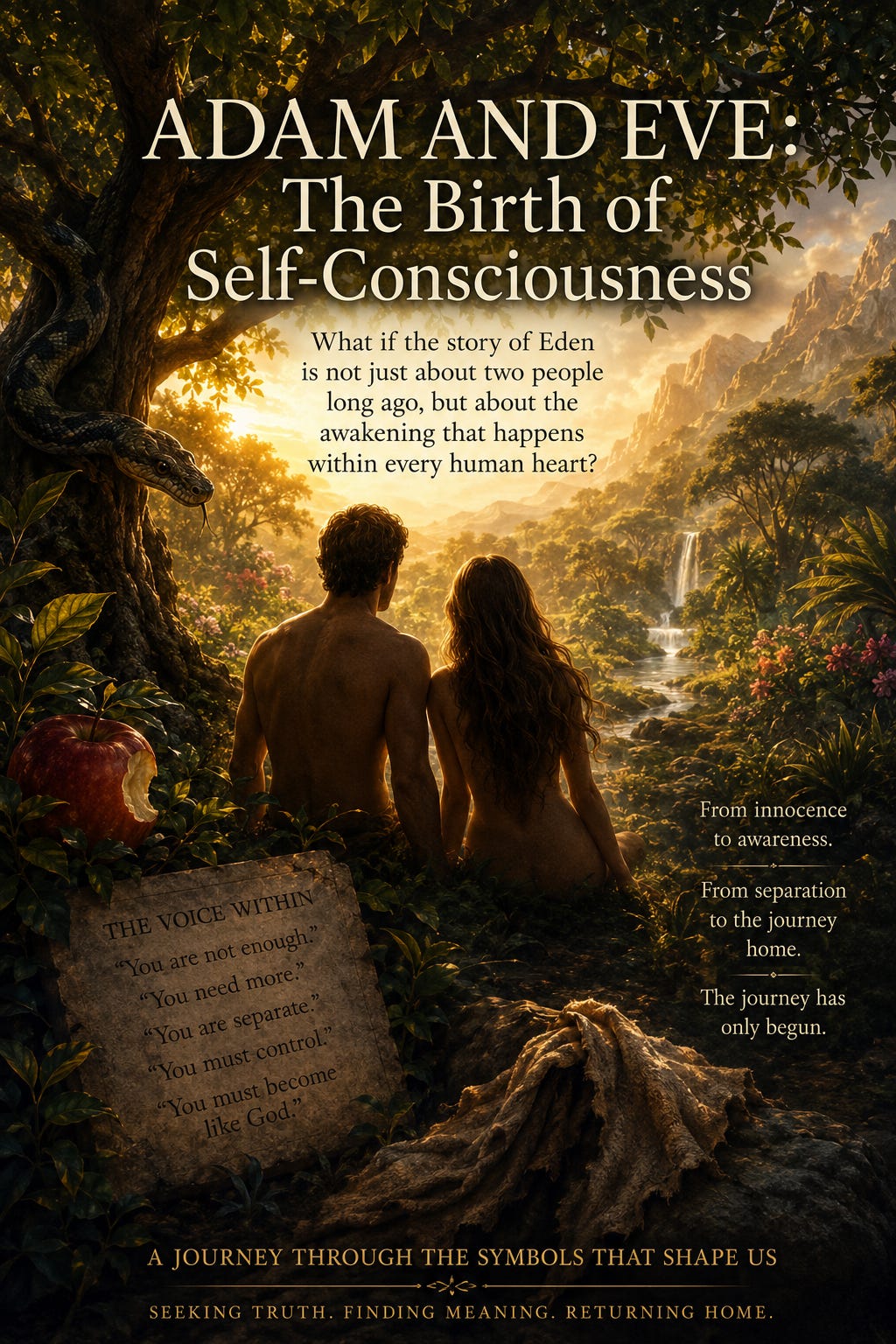
For centuries, the story of Adam and Eve has been understood primarily as the story of humanity’s fall. Two people disobeyed God, ate forbidden fruit, and were expelled from Paradise. That understanding has shaped much of Christian thought. But what if there is more to the story? What if this ancient account is not merely telling us what happened to two individuals long ago, but is also describing something that happens within every one of us? After all, that is what powerful symbols do. They speak beyond a particular place and time. Perhaps that is one reason these ancient stories have survived for thousands of years. Somewhere within them, we continue to recognize ourselves.
Before eating from the Tree of the Knowledge of Good and Evil, Adam and Eve lived in innocence. Genesis tells us that they were naked and yet felt no shame. Think about what that suggests. There was nothing to defend, nothing to conceal, and apparently nothing about themselves that they believed needed to be different. There was no carefully constructed image to maintain. Then something changed. Their eyes were opened. Suddenly they became aware of themselves in a different way. They noticed their nakedness. Shame entered their experience. They covered themselves, and when they heard God approaching, they hid. Fear had appeared where trust had once existed.
Perhaps this story is describing something deeper than simply the breaking of a rule. Perhaps it is describing the awakening of self-consciousness and the beginning of the divided human experience. Most of us can find something very similar in our own lives. Watch very young children playing. Before they become strongly self-conscious, they often simply are. They may sing without wondering whether they have a good voice. They dance without asking whether anyone thinks they look foolish. They ask questions without worrying that someone might think they are ignorant. Their experience is immediate and largely unguarded.
Then, little by little, another awareness develops. What do people think of me? Am I good enough? Why does that person have more than I do? Why wasn’t I chosen? Why did they laugh at me? What is wrong with me? Something that once flowed naturally becomes filtered through our awareness of ourselves in relation to everyone else. We begin constructing an identity. We learn what receives praise and what receives criticism. We discover embarrassment and rejection. We compare ourselves with others, and we learn how to protect ourselves.
In a sense, each one of us leaves the garden.
Perhaps we don’t leave it all at once. We may even wander in and out of it throughout our lives. There are still moments when we forget ourselves completely—watching a sunset, holding a grandchild, working with our hands, praying, laughing with someone we love, walking through the woods, or simply sitting quietly. For a few moments the constant concern with “me” disappears. We aren’t trying to impress anyone or defend anything. We simply are. Then the mind begins talking again, and there we are, back in the world of comparison, judgment, worry, and self-consciousness.
The Tree of the Knowledge of Good and Evil becomes especially interesting when looked at symbolically. Once we eat from that tree, everything begins to be divided and labeled: good and evil, right and wrong, success and failure, beautiful and ugly, important and insignificant, worthy and unworthy, us and them. Of course, discernment is necessary. We need to recognize the difference between actions that heal and actions that harm. But something changes when judgment becomes the lens through which we see everything, including ourselves.
Instead of recognizing that we made a mistake, we begin believing, “I am a failure.” Instead of simply disagreeing with another person, we decide that person is the problem. Instead of experiencing life as it comes, we continually measure it against what we think it should be. We divide the world around us, and eventually we become divided within ourselves. Perhaps that is one symbolic meaning of eating from the Tree of the Knowledge of Good and Evil. We enter a world of opposites and begin continually deciding where everything belongs—including ourselves.
Then there is the serpent. Traditionally, Christianity has associated the serpent with Satan, and that remains an important part of the traditional reading. But symbolically, perhaps the serpent can also help us recognize a voice operating within ourselves. It is the voice that whispers that something is missing, that we need something more before we can be complete. We need to prove ourselves. We need others to recognize our importance. We need to protect our image. We need to be right. We need to control what happens next.
Isn’t that voice familiar?
We might call it ego, the false self, the carnal mind, or simply the fearful and self-centered part of human nature. The name matters less than learning to recognize its voice. The serpent’s promise is particularly interesting: “You will be like God.” Yet Genesis has already told us that humanity was created in the image of God. Perhaps that is part of the deception. We spend much of our lives trying to become what, at the deepest level, God has already invited us to discover.
We search outside ourselves for worth. We accumulate possessions, titles, knowledge, approval, accomplishments, and sometimes even religious certainty, hoping somehow to arrive at the place where we can finally say, “Now I am enough.” But the finish line keeps moving. There is always another accomplishment, another possession, another argument to win, another person whose approval we think we need. There is always another fruit hanging from another branch.
After Adam and Eve eat the fruit, one of the most revealing things in the entire story happens. They hide. Perhaps humanity has been hiding ever since. We hide behind accomplishments and possessions. We hide behind occupations and titles. We hide behind humor, anger, busyness, knowledge, and carefully constructed identities. Sometimes we even hide behind our beliefs. Religion itself can become another hiding place if knowing the correct doctrines becomes easier than honestly looking at what is happening inside us.
We can know Bible verses and still be afraid. We can defend God and still refuse to forgive our neighbor. We can speak about love while carrying resentment. We can attend church while remaining hidden from ourselves. That doesn’t necessarily make us hypocrites. It makes us human. Adam hid. We hide.
And then comes one of the most remarkable questions in Scripture. God walks through the garden and asks Adam, “Where are you?”
Surely an all-knowing God did not need directions. Perhaps the question wasn’t asked because God couldn’t find Adam. Perhaps Adam couldn’t find Adam. “Where are you?” may be one of the first great questions of spiritual self-examination in the Bible.
Where am I right now? Am I living from love or fear? Am I responding to what is actually happening, or am I reacting to an old wound? Am I seeking truth, or am I defending something simply because my identity has become attached to it? Am I present in this moment, or am I lost in yesterday and tomorrow? Am I walking openly with God, or am I hiding behind bushes I have planted around myself?
Seen this way, God’s question doesn’t have to sound like an accusation. It can sound like an invitation. Come out from hiding. Allow yourself to be seen. And perhaps just as importantly, begin to see yourself.
Maybe the entire Bible can be read, at least on one level, as humanity trying to find its way home. Not necessarily back to a physical garden with particular trees and rivers, but back to relationship with God—to trust, love, wholeness, and the awareness that we were never created to live entirely in fear and separation.
When we begin looking at Scripture this way, many of the stories that follow take on another dimension. We encounter brothers fighting brothers, people enslaved and longing for freedom, wilderness journeys, giants that appear impossible to defeat, kings who begin well and lose their way, prophets calling people to awaken, and people building temples while sometimes forgetting the God the temple was supposed to honor. These aren’t only things that happened to other people. We have our own Egypts, our own wildernesses, our own giants, our own battles, and our own places of captivity.
Eventually we encounter Jesus, speaking again and again about something He calls the Kingdom of God. Perhaps the journey from Genesis onward is not simply a collection of unrelated stories. Perhaps there is a thread running through all of it. The garden is lost. Humanity wanders. God continues calling. And eventually the Kingdom begins to be rediscovered—not simply as a place we hope to enter someday, but as a reality that can begin changing us from within.
This also gives us another way of thinking about salvation. Salvation certainly carries the traditional Christian meaning of reconciliation with God through Christ. But perhaps reconciliation is also something we are meant to experience here and now. What are we being saved from? Fear, hatred, resentment, blindness, endless reaction, the need to dominate, the need always to be right, and the belief that we are completely separate from everyone around us. And what are we being saved into? Love, forgiveness, awareness, compassion, truth, and relationship with God.
Perhaps salvation is not merely something waiting for us after death. Perhaps Jesus was showing us a way of living in which the Kingdom begins taking root within us now.
And perhaps the most beautiful detail of the Garden story is one we sometimes overlook. God does not abandon Adam and Eve. There are consequences to what has happened. Life outside the garden will contain struggle, work, pain, conflict, and death. But God remains involved. He clothes them. He speaks to them. Their children are born. The story continues.
Human beings may leave the garden, but God does not stop seeking human beings.
That changes the tone of the entire story. Instead of reading Genesis merely as the account of humanity ruining everything, perhaps we can also see it as the beginning of a long journey in which God continually meets humanity wherever it has wandered.
And perhaps He is still asking the same question today: “Where are you?”
Not because He doesn’t know.
But because sometimes we don’t.
Perhaps the entire rest of Scripture is the story of the Father calling His children home. And perhaps, as we make our way through these familiar Bible stories, we will discover that they aren’t merely stories about Adam, Abraham, Moses, David, Jonah, Peter, Paul, and countless others.
They are stories about us.
Because somewhere along the way, we have all lived in the garden. We have all listened to the serpent. We have all hidden. We have all wandered.
And perhaps, if we become quiet enough to hear it, the Father is still walking through the garden, calling us home.
Coming Next
Cain and Abel: The Battle Within
What if the first murder recorded in Scripture is not only about two brothers long ago, but about the struggle between two forces within every human heart?
Thank you for this comment. I think that rather than being black or white we need to look at our inner awareness. Have we grown beyond ego or have we become stagnant. Like a koan it begs us to look inward
This is an interesting analysis. "Where are you" as koan.
When we begin thinking beyond dualities and think more cohesively, or circularly, or with nuances...have we grown?