

The story of Cain and Abel has often been understood simply as the account of the first murder. Two brothers bring offerings to God. One offering is regarded favorably while the other is not. Jealousy enters the picture, anger grows, and eventually one brother takes the life of the other.
But what if this story is about more than two brothers who lived long ago? What if Cain and Abel also represent something that continues to take place within the human heart? If the story of Adam and Eve describes our movement from innocence into self-consciousness, fear, judgment, and separation, perhaps Cain and Abel show us what can happen next. Once we begin seeing ourselves as separate, comparison soon follows. And once comparison enters, jealousy and resentment are never far behind.
Throughout our lives, we experience this struggle in countless forms. There is a part of us that longs for peace, trust, gratitude, and harmony. Yet there is another part that compares itself with others, seeks recognition, wants to be appreciated, and becomes resentful when life does not unfold as expected. Sometimes both can be present within us at the same moment.
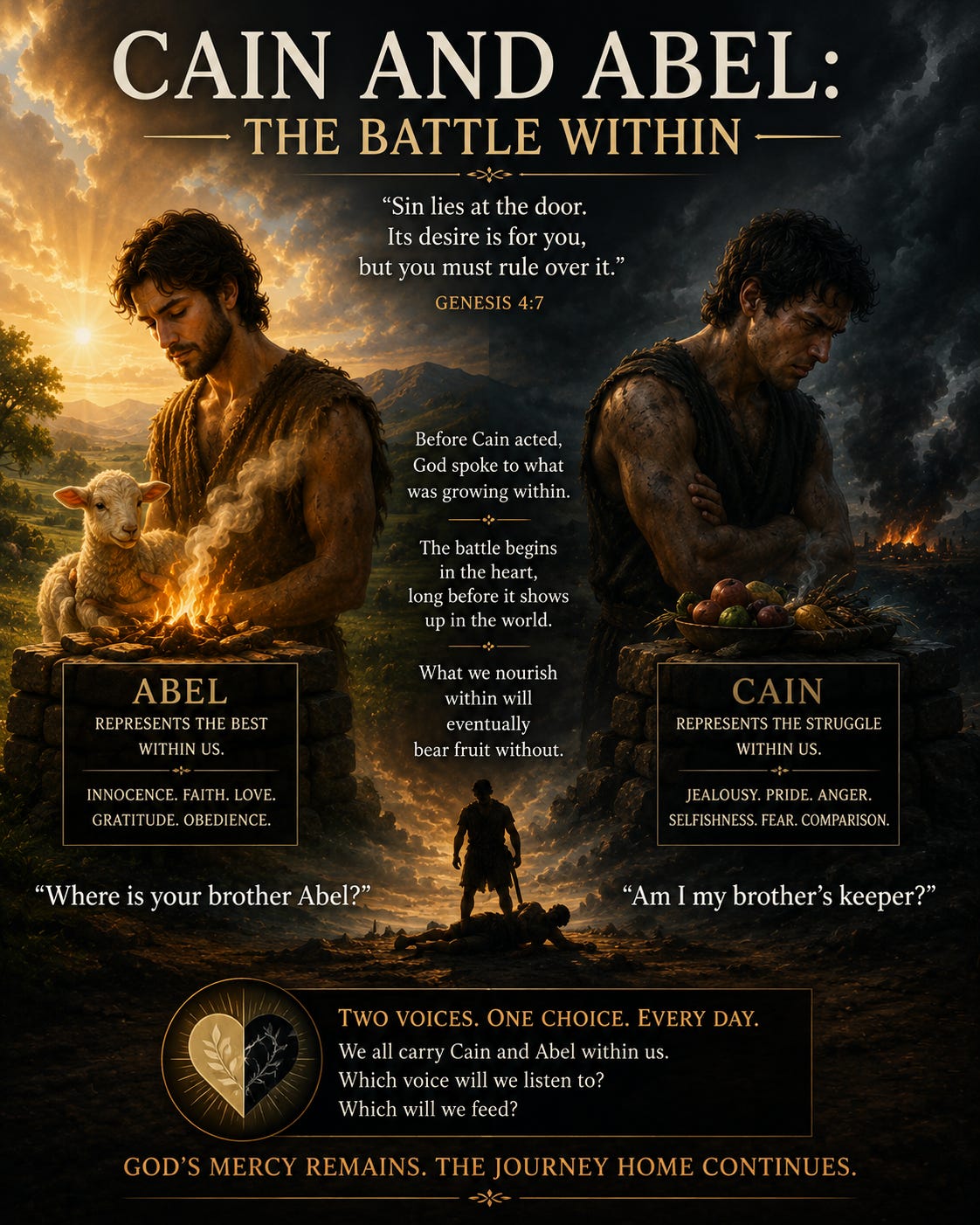
Perhaps Abel represents something innocent and trusting within our nature, while Cain symbolizes the part of us that measures, compares, competes, and seeks approval. This does not necessarily mean that Cain is simply the “bad” part of us and Abel the “good” part. That would almost return us immediately to the Tree of the Knowledge of Good and Evil, dividing everything neatly into opposites. Cain may instead represent something wounded and fearful within us that has forgotten where its worth comes from.
The story tells us that Cain and Abel both brought offerings to God. Cain brought from the fruit of the ground, while Abel brought from the firstborn of his flock. Genesis tells us that God regarded Abel and his offering favorably, while Cain and his offering were not regarded in the same way. For centuries people have debated why. Was it the nature of the offering? Was it the quality of what was given? Was it the attitude of the person giving it? Scripture itself leaves room for reflection.
Perhaps, when reading the story symbolically, the deeper question is not simply why God preferred one offering over another, but what our own offerings reveal about us. We can perform exactly the same outward action for very different inward reasons. One person can give because of love while another gives because of obligation. We can serve because we genuinely care, or because we want to be noticed. We can pray because we desire relationship with God, or because we hope to receive something in return. We can even do something generous while quietly hoping someone will recognize how generous we have been.
The outward offering may look much the same. What is taking place within us may be entirely different.
This is where Cain’s story becomes very personal. How often do we compare our lives with those around us? How often do we wonder why someone else seems to prosper while we struggle? Why did they receive the recognition? Why did their prayer seem to be answered? Why did their family turn out differently? Why do they have more money, better health, greater ability, or an easier life? We may sincerely wish another person well and still feel something uncomfortable stirring within us when they receive what we wanted.
That is Cain standing at the door.
And perhaps the most important part of the story occurs before Cain ever harms Abel. God speaks to Cain while there is still time to choose another path: “Why are you angry? And why has your countenance fallen?” Then comes the warning that sin is lying at the door, desiring him, but that he must rule over it.
This may be one of the earliest and most profound lessons in self-observation found in Scripture. Notice that God does not begin with Cain’s outward behavior. He draws Cain’s attention to what is happening inside him. Why are you angry? What is happening within you?
That question could be asked of us countless times during an ordinary week.
Why did that comment bother me so much? Why am I irritated with this person? Why do I feel threatened by what they said? Why am I pleased when someone I dislike fails? Why do I need to prove that I am right? Why does someone else’s success make me feel smaller?
These questions are not meant to condemn us. They help us see what is happening before it takes control.
Long before harsh words are spoken, relationships are broken, families divide, or nations go to war, something begins in the unseen world of thought and emotion. An impression enters us. Something happens that we do not like. We interpret it. Emotion follows. The mind begins building a case. We replay the event. We add motives that we cannot actually know. We tell ourselves why we are justified. Before long, a passing irritation has become resentment.
Perhaps this is what it means for sin to be “lying at the door.” The door is still closed. Nothing has happened yet. Cain has not killed Abel. There is still a moment in which awareness can intervene.
We all know that moment.
Someone says something that irritates us, and immediately we feel the response forming. We can almost feel it in the body before the words come out. Something in us wants to strike back, defend itself, correct the other person, or make sure they understand what they have done to us. Sometimes we act on it immediately. Other times we carry it silently for hours, days, or even years.
But there is a small space between what happens to us and what we do with it.
Perhaps that is the doorway.
God tells Cain that sin desires to master him, but Cain must rule over it. This does not sound like Cain is helpless. He has a choice. He can observe what is arising within him before becoming completely identified with it. Anger may be present, but Cain does not have to become his anger. Jealousy may appear, but he does not have to obey it.
Sadly, Cain does.
Jealousy becomes resentment, resentment grows into hatred, and hatred eventually becomes violence. What began invisibly inside Cain finally becomes visible in the world around him.
That pattern has repeated itself throughout human history, but we do not have to look at wars and murders to recognize it. We can see it in marriages, families, churches, workplaces, communities, politics, and friendships. A small grievance goes unattended. Someone feels overlooked. Pride is wounded. Neither person wants to yield. Each begins collecting evidence against the other. Eventually the original disagreement may hardly matter anymore. What matters is winning.
Cain has killed Abel many times without anyone physically dying.
Something gentler dies instead.
Trust can die. Friendship can die. A marriage can slowly lose its tenderness. Families can stop speaking. Churches can divide. Neighbors can become enemies. Compassion can disappear because protecting our own position becomes more important than understanding another person.
Then God asks Cain another question: “Where is Abel your brother?”
It is interesting that this echoes the question God asked Adam in the garden: “Where are you?” First comes the question concerning ourselves. Then comes the question concerning our brother.
Where are you?
Where is your brother?
Perhaps the two questions belong together. Until we begin seeing what is happening within ourselves, it is difficult to truly see the person standing beside us.
Cain responds with one of the most haunting questions in Scripture: “Am I my brother’s keeper?”
That question has echoed throughout human history. Am I responsible for what happens to others? Does their suffering matter to me? Can I simply live my own life without concern for the people around me? Where does my responsibility end?
The life and teachings of Jesus return to this question again and again. Love your neighbor. Forgive. Care for the stranger. Feed the hungry. Visit the sick. Love even your enemies. The Good Samaritan crosses the road toward the wounded man rather than away from him. Jesus continually expands the circle of who counts as our neighbor.
Perhaps Cain’s question is therefore not answered only with words. It is answered through an entire way of living.
Yes, your brother matters.
But there is another layer to this story that may be even more personal. If Cain and Abel symbolize different possibilities within ourselves, perhaps we must also ask: What happens to the Abel within us when Cain takes control?
What happens to our compassion when resentment rules us? What happens to gratitude when comparison dominates our thinking? What happens to peace when we constantly measure ourselves against others? What happens to love when being right becomes more important than relationship?
The Cain within us can silence the Abel within us.
This does not mean we should hate or destroy the Cain part of ourselves either. In fact, that may be another trap. If Cain represents the wounded, frightened, comparing part of us, perhaps it too needs to be brought into the light and understood. We cannot heal what we refuse to see. The goal is not to pretend that jealousy, anger, pride, and resentment never arise. The goal is to recognize them before they sit upon the throne and begin making our decisions for us.
This is where these ancient stories become surprisingly practical. The next time jealousy appears, we can notice it. The next time someone receives recognition we wanted, we can observe what happens within us. The next time anger rises, we can hear God’s question to Cain: “Why are you angry?”
Not, “Why are you such a terrible person?”
Simply, “Why are you angry?”
There is a tremendous difference.
One condemns. The other invites awareness.
Perhaps God is teaching Cain to look inward before acting outward. Cain’s tragedy is not that anger appeared. Anger is part of human experience. His tragedy is that he allowed what appeared within him to become his master.
Yet even after Cain’s terrible act, the story contains something unexpected. God does not simply destroy him. Cain must live with the consequences of what he has done, but God places a mark upon him so that others will not kill him.
Even here, mercy remains.
That does not erase Abel’s death or excuse Cain’s action. Consequences are real. But neither does Cain’s worst act place him entirely beyond God’s concern.
Perhaps there is hope for us in that as well.
We will not always catch ourselves at the doorway. Sometimes we will speak before thinking. Sometimes resentment will get the better of us. Sometimes pride will win. Sometimes we will hurt people we love. There may even be things in our past that we deeply regret.
But failure does not have to be the end of the journey.
God continues calling us toward awareness, responsibility, reconciliation, and love.
Perhaps Cain and Abel are therefore not merely two brothers from the distant past. They represent a drama that continues within the human heart. Fear and love, comparison and gratitude, resentment and compassion are continually asking for our attention.
Every day we nourish something.
And perhaps one of the great lessons of Cain and Abel is simply this: Pay attention to what is growing within you before it becomes what you give to the world.
The journey home is not about becoming perfect people who never experience anger, jealousy, fear, or resentment. It is about becoming increasingly aware of these movements within ourselves and gradually learning not to let them rule us.
The question God asked Cain remains with us:
“Why are you angry?”
And close behind it comes another:
“Where is your brother?”
Perhaps learning to answer the first honestly is part of learning how to care for the second.
Coming Next
Noah’s Flood: What Must Be Washed Away?
What if the flood story is not simply about a world destroyed long ago, but about those times in life when everything familiar is swept away so that something new can emerge?