


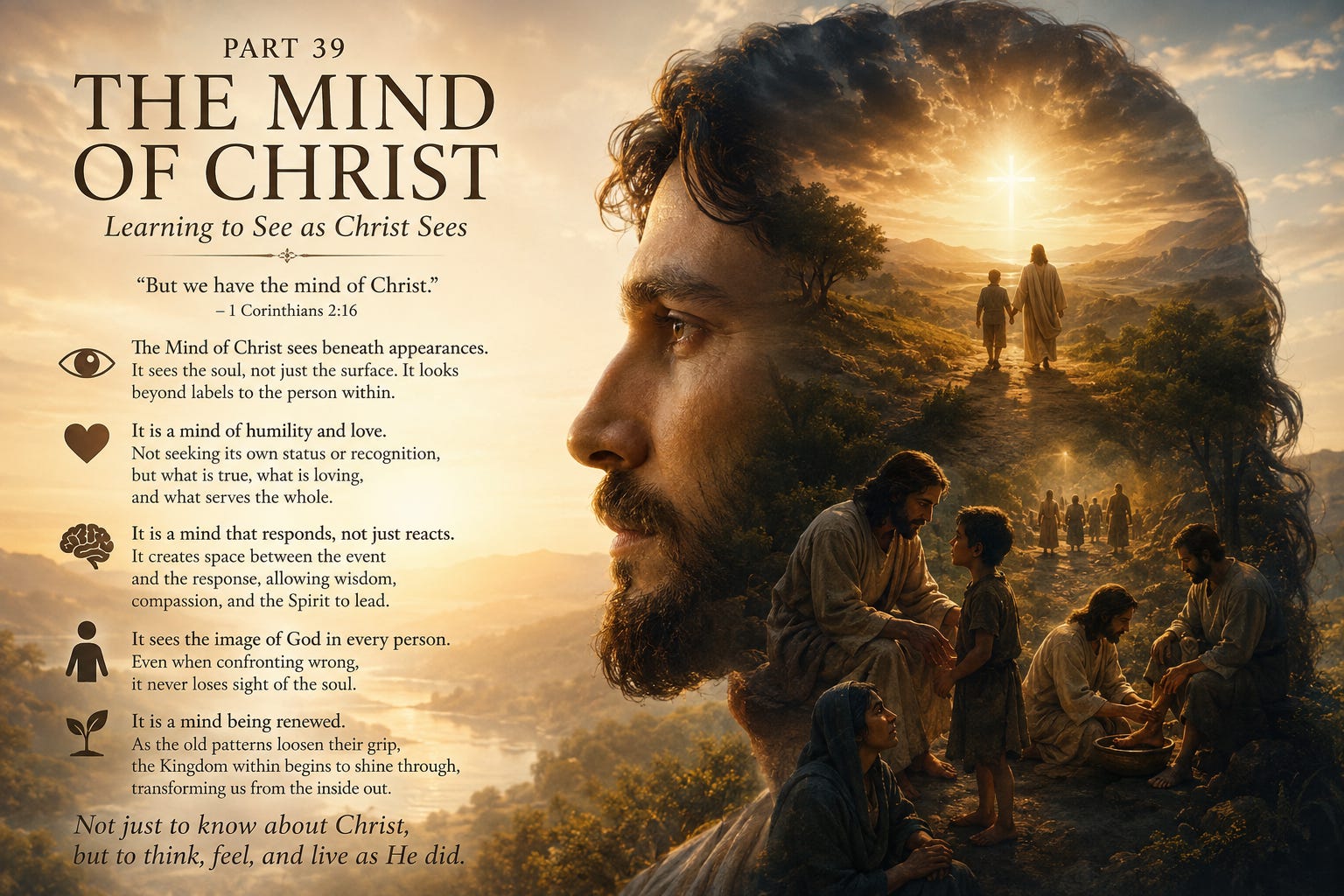
In the previous article, we looked at Paul’s image of humanity as the Body of Christ—many members, many gifts, many functions, yet one living body. But a body needs more than individual parts. It needs something that coordinates them. It needs a mind.
Paul makes an extraordinary statement:
“But we have the mind of Christ.” — 1 Corinthians 2:16
For many years I might have read those words as meaning that Christians are supposed to learn what Jesus believed and then try to think the same way. There is certainly truth in that, but I have come to believe Paul may be pointing toward something much deeper. The Mind of Christ is not merely knowing about Jesus or agreeing with certain doctrines about Him. It is a transformation in the very place from which we see, judge, respond, and live.
It is possible to know the Bible very well and still react from anger, fear, pride, tribal loyalty, resentment, or self-interest. We may quote Jesus while responding to another person in ways completely unlike Jesus. The Mind of Christ therefore cannot simply mean possessing correct religious information. It must involve a change in consciousness—a transformation not only in what we think, but in the part of us from which our thoughts and reactions arise.
A Different Way of Seeing
Jesus continually saw people differently from those around Him. Religious leaders saw a sinful woman; Jesus saw a human being capable of transformation. Others saw a despised tax collector; Jesus saw Zacchaeus. The disciples saw troublesome children; Jesus saw the Kingdom of Heaven reflected in them. Society saw lepers, Samaritans, foreigners, enemies, failures, and outcasts. Jesus repeatedly looked beyond the label and encountered the person.
This may be one of the clearest signs of the Mind of Christ: it sees beneath appearances. Our ordinary mind divides the world very quickly into friend or enemy, good person or bad person, conservative or liberal, believer or unbeliever, worthy or unworthy, right or wrong. Sometimes distinctions are necessary, of course, but trouble begins when the label becomes the whole person. Once that happens, compassion can disappear because we are no longer truly seeing the human being before us.
Jesus seemed able to recognize what was wrong without reducing a person to what was wrong with them. He could confront hypocrisy strongly while still seeking restoration. He could disagree without hatred. He could see the sin without losing sight of the soul. Perhaps having the Mind of Christ means learning to do the same.
“Let This Mind Be in You”
Paul writes:
“Let this mind be in you, which was also in Christ Jesus.” — Philippians 2:5
The verses that follow describe humility. Christ does not grasp for status or superiority but empties Himself and takes the form of a servant. That tells us something important about the kind of mind Paul is describing. The Mind of Christ is not obsessed with proving itself right. It is not constantly defending its importance. It does not need to dominate every conversation, defeat every opponent, or receive recognition.
The ordinary ego tends to ask, How does this affect me? What will people think of me? Am I winning? Am I respected? The Mind of Christ asks something quite different: What is true? What is loving? What serves the whole? What is mine to do?
This is not weakness. Jesus could be remarkably forceful when necessary. He overturned tables, challenged religious authorities, and refused to compromise truth merely to keep people comfortable. Yet even His strength did not seem to arise from wounded pride. He was not defending an insecure personal identity. That difference may be crucial.
The Mind That Reacts and the Mind That Responds
Most of us discover, if we watch ourselves carefully, how quickly reactions arise. Someone criticizes us and an answer forms almost instantly. Someone disagrees politically or religiously, and we begin constructing an argument before they have finished speaking. Someone hurts us, and the mind begins replaying the event, defending ourselves and judging them. Much of this happens so quickly that we assume the reaction simply is us.
Sometimes the reaction may even be justified. But something important can happen if there is a small space between the event and our response. In that space we might ask, What is happening inside me right now? Why am I so threatened by this? Am I responding to what this person actually said, or to something inside myself? What would love see here that my first reaction does not?
This does not mean suppressing anger, denying injustice, or pretending everything is acceptable. Jesus certainly did none of those things. It means that the first automatic reaction does not necessarily have to become the final response. There can be a moment in which we actually see what is occurring within us before it takes control. In that moment, another possibility appears. There is room for another kind of seeing, and perhaps that is one doorway into the Mind of Christ.
And here is a little preview of where we will be going after this present series is completed: we will begin exploring much more practically how we can become aware of these mostly unconscious reactions and gradually gain some freedom from being controlled by them. It is one thing to say that we should respond differently; it is another thing entirely to learn how to observe what is happening within ourselves while it is actually happening.
The Renewal of the Mind
Paul describes this transformation elsewhere:
“Be transformed by the renewing of your mind.” — Romans 12:2
Notice that he does not merely say, learn more information. He says be transformed. Transformation means that the person doing the seeing begins to change.
Our minds have been shaped by family, culture, religion, politics, fears, wounds, successes, failures, and countless experiences we may barely remember. We inherit assumptions about how the world works and then easily mistake those assumptions for reality itself. Jesus repeatedly challenged these inherited ways of seeing. Again and again He began with some version of, “You have heard that it was said…” and then followed with, “But I say unto you…”
He moved beneath the external rule toward the inward condition. Murder became connected with anger. Adultery became connected with desire. Loving one’s neighbor expanded into loving one’s enemy. Religious purity gave way to purity of heart. The transformation was moving inward. The Kingdom was moving inward. Eventually even the law was to be written upon the heart.
The Mind of Christ may be the consciousness that begins to perceive life from that inward Kingdom.
Christ Consciousness Is Not Spiritual Superiority
There is a danger here that is worth recognizing. Whenever human beings encounter spiritual ideas, the ego can quietly claim them for itself. A person can begin thinking, I have the Mind of Christ. I understand what others do not. Ironically, the very claim can become evidence that we have moved away from it.
The Mind of Christ does not seem to produce spiritual arrogance. Jesus washed feet. He ate with people religious society rejected. He repeatedly warned against seeking the highest seats and being admired for religious performance. The more deeply a person begins to see, the more aware he may become of how incomplete his own understanding still is.
Perhaps one sign of spiritual maturity is the ability to say, “I may be wrong.” That does not mean abandoning conviction. It means holding conviction without making our own present understanding identical with God. There is an enormous difference between saying, “This is what I presently believe to be true,” and saying, “God sees everything exactly as I do.” History shows how dangerous the second assumption can become.
Seeing the Divine Image in Others
Jesus taught that what we do to “the least of these,” we somehow do to Him. That teaching becomes astonishing when taken seriously because it suggests that Christ is not merely someone we worship from a distance. Christ is also somehow encountered in the human being standing before us—the difficult neighbor, the stranger, the poor, the prisoner, the person whose beliefs disturb us, and even the enemy.
This does not mean that everyone behaves rightly or that destructive behavior should be tolerated. Love sometimes requires boundaries, confrontation, justice, or separation. Jesus Himself confronted wrongdoing. But even then, another human being does not cease to carry the image of God.
The ordinary mind asks whether someone deserves love. The Mind of Christ seems to begin somewhere deeper. Love is not merely a reward given to those who deserve it; it becomes a condition of consciousness from which we meet the world.
From Believing in Christ to Allowing Christ to Live Through Us
This entire series has gradually been moving toward an important distinction. Christianity can become primarily a religion about Jesus—believing certain things about His birth, death, resurrection, divinity, and return. Those beliefs may be deeply meaningful. But the New Testament repeatedly pushes us beyond belief about Christ toward something much more intimate: Christ in you, the Spirit dwelling within you, the Kingdom of God within you, the law written upon the heart, the Body of Christ made of human beings, and now Paul’s remarkable statement, “We have the Mind of Christ.”
The direction is unmistakably inward.
The question gradually changes from Do I believe in Jesus? to something even more demanding: Is the life of Jesus becoming visible through me? Can I forgive more freely? Can I see another person without immediately judging them? Can I remain compassionate while still recognizing wrongdoing? Can I tell the truth without hatred? Can I disagree without needing to destroy the person with whom I disagree? Can I become less controlled by fear, pride, resentment, and the need to be right?
These questions may tell us more about our actual spiritual condition than how many theological answers we have memorized.
Who Is Sitting on the Throne?
There is another way of expressing this. Something is always governing our inner life. At different times fear may sit on the throne, or anger, pride, woundedness, political identity, religious certainty, the desire for approval, or simply habit. Whatever occupies that inner throne influences what we notice, what we believe about what is happening, and how we respond.
The spiritual journey may therefore involve repeatedly noticing what has taken control and allowing something deeper to return to its rightful place. Jesus called it seeking first the Kingdom of God. Paul called it being led by the Spirit. Elsewhere Scripture speaks of putting on the new man. Here Paul calls it possessing the Mind of Christ.
Different language may be describing aspects of the same inward transformation: the ordinary, reactive self is no longer the unquestioned ruler of the inner world.
The Mind of Christ in Daily Life
Perhaps this teaching becomes most meaningful when we bring it out of theology and into ordinary life. Someone speaks sharply to me, and I feel the reaction rise. For a moment, perhaps I can see it before I become completely identified with it. I can listen. I can ask what is really happening. I can decide whether anything needs to be said at all.
Someone disagrees with something deeply important to me and my mind immediately begins preparing its defense. But perhaps I can first hear the person—not merely wait for my turn to speak, but actually hear. Someone behaves badly, and I may need to confront the behavior, but I do not necessarily have to hate the person. Someone suffers and, instead of immediately explaining why their suffering is their own fault, perhaps compassion can arise first.
These moments may seem insignificant compared with great religious experiences, but this is where spiritual transformation becomes real. The Mind of Christ is tested in traffic, at the dinner table, in political conversations, in church disagreements, in family conflict, in disappointment, and in the quiet thoughts we never speak aloud. That is where the Kingdom either begins to become flesh in us—or remains only an idea.
Becoming What We Have Been Seeking
At the beginning of the spiritual journey, God often seems to be somewhere outside us. We search upward and outward through books, churches, teachers, doctrines, experiences, and traditions. All of those may help us. But eventually Scripture begins pointing toward a mystery: the One we have been seeking has also been working within us.
The Kingdom is within. The Spirit is within. Christ is within. And the mind itself can be renewed.
Perhaps salvation is therefore more than being rescued from something after death. Perhaps it also includes being gradually liberated from the unconscious patterns that prevent us from loving, seeing, and living as Christ did. The Mind of Christ is not something we manufacture simply by trying harder to be religious. It emerges as the old mind loosens its grip—as fear gives way to trust, judgment gives way to understanding, pride gives way to humility, and automatic reaction gradually gives way to conscious response.
We do not become Jesus. But something of the consciousness revealed through Jesus can begin to awaken within us. Perhaps that has been the invitation all along: not merely to worship the Light, but to allow that Light to illuminate the mind through which we see ourselves, one another, and the world.
A Question to Carry With Us
As we move through the coming days, perhaps we can begin watching ourselves without condemnation and simply ask: What is seeing through me right now? Is it fear? Resentment? Pride? Habit? A wound from the past? Or, just for a moment, can I see this person and this situation through something closer to the Mind of Christ?
That small moment of awareness may be where transformation begins.
Coming Next: Part 40 — Revelation: The Unveiling Within
The word Revelation carries the meaning of an unveiling—something previously hidden becoming visible. Rather than beginning with Revelation only as a timetable of disasters occurring somewhere outside us, we will explore another possibility: that this strange and powerful book can also describe an unveiling taking place within human consciousness.
The beasts, the dragon, Babylon, judgment, the Lamb, and ultimately the New Jerusalem may reveal an inner struggle between an old order of consciousness and the birth of something entirely new. And as we begin that final movement of the series, we will also begin making our way back toward the place where this entire journey started: In the Garden.