

The Book of Revelation may be the most misunderstood book in the Bible. For many people, it immediately brings to mind frightening images: beasts rising from the sea, plagues falling upon the earth, armies gathering for battle, stars falling from heaven, the mysterious number 666, and the final destruction of the world. Entire systems of prophecy have been constructed trying to match these symbols with nations, political leaders, technologies, and events in the news. But the very name of the book offers another possibility.
The Greek word apokalypsis, translated Revelation, means an unveiling, an uncovering, or a revealing of something previously hidden. What if Revelation is not primarily about God hiding the future in a complicated code? What if it is about something being uncovered within us?
Throughout this series, we have been looking at Scripture through that inward lens. Egypt became more than an ancient country; it became the state of bondage within us. The wilderness became the place where the old identity is stripped away. Jerusalem became the inner city where God is meant to dwell. The cross became the surrender of the false self, the Resurrection the awakening of a new life, Pentecost the coming of Spirit within humanity, and the Mind of Christ the beginning of an entirely different way of seeing. If that pattern continues, Revelation may be describing what happens when that awakening reaches its deepest levels.
The Revelation of Jesus Christ
The book begins:
“The Revelation of Jesus Christ…”
That phrase can be read in more than one way. It certainly means a revelation given through Jesus Christ. But perhaps it also points toward the revealing of Christ within humanity—the gradual unveiling of what has always been hidden beneath our fear, conditioning, pride, desire, and mechanical reactions.
Jesus had already said:
“The kingdom of God is within you.”
— Luke 17:21
If the Kingdom is within, then perhaps the great struggle preceding its full establishment must also occur within. Revelation then becomes strangely personal. The dragon is not merely somewhere in the world, Babylon is not merely somewhere in history, and the Beast is not merely someone we must identify. These images can also represent forces operating within the human soul. Suddenly the central question changes from “When will these things happen?” to “Where are these things happening in me?”
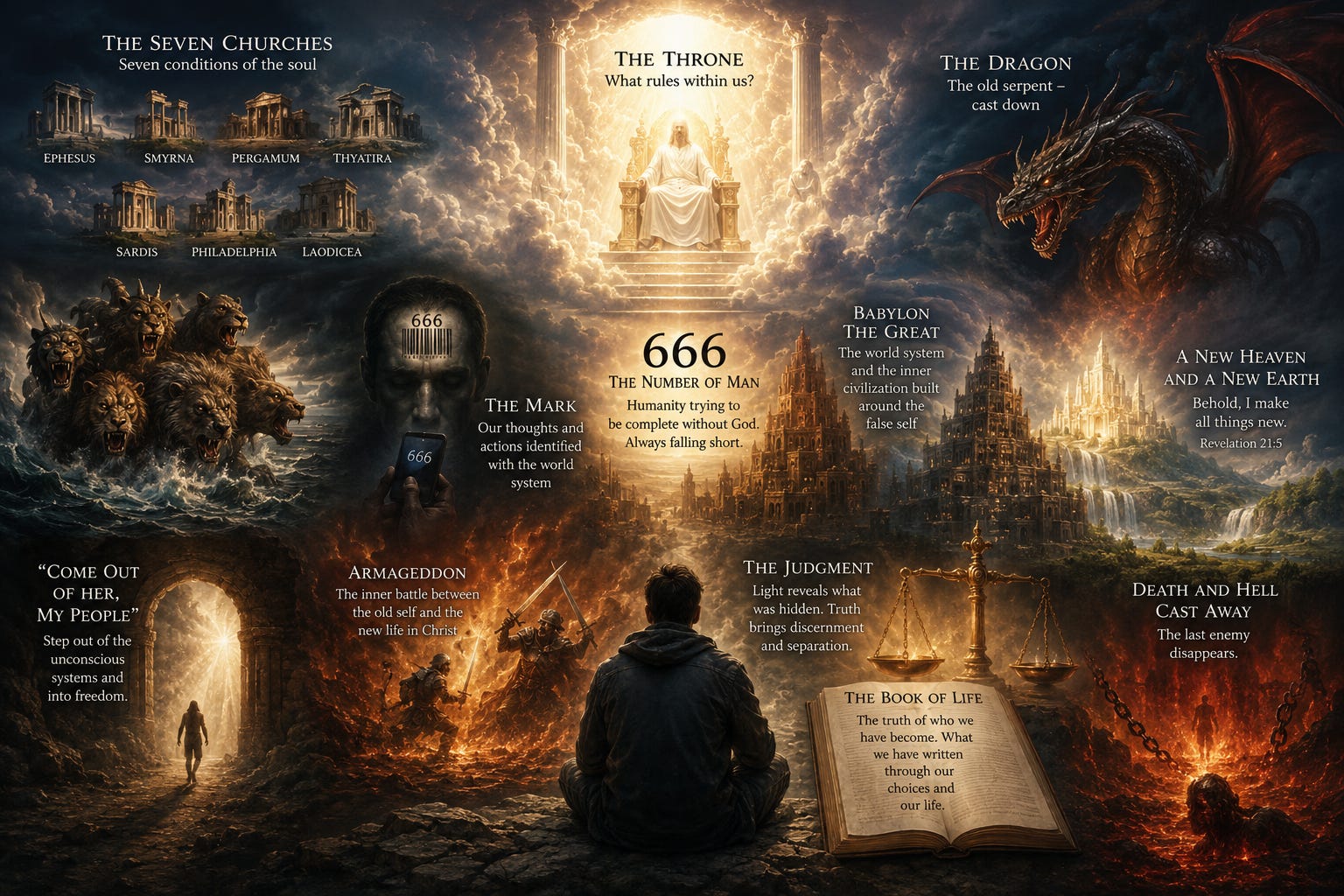
The Seven Churches — Seven Conditions of the Soul
John first addresses seven churches: Ephesus, Smyrna, Pergamum, Thyatira, Sardis, Philadelphia, and Laodicea. Historically, these were real communities in Asia Minor, but the number seven repeatedly symbolizes completeness in Scripture. Perhaps these churches can also represent different spiritual conditions that exist within us.
One part of us may have lost its first love while another remains faithful under pressure. Another compromises with the world around it, another appears alive outwardly but is spiritually asleep, another has endured patiently, and still another has become lukewarm—neither passionately seeking God nor completely rejecting Him. That sounds remarkably like the inner life.
We are rarely one completely consistent person spiritually. On Monday we may feel deeply connected to God; on Tuesday we become irritated over something insignificant. We may show compassion in one situation and judgment in another. One part of us sincerely wants transformation while another quietly prefers that nothing disturb the comfortable life we already have.
The message repeated to the churches is therefore important:
“He that hath an ear, let him hear what the Spirit saith…”
The invitation is to hear, to become conscious, and to see our actual condition. Revelation begins not simply with predicting world events, but with self-examination.
The Throne — What Rules Within Us?
John is then taken through an open door in heaven and sees a throne. Throughout Scripture, the throne represents authority. Whoever sits upon the throne rules the kingdom. This raises one of the central spiritual questions we have encountered throughout this series: What is sitting on the throne within me?
We may sincerely say that God rules our lives, yet anger can suddenly take the throne. Fear can take it. Pride, resentment, political identity, religious certainty, money, recognition, security, appetite, or simply the need to be right can occupy that place without our realizing it. The spiritual journey gradually reveals how many false kings have occupied the throne within us, and Revelation can be understood as the story of their removal.
The Beast
Few biblical symbols have generated more speculation than the Beast. Through the centuries, people have identified it with emperors, governments, religious institutions, economic systems, political leaders, computer technology, artificial intelligence, barcodes, credit cards, identification systems, and countless other possibilities. Some historical interpretations may contain truth, because Revelation was certainly written within a political and religious world familiar to its original readers. But the symbol becomes even more powerful when we also allow it to speak inwardly.
A beast lives primarily through instinct, appetite, reaction, domination, and survival, and human beings possess these same forces. When consciousness sleeps, we can become remarkably mechanical. Someone insults us, and anger immediately answers. Someone disagrees with us and defensiveness arises before we have even considered what was said. Desire appears and begins directing our behavior. Fear enters and suddenly controls our imagination. We believe we are choosing, when often something within us has already chosen before conscious thought has even arrived.
The Beast may therefore symbolize humanity when the higher spiritual nature has become subordinate to the lower, reactive nature. The problem is not that we possess instincts, emotions, desires, or even a survival mechanism; all of these belong to human life. The problem comes when these forces occupy the throne and begin ruling the whole person.
The Mark of the Beast
Then comes perhaps the most famous warning in Revelation—the mark placed upon the forehead or the hand. The symbolism itself is striking because the forehead can represent thought while the hand represents action. Seen inwardly, the mark could describe a condition in which both our thinking and our actions have become identified with the same unconscious system.
We think as the world teaches us to think, react as our conditioning has trained us to react, desire what society teaches us to desire, fear what we are told to fear, and sometimes even hate those we have been taught to hate. Because the people around us may be doing much the same thing, it can feel perfectly normal. We may never realize how much of what we call my thinking is actually inherited, absorbed, repeated, and reinforced.
The mark, then, does not necessarily have to be understood only as something externally stamped upon human beings. It may also describe something much subtler: a person whose mind and actions have become completely identified with the consciousness of the surrounding world.
Paul described the opposite condition:
“Be not conformed to this world: but be ye transformed by the renewing of your mind.”
— Romans 12:2
Revelation may be presenting that same choice through dramatic symbolic language. Will our thinking and actions arise from unconscious conformity, or from an awakening consciousness increasingly aligned with God?
666 — The Number of Man
Revelation calls 666 “the number of a man.” Six repeatedly falls short of seven, the biblical number associated with completion, and humanity itself was created on the sixth day. Seven represents completion and rest in God. Perhaps 666 therefore symbolizes humanity multiplied upon itself—human consciousness attempting to become complete without God.
The intellect alone cannot complete us, nor can material achievement, religious identity, technology, power, possessions, or recognition. The ego continually promises that one more accomplishment, one more possession, one more victory, one more experience, or even one more certainty will finally make us whole. Yet six never becomes seven simply by accumulating more sixes. Something remains incomplete until human life reconnects with its Source.
Babylon the Great
Then we encounter Babylon. In the Old Testament, Babylon was the empire that conquered Jerusalem and carried its people into captivity. In Revelation it becomes something much larger: a glittering world system built upon wealth, power, seduction, exploitation, and spiritual corruption. It is easy to look outward and begin identifying governments, corporations, religious organizations, nations, or economic systems as Babylon, and perhaps aspects of Babylon can indeed manifest through all of these.
But Revelation invites us to look deeper because there can also be a Babylon within us. It is the inner civilization we have constructed around the false self—the collection of beliefs, ambitions, fears, attachments, identities, grievances, accomplishments, and desires that gradually tell us who we think we are.
Like ancient Babylon, the personality builds towers. It says, Look what I have accomplished. Look what I know. Look what I own. Look what I believe. Look who I am. Much of this can appear impressive, respectable, and even spiritual. Yet eventually comes the astonishing announcement:
“Babylon is fallen, is fallen…”
The spiritual path gradually dismantles the structure we may have spent much of our lives constructing. What we believed was us begins to loosen. That process can feel like destruction because the personality does not easily surrender what has given it identity and security. But from another perspective, the fall of Babylon is not destruction at all. It is liberation.
“Come Out of Her, My People”
Then comes a voice from heaven:
“Come out of her, my people…”
This may be one of Revelation’s clearest spiritual invitations. It does not necessarily mean physically abandoning civilization, because Jesus did not teach his followers to withdraw from humanity. He taught them how to live within the world without inwardly belonging to its unconscious values.
To come out of Babylon can mean withdrawing our identity from the systems within and around us that previously controlled us. We begin seeing anger rather than simply being angry. We begin observing fear rather than automatically obeying it. We notice our need for approval, our desire to control a conversation, the strange satisfaction that can arise from proving someone else wrong, and how quickly the mind divides humanity into us and them.
Something within us begins stepping outside the machinery. There appears a small space between the impression we receive and the reaction that once followed automatically. We can see the reaction arising without immediately becoming it. That small space between seeing a reaction and becoming the reaction may be one of the first beginnings of genuine spiritual freedom.
Armageddon — The Inner Battle
Eventually Revelation brings us to Armageddon. Millions have wondered where and when this final battle will occur, but anyone who has seriously attempted inner transformation already knows something about Armageddon. There comes a conflict between the person we have been and the person we are becoming.
Jesus acknowledged this struggle when he said:
“The spirit indeed is willing, but the flesh is weak.”
Paul described it even more personally:
“For the good that I would I do not: but the evil which I would not, that I do.”
The ancient spiritual teachers understood something that modern psychology would later rediscover: the human being is divided. One part wants God while another wants comfort. One part wants forgiveness while another wants revenge. One part seeks humility while another longs for recognition. One part wants truth while another desperately wants its existing beliefs to remain true.
Armageddon may therefore represent the point at which these opposing kingdoms can no longer peacefully coexist. As consciousness grows, the contradictions become increasingly visible. Eventually something must surrender the throne.
The Dragon Cast Down
The great dragon is eventually defeated, and Revelation identifies the dragon with “that old serpent,” deliberately taking us all the way back to Genesis. That is an extraordinary connection. The Bible begins with a serpent in a garden and approaches its conclusion with that same serpent finally losing its power. The pattern has come full circle.
What began as separation in Eden—human consciousness turning away from divine guidance and becoming increasingly dominated by self-consciousness—must eventually be healed. The serpent cannot simply be defeated through external religion or merely by believing the correct doctrine. Its influence has to be recognized within consciousness itself.
Every time we observe the false self without automatically feeding it, its authority weakens. Every time we choose compassion over retaliation, truth over self-deception, humility over pride, or conscious awareness over mechanical reaction, another small portion of the old serpent’s power is lost. This battle is not won by hating ourselves or trying to destroy the human personality. It is won by bringing what has been unconscious into the light of consciousness.
The Judgment
Revelation then describes the great judgment before the throne of God. Traditional Christianity often pictures this exclusively as a future courtroom scene in which every human being stands before God. There may indeed be realities beyond this life that we cannot presently understand, but judgment also has an immediate spiritual meaning.
Judgment involves discernment and separation. Light reveals what darkness concealed. As consciousness grows within us, things previously hidden begin to become visible. We recognize motives we once justified, selfishness hiding beneath apparent generosity, pride hiding beneath religious certainty, fear beneath anger, and insecurity beneath our desire to control people or circumstances.
This kind of judgment can be uncomfortable because real self-knowledge often is. Yet its purpose need not be understood primarily as punishment. It is revelation. Jesus said:
“For every one that doeth evil hateth the light, neither cometh to the light, lest his deeds should be reproved.”
The light does not create what is hidden; it simply reveals what was already there. And that is precisely what Revelation means. What has been concealed is brought into the light where it can finally be seen and transformed.
The Book of Life
Then books are opened, including the Book of Life. Perhaps we should resist the temptation to imagine God merely keeping a gigantic celestial ledger of good and bad behavior. What if the Book of Life also represents something deeper—the truth of what we have actually become?
Every repeated thought shapes us. Every choice, act of compassion, resentment we nurture, truth we accept, and reaction we either blindly follow or consciously observe leaves something within us. Each time we become conscious instead of reacting mechanically, something changes in our being. In that sense, we are continually writing ourselves, and eventually what is repeatedly written becomes part of who we are.
The question may therefore be deeper than whether our name appears in a book somewhere in heaven. Perhaps we should also ask: How much Life has been written into us? How much of the life of Christ—love, compassion, forgiveness, courage, humility, truth, and awareness—has actually become part of our nature?
Death and Hell Are Cast Away
One of Revelation’s most remarkable images appears near the end:
“And death and hell were cast into the lake of fire.”
Even death itself eventually disappears. Something is being completed. The consciousness that began in fear, separation, mortality, and self-preservation is giving way to another kind of life. Paul had written, “The last enemy that shall be destroyed is death.”
Perhaps the deepest meaning of death is not limited to physical death. It may also include the consciousness that experiences itself as completely separate from God, from others, and from the deeper Life within creation. Jesus repeatedly called humanity into another quality of existence—what he called eternal life. Perhaps eternal life means more than life that continues endlessly after physical death. It may mean a life that begins to participate in the Eternal even now.
Revelation Is Not Meant to Frighten Us
Seen this way, Revelation becomes far less about terror and far more about transformation. The frightening images remain because genuine transformation can indeed feel frightening to the ego. Everything upon which the false self has constructed its kingdom is being shaken. Babylon falls, the Beast loses authority, the dragon is cast down, the false kingdoms collapse, and even death itself disappears.
From the perspective of the ego, this may look like the end of the world—and perhaps, in one sense, it is the end of its world. But what follows is not annihilation. Something entirely new appears.
John says:
“And I saw a new heaven and a new earth…”
The destruction was never the final destination. Transformation was. Perhaps this is one of the great messages hidden within Revelation: God is not ultimately destroying creation. God is making all things new, and that includes us.
The entire biblical journey—from the Garden, through slavery, wilderness, kingdoms, exile, prophets, Jesus, the cross, Resurrection, Spirit, and finally Revelation—has been moving toward this moment. What began in the Garden is approaching its completion. The false kingdom collapses, the true King returns to the throne, and the Garden begins to appear again.
Coming Next — Part 41: A New Heaven and a New Earth
John’s vision does not end with destruction. It ends with restoration. The old heaven and earth pass away, the Holy City descends, tears are wiped away, death disappears, and God declares, “Behold, I make all things new.”
But what if the New Heaven and New Earth are not only descriptions of a future world? What if they also describe what happens when our inner heaven—our consciousness—and our inner earth—our lived life—are transformed? In Part 41, we will explore The New Heaven and the New Earth: A New Consciousness and a New Way of Living.
If what you’ve been reading has helped you see yourself or these ideas a little more clearly, perhaps someone you know would benefit from it too. If so, please consider hitting the Share button. You never know—you may help someone else begin seeing themselves, their reactions, and their journey in a new way.
If you would like these stories in order, just go to GetTheKingOutOfTheGarden.com