


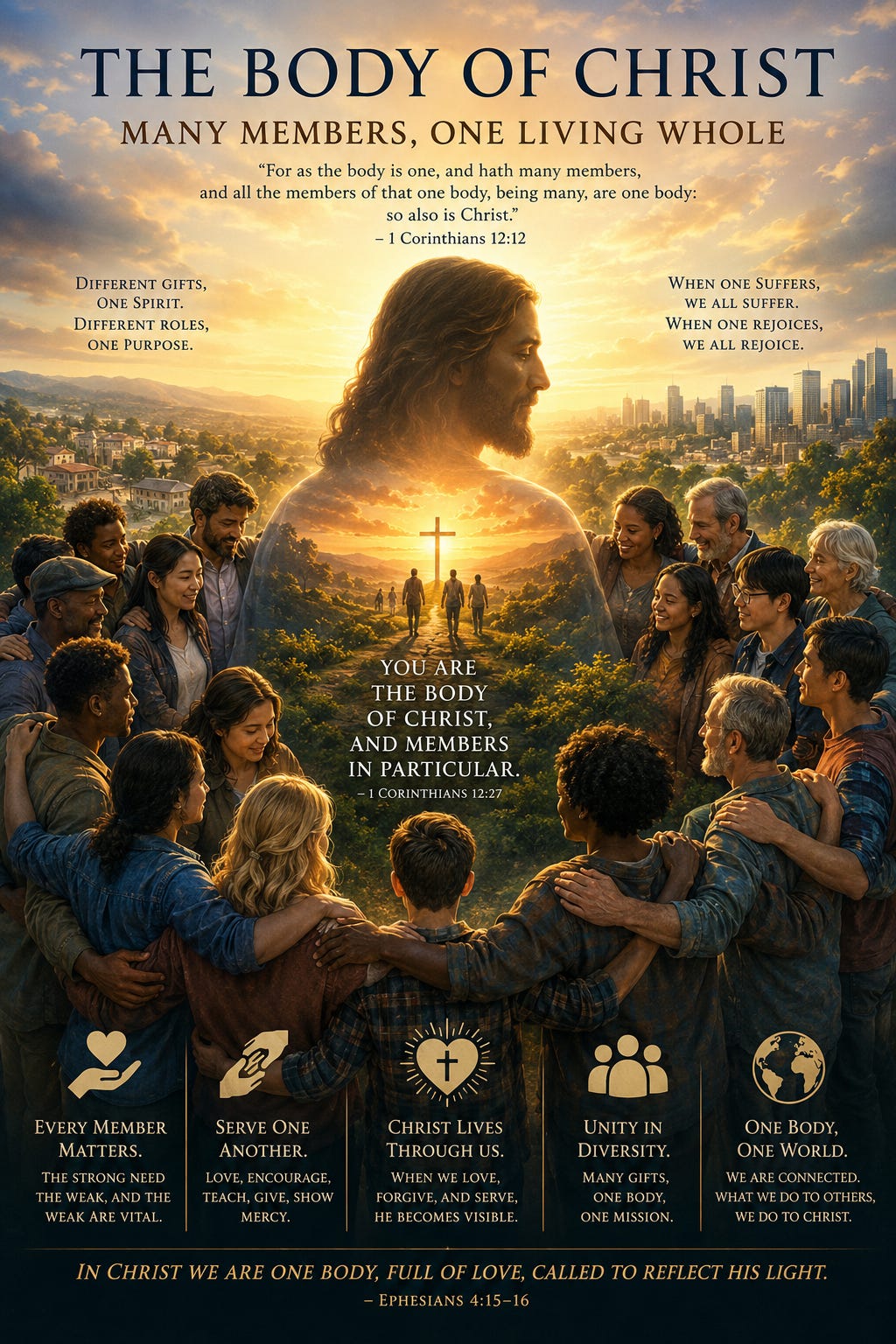
In the last part, we explored the Gifts of the Spirit—the many different ways the Spirit may work through human beings. Paul’s teaching naturally leads to another of his most powerful images: the Body of Christ.
Paul writes:
“For as the body is one, and hath many members, and all the members of that one body, being many, are one body: so also is Christ.”
— 1 Corinthians 12:12
At first glance, this may seem like a simple illustration about the church. Different people have different roles, just as a body has hands, feet, eyes, and ears. But Paul may be pointing toward something much deeper than organizational cooperation. What if the Body of Christ is an image of spiritual unity itself? What if Christ is not only someone we follow from outside ourselves, but also a pattern of divine life awakening within humanity? Then Paul’s metaphor becomes enormous. Humanity may be far more connected than we ordinarily realize.
One Body, Many Members
Every human body contains trillions of cells. Each cell performs a particular function, yet no healthy cell exists entirely for itself. A heart cell cannot decide that the rest of the body is irrelevant. A lung cannot declare independence from the bloodstream. A hand cannot survive separated from the body. The health of each part depends upon the health of the whole.
Paul uses essentially this same insight when he says, “And the eye cannot say unto the hand, I have no need of thee” (1 Corinthians 12:21). The message appears simple: we need one another. Yet the implications go far beyond church life.
Modern society often teaches us to think primarily as separate individuals. We compete for resources, recognition, money, influence, status, and security. We construct identities around race, nationality, religion, politics, social class, education, and countless other distinctions. These categories may have practical value, but they can also hide something more fundamental. Before we are Republicans or Democrats, Americans or Europeans, Christians or Muslims, wealthy or poor, educated or uneducated, we are human beings sharing the same fragile planet. We breathe the same atmosphere, depend upon the same ecosystems, and experience love, fear, grief, hope, pain, and longing.
We are separate, yet deeply interconnected. Paul’s body imagery may be inviting us to recognize that difference does not cancel unity.
Unity Does Not Mean Sameness
One of the most important aspects of Paul’s metaphor is that the body requires diversity. If every part were an eye, there would be no hearing. If every part were an ear, there would be no smelling. Paul asks, “If the whole body were an eye, where were the hearing?” (1 Corinthians 12:17). A healthy body does not eliminate differences; it coordinates them.
This is a profound spiritual lesson because human beings often confuse unity with conformity. We imagine that peace will come when everyone believes the same things, worships the same way, belongs to the same group, or interprets Scripture exactly as we do. But a body made entirely of identical organs would not be healthy. It would be impossible.
Perhaps humanity’s diversity is not an unfortunate obstacle God must somehow overcome. Perhaps diversity is part of the design. Different cultures may perceive different aspects of human experience. Different personalities contribute different gifts. Different generations see different problems. Different spiritual traditions may emphasize different dimensions of humanity’s relationship with the Divine. Unity does not require erasing those differences. It requires learning how those differences can serve the whole.
When One Part Suffers
Paul makes another remarkable statement:
“And whether one member suffer, all the members suffer with it; or one member be honoured, all the members rejoice with it.”
— 1 Corinthians 12:26
Anyone who has injured a finger knows how true this is physically. A tiny wound can affect the entire body. The nervous system responds, attention shifts, other muscles compensate, and sleep may be disturbed. The whole organism participates in the pain.
Paul seems to suggest that human community works similarly. When one portion of humanity suffers, the consequences rarely remain isolated. Poverty creates instability. War produces refugees. Despair can produce violence. Environmental damage crosses borders. Fear spreads, and hatred spreads, but compassion, kindness, courage, new ideas, and healing spread too. What happens in one portion of the human family eventually affects others in ways we may never fully see.
The Body of Christ therefore challenges the illusion that another person’s suffering is completely unrelated to us. The wounded stranger is not entirely separate. He is another part of the body.
Jesus Expanded the Meaning of Neighbor
This same principle appears repeatedly in Jesus’ teaching. When someone asked Him, “Who is my neighbour?”, Jesus responded with the parable of the Good Samaritan. The Samaritan was from a group viewed with suspicion and hostility by many of Jesus’ listeners, yet Jesus made him the example of compassion. The neighbor was not simply the person from our tribe; the neighbor was the person before us who needed mercy.
Jesus pushed this even further when He said, “Love your enemies” (Matthew 5:44). That command makes little sense if humanity consists only of separate competing individuals, but it becomes more understandable if humanity is one interconnected spiritual organism. Hatred directed toward another member of the body ultimately wounds the body itself.
This does not mean ignoring injustice or refusing to confront harmful behavior. A healthy body sometimes must fight infection, stop bleeding, or remove something dangerous. But healing remains the goal. The purpose is restoration, not hatred.
“You Are the Body of Christ”
Paul eventually makes the image personal:
“Now ye are the body of Christ, and members in particular.”
— 1 Corinthians 12:27
Notice what he does not say. He does not merely say, You belong to an organization called Christianity. He says, “You are the body of Christ.” That is a much stronger statement.
What might it mean spiritually? Perhaps it means that Christ continues entering the world through human beings. When someone feeds the hungry, the hands of Christ are working. When someone comforts a grieving person, the compassion of Christ becomes visible. When someone forgives, reconciliation enters the world. When someone speaks truth despite personal cost, courage becomes embodied. When someone protects the vulnerable, love takes physical form.
Christ is no longer only a figure walking through Galilee two thousand years ago. The pattern of Christ continues whenever divine love becomes embodied in human action.
Christ Within
Paul repeatedly uses another striking phrase: “Christ in you, the hope of glory” (Colossians 1:27). Traditional Christianity often emphasizes Christ as someone to believe in, and Paul certainly teaches that. But he also speaks repeatedly about Christ being within.
This opens an important symbolic dimension. Perhaps Christ represents the divine image awakening within the human being—the deeper self aligned with God rather than the ego-centered self that normally governs our lives. Jesus says, “I am the vine, ye are the branches” (John 15:5). A branch does not imitate the vine from a distance. The same life flows through both.
This may be one of the deepest meanings behind the Body of Christ. The spiritual life is not merely imitation; it is participation. We do not simply ask, What would Jesus do? Eventually the deeper question becomes: Can the same Spirit that moved through Jesus begin moving through me?
The False King and the Living Body
This connects strongly with the image we have returned to throughout this series: the inner struggle over what sits upon the throne of consciousness. The ego tends to experience itself as separate and preoccupied with my interests, my reputation, my beliefs, my possessions, my fears, and my grievances. The false king builds walls because separation protects its identity.
But the Body of Christ points in the opposite direction. The deeper consciousness begins recognizing connection. The other person is no longer merely a competitor, inconvenience, enemy, stranger, or category. Something within us begins to see another human being. And sometimes, if we are quiet enough, something even deeper recognizes that there is life in that person that comes from the same Source as the life in us.
This does not erase personality. The hand remains a hand, and the eye remains an eye, but neither mistakes itself for the whole body. Perhaps getting the false king out of the Garden allows us to rediscover that we were never the entire kingdom. We are part of something far larger.
The Church as Body — and Its Temptation
Historically, Christians have understandably interpreted the Body of Christ primarily as the church. There is truth in that. A spiritual community can become a living organism in which people support, teach, encourage, challenge, and care for one another.
But there is also a danger. The metaphor intended to reveal interconnectedness can itself become another boundary. We can begin thinking, We are the Body of Christ, and they are outside it.
Yet Jesus repeatedly crossed the boundaries religious communities created. He ate with tax collectors, spoke with Samaritans, touched lepers, defended people regarded as sinful, and praised the faith of outsiders. His ministry continually enlarged the circle.
Perhaps the mature understanding of the Body of Christ must do the same. Instead of asking only, “Who belongs inside our body?”, perhaps we should ask, “How far does divine life extend?” The answer may be larger than our institutions.
The Least Members Matter Most
Paul makes another statement that turns ordinary human hierarchy upside down:
“Nay, much more those members of the body, which seem to be more feeble, are necessary.”
— 1 Corinthians 12:22
That sounds very much like Jesus. The world tends to honor strength, wealth, beauty, achievement, intelligence, and influence, but Paul says the parts that appear weaker may actually be indispensable.
This radically changes the way we evaluate human worth. A person does not become more valuable because they are productive, nor do they become less valuable because they are elderly, disabled, poor, sick, unnoticed, or unable to contribute economically. If humanity is a living body, every member possesses inherent dignity.
Sometimes the supposedly weaker members even reveal something the stronger members have forgotten. They teach patience, compassion, dependence, humility, care, and love without usefulness attached to it. Perhaps a society reveals its spiritual maturity not by how it treats its strongest citizens but by how it treats those from whom it expects nothing in return.
Spiritual Gifts Make Sense Only Within the Body
This is why Paul’s teaching about the Body of Christ comes directly after his discussion of spiritual gifts. A gift makes little sense by itself. An eye exists because there is a body that needs sight. A hand exists because something must be touched, lifted, carried, repaired, or protected.
Likewise, wisdom exists because someone needs guidance. Teaching exists because someone needs understanding. Mercy exists because someone is hurting. Leadership exists because people need direction. Giving exists because someone lacks something. Healing exists because something is wounded.
The gift and the need belong together. Seen this way, discovering our purpose may not require uncovering some grand hidden destiny. Sometimes purpose is simply what happens when our gift meets another person’s need.
The Body Must Learn to Feel
One reason humanity continues hurting itself may be that we have not yet fully developed the ability to feel ourselves as one body. Imagine if your hand could injure your foot but never feel the pain. It might continue causing damage indefinitely.
Something similar happens in societies. When suffering is distant enough, it can become an abstraction—numbers on a screen, statistics in a report, people somewhere else. But compassion reconnects the nervous system of humanity. Suddenly the suffering person becomes real. We see a face, hear a story, and recognize a parent, child, neighbor, or friend. The pain enters our awareness.
Perhaps compassion is one of the ways the Body of Christ begins developing spiritual sensation. We learn to feel what previously remained invisible.
What We Do to Others, We Do to Christ
Jesus expresses this connection in one of His most challenging teachings:
“Inasmuch as ye have done it unto one of the least of these my brethren, ye have done it unto me.”
— Matthew 25:40
He identifies Himself with the hungry, the thirsty, the stranger, the naked, the sick, and the imprisoned. This is extraordinary. Jesus does not merely say, Help them because I told you to. He says, in effect, I am there.
Perhaps this is one of the clearest expressions of the Body of Christ. Christ is encountered in the other, especially in the person we might otherwise overlook. This means spirituality can never remain entirely private. Meditation, prayer, worship, Scripture, and contemplation may awaken us inwardly, but eventually something must move outward. The awakened heart recognizes the sacred in another human being.
Humanity Awakening to Itself
Perhaps the Body of Christ can also symbolize something still unfolding. Humanity may be slowly awakening to the realization that we truly are one interconnected species.
For most of human history, communities existed largely separated from one another. Today, a message can travel around the world in seconds. Events thousands of miles away can affect our economy, environment, health, and security almost immediately. Technology has connected humanity externally faster than consciousness has connected us internally. We have created something resembling a global nervous system, but we have not yet fully learned how to become a global spiritual community.
That may be one of humanity’s great challenges. Can our consciousness catch up with our technology? Can we learn to think not only as individuals, nations, religions, or political tribes, but as members of one human family? Perhaps this is part of what the ancient symbol of the Body of Christ has been pointing toward all along.
Individuality Within Unity
There is another beautiful paradox here. Spiritual awakening does not erase individuality. The goal is not to dissolve into some featureless collective. A healthy body depends upon each organ performing its unique function, and spiritual unity may actually allow individuality to flourish more fully.
When we no longer need to compete constantly for identity or superiority, we become freer to express the gift that is genuinely ours. The violin does not need to become the trumpet, and the trumpet does not need to imitate the drum. Each contributes something different to the music. The harmony exists because the instruments remain distinct.
Perhaps this is how the Divine expresses itself through creation: one Source, countless expressions.
The Body Is Still Growing
Paul’s image also suggests that the Body of Christ is not finished. Humanity is still learning, still stumbling, still dividing, and still awakening. We should not be surprised that spiritual development appears messy.
A child learning to walk falls repeatedly. A body healing from injury may experience pain. Human consciousness may likewise be undergoing a long process of development. Perhaps the Kingdom of God is not simply something that suddenly descends upon humanity from outside. Perhaps it also grows within humanity as more individuals awaken to compassion, truth, responsibility, and interconnectedness.
Jesus compared the Kingdom to a mustard seed—something tiny that becomes something enormous. Maybe every act of genuine love contributes another living cell to that growing reality.
A Different Way of Seeing the World
If we truly believed we were members of one body, much of life would look different. Competition would not disappear, but it would lose its cruelty. Success would not require another person’s failure. Compassion would cease being optional. Justice would become a form of healing, forgiveness would become restoration, and service would become natural.
Perhaps even disagreement would change. Two parts of the same body can perform very different functions without becoming enemies. What if we learned to disagree while still recognizing one another as members of the same human family? That alone would represent an enormous spiritual awakening.
The Christ Pattern
Perhaps “Christ” can be understood not only as a name but also as a pattern. Jesus embodied a way of being centered in love, compassion, truth, forgiveness, courage, humility, and union with God. That pattern can awaken within others.
One candle lights another without losing its flame. One life awakens another. The Body of Christ therefore may not be merely a collection of people who believe certain doctrines. It may also be the emerging community of those through whom the Christ pattern is becoming embodied.
Whenever compassion overcomes cruelty, the Body moves. Whenever forgiveness overcomes vengeance, the Body heals. Whenever truth overcomes deception, the Body sees more clearly. Whenever service overcomes selfishness, the Body grows stronger. Whenever love overcomes fear, Christ becomes visible again.
The Garden Is Larger Than We Thought
Throughout this series, the Garden has represented the inner field of consciousness—the place where thoughts, fears, desires, reactions, and deeper awareness meet. But perhaps eventually we discover that the Garden is not entirely private.
My inner life influences how I treat you. Your inner life influences how you treat someone else. Every reaction sends something outward, and every act of compassion does too. The inner Garden and the outer world are connected.
When the false king rules within, separation spreads outward. When love, awareness, and compassion rule within, something different enters the world. Perhaps this is how the Body of Christ grows: one awakened relationship at a time, one merciful response at a time, one person recognizing another person as part of the same living whole.
The Question Changes
Early in the spiritual journey we may ask, “How can I be saved?” Later the question may become, “How can I awaken?” But eventually perhaps an even larger question appears: “How can my awakening serve the whole?”
That may be where the Body of Christ becomes more than theology. It becomes practice. We begin realizing that our spiritual development is not merely about ourselves. If one member becomes more compassionate, the body gains compassion. If one member becomes more truthful, the body gains truth. If one member becomes more peaceful, peace has entered the world somewhere it did not exist before.
None of us can heal the entire world, but every one of us influences the portion of the body we touch. Perhaps that is enough. Perhaps that is how the Kingdom grows—not through one giant transformation forced upon humanity from above, but through millions of smaller awakenings spreading through the living body of humanity.
And eventually we may discover what Paul seemed to see nearly two thousand years ago:
We are many, yet beneath all our differences, we are one.
The Mind of Christ is next,
If what you’ve been reading has helped you see yourself or these ideas a little more clearly, perhaps someone you know would benefit from it too. If so, please consider hitting the Share button. You never know—you may help someone else begin seeing themselves, their reactions, and their journey in a new way.
I am already to the point of asking how my awakening can serve the whole.