


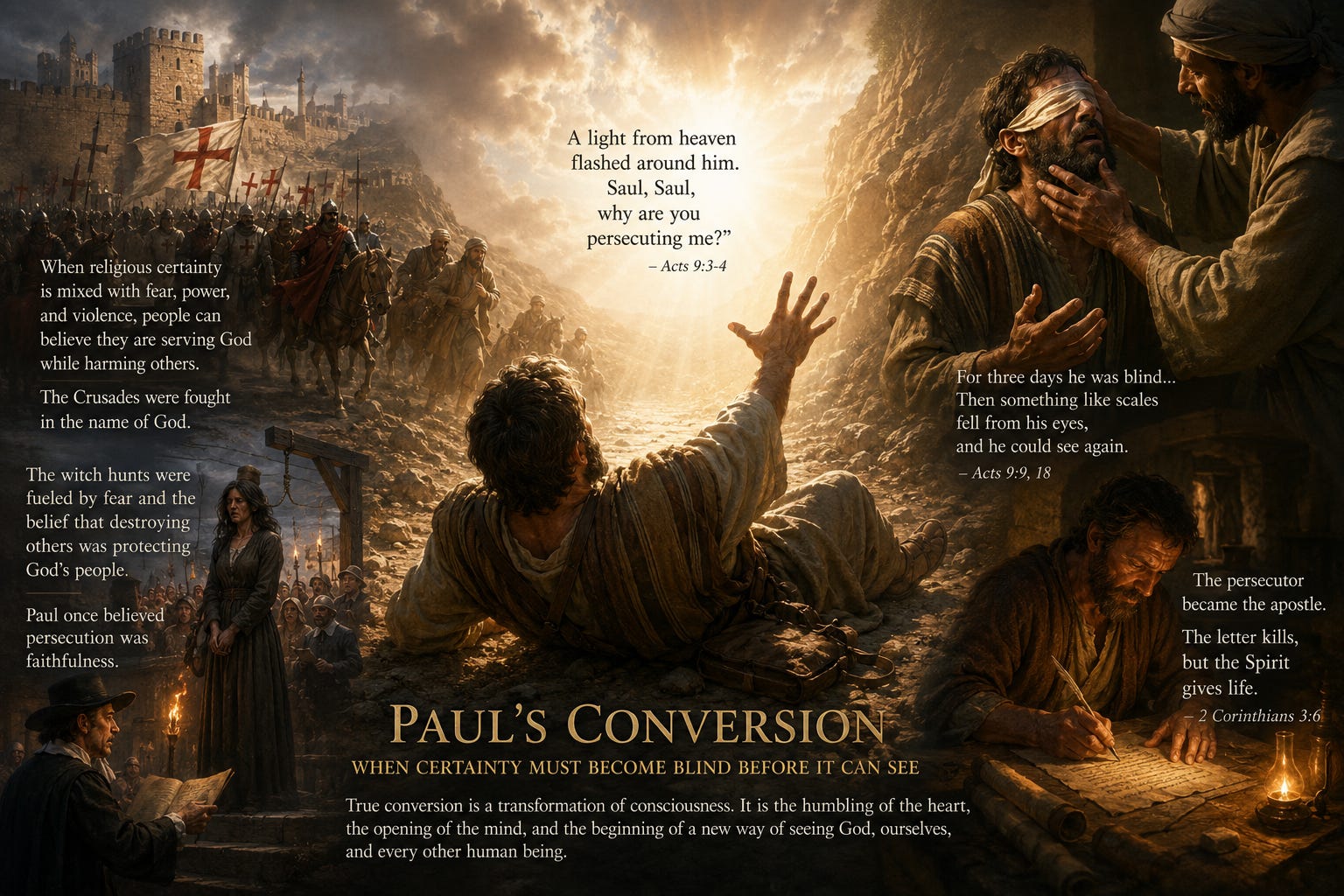
The story of Paul’s conversion on the road to Damascus is usually remembered as the dramatic moment when Christianity’s greatest persecutor became one of its greatest messengers. Historically, that is certainly part of the story. Saul of Tarsus was a zealous defender of the religious tradition he had inherited. He believed the followers of Jesus were dangerous, misguided, and perhaps even blasphemous, and he was so convinced of this that he actively participated in their persecution.
Yet when we read the story symbolically, something even deeper appears. Paul’s conversion becomes the story of what happens when a person who is absolutely certain that he sees clearly suddenly discovers that he has been spiritually blind. It is the collapse of certainty, the breaking open of the religious mind, and the beginning of an entirely different way of seeing God.
Saul Was Not Running Away From God
One of the most important details of Paul’s story is easily overlooked: Saul was not an irreligious man running away from God. He believed he was serving God. Paul later described himself as a Pharisee, deeply trained in the traditions of his people and extraordinarily zealous for the Law. He was not indifferent toward spiritual things. He cared passionately about them.
That may actually make his story more relevant to religious believers than to unbelievers. Saul represents the part of the human mind that can become so convinced that it understands God that it is no longer open to being corrected by God. Religion can become a structure through which we encounter the Divine, but it can also become a structure that prevents us from recognizing the Divine when God appears outside the boundaries we have constructed.
Jesus had encountered this problem repeatedly. The religious leaders knew the Scriptures, the commandments, and the traditions, yet many could not recognize the Spirit working directly in front of them. Saul inherited the same struggle. He knew what he believed, knew who was right, knew who was wrong, and because he believed he was defending God, he could justify persecuting those who threatened his understanding of God.
There is a sobering spiritual lesson here. Sometimes our greatest blindness does not come from knowing too little. It comes from becoming too certain that we already know.
The Road to Damascus
Acts tells us that Saul was traveling toward Damascus carrying authority to arrest followers of Jesus. He was moving with purpose and confidence. He knew where he was going—or at least he thought he did.
Then suddenly, Acts tells us, “a light from heaven flashed around him.”
Throughout Scripture, light repeatedly becomes a symbol of revelation, truth, consciousness, divine presence, and spiritual awakening. Paul does not discover this light through an argument or slowly reason his way toward it. The light breaks into his world and interrupts the direction in which he has been traveling.
This is often how genuine spiritual transformation begins. Something penetrates the structure through which we have been interpreting reality. It may come through a dream, a crisis, a loss, a mystical experience, another human being, a passage of Scripture suddenly understood differently, or simply through a question that refuses to disappear. The worldview that once seemed complete may continue working for years until something greater breaks through it.
Then suddenly there is light, and what once seemed obvious no longer seems quite so certain.
“Saul, Saul, Why Are You Persecuting Me?”
Saul falls to the ground and hears a voice asking, “Saul, Saul, why are you persecuting me?” Saul responds, “Who are you, Lord?” The answer must have shattered his entire understanding of reality: “I am Jesus, whom you are persecuting.”
Consider what that meant. Saul believed he was defending God against the followers of Jesus, yet the voice of the Divine tells him that in persecuting these people, he has actually been persecuting Christ. Everything has suddenly reversed. The righteous man discovers that his righteousness has become destructive. The defender of God discovers that he has been fighting against the movement of God. The man who believes himself spiritually awake is about to become physically blind.
This reversal is one of the great spiritual patterns running throughout Scripture. Jesus repeatedly suggested that those who were certain they could see might actually be blind, while those who recognized their blindness might finally begin to see. Paul now has to experience that truth personally.
The Fall to the Ground
Paul falls. That small detail carries enormous symbolic meaning. The old Saul must come down. His position, certainty, religious authority, identity, and confidence collapse beneath the light of a greater reality.
Throughout the spiritual journey, awakening frequently includes some form of falling—not necessarily physically, but the falling away of an identity or understanding upon which we have depended. I know what God wants. I understand Scripture correctly. I know who is right. I know who is wrong. I know exactly how God works. These beliefs may provide stability for a time, but they can also become walls around consciousness.
Paul’s fall therefore should not be understood merely as humiliation. It is preparation. Something must fall before something deeper can arise. The ego often experiences awakening as loss because it cannot yet recognize the larger understanding that is attempting to emerge.
Blindness After Seeing the Light
Perhaps the most fascinating part of the story is what happens next. Paul sees the light—and then becomes blind. Acts says that when he opened his eyes, “he could see nothing.”
At first this sounds almost contradictory. Shouldn’t divine illumination cause someone to see more clearly? Spiritually, however, it makes perfect sense. Paul’s old way of seeing has been destroyed, but his new way of seeing has not yet formed. He is between worlds. The old understanding no longer works, yet the new understanding has not become clear.
This is a familiar stage of spiritual transformation. There may come a point when we recognize that something we have believed for years is incomplete, but we do not immediately know what should replace it. Such a period can feel like darkness, uncertainty, or even the loss of faith. Yet it may actually be sacred darkness—the space between an old consciousness and a new one.
Paul’s blindness need not be seen as punishment. It can be understood as a transition. He must temporarily stop seeing through his old eyes before he can learn to see differently.
Three Days in Darkness
Acts tells us that Paul remained blind for three days and did not eat or drink. Once again, we encounter the biblical symbolism of three days. Jesus is in the tomb three days. Jonah is within the great fish three days. Now Paul spends three days in darkness.
The pattern is remarkably similar. Something dies, there is an interval of darkness, and then something new emerges. Paul’s three days of blindness resemble a symbolic death and resurrection. Saul enters the darkness as one person and emerges as another. The man who entered Damascus intending to imprison followers of Jesus will eventually leave as one of them. The persecutor becomes the apostle, and the defender of an external religious structure becomes one of history’s strongest voices for the inner life of the Spirit.
Ananias and the Person We Fear
While Paul waits in darkness, God speaks to a disciple named Ananias and tells him to visit Saul. Ananias understandably resists. He has heard about Saul and knows what this man has done. From his perspective, Saul is the enemy.
Yet God sees something in Saul that Ananias cannot yet see. Human beings tend to freeze one another in time. We define people by what they have done: the violent person, the unbeliever, the extremist, the sinner, the person who betrayed us, the difficult family member. But spiritual transformation means that no human being is necessarily identical tomorrow to who that person is today.
Ananias must trust that transformation is possible even in someone he fears. Paul, meanwhile, who had entered Damascus intending to exercise authority over Christians, must now humbly receive help from one. Their roles have completely reversed.
The Scales Fall From His Eyes
Ananias lays his hands upon Saul and tells him that Jesus has sent him so that Saul may regain his sight and be filled with the Holy Spirit. Acts then says that “something like scales fell from Saul’s eyes, and he could see again.”
The symbolism could hardly be more powerful. The scales represent more than physical blindness. They can represent the mental and spiritual structures through which Paul had been looking at reality: assumptions, prejudices, fear, certainty, inherited beliefs, religious identity, and the need to defend a particular understanding of God.
When the scales fall away, Paul does not simply regain his former sight. He sees the world differently. The people he once regarded as enemies become brothers and sisters. The Jesus he considered a dangerous false teacher becomes the center of his spiritual life. The movement he attempted to destroy becomes the movement he will spend the remainder of his life serving.
The world did not change during those three days.
Paul did.
And when consciousness changes, the world appears different because we are no longer looking through the same eyes.
From the Letter to the Spirit
Something particularly significant develops in Paul’s later writings. The man who once built his identity around religious law eventually writes, “the letter kills, but the Spirit gives life.” This does not mean that Paul rejected Scripture, morality, or spiritual discipline. Rather, he came to recognize that external religious observance by itself cannot produce inner transformation.
That is a remarkable development considering who Paul had once been. The former Pharisee becomes one of Christianity’s strongest voices for inward transformation. Again and again, he speaks about Christ within. He tells believers that they are the temple of God, speaks of walking according to the Spirit, and describes the transformation and renewing of the mind.
Paul’s religion moved inward. What had once been primarily an external system of commandments increasingly became a matter of the heart and Spirit. The spiritual journey was no longer simply about obeying rules. It was about becoming a different kind of human being.
The Greater Meaning of Conversion
We often use the word conversion to describe changing religions or accepting a particular collection of beliefs. Paul’s experience suggests something much deeper. True conversion is a transformation of consciousness.
The biblical idea of repentance carries this same sense of turning and changing the mind. Paul does not simply add Jesus to his existing worldview. His worldview is shattered and reconstructed. That is why genuine spiritual awakening can sometimes be unsettling. Truth does not always confirm what we already believe. Sometimes it expands our understanding, sometimes it corrects us, and sometimes it overturns something we were once absolutely certain was true.
Paul’s greatness may therefore lie not simply in becoming convinced that Jesus was the Christ, but in his willingness to allow an encounter with truth to change him. He could have resisted the experience, rationalized it away, or clung desperately to the identity he already possessed. Instead, he allowed the old Saul to die.
That requires humility.
When Religious Certainty Becomes Dangerous
Paul’s story also contains a warning that echoes far beyond the first century. Religious certainty becomes dangerous when defending beliefs becomes more important than embodying love. Saul believed he was protecting truth, yet that conviction enabled him to participate in persecution.
Jesus had warned his followers about precisely this possibility when he said that a time would come when people who killed them would believe they were offering service to God. That may be one of Jesus’ most sobering observations about religion. Human beings can become so convinced that God supports their position that cruelty itself begins to feel righteous.
History provides painful examples of how far this can go. During the Crusades, religious devotion became entangled with political ambition, territorial struggles, fear, economic interests, and warfare. Many people nevertheless went into battle convinced that their cause had divine approval. Violence could therefore be interpreted not merely as politically necessary, but as spiritually justified.
The witch hunts of Europe and colonial America offer another example. Fear of evil combined with religious certainty, social tensions, superstition, and legal authority leading to accusations, imprisonment, torture in some regions, and executions. Catholics and Protestants alike became involved in different places and periods. People could convince themselves that destroying another human being was necessary in order to defend their community and preserve the will of God.
The deeper point is not simply that earlier generations were ignorant or uniquely cruel. It would be far too easy to look backward and congratulate ourselves for knowing better. The same human tendency remains within us. Whenever we become completely certain that we possess God and the other person represents evil, the road toward dehumanization has already begun.
That is why Paul’s question continues to confront us: What if the very people we believe we must oppose contain something God is asking us to see?
Paul himself once believed persecution was faithfulness.
Then the light came.
Knowledge Without Love
Perhaps Paul understood the danger of religious certainty more deeply because he had lived through it himself. The man who once persecuted others because of what he believed later wrote one of the most powerful descriptions of love in all of Scripture. In 1 Corinthians 13, Paul says that even extraordinary faith, spiritual gifts, knowledge, sacrifice, and religious devotion amount to nothing without love.
That becomes even more significant when we remember Paul’s history. He knew firsthand that a person could possess tremendous religious zeal and still misunderstand the heart of God.
Knowledge is not enough. Faith is not enough. Religious passion is not enough. Correct doctrine, by itself, is not enough. Even spiritual experiences are not enough if they do not gradually produce greater love, compassion, humility, patience, and mercy.
Perhaps Paul understood this precisely because he once possessed enormous religious conviction without yet understanding the depth of divine love.
The Persecutor Becomes the Messenger
One of the beautiful ironies of Paul’s life is that many of the qualities that once made him dangerous eventually became part of what made him effective. His intensity did not disappear. His courage did not disappear. His intelligence, determination, and passion did not disappear.
They were redirected.
This reveals another important spiritual principle. Transformation does not necessarily mean destroying who we are. It means allowing what we are to become aligned with something higher. The stubborn person may become steadfast. The questioning person may become a seeker of truth. The intense person may become deeply committed. The wounded person may become compassionate. Even qualities hidden within our shadow may contain energy that, once transformed, becomes part of our calling.
God did not create an entirely different human being on the road to Damascus. Something within Saul was redirected.
The persecutor became the messenger.
Our Own Road to Damascus
The story becomes especially powerful when we stop treating Damascus merely as a place Paul traveled two thousand years ago. Every person has a road to Damascus. It is the place where our certainty encounters something larger than itself.
Sooner or later, the sincere seeker may have to ask difficult questions: What if I have misunderstood something? What if God is larger than the boundaries I have placed around Him? What if the person I have judged most harshly has something to teach me? What if a belief I inherited represents one stage of understanding rather than the final word? What if spiritual growth sometimes means allowing God to change the way I understand God?
These questions do not require us to abandon discernment or believe everything we encounter. They require humility. There is an important difference. Spiritual maturity is neither believing everything nor refusing to reconsider anything. It is remaining anchored in the search for truth while remaining open to deeper truth.
When the Old Eyes No Longer Work
There may be times in our own spiritual journey when we experience something similar to Paul’s blindness. The old explanations stop satisfying us. Doctrines that once seemed complete begin raising new questions. We encounter contradictions within our assumptions or meet people whose experience does not fit neatly inside the categories we inherited.
At first, this can feel like losing faith. Yet sometimes what is actually being lost is not faith but certainty, and those are not the same thing.
Certainty says, I already know.
Faith says, I will continue walking even when I do not fully see.
Paul had to be led by the hand into Damascus. The man who began the journey believing he knew exactly where he was going ended it depending upon others to guide him. That may be one of Scripture’s most beautiful pictures of spiritual humility.
Sometimes awakening begins when we finally allow ourselves to be led.
The Light Is Still on the Road
Paul’s Damascus experience was extraordinary, but its pattern continues throughout human spiritual life. The Divine keeps interrupting our journeys—sometimes gently and sometimes dramatically, sometimes through joy and sometimes through suffering, sometimes through another person and sometimes through the quiet voice within. Occasionally the interruption comes through the uncomfortable realization that something we were absolutely certain about may have been incomplete.
The question is not whether light continues to appear.
The deeper question is what we do when it does.
Do we defend the old eyes, or do we allow the scales to fall?
Paul’s story reminds us that spiritual transformation is not simply the accumulation of more religious knowledge. It is becoming willing to see differently. The greatest conversion may not always be from unbelief to belief. Sometimes it is the conversion from certainty to humility, from fear to love, from the outer letter to the inner Spirit, and from defending our image of God to allowing God to transform us.
Paul entered the road to Damascus convinced that he could see. He left Damascus knowing that true sight sometimes begins only after we become willing to admit our blindness.
Perhaps that is why his story continues to speak so powerfully.
Sooner or later, every sincere seeker reaches a place where the old way of seeing is no longer enough.
And somewhere on that road, the light waits.
Coming Next — Part 34: The Thorn in the Flesh — When Weakness Becomes a Doorway to Grace
Paul’s conversion did not mean that every struggle disappeared. Later he would speak mysteriously of a persistent “thorn in the flesh” that he repeatedly asked God to remove. Instead, the answer he received was, “My grace is sufficient for you, for my power is made perfect in weakness.”
Perhaps some struggles are not evidence that the spiritual journey has failed. Perhaps they become the very places where the deepest spiritual work is being done.