


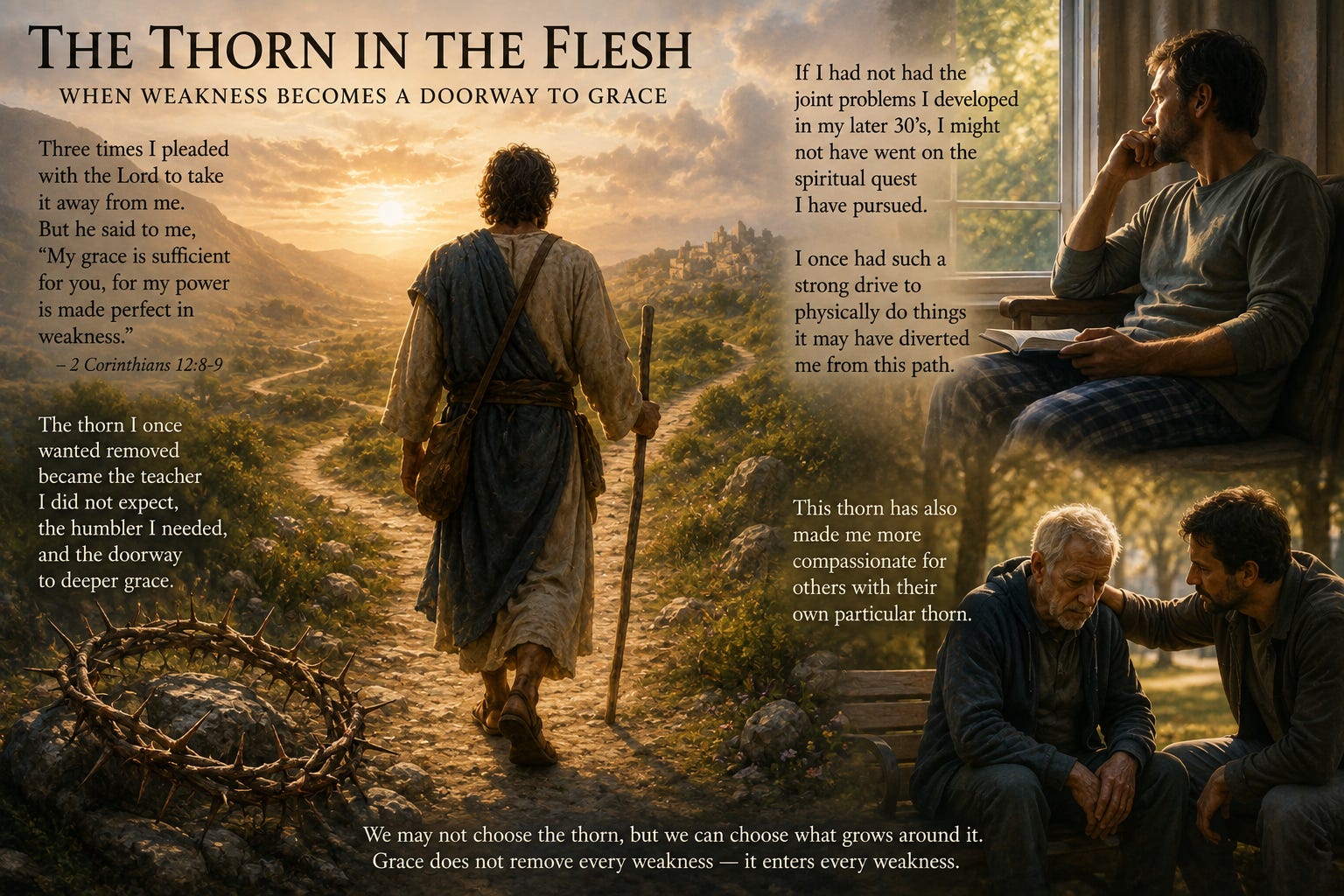
Paul’s conversion on the road to Damascus was dramatic. Light broke into his world, his old understanding collapsed, and the man who had persecuted followers of Jesus became one of Christianity’s most influential voices. It would be easy to imagine that after such an extraordinary experience, Paul’s spiritual life became clear and victorious, as though transformation had somehow removed the ordinary struggles of being human. Yet Paul tells us something very different. Even after his conversion, his visions, his experiences of the Spirit, and his years of ministry, something continued to trouble him. He called it a “thorn in the flesh.”
Paul never clearly tells us what this thorn was, and perhaps that is one reason the passage has remained so meaningful. If he had identified it as one particular illness, temptation, emotional struggle, or physical limitation, we might have assumed that the lesson applied mainly to people experiencing that same difficulty. Instead, the thorn remains unnamed, allowing almost everyone to recognize something of themselves within it. Most of us have some persistent struggle, weakness, wound, fear, limitation, temptation, habit, or circumstance that we would gladly remove if we could. In that sense, Paul’s thorn becomes a symbol for something nearly universal in the human spiritual journey.
The Thorn That Would Not Leave
Paul writes in 2 Corinthians that he was given “a thorn in the flesh” and that three times he pleaded with the Lord to take it away. The answer he received was not removal but reassurance: “My grace is sufficient for you, for my power is made perfect in weakness.” Through the centuries, people have suggested many possibilities for Paul’s thorn—physical illness, poor eyesight, epilepsy, depression, temptation, persecution, or some other recurring difficulty—but Scripture never settles the question.
Symbolically, perhaps the unanswered question is more valuable than a definite answer would have been. The thorn can represent whatever repeatedly presses against us and exposes those places where we are not completely strong, healed, certain, or in control. It may be something within us, something that happens to us, or even a difficult circumstance that continually touches a vulnerable place. Whatever form it takes, it is the thing we wish would simply disappear.
Paul certainly wanted his removed. He did not pretend to enjoy it or call suffering good. He prayed for deliverance and asked more than once for the burden to be taken away. Yet the answer he received suggests that spiritual growth does not always come through the removal of difficulty. Sometimes something deeper happens when the difficulty remains.
“My Grace Is Sufficient”
God’s response to Paul—“My grace is sufficient for you”—does not mean that suffering should be sought or that every painful situation should simply be endured. Illness should be treated when possible, harmful behavior should be confronted, destructive habits should be changed, and abusive situations should never be justified by telling someone that suffering is spiritually necessary. There are many thorns that should be removed if we are able to remove them.
But there are also struggles that remain despite sincere effort. We pray, work on ourselves, change our habits, seek understanding, ask for healing, and try again, yet something remains. At that point, the spiritual question may gradually change. Instead of asking only, “Why won’t God remove this?” we may begin asking, “What can God do within me even if this remains?”
That shift does not glorify the thorn. It changes our relationship to it. Spiritual growth does not always mean changing the circumstances around us; sometimes it means allowing those circumstances to awaken something deeper within us. What once appeared only as an obstacle may eventually become a place where patience, humility, courage, compassion, or dependence upon grace begins to grow.
The Thorn and the Ego
Paul gives us an important clue when he says that the thorn kept him from becoming conceited because of the extraordinary spiritual experiences he had received. Paul describes visions and even speaks of being caught up into what he calls the “third heaven.” He had experienced the risen Christ, become a respected teacher and missionary, and watched his influence spread throughout the early Christian communities. Experiences like these could easily become nourishment for the spiritual ego.
The spiritual ego can be especially difficult to recognize because it often disguises itself as holiness. A person may begin believing that mystical experiences, biblical knowledge, theological understanding, spiritual gifts, or religious leadership somehow make them superior to others. The person may still speak about God while quietly becoming more concerned with being spiritually advanced, being right, or being recognized.
Paul’s thorn continually reminded him that he remained human. He still had limitations, still needed grace, and still could not control everything. In that sense, the very thing he wanted removed may have protected him from something even more dangerous. The thorn kept a door open to humility.
Jacob Walked With a Limp
Paul’s thorn belongs to a larger biblical pattern. Jacob wrestled through the night with the mysterious divine figure and emerged transformed, but he also emerged limping. He received a new name—Israel—and yet carried the mark of the encounter in his body afterward.
We often imagine spiritual growth as a process of becoming increasingly strong, certain, and complete. Scripture offers a much more complicated picture. Jacob walks away blessed and limping. Paul becomes spiritually powerful while carrying a thorn. Jesus rises from the dead while still bearing the wounds of crucifixion. Again and again, transformation does not necessarily erase the marks of what has happened.
Perhaps spiritual wholeness does not always mean that every wound disappears. Sometimes it means that the wound no longer determines who we become. The scar may remain, the memory may remain, the weakness may occasionally return, but its power over us can change. We can carry something without allowing it to carry us.
The Wound Can Become the Teacher
There are struggles people may spend years attempting to overcome: fear, pride, anger, grief, addiction, loneliness, self-doubt, physical limitation, old childhood wounds, difficult relationships, the need for approval, resentment, judgment, or persistent temptation. At first, we naturally experience these things only as obstacles standing between us and the person we believe we should become.
But a difficult question emerges from Paul’s experience: What if some of our struggles can also become teachers? Fear may teach courage because courage cannot develop where fear never appears. Impatience may become the place where patience is learned. Pride can force us toward humility. Grief can deepen compassion. Failure can make us more merciful toward the failure of others. Physical limitation can expose our dependence upon other people and upon God.
The person who has wrestled deeply with judgment may eventually become extraordinarily understanding. Someone who has experienced brokenness may become the person most able to sit gently beside another person who is hurting. The thorn does not automatically produce wisdom; it can produce bitterness just as easily. But when brought into conscious spiritual work, something painful can gradually become a doorway into qualities that might never have developed without it.
When Fighting the Thorn Becomes Another Thorn
Sometimes our struggle against the thorn becomes almost as painful as the thorn itself. We become angry that it exists, ashamed that we have not overcome it, or convinced that our continued struggle proves some spiritual failure. We compare ourselves with people who seem stronger and begin imagining that true spiritual maturity would mean reaching a point where nothing frightens us, nothing tempts us, nothing angers us, and nothing hurts.
Scripture gives us very little support for that kind of perfection. Moses struggles with anger. Elijah collapses into despair shortly after one of his greatest victories. David combines extraordinary devotion with serious moral failure. Peter can be courageous one moment and frightened the next. Thomas doubts. Paul carries his thorn. The Bible is remarkably honest about human weakness.
Perhaps we sometimes demand a kind of perfection from ourselves that Scripture does not even demand from its greatest figures. The spiritual life may not be about eliminating every trace of human vulnerability. It may be about becoming increasingly conscious of it so that it no longer operates unseen.
Acceptance Is Not Surrender
There is an important difference between accepting that a struggle exists and surrendering ourselves to it. Suppose someone recognizes that anger is a recurring thorn. Acceptance does not mean saying, “That is simply who I am, so everyone else will have to tolerate it.” Rather, acceptance means becoming honest enough to say, “This is an area where I must remain awake.”
The thorn can become a spiritual alarm. It reveals where unconscious patterns still operate, where the ego is easily wounded, where fear remains active, or where greater awareness is needed. If we refuse to acknowledge the thorn, it often continues controlling us from the shadows. Once we recognize it, however, we can begin working with it consciously.
That may be one reason so many spiritual traditions emphasize self-examination. We cannot transform what we refuse to see. A weakness brought into awareness has already begun to lose some of its unconscious power.
The Thorn and the Shadow
In psychological language, part of this process could be described as confronting the shadow—the aspects of ourselves we would rather not see. We naturally prefer identifying with our better qualities. We want to think of ourselves as patient, loving, generous, courageous, forgiving, and spiritually mature. Then someone criticizes us, disagrees with us, succeeds where we have failed, or touches an old wound, and suddenly another side appears: jealousy, anger, fear, resentment, superiority, defensiveness, or the desire to retaliate.
Because these feelings do not fit the person we believe ourselves to be, we may quickly push them away. Yet pushing them away does not necessarily remove them. Sometimes the thorn is pointing directly toward something that needs to be brought into the light.
This connects beautifully with Paul’s Damascus experience. On the road to Damascus, Paul discovered that he had been blind to something outside himself. His understanding of God and the followers of Jesus had been profoundly mistaken. The thorn now teaches another kind of sight: the willingness to remain conscious of what exists within himself.
The spiritual journey requires both.
“When I Am Weak, Then I Am Strong”
Paul eventually reaches a conclusion that sounds almost contradictory: “When I am weak, then I am strong.” How could weakness possibly become strength?
Perhaps because weakness exposes the illusion of self-sufficiency. When we feel completely capable, we may begin assuming that everything we have achieved is the result of our own wisdom, discipline, intelligence, or strength. Weakness reminds us that life is larger than the ego and that none of us is completely self-contained.
It can also open us more deeply to other people. Someone who has never struggled may find it relatively easy to judge someone who does. Someone who has fallen, failed, suffered, and had to get back up may recognize how difficult that journey really is. Our own weakness can therefore become the birthplace of compassion. In that way, divine strength can sometimes become more visible through human vulnerability than through human perfection.
The Cracked Vessel
There is an old image of light shining through a cracked vessel that captures this beautifully. Much of human life can be spent trying to hide the cracks. We want other people to see competence, certainty, strength, success, and control, so we carefully cover the places where we feel inadequate or wounded.
Yet perhaps those very cracks sometimes allow something deeper to shine through. Paul himself uses similar imagery when he writes that “we have this treasure in jars of clay.” A clay vessel is fragile. It can crack and break, yet it can still carry something precious.
Perhaps our humanity is not an unfortunate container that prevents spiritual life from appearing. Perhaps it is the very vessel through which spiritual life must appear. Grace does not necessarily wait until the vessel is flawless before entering it.
Jesus Entered Human Weakness
This theme reaches its deepest expression in Jesus. Christianity makes the extraordinary claim that the Divine does not simply observe human vulnerability from a distance but enters it. Jesus experiences hunger, exhaustion, rejection, grief, betrayal, physical pain, loneliness, and death. In Gethsemane, he even asks whether the cup before him might pass away.
That prayer echoes Paul’s request concerning the thorn. Both express the very human desire that suffering might be removed. Yet in each case, the path ultimately moves through the difficulty rather than around it.
This does not make suffering itself sacred. It suggests something different: no experience of human vulnerability automatically places us outside the presence of God. If the Divine can be encountered in weakness, then perhaps our unfinished places are not spiritual wastelands. They may become some of the very places where we learn dependence, surrender, compassion, and trust.
Everyone Has a Thorn
We often look at other people from the outside and imagine they have somehow escaped the struggles that trouble us. Usually, we simply cannot see what they carry. The confident person may live with tremendous insecurity. The successful person may be haunted by fear of failure. The cheerful person may carry grief few people know about. The spiritually knowledgeable person may struggle privately with doubt. The physically strong person may fear the gradual loss of that strength.
Remembering this can change the way we treat others. We rarely know the whole story behind another person’s behavior. That does not excuse harmful actions, but it can temper judgment with understanding. The person who irritates us may be responding from a wound we cannot see. The person who appears strong may be using every bit of strength available merely to keep moving forward.
Everyone we meet is carrying something, and recognizing that truth can make us gentler with one another.
Do Not Make the Thorn Your Identity
There is also an important caution in Paul’s story. The thorn should never become our entire identity. A person can become so focused upon a wound that eventually everything in life begins revolving around it. The inner story becomes, I am the person this happened to. I am the one who was betrayed. I am the one with this weakness. I am the person who can never change.
When that happens, the thorn becomes almost like an altar around which the identity revolves.
Paul does not do this. He acknowledges the thorn, asks for its removal, accepts that it remains, and then continues his mission. The thorn travels with him, but it does not become him. That distinction is essential. We are always larger than our wounds. A struggle may influence part of our journey, but it does not have to determine the destination.
Sometimes the Thorn Changes
Sometimes a thorn really does disappear. A fear that once dominated us loses its power. An addiction is overcome. An old resentment is released. A wound gradually heals. Something that once felt impossible becomes manageable.
At other times, the thorn remains but its meaning changes. What once felt like an enemy becomes a reminder to remain conscious. What once produced shame becomes a source of compassion. What once seemed to prove our weakness becomes evidence of how much we have learned.
This may be one of the deepest forms of transformation. The circumstances remain recognizable, but we no longer meet them as the same person. The thorn has not necessarily changed; we have.
The Thorn Is Not the End of the Story
Paul could have spent the remainder of his life asking why God had not removed his thorn. Instead, he eventually learned how to carry it, and because he learned to carry it, the thorn did not prevent him from becoming who he was called to become.
That may be one of the most encouraging lessons in the entire story. We do not have to solve every problem before our life can have meaning. We do not have to heal every wound before we can help another person. We do not have to eliminate every weakness before spiritual growth can occur, nor do we have to completely understand why certain struggles remain.
The thorn may travel with us, but grace travels with us as well.
What Is My Thorn Teaching Me?
Paul’s experience invites a question that may be more useful than simply asking how quickly we can eliminate whatever troubles us. Sometimes we might ask, What is this revealing within me? What reaction does it repeatedly trigger? What fear lies beneath it? What attachment does it expose? Where am I being asked to grow?
We can ask whether the difficulty is making us more compassionate or more bitter, more patient or more resentful, more conscious or more reactive. We can ask whether it is exposing some place where pride, fear, control, or insecurity still holds more power than we realized.
These questions do not glorify suffering. They transform our relationship to it. Instead of treating the thorn only as an enemy, we begin asking whether it also carries information about the unfinished work within us.
Grace in the Unfinished Places
Perhaps one of the greatest illusions of the spiritual journey is the belief that someday we will finally become finished—no fears, no doubts, no weaknesses, no wounds, no inner conflicts, nothing left to overcome. Paul’s thorn suggests another possibility. Spiritual maturity may not mean reaching a state in which weakness disappears. It may mean learning to walk consciously with whatever weakness remains.
We become less controlled by it, less ashamed of it, less likely to project it onto others, and more aware of what it is teaching us. We become more compassionate because we know what it means to struggle and more dependent upon grace because we have stopped pretending that we are entirely self-sufficient.
Paul discovered something he had not expected. The thing he believed was preventing him from becoming spiritually strong became one of the places where he discovered what spiritual strength actually was. It was not domination, perfection, or self-sufficiency. It was humility, perseverance, surrender, and grace.
Perhaps that is why the thorn was never named. Its name changes from person to person. For one of us it may be fear; for another, pride. For another it may be grief, physical limitation, anger, insecurity, an old wound, or a recurring temptation. Whatever its name, the deeper question is much the same: Will the thorn make us bitter, or will we allow it to make us deeper?
Paul wanted his thorn removed. Instead, he discovered grace within it. And sometimes that may be the greater healing.
The Wound Can Become the Teacher
There are struggles people may spend years attempting to overcome: fear, pride, anger, grief, addiction, loneliness, self-doubt, physical limitation, old childhood wounds, difficult relationships, the need for approval, resentment, judgment, or persistent temptation. At first, we naturally experience these things only as obstacles standing between us and the person we believe we should become.
But a difficult question emerges from Paul’s experience: What if some of our struggles can also become teachers? Fear may teach courage because courage cannot develop where fear never appears. Impatience may become the place where patience is learned. Pride can force us toward humility. Grief can deepen compassion. Failure can make us more merciful toward the failure of others. Physical limitation can expose our dependence upon other people and upon God, but it may also redirect our lives in ways we could never have anticipated.
I have sometimes wondered about this in my own life. When I began developing joint problems in my later thirties, I naturally would have preferred never to have had them. I had always possessed a strong drive to work physically, to build, repair, accomplish, and keep moving. Had my body continued allowing me to pursue that kind of activity without limitation, it is possible that much of my energy would have remained directed outward. I may never have been drawn as deeply into the spiritual search that has become such an important part of my life. What I once saw only as a physical limitation may, in ways I could not recognize at the time, have helped redirect part of my life toward questions of God, consciousness, meaning, and spiritual growth.
That does not mean I would call the joint problems a blessing or suggest that God deliberately causes suffering in order to teach us lessons. It means that something difficult can sometimes become part of the path once it has entered our lives. We may not choose the thorn, but we can gradually choose what grows around it. Looking back, I can also see that living with my own physical limitations has made me more compassionate toward other people carrying their particular thorn. When we have personally experienced the frustration of wanting our body, mind, circumstances, or emotions to cooperate and finding that they will not, it becomes harder to casually judge another person’s struggle.
Perhaps this is one reason our thorns can eventually soften us. The person who has wrestled deeply with judgment may become extraordinarily understanding. Someone who has experienced brokenness may become the person most able to sit gently beside another person who is hurting. Someone who has learned to live with physical limitation may look differently upon another person’s pain. The thorn does not automatically produce wisdom; it can produce bitterness just as easily. But when brought consciously into the spiritual journey, something painful can gradually become a doorway into qualities that might never have developed without it.
We may therefore discover, sometimes only many years later, that the thorn did more than restrict one path. It quietly opened another.
Coming Next — Part 35: The Armor of God — The Inner Battle
Paul would later describe the spiritual life using the imagery of armor: the belt of truth, the breastplate of righteousness, the shield of faith, the helmet of salvation, and the sword of the Spirit. Read only on the surface, the language can sound like preparation for warfare. Read inwardly, however, it may describe something very different—the spiritual qualities needed for the battle that takes place within human consciousness itself.