


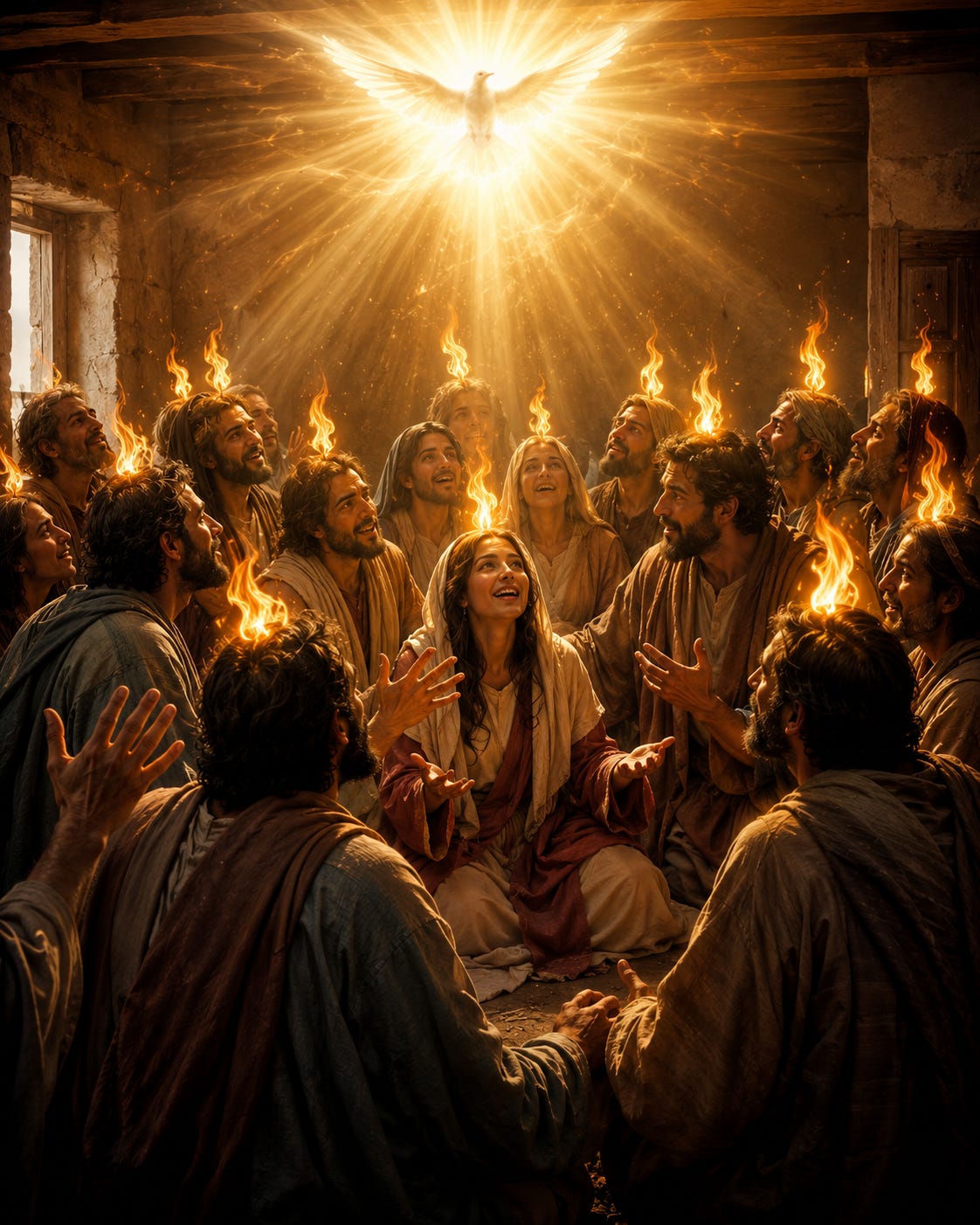
The story of Pentecost begins after a period of uncertainty. Jesus has ascended. The disciples have lost the physical presence upon which they had depended, but the Spirit he promised has not yet become visible within their experience. They are waiting in Jerusalem, gathered together in one place, perhaps still unsure exactly what they are waiting for. The old way of relating to Jesus has ended, but the new way has not yet fully appeared.
Then something happens that cannot be controlled or contained. A sound like a powerful wind fills the house. Tongues like fire appear and rest upon each of them. The disciples begin speaking in other languages, and people from many nations hear them declaring the works of God in their own tongues. Christianity has traditionally understood Pentecost as the coming of the Holy Spirit upon the followers of Jesus and the beginning of the Church’s public mission. Symbolically, it also represents a profound shift in the relationship between humanity and the Divine. The presence that had been experienced through Jesus is no longer confined to one visible teacher standing before them. The Spirit begins moving through ordinary human beings.
This is the fulfillment of the transition that began with the Ascension. The outer teacher disappears from sight, not so that humanity will be abandoned, but so that something deeper can awaken. The disciples who once continually looked toward Jesus must now discover that the life he embodied can begin working within them. Pentecost is therefore not the replacement of Jesus. It is the spreading of what Jesus revealed into the lives of many.
Wind: The Presence We Cannot Control
The first image of Pentecost is wind. The book of Acts says that a sound like a rushing mighty wind filled the house where the disciples were sitting. Wind is invisible, yet its effects are unmistakable. We cannot see the wind itself, but we can see trees move, clouds travel, waves rise, and leaves scatter because of it.
This makes wind a powerful symbol for Spirit. In both Hebrew and Greek, the biblical words translated as “spirit” can also carry the meaning of breath or wind. From the beginning of Scripture, divine breath is connected with life. God breathes into the human creature, and humanity becomes alive. The valley of dry bones in Ezekiel receives breath and rises. Jesus speaks of the Spirit as wind that blows where it wills. Pentecost continues this ancient image.
Spirit cannot be possessed like an object. We may build institutions around spiritual experiences, write doctrines about them, and create traditions to preserve their memory, but the Spirit itself remains free. Wind cannot be placed in a box. The moment we believe we have completely captured God within our own theology, denomination, interpretation, or spiritual system, the image of wind reminds us that divine reality is larger than the structures we create to describe it.
Yet freedom does not mean disorder for its own sake. We recognize the wind by what it moves. In the same way, genuine spiritual awakening reveals itself through its effects. Does it make us more loving, compassionate, patient, truthful, courageous, humble, and willing to serve? Or does it make us more self-important, fearful, hostile, and convinced of our superiority? The Spirit may be invisible, but its fruit becomes visible in the life through which it moves.
Fire: What Burns Without Destroying
The second great image of Pentecost is fire. Tongues like fire appear and rest upon each person. Throughout Scripture, fire often accompanies divine presence. Moses encounters God in the burning bush. Fire appears at Sinai. A pillar of fire guides Israel through the wilderness. The prophets speak of refining fire. Now the fire that once appeared in extraordinary places rests upon human beings.
This is a remarkable movement in the biblical story. The sacred is no longer located only on a mountain, behind a veil, within a sanctuary, or in the person of a single teacher. The fire rests upon people.
Fire can illuminate, warm, purify, and transform. It can also destroy, which makes it a fitting spiritual symbol because genuine transformation often consumes something within us. Pride may have to burn. Resentment may have to burn. False certainty, prejudice, fear, and the need to control may have to pass through a refining fire. The Spirit does not necessarily make us comfortable. Sometimes it reveals what we have avoided seeing.
Yet the fire of Pentecost does not consume the disciples. It rests upon them without destroying them. The image recalls the burning bush that burned without being consumed. Perhaps this is another picture of what spiritual transformation looks like. Divine presence does not erase our humanity or turn us into identical spiritual copies of one another. It illuminates and transforms what is already there.
The disciples remain themselves, but something within them has become alive.
The Spirit Rests Upon Each One
One small detail in the Pentecost account carries enormous symbolic importance: the fire divides and comes to rest upon each person. Not merely upon Peter. Not only upon the apostles with the strongest personalities. Not upon one priest who will then distribute the Spirit to everyone else. The fire rests upon each one.
This image carries forward one of the deepest movements we have been following throughout this series. In the ancient biblical world, divine presence was often associated with special places and specially chosen individuals: prophets, priests, kings, temples, mountains, and sacred objects. Jesus then reveals divine life through a human life lived in extraordinary union with the Father. At Pentecost, that movement expands again. The Spirit is poured out upon a community.
This does not make every individual infallible, nor does it mean every thought that occurs to us is the voice of God. But it does challenge the idea that spiritual access belongs only to a religious elite. The sacred is not the private possession of a priesthood, institution, denomination, teacher, or spiritually gifted personality. Pentecost declares that ordinary people can become vessels through which divine life moves.
That idea carries tremendous responsibility. If the Spirit can work within us, then we can no longer place all spiritual responsibility upon someone else. We cannot simply ask the pastor, teacher, church, or book to do our discerning for us. We must learn to listen, test, pray, observe the fruits, remain humble, and allow ourselves to be corrected. The Spirit within does not eliminate discernment. It makes discernment necessary.
Many Languages, One Spirit
Perhaps the most visible sign of Pentecost is the sudden appearance of many languages. Jerusalem is filled with people from different regions, cultures, and linguistic backgrounds, yet each hears the message in his or her own language.
This is important because Pentecost does not create one sacred language that everyone else must learn. Instead, the message comes to people in languages they already understand. Diversity remains, but communication becomes possible across the differences.
There is a beautiful spiritual principle here. Human beings often assume that unity requires sameness. We want everyone to use our words, adopt our customs, accept our interpretation, join our group, or understand God exactly as we do. Pentecost offers a different image. The Spirit does not erase different languages. It moves through them.
Perhaps divine truth is larger than any single human vocabulary used to describe it. One person may speak of God through traditional Christian language. Another may understand through contemplation, service, music, nature, or deep inner experience. Even within Christianity, people encounter the same Gospel through different personalities, cultures, histories, and forms of worship. Pentecost suggests that the work of the Spirit is not necessarily to make every voice identical, but to create understanding through diversity.
Unity in Spirit is not uniformity. It is possible for people to speak differently while being moved by the same love.
Pentecost and the Healing of Babel
There is an ancient biblical story that provides an interesting contrast to Pentecost. At the Tower of Babel, humanity attempts to build upward toward heaven and “make a name” for itself. The result is confusion of language, and the people scatter because they can no longer understand one another.
At Pentecost, people of many languages gather and suddenly understand. For that reason, Christians have often seen Pentecost as a kind of symbolic reversal of Babel. At Babel, human ambition produces division. At Pentecost, Spirit creates communion without eliminating difference.
The contrast becomes even richer when we consider the direction of movement. Babel is humanity attempting to climb toward heaven through its own greatness. Pentecost is Spirit moving toward humanity as gift. One is built around making a name for ourselves; the other empowers people to speak of something greater than themselves.
We still build Towers of Babel. They may not be made of brick. We build them from ideology, religion, politics, nationality, status, wealth, technology, or even spiritual knowledge. Whenever the purpose becomes proving that our group is above another, language begins breaking down. We may still use the same words, but we stop truly hearing one another.
Pentecost represents the opposite movement. Spirit teaches people to hear across boundaries. Perhaps one of the clearest signs of genuine spiritual maturity is not that we have become better at defeating those who disagree with us, but that we have become better at hearing the human being behind their words.
From Fear to Courage
Before Pentecost, the disciples repeatedly struggle with fear. They flee when Jesus is arrested. Peter denies knowing him. After the crucifixion, they hide behind locked doors. Even after the Resurrection, they are not immediately transformed into fearless messengers.
Then Pentecost occurs, and something changes. Peter, who had once been afraid to admit his relationship with Jesus to a servant girl, stands publicly before a crowd and speaks. The others also move outward. The people who had been hiding become witnesses.
This does not necessarily mean fear disappears completely. Courage is not the absence of fear. Courage is the discovery that something within us has become stronger than fear. That is an important distinction in the spiritual life. We sometimes wait to act until we feel completely confident, completely healed, completely certain, or completely unafraid. But transformation rarely works that way. The disciples do not become perfect people at Pentecost. The New Testament will continue showing their disagreements, mistakes, and limitations.
Pentecost does not make them perfect. It makes them available.
Something has shifted from “What will happen to me?” toward “What am I being called to do?” When our attention moves from protecting the ego toward serving something greater than ourselves, fear begins losing some of its authority.
The Temple Moves Again
Earlier in this series, we explored the Temple as a symbol of the inner sanctuary, the sacred center where humanity encounters God. The torn veil at the Cross suggested that the Holy of Holies could no longer be understood as a place sealed away from ordinary people. Pentecost carries that symbolism another step.
The sacred presence moves into people.
Later, Paul will ask, “Do you not know that you are God’s temple and that God’s Spirit dwells in you?” Whether understood individually or collectively, the image is revolutionary. The place where God is encountered is no longer only a building made of stone. Human life itself can become sacred space.
This does not make churches, temples, rituals, or sacred places meaningless. Physical places can help us become quiet, remember what matters, gather in community, and turn our attention toward God. But their purpose is to awaken something that cannot remain confined within their walls.
If we leave a sacred building and treat another person without compassion, something has been missed. If we worship God in a sanctuary but refuse to recognize sacred worth in the person beside us, the outer temple has not yet awakened the inner one.
Pentecost asks us to become what we once traveled somewhere else to find.
The Spirit Within Is Not the Ego Within
This point is especially important when we speak about the Spirit within humanity. There is a danger in spiritual language that emphasizes inner guidance without also emphasizing humility and discernment. It is very easy for the ego to disguise itself as divine authority.
A strong feeling is not automatically the Spirit. A thought that appears in our mind is not automatically God speaking. An intuition may be meaningful, but it can also be shaped by fear, desire, memory, prejudice, or wishful thinking.
The disciples themselves will continue needing one another. They gather, discuss, disagree, pray, and seek wisdom together. The coming of the Spirit does not turn each person into an isolated spiritual authority who no longer needs correction.
How, then, might we discern the difference? Jesus repeatedly gives us a direction: look at the fruit. Does the inner movement produce greater love? Does it lead toward patience, compassion, humility, courage, truthfulness, mercy, self-control, and service? Does it enlarge our concern for others, or merely inflate our sense of importance? Does it make us more willing to listen and learn, or increasingly certain that everyone else is blind?
The Spirit within does not glorify the ego. It gradually loosens the ego’s grip.
Pentecost Is a Harvest
Pentecost occurred during the Jewish Feast of Weeks, a festival connected with the harvest and firstfruits. That setting gives the story another beautiful symbolic dimension. Jesus had often spoken of seeds, fields, vines, fruit, sowing, and harvest. Now the spiritual seed planted through his life begins producing fruit in other human beings.
Jesus is no longer physically walking through Galilee, yet his compassion begins walking through the disciples. His words begin speaking through their voices. His courage begins appearing in people who once ran away. His message begins crossing borders he never physically crossed during his earthly ministry.
This is how a true teacher continues—not by creating permanent admirers, but by producing people in whom the teaching becomes alive.
A farmer does not plant a seed so that the seed can remain exactly as it was. The seed disappears into the ground and eventually becomes something far greater than itself. In the same way, the life of Jesus does not remain confined to one place and time. At Pentecost, what was planted begins multiplying.
The harvest is people becoming capable of bearing the same fruit.
The Spirit Within Humanity
Pentecost therefore points toward something much larger than a dramatic supernatural event experienced by a small group two thousand years ago. Symbolically, it reveals the possibility of humanity becoming increasingly conscious of divine presence within and among us.
This does not mean humanity suddenly became perfect at Pentecost. History clearly tells us otherwise. Nor does it mean every human impulse is divine. Rather, Pentecost announces a possibility: ordinary human beings can become increasingly receptive to Spirit and can allow that Spirit to shape the way they live.
Perhaps this is part of what Jesus meant when he told his followers that they would do the works he did and even greater works. His mission was never meant to end with admiration of Jesus. It was meant to continue through transformed people.
The question therefore changes. Instead of only asking, “What would Jesus do?” we begin asking, “What quality of Christ is trying to become alive through me now?” Compassion? Forgiveness? Courage? Truth? Service? Patience? Love?
The more these become embodied in human lives, the more Pentecost continues.
One Fire, Many Lamps
Imagine one flame lighting many lamps. The original flame is not diminished because another lamp becomes illuminated. Light multiplies without dividing itself.
This may be one of the simplest ways to understand the symbolism of Pentecost. Jesus did not need to remain physically present in one location because the light he revealed was never meant to remain confined to one human body. At Pentecost, that light begins appearing through many lives.
Yet every lamp gives the light a slightly different expression. Each person has a different history, personality, ability, culture, and calling. Peter does not become John. Mary does not become Peter. Paul, when his time comes, will not become any of them.
The Spirit does not erase individuality. It transforms individuality into an instrument of something larger.
A healthy spiritual community therefore does not produce identical people. It produces people whose differences become ways of expressing the same underlying love. One serves quietly. Another teaches. Another comforts. Another creates. Another challenges injustice. Another prays. Another simply sits beside someone who is suffering.
Different lamps. One fire.
Pentecost Within Us
The question of Pentecost is therefore not merely whether tongues of fire appeared over the disciples long ago. The deeper question is whether the fire has begun illuminating anything within us.
Has our spirituality made us more courageous? Has it made us more compassionate? Has it helped us hear people who speak a different “language” from our own—not only literally, but politically, culturally, religiously, emotionally, or spiritually? Has it moved God from being primarily an idea outside us toward becoming a living presence that affects how we think, speak, forgive, serve, and love?
The disciples entered the room waiting for something to happen to them. They left prepared to allow something to happen through them. Perhaps that is the real movement of Pentecost.
For much of the spiritual journey we ask God to help us, guide us, protect us, heal us, answer us, and show us the way. Those prayers have their place. But eventually, another prayer begins to emerge: “Father, what would You have me become?” Then perhaps an even deeper one: “How can Your love move through me?”
At that point, spirituality begins to move from consumption toward participation. We stop asking only what God can give us and begin asking what the divine presence might give to the world through us.
The fire has moved from the mountain to the sanctuary, from the sanctuary to the Christ, and from the Christ into a community of ordinary human beings. The story has been moving inward all along.
But what awakens within us is never meant to remain there. The Spirit within becomes love expressed outward.
A Question for Reflection
If the Spirit of God truly desires to work within ordinary human beings, what might change if you began each day not only asking for guidance, but asking, “What quality of divine love is trying to become visible through me today?”
And when you examine the fruits of your own spiritual life, do they reveal increasing love, patience, humility, courage, understanding, and compassion?
Coming Next
Part 33 — Paul’s Conversion: When Certainty Becomes Humility
Pentecost shows the Spirit awakening within ordinary people, but one of the most remarkable transformations is still ahead. A deeply religious man named Saul is completely convinced that he is defending God while persecuting those whose understanding differs from his own.
Then, on the road to Damascus, the certainty that had guided his life is shattered.
His conversion will raise one of the most important questions of the spiritual journey: What happens when we discover that sincere religious certainty and spiritual truth are not always the same thing?