


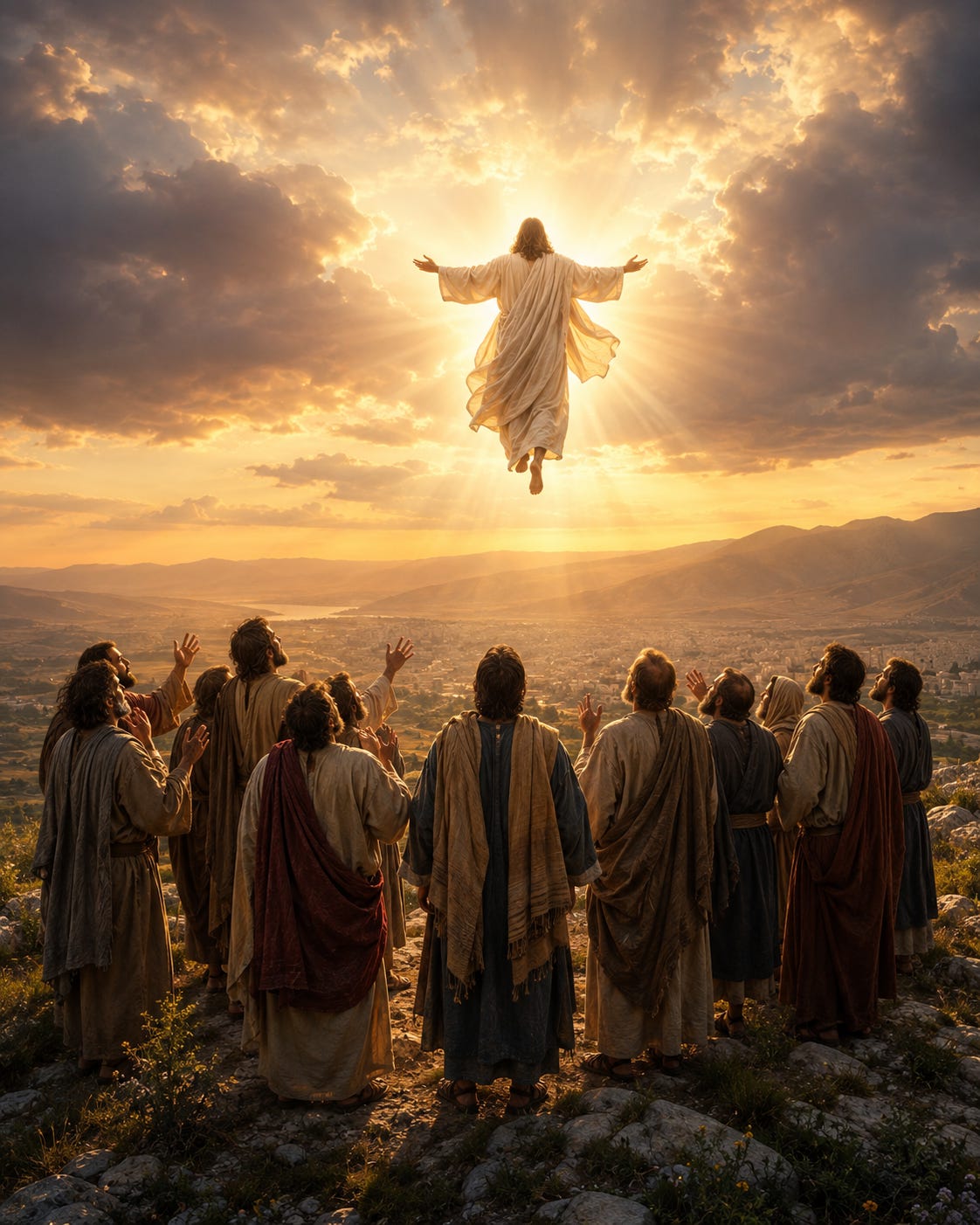
The Resurrection changed everything for the disciples, but it did not restore their lives to what they had been before the crucifixion. Jesus appeared among them again, yet something about the relationship had changed. He was present, but not in the ordinary way they had known him. He appeared and disappeared. Sometimes they recognized him immediately, and sometimes they did not. The familiar teacher they had followed along roads, listened to beside the sea, and sat with at meals was now leading them toward another transition.
The Ascension is traditionally understood as the moment when the risen Jesus was taken from the disciples’ sight and exalted into heaven. That meaning remains central to Christian faith. Yet symbolically, the Ascension also speaks to something that eventually occurs in every serious spiritual journey: the outer teacher can take us only so far. There comes a time when what we have received from outside must begin becoming alive within us.
For years the disciples had been able to look toward Jesus whenever they were confused. They could ask him what a parable meant, watch how he responded to an enemy, observe how he prayed, and depend upon his physical presence when they were frightened. Even after the Resurrection, he continued appearing among them. But if they were ever to become more than followers standing behind their teacher, this arrangement could not continue forever. At some point they would have to live what he had taught them without continually looking over their shoulders for him to provide the next answer.
The Ascension marks that turning point. It is not simply the story of Jesus going somewhere else. It is the moment when the disciples are asked to grow into what his presence had been preparing them to become.
Forty Days of Preparation
The book of Acts describes Jesus appearing to the disciples during forty days before the Ascension. Throughout Scripture, forty often marks a period of preparation, testing, purification, or transition. The rain of Noah lasted forty days. Israel wandered forty years. Moses remained on the mountain forty days. Jesus spent forty days in the wilderness before beginning his public ministry. Now another forty appears between the Resurrection and Ascension.
The number does not need to be treated as a secret code to appreciate the pattern. Symbolically, these forty days suggest that awakening must be allowed time to settle into us. A powerful spiritual experience may change us, but we still need time to understand what has happened. Insight has to move from the moment of revelation into the ordinary structure of our lives.
The disciples had experienced something overwhelming. The man they had watched die was alive again. Yet even that experience did not instantly make them spiritually mature. They still had questions. They still wondered about the restoration of Israel. They still looked outward for signs of what would happen next. The forty days become a kind of spiritual transition in which Jesus is gradually preparing them for a life in which his physical presence will no longer be their source of certainty.
We often experience something similar. A loss, awakening, dream, answered prayer, unexpected insight, or profound encounter may open our understanding, but afterward comes the slower work of integration. We have to learn what the experience means in daily life. Revelation may happen in a moment; transformation usually takes longer.
Why Are You Looking Upward?
One of the most striking details of the Ascension occurs immediately after Jesus disappears from sight. The disciples remain standing there, looking upward into heaven. Then two figures ask them, “Why do you stand looking into heaven?”
It is almost humorous in its simplicity. What else would they be doing? Their teacher has just disappeared into the sky. Of course they are looking upward. Yet symbolically, the question is profound.
Human beings have often looked upward for God. We imagine the Divine somewhere beyond the clouds, far removed from ordinary earthly life. Heaven becomes “up there,” while we remain “down here.” We look for God in spectacular signs, supernatural events, distant realms, sacred buildings, special teachers, or future circumstances. The disciples themselves are caught in this posture, staring into the heavens after the one they had followed.
But the question interrupts them: Why are you still standing here looking upward? They have been given something to do.
This does not mean heaven is unreal or that there is nothing beyond the physical world. It means the spiritual life cannot consist only of looking away from the world toward another realm. Jesus had spent his ministry bringing divine love into human suffering, touching lepers, feeding hungry people, forgiving sinners, confronting hypocrisy, comforting the grieving, and teaching people how to live. If his followers now simply stood gazing into the sky waiting for him to return, they would miss the purpose of everything he had shown them.
The direction of the spiritual journey begins to change. Instead of continually looking upward for someone else to act, they must begin carrying what they have received outward into the world.
The Cloud That Hides Him
The account says that a cloud received Jesus out of their sight. In Scripture, clouds often accompany encounters with divine presence. A cloud covers Mount Sinai. A cloud fills the Tabernacle. A cloud appears at the Transfiguration. The cloud often represents the mysterious boundary between what can be seen and what cannot be seen, between what the human mind can understand and what remains hidden within God.
The cloud of the Ascension therefore need not symbolize Jesus simply traveling upward through the atmosphere as though heaven were located somewhere beyond the stars. Its deeper image is one of transition from visible presence into hidden presence. The disciples can no longer relate to Jesus primarily through their physical senses.
This is an important stage in spiritual maturity. We often become attached to the form through which truth first reached us. It may have come through a particular church, teacher, book, tradition, experience, or way of understanding Scripture. Because that form helped awaken us, we may begin believing that God must always speak through the same form. But eventually the form may change.
A teacher dies or leaves. A congregation changes. A belief that once carried us no longer answers our deeper questions. A spiritual experience fades into memory. The emotional certainty we once felt may disappear. At such moments we can assume that God has left us, when perhaps the form through which we recognized God is simply being withdrawn.
The cloud does not necessarily mean absence. It may mean presence that can no longer be possessed by sight.
Letting Go of the Outer Teacher
There is nothing wrong with teachers. Jesus himself taught constantly, and the disciples clearly needed his guidance. Every spiritual path begins with learning from somewhere. We listen to parents, pastors, teachers, writers, traditions, Scripture, and people whose experience is greater than our own. We need guidance because none of us begins with complete understanding.
The problem comes when the teacher becomes a substitute for our own spiritual awakening. We can become so dependent upon an outer authority that we stop listening inwardly. We may ask what a preacher thinks before asking whether something bears the fruits of love, truth, mercy, humility, and wisdom. We may fear questioning an inherited belief because we have confused loyalty to a teaching with loyalty to God. We may collect the answers of other people without ever discovering whether those answers have become living truth within us.
The Ascension challenges this dependence. Jesus does not leave because the disciples no longer need God. He leaves them precisely so that their relationship with God can deepen beyond physical dependence upon him. What he has revealed must now become part of them. They cannot simply imitate the outward movements of their teacher forever. His way of seeing, loving, forgiving, and trusting the Father must begin taking root within their own consciousness.
This does not make the individual ego the new authority. The message is not, “Whatever I think must be true because it came from inside me.” Our inner world contains fear, desire, prejudice, pride, and self-deception as well as genuine spiritual insight. Discernment remains essential. But spiritual maturity requires that we begin learning to distinguish the quieter movement of truth within us rather than remaining permanently dependent upon someone else to tell us what God is saying.
From Followers to Witnesses
Just before the Ascension, Jesus tells the disciples that they will be his witnesses. This is an important change in identity. A follower walks behind someone. A witness carries within himself or herself something that has been personally seen, experienced, or known.
The disciples cannot remain merely an audience. Everything they have experienced—the teachings, healings, parables, Cross, Resurrection, forgiveness, failures, and restoration—must now become embodied in their own lives. The message of Jesus will no longer travel primarily because Jesus walks from village to village. It will travel because ordinary people have been changed deeply enough that they begin carrying it themselves.
This is the difference between repeating truth and becoming a witness to truth. We can repeat the words “love your enemies” without becoming less hateful. We can speak endlessly about forgiveness while continuing to nurse resentment. We can teach that God is love while frightening people with God. We can memorize Scripture without allowing it to transform the way we treat the person standing in front of us.
A witness is different because the truth has passed through experience. The person who has truly forgiven knows something about forgiveness that cannot be learned merely by reading about it. The person who has surrendered pride knows what surrender costs. The person who has walked through darkness and discovered that God was still present carries a quiet knowledge that arguments alone cannot produce.
The Ascension asks us whether the teachings of Jesus remain information we admire or whether they are gradually becoming the way we live.
The Difference Between Presence and Possession
The disciples loved Jesus, and understandably they wanted him near them. But love can sometimes become confused with possession. We want the person, experience, or spiritual state that brought us life to remain exactly as it was. We want to hold onto the moment. Yet much of spiritual growth involves learning to receive without possessing.
Jesus repeatedly resists being possessed. After the Resurrection, Mary Magdalene reaches toward him and is told not to cling to him. Later, at the Ascension, the disciples must release his visible form entirely. The pattern suggests that divine presence cannot be confined to the form in which we first encountered it.
This can be painful because human beings naturally cling to what has given us security. We may try to preserve a particular season of life, a relationship, a congregation, a way of worship, or an understanding of God long after life itself has begun moving us forward. We confuse faithfulness with refusing to change. But living things change form.
The child must eventually leave the parent’s hand. The student must one day leave the classroom. The apprentice eventually has to work without the master standing beside him. None of this means the earlier relationship was unimportant. On the contrary, its purpose was fulfilled precisely because something of the teacher now lives within the student.
The Ascension is therefore not rejection. It is graduation.
He Leaves While Blessing Them
Luke gives us another beautiful detail. Jesus is blessing the disciples as he is taken from them. His last visible gesture is not disappointment, warning, or condemnation. It is blessing.
This changes the emotional meaning of the Ascension. The disciples are not being abandoned by an irritated teacher who has grown tired of their failures. Jesus leaves with his hands extended in blessing. Even their future mistakes will take place beneath that blessing.
There is something deeply reassuring in this image. Many of us carry a fear that if we question, grow, change, or move beyond a familiar religious framework, we are somehow leaving God behind. But what if genuine growth sometimes occurs beneath blessing rather than condemnation? What if God is not threatened by our spiritual maturity?
A good teacher does not want the student permanently dependent. A loving parent does not want an adult child forever unable to make a decision without permission. Perhaps divine love also draws us toward increasing responsibility. We are blessed, and then we are sent.
The Ascension of Our Image of God
There may be another level to the symbolism. As we mature spiritually, our image of God itself often has to ascend beyond the limited forms in which we first understood God.
As children, we may picture God almost as a powerful human being somewhere in the sky. Later we may understand God through rules and religious structures. Still later, we may begin recognizing divine presence as something infinitely greater than any mental picture we can construct. This does not mean our earlier understanding was useless. A child’s understanding may have been entirely appropriate for that stage of development. The difficulty arises when we insist that the image suitable for one stage must remain unchanged forever.
The Ascension invites our understanding of Christ to expand as well. Jesus can no longer be confined to one location where only a few people can physically stand beside him. His visible presence disappears, yet his influence expands throughout the world. Paradoxically, by no longer belonging to one small group in one physical place, his presence becomes available in an entirely new way.
Spiritually, the Christ we once sought only outside ourselves begins becoming something we recognize through the qualities he embodied: love, mercy, courage, forgiveness, humility, truth, and union with the Father. The form ascends. The reality remains.
Standing Between Ascension and Pentecost
The disciples now enter another period of waiting. Jesus has departed, but Pentecost has not yet occurred. They stand between two spiritual realities. The teacher they depended upon is gone, and the power that will awaken within them has not yet fully appeared.
This may be one of the most uncomfortable places on the spiritual journey. We have outgrown an old dependence but have not yet discovered our new strength. The old answers no longer satisfy us, but the deeper answers have not become clear. We know we cannot return to the previous stage, yet we do not know what the next one will feel like.
It is tempting in this space to run backward. We may search for another authority to replace the one we lost, another rigid system to eliminate uncertainty, another person who will tell us exactly what to believe and what to do. But the disciples are told to wait.
Waiting here is not inactivity. It is openness. They gather together. They pray. They remain attentive. They do not manufacture Pentecost. They prepare themselves to receive what they cannot create through effort alone.
The spiritual journey contains both action and receptivity. There are times when we must walk, choose, forgive, speak, and act. There are other times when our task is simply to become quiet enough for something deeper to emerge.
When the Teacher Is No Longer Outside Us
The Ascension ultimately asks a deeply personal question: What happens when the teacher is no longer standing in front of us? Do we stop growing? Do we immediately search for another person to follow? Or do we begin discovering that the purpose of the teacher was never to create permanent dependence, but to awaken within us the capacity to recognize truth?
Jesus had spent years pointing people toward the Father, toward love, toward the Kingdom of God, and toward a transformed way of living. Now the visible form through which those teachings came is withdrawn. The disciples must carry the teachings within themselves.
Perhaps this is part of what spiritual adulthood looks like. We continue learning from Scripture, teachers, communities, and one another, but we no longer surrender the responsibility of discernment. We listen. We question. We pray. We observe the fruit. We remain humble enough to change. We ask whether what we believe makes us more loving or more fearful, more compassionate or more judgmental, more truthful or merely more certain.
The mature spiritual life is not a life without teachers. It is a life in which teachers help us hear the deeper Teacher.
The Ascension prepares the disciples for precisely this transition. Jesus disappears from their sight so that they can discover another form of his presence. But something more is still required. Knowing the teachings is not enough. Remembering Jesus is not enough. Even sincere intention is not enough. The frightened disciples who once hid behind locked doors need an inner power greater than their own fear.
That is why the story does not end with the Ascension. Something is coming.
A Question for Reflection
Where in your spiritual life might you still be looking outward for someone else to give you an answer that you are being invited to prayerfully discover and live for yourself? And is there some familiar form of faith, certainty, or dependence that God may not be taking away from you, but transforming into something deeper?
Coming Next
Part 32 — Pentecost: The Spirit Within Humanity
The Ascension removes the visible teacher from the disciples’ sight, but it does not leave them empty. They are told to wait, and in that waiting something extraordinary happens. At Pentecost, the divine presence that they had experienced through Jesus begins moving within ordinary human beings.
The fire will no longer rest upon one mountain or remain hidden within one sanctuary. It will rest upon people. And the followers who once looked toward Jesus for everything will begin discovering the Spirit alive within themselves.