


Returning to What Was Never Lost
As we have journeyed through the symbolic stories of Scripture, one theme has quietly woven itself through every lesson. Adam and Eve left the Garden believing something outside themselves could offer what they already possessed. Cain wandered farther from his true nature. Noah passed through the waters of transformation. Abraham stepped into the unknown. Jacob wrestled until a new identity emerged. Joseph descended before he could rise. Israel wandered through the wilderness, entered the Promised Land, lost it again through exile, and eventually returned home. Jonah fled from his calling before discovering that there was no place beyond God’s presence. John the Baptist prepared the way for a new consciousness, and Jesus revealed that the Kingdom of God is not found in distant places but within.
Each of these stories has been describing the same journey from a different perspective. They are not merely the history of a people but the unfolding story of every human soul. Jesus understood this perhaps better than anyone, and nowhere does He gather all of these themes together more beautifully than in the parable of the Prodigal Son.
On the surface it appears to be a simple family story—a son who rebels, wastes everything he has been given, and finally returns to ask for forgiveness. Yet beneath the simplicity lies one of the deepest spiritual pictures in all of Scripture. This is the story of every person who has ever searched for fulfillment outside themselves, only to discover that what they were seeking had quietly been waiting within all along.
Perhaps this is why the story continues to speak so powerfully across cultures and generations. Whether we recognize it or not, we have all been the younger son. We have all wandered into our own far country. We have all believed, at one time or another, that happiness, security, identity, or peace could finally be found if only we reached the next destination, achieved the next goal, or acquired the next possession. We may have searched through success, relationships, knowledge, religion, wealth, or countless other pursuits. None of these things are evil in themselves, yet none of them can satisfy the deepest longing of the soul because that longing is not for something we can possess. It is a longing to remember who we truly are.
The Freedom to Wander
The younger son asks his father for his inheritance while his father is still alive. To those listening to Jesus, this request would have sounded shocking, almost as though the son were saying, “I would rather have your gifts than your presence.” Yet if we look honestly at our own lives, have we not often done the same?
From our earliest years we begin building an identity. We discover our talents, develop our opinions, accumulate knowledge, and gradually construct a picture of who we believe ourselves to be. Much of this is a natural part of human growth, yet hidden within it is a subtle illusion. We begin to believe that this carefully constructed identity is our true self. We become attached to what we have accomplished, what others think of us, or even the beliefs we hold about God. Without realizing it, we begin living from the personality rather than from the deeper life that quietly exists beneath it.
The father allows his son to leave. There is no argument, no attempt to force him to stay. Love never imprisons. One of the remarkable truths revealed throughout Scripture is that God grants humanity the freedom to wander. Love that demands obedience through force is not love at all. It patiently allows experience itself to become the teacher.
How many of life’s greatest lessons have come not because someone explained them to us, but because we lived them?
The Far Country
Jesus never tells us where the far country is. That omission may be intentional because the far country is not a place on a map. It is a condition of the heart.
A person may travel across the world and remain close to God, while another may spend every day within the walls of a church and still live in the far country. The distance is measured neither in miles nor in religious activity. It is measured by awareness. Whenever we lose ourselves in the endless pursuit of external fulfillment while neglecting the quiet life of the spirit, we have entered that distant land.
Modern society often encourages exactly this way of living. We are taught that fulfillment lies just beyond our present circumstances. A larger home, greater success, more recognition, stronger certainty, greater comfort, or even more spiritual knowledge promises to complete us. Yet each achievement soon gives way to another pursuit, leaving behind a faint but persistent feeling that something essential is still missing.
Perhaps that quiet dissatisfaction is not a sign that we have failed. Perhaps it is the soul gently reminding us that it cannot be nourished by things that exist only outside itself.
The Gift Hidden Within the Famine
Then Jesus introduces a famine.
Every spiritual journey eventually encounters one.
For some, it comes through illness. For others, through grief, disappointment, broken relationships, financial hardship, or the slow realization that the things once pursued with such determination no longer satisfy. Sometimes the famine arrives without any outward tragedy at all. Life may appear successful by every worldly measure, yet an emptiness quietly begins to grow beneath the surface.
Most of us resist these seasons because they feel like loss. Yet when we look back over our lives, it is often these very moments that become the turning points of our spiritual awakening. The famine exposes what abundance had concealed. It reveals that while the body and the ego may consume endlessly, the soul hungers for something entirely different.
The younger son eventually finds himself feeding pigs, longing even to eat what has been given to them. To Jesus’ audience, this represented the lowest imaginable condition. Symbolically, it portrays the soul reaching the point where it finally recognizes that it has been trying to feed itself with things incapable of giving life.
Many of us spend years attempting to satisfy a spiritual hunger with material achievements, intellectual certainty, or even religious performance. None of these were ever intended to replace living communion with the Divine. The famine gently uncovers that truth.
Coming to Ourselves
Then Jesus speaks a sentence so simple that its depth can easily be overlooked:
“He came to himself.”
Those few words may describe the entire spiritual journey.
Notice that Jesus does not say the son became someone new. He does not say he finally earned wisdom or discovered a hidden truth that had never existed before. Instead, He says that the son came to himself. Something that had always been present emerged from beneath the confusion that had covered it.
Throughout this series, we have seen this same pattern repeatedly. The image of God within humanity was never destroyed in the Garden. It became hidden beneath fear. Jacob did not receive a new soul after wrestling through the night; his true identity was revealed. Jonah did not become worthy after emerging from the great fish; he became willing. Jesus did not teach people to manufacture the Kingdom of God but to awaken to the Kingdom already within them.
Perhaps salvation is less about becoming someone else than remembering who we have always been beneath the layers of fear, pride, ambition, shame, and separation. The farther we wander into false identities, the more extraordinary it feels when we finally recognize the quiet Presence that has accompanied us all along.
The journey home begins, not with a change of location, but with a change of awareness.
The Father Who Never Stopped Watching
As the son begins the long walk home, he carefully prepares the words he intends to speak. He no longer expects to be welcomed as a son. His experiences have convinced him that he must now earn whatever place remains for him. It is a way of thinking familiar to many of us. After our failures, we often imagine that God must surely love us less than before and that we must somehow prove ourselves worthy again.
Jesus quietly overturns that belief.
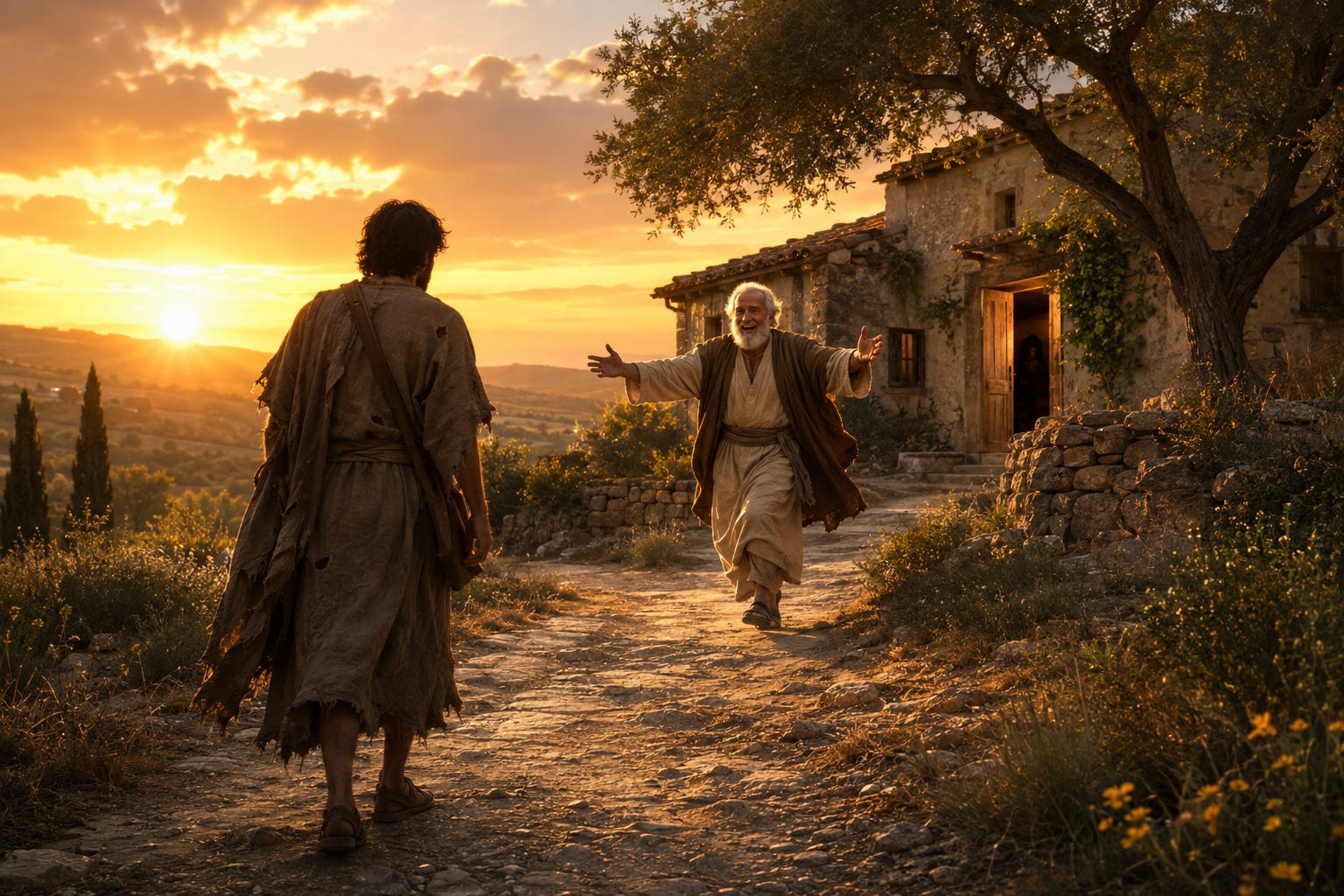
Before the son can reach the house, while he is still only a distant figure upon the road, his father sees him. The picture suggests that he has been watching the horizon for a very long time. His love has not faded during the years of separation. The son may have forgotten his father many times, but the father has never forgotten his son.
Without hesitation, the father runs toward him. In the culture of Jesus’ day, this would have been astonishing. Men of dignity did not run through the village. Yet love is unconcerned with preserving appearances when restoration is at hand. The father does not wait for the perfect apology or demand an explanation for every mistake. His first response is simply to embrace the child he has always loved.
Perhaps this is one of the greatest revelations Jesus ever offered about the nature of God. We often imagine ourselves searching for the Divine, hoping that one day we may finally arrive. Yet perhaps the greater truth is that Divine Love has been searching for us from the very beginning. Before we ever take a single step homeward, Love is already moving toward us.
Restoring What Never Ceased to Belong
The son begins the speech he has rehearsed so carefully, but he never finishes it. Before he can ask to become a servant, his father calls for a robe, a ring, and sandals. Each gift quietly restores what the son believed he had permanently lost.
The robe covers his shame. The ring restores his place within the family. The sandals distinguish him from the servants who walked barefoot. Every action proclaims the same truth: the son has not returned as a stranger seeking employment but as a child returning to the home that has always been his.
This is far more than forgiveness. Forgiveness alone removes guilt. Restoration returns identity.
How often do we approach God believing we must earn acceptance, when all along the invitation has been to awaken to a relationship that never truly ended? The father is not creating a new son. He is revealing what had remained true even while the son believed himself lost.
The Elder Brother
Jesus ends the parable with a surprising twist. The elder brother has never left home, yet he is unable to rejoice. His life has been marked by duty, obedience, and hard work, but beneath it lies a heart that has quietly measured love through performance. He cannot understand grace because he has come to believe that acceptance must always be deserved.
Here Jesus reveals that there is more than one way to become lost.
Some lose themselves through rebellion.
Others lose themselves through self-righteousness.
Some run far from home.
Others remain physically near while their hearts slowly drift away.
Both sons misunderstand their father. One doubts his love after failure; the other doubts his love because it appears too generous. Yet the father goes out to both. His invitation is the same for each. “Come into the celebration. Come and discover who I have always been.”
The Father’s love is large enough to embrace both kinds of lostness.
The Journey Home
The beauty of this parable is that it never truly ends. Jesus leaves the elder brother standing outside, and He never tells us whether he enters the celebration. Perhaps that is because the final chapter belongs to us.
Each day we are invited to choose whether we will continue searching for fulfillment in the far country or begin listening once again to the quiet voice that has never stopped calling us home. The road home is not measured by distance but by awakening. It begins the moment we remember that beneath every role we play, every success we celebrate, every failure we regret, and every identity we have constructed, there remains something that has never been broken.
The Father has never ceased watching the road.
Perhaps He always knew that one day we would discover that the home we longed for was never merely a place we had left behind. It was the living relationship that had quietly surrounded us all along, patiently waiting for the moment when we would finally come to ourselves.
Reflection
As you read this parable, resist the temptation to ask which character you resemble, for most of us have been each of them at different seasons of our lives. Instead, ask a quieter question.
Where am I today? Am I searching for life in a far country?
Am I trying to earn a love that has already been freely given?
Or am I beginning to awaken to the gentle realization that the One I have been seeking has never stopped walking beside me?
If so, then perhaps you are already on the journey home.
Coming Next: Part 29 – The Cross: Where Heaven and Earth Meet