


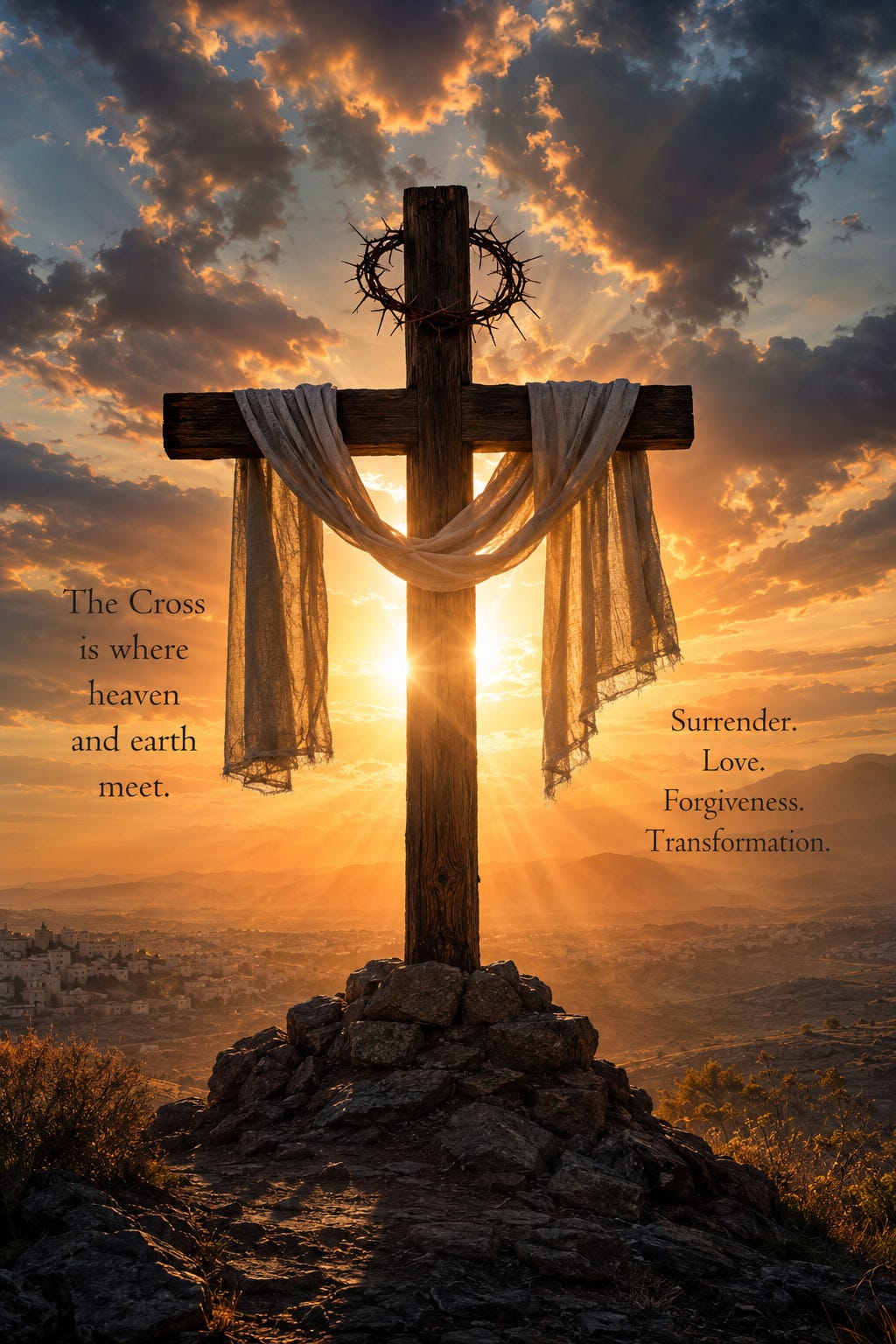
In the previous part, the parable of the Prodigal Son showed us a God who does not stand at a distance waiting to punish the wandering child, but a Father who runs to meet him, embraces him, and restores him to his place in the household. The Cross carries that same revelation even deeper. It shows divine love entering the very center of human cruelty, fear, shame, and violence without becoming cruel, fearful, shaming, or violent in return. Jesus does not merely speak about love from a safe distance. He remains faithful to it when everything around him appears to deny it.
For Christians, the Cross is inseparable from the historical crucifixion of Jesus and from the belief that something decisive occurred there between humanity and God. A symbolic reading does not need to take that meaning away. It invites us to ask what the Cross reveals within us now. Why did Jesus tell his followers to take up their own cross? What must be surrendered within us? What part of us resists love, truth, forgiveness, and trust? The Cross is not only something we look back upon. It is a pattern of inner transformation through which the false self loses its power and the deeper self begins to live.
The Vertical and Horizontal Beams
The shape of the Cross itself offers a profound spiritual symbol. The vertical beam reaches upward and downward, joining heaven and earth. It represents our relationship with God, the movement of divine life into human experience, and the awakening of the human spirit toward its Source. It reminds us that we are more than our fears, possessions, roles, opinions, and physical circumstances. There is a sacred dimension within us that reaches beyond the temporary personality toward the eternal.
The horizontal beam reaches outward in both directions. It represents our relationship with other people and with the whole human family. It stretches toward friend and stranger, the accepted and rejected, those who understand us and those who do not. We cannot truly embrace the vertical beam while refusing the horizontal one. Love of God cannot be separated from love of neighbor. A spirituality that reaches upward while withholding mercy, forgiveness, compassion, and justice from others remains incomplete.
The two beams meet at the center, at the place of the heart. This is where heaven and earth meet within us. It is where our love for God must become love expressed through human life. It is where prayer becomes forgiveness, faith becomes courage, truth becomes integrity, and spiritual insight becomes service. The Cross therefore symbolizes integration. It brings together what we often divide: spirit and matter, contemplation and action, the inner life and the outer life, our relationship with God and our relationships with one another.
The Death of the False Self
When Jesus speaks of losing one’s life in order to find it, he points toward one of the great paradoxes of the spiritual journey. Something must die, but it is not the sacred essence of who we are. What must die is the false self we have constructed—the self built upon fear, control, pride, resentment, comparison, image, and the need to be proven right. This false self is not entirely evil; much of it was formed as a way of surviving and protecting ourselves. Yet what once protected us can eventually imprison us.
The ego fears the Cross because the Cross removes its disguises. It cannot carry its titles, defenses, accomplishments, grievances, or carefully managed reputation through the place of surrender. At the Cross, we are asked to release the illusion that we can save ourselves through control. We are asked to stop demanding that life, other people, and even God conform to our expectations. We are brought to the place where we can finally say, in the spirit of Jesus, “Not my will, but Yours.”
This surrender does not mean becoming passive, weak, or unable to think for ourselves. It does not mean allowing others to mistreat us or remaining in destructive situations. Taking up one’s cross should never be used to tell an abused person to endure more abuse, or to suggest that suffering is holy merely because it hurts. Jesus did not glorify pain for its own sake. The Cross represents faithfulness to love and truth even when that faithfulness has a cost. It is the surrender of the false self, not the destruction of the God-given self.
Carrying the Cross
Before Jesus was crucified, he carried the instrument of his execution toward Golgotha. Symbolically, this speaks to the burdens, wounds, responsibilities, and unfinished inner work we each must face. We may wish someone else could do this work for us, but there are places within ourselves that only we can enter. Others may encourage us, pray for us, guide us, or walk beside us, but they cannot surrender our pride, forgive our enemies, face our fears, or release our bitterness in our place.
Yet the story also tells us that Simon of Cyrene was compelled to help Jesus carry the Cross. This detail reminds us that the spiritual path is personal, but it is not meant to be solitary. There are times when our burden becomes too heavy to carry alone. Grace may then appear through another person—a friend, spouse, stranger, counselor, teacher, or quiet companion who helps us take the next few steps. Receiving help is not spiritual failure. Sometimes humility means allowing another person to carry part of the weight.
Our cross is not simply every unpleasant thing that happens to us. It is the particular place where love asks us to grow beyond our present limits. For one person, it may involve releasing a resentment that has shaped decades of life. For another, it may mean admitting a wrong, speaking a difficult truth, letting go of the need for approval, or forgiving oneself. The Cross appears wherever the old self says, “I cannot surrender this and still remain who I am,” while the spirit quietly answers, “You cannot become who you truly are until you do.”
The Nails, the Thorns, and the Wounded Mind
The nails fastened Jesus to the Cross. Inwardly, they can symbolize the attachments that keep us fixed to patterns of suffering: our insistence on being right, our fear of change, our identification with an old wound, or our determination to make another person pay for what they have done. These attachments can become so familiar that we mistake them for part of our identity. We may say, “This is simply who I am,” when it is actually a pattern we have repeated for so long that we no longer imagine freedom from it.
The crown of thorns points toward the suffering of the mind. Thorns are sharp, tangled, and difficult to remove without pain. So are the thoughts that torment us—shame, accusation, anxious imagining, humiliation, and the endless replaying of old injuries. Jesus is mocked as a king while wearing a crown designed to wound him. The world cannot recognize the kind of kingship he represents because it is looking for domination, spectacle, and power over others. Jesus reveals a different authority: the power to remain rooted in love when the wounded human mind is surrounded by hatred and contempt.
The spiritual journey does not ask us to pretend that our wounds do not hurt. Jesus does not deny pain. He cries out from the Cross. True spirituality is not emotional numbness, nor is it the performance of calmness while suffering inwardly. The Cross gives us permission to bring anguish, confusion, and even the feeling of abandonment into the presence of God. Faith is not always certainty. Sometimes faith is the thin thread that remains when certainty has disappeared.
“Father, Forgive Them”
One of the most transforming moments of the crucifixion is Jesus’ prayer for those who are harming him: “Father, forgive them, for they know not what they do.” This does not excuse cruelty or erase responsibility. It reveals that beneath human wrongdoing there is often a profound blindness. People act from fear, woundedness, conformity, anger, ambition, and unconscious patterns they do not fully understand. Jesus sees the darkness of their actions without allowing that darkness to take possession of him.
Forgiveness is one of the deepest forms of inner crucifixion because the ego often survives by keeping the case against another person alive. It believes resentment will protect us, that anger will maintain justice, or that releasing the debt will somehow declare the harm acceptable. But forgiveness does not mean calling evil good. It means refusing to let another person’s actions continue governing our inner life. It places judgment into larger hands and frees the heart from carrying poison as though it were protection.
This kind of forgiveness may unfold slowly. Some wounds cannot be released through a single decision or prayer. The Cross does not demand that we manufacture feelings we do not yet have. It invites us to begin with willingness: “Father, I am not yet able to forgive fully, but I am willing to be led toward freedom.” Even that small willingness opens a space through which grace can work.
The Darkness and the Torn Veil
The Gospel accounts describe darkness covering the land as Jesus hangs upon the Cross. Symbolically, this is the darkness that often surrounds genuine transformation. There comes a point when the old identity is dying, but the new life has not yet appeared. The beliefs and defenses that once gave us security no longer work, yet we cannot see what will replace them. This is a spiritual night in which God may seem absent, even though something sacred is taking place beneath the surface.
Many people turn back at this point because darkness feels like failure. We assume that if we were truly growing, we would feel peaceful, certain, and spiritually strong. Yet some of the deepest changes occur when we feel stripped of our usual supports. The seed breaks open in darkness. The caterpillar loses its former shape within the cocoon. The soul may also pass through a place where it cannot return to what it was and cannot yet see what it is becoming.
At the moment of Jesus’ death, the veil of the Temple is torn from top to bottom. The veil had separated the Holy of Holies from the rest of the sanctuary. Inwardly, its tearing symbolizes the end of the belief that God is locked away in a distant sacred place, accessible only through special intermediaries. The innermost sanctuary has been opened. The divine presence is no longer hidden behind the veil of fear, unworthiness, religious status, or separation. The way into the Holy of Holies is now the way into the transformed heart.
“It Is Finished”
Jesus’ words, “It is finished,” are not merely words of defeat. They announce completion. The full movement of surrender has reached its end. Nothing remains to be defended, proven, controlled, or withheld. Love has entered the worst that human beings can do and has not surrendered its nature. Violence has spent its force, but it has not transformed Jesus into its own image.
There are moments in our lives when we also need to say, “It is finished.” The old grievance has ruled long enough. The false identity has been carried far enough. The effort to win approval, control every outcome, or relive what cannot be changed has reached its end. These words do not mean that every consequence disappears immediately. They mean that we stop feeding the pattern with our life. We place it into the hands of God and allow something new to begin.
The Cross reveals that transformation is not achieved by decorating the old self with spiritual language. It comes through surrender. We do not rise into a new life while clinging to everything that belongs to the old one. Before resurrection there is a letting go, a silence, and a tomb. Yet the Cross is not the final word. It stands at the threshold between the life we have known and the life that is waiting to be born.
The Cross Within Us
To contemplate the Cross is therefore to ask more than what happened to Jesus. It is to ask what the pattern of Jesus’ life is revealing within us. Where do heaven and earth still remain divided in me? Where does my professed love of God fail to become patience, mercy, honesty, and compassion toward others? What identity am I afraid to surrender? What wound have I allowed to define me? What burden must I carry faithfully, and what burden am I being invited to release?
The Cross does not tell us that we are worthless. It reveals that the falsehoods we have mistaken for ourselves are not the deepest truth about us. Beneath fear is trust. Beneath resentment is the possibility of freedom. Beneath the defended ego is a soul capable of love. The Cross brings us to the place where these hidden possibilities can emerge, because it is where the power of separation is exposed and surrendered.
When the vertical love of God and the horizontal love of humanity meet within the heart, the Cross is no longer only an object outside us. It becomes a living pattern within us. We begin to understand that salvation is not merely escape from punishment, but deliverance from the fear, pride, hatred, and illusion that keep us separated from God, from one another, and from our own deepest nature. At that meeting place, something in us dies—but something far more real is preparing to live.
A Question for Reflection
What are you still holding onto that may need to be placed upon the Cross—not because God wishes to diminish you, but because it is keeping you from becoming more loving, truthful, free, and fully alive?
Coming Next
Part 30 — Resurrection: Dying Before We Die
The Cross brings the false self to its end, but the spiritual journey does not stop at surrender. Next, we will explore the Resurrection as an inner awakening—the birth of a new consciousness that can begin even before physical death.