

What Becomes Visible When We Are Born Again
In the previous article, we explored what Jesus may have meant when He said that a person must be born again in order to see the kingdom of God. Spiritual rebirth is not merely the adoption of a new belief or the promise of a future destination. It is the awakening of a different way of seeing. The old mind views life through fear, separation, control, judgment, and the need to protect the image it has created. The newly awakening spirit begins to see through compassion, truth, humility, forgiveness, and trust in the Father.
This leads naturally to the next question: What does the spiritually awakened person begin to see?
Jesus’ answer was the kingdom of God.
Many of us were taught to think of heaven primarily as a place we may enter after death. Yet Jesus repeatedly spoke of the kingdom as something that had already drawn near. He said it was present among the people, compared it to seed growing quietly in the earth, described it as leaven working invisibly through dough, and taught that it could be received like a child. The kingdom was not presented only as a distant reward. It was a living reality that could begin within a person now.
This does not mean there is no life beyond this one, nor does it reduce heaven to a state of mind. It means that eternal life does not begin only when the body dies. It begins whenever the life of God begins to rule within us.
Where Is the Kingdom?
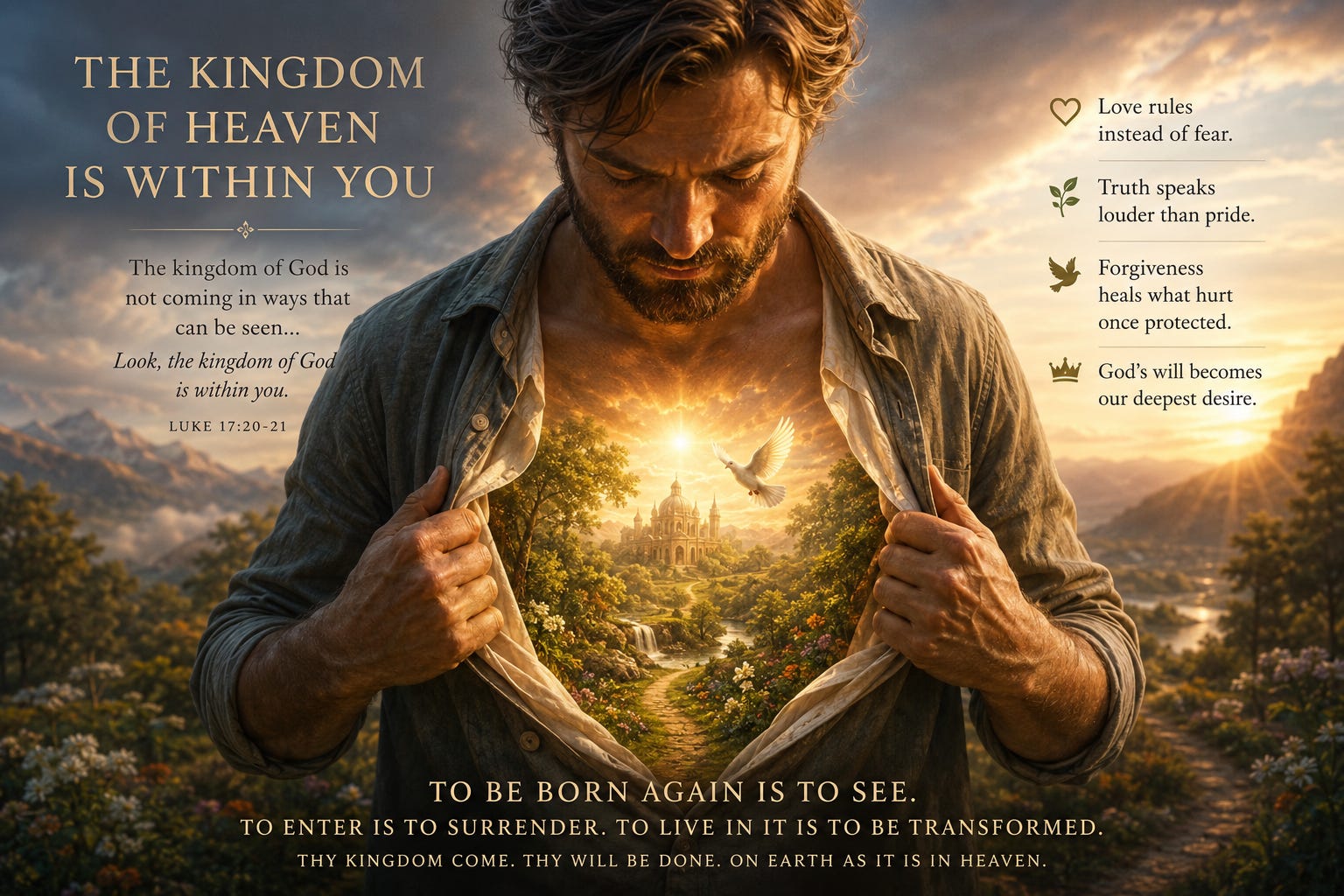
When the Pharisees asked Jesus when the kingdom of God would come, He told them that it would not arrive through outward observation. People would not be able to point and say, “Here it is,” or “There it is.” He then said that the kingdom of God was within them, or, as some translations express it, among them.
Both expressions carry an important truth. The kingdom was among them because Jesus stood in their midst, embodying the will, character, and love of the Father. Yet many could not recognize it because they were looking for something else. They expected a visible political kingdom, a dramatic overthrow of their enemies, and the restoration of national power. Jesus brought a kingdom that first confronted the human heart.
The kingdom was near, but it could not be seen by the old way of seeing.
This is why the teaching about being born again comes first. Unless our perception changes, we may stand in the presence of truth and never recognize it. We may read the words of Jesus, attend worship, defend doctrines, and wait for God to transform the world while overlooking the place where His work must begin.
The kingdom of heaven begins within.
It begins when truth takes the throne that illusion once occupied. It begins when love becomes stronger than fear, when forgiveness becomes more important than revenge, and when surrender replaces the desperate need to control. It begins when the voice of conscience is no longer pushed aside by pride, resentment, ambition, or the approval of others.
The kingdom is wherever the Father’s will is welcomed and lived.
Removing the False King
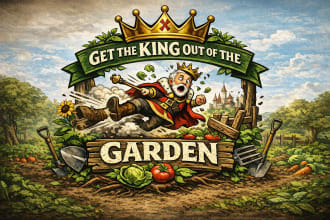
The title of this publication, Get the King Out of the Garden, points toward this same inner struggle. There is a false king within the human personality that wants to rule the garden of the soul. It is the part of us that insists on being right, being admired, being obeyed, and being safe at any cost. It builds its throne from fear and calls it wisdom. It protects old wounds and calls it justice. It seeks recognition and calls it service. It may even use religion to strengthen its position.
Jesus did not come merely to make the false king more religious. He came to remove it from the throne.
The kingdom of heaven cannot fully appear within us while the ego remains ruler. This does not mean that the human personality must be destroyed. Our personality is a necessary part of life, but it was never intended to be sovereign. It is meant to become a servant of the spirit rather than its master.
When Jesus taught us to pray, “Thy kingdom come, Thy will be done, on earth as it is in heaven,” He gave us more than a prayer for world events. He gave us a pattern for the inner life. The “earth” within us includes our ordinary thoughts, habits, reactions, relationships, and choices. Heaven is the order of divine love and truth. For heaven to come to earth, what is true in the spirit must gradually become visible in the way we live.
The prayer becomes personal: Father, let Your kingdom come within me. Let Your will be done in my thoughts, my words, my desires, and my treatment of others. Remove from the throne whatever does not reflect You.
A Kingdom That Grows Quietly
Jesus often described the kingdom through small and hidden things. A mustard seed appears insignificant, yet it contains the pattern of something far greater. Leaven disappears into the dough but slowly changes the whole loaf. A seed grows beneath the soil before anything becomes visible above the ground.
These images teach us patience with the inner journey.
We may expect spiritual transformation to arrive through a dramatic experience that permanently removes every fear, weakness, temptation, and doubt. Sometimes a powerful awakening does occur, but even then the kingdom usually unfolds through quiet daily choices. A person begins to pause before reacting. An old resentment loosens its grip. The need to win an argument becomes less important than understanding another person. We become able to admit when we are wrong. We notice motives that once remained hidden. We feel compassion where we once felt only judgment.
These changes may seem small, but the kingdom often enters life as a seed.
The question is not whether we have become perfect. The question is whether something living has begun to grow. Are we becoming more honest? More merciful? More teachable? More willing to look within? More able to recognize the humanity of those we disagree with? More willing to follow truth even when it changes the way we believe?
The kingdom grows wherever we stop resisting the transforming work of the spirit.
Seeking First the Kingdom
Jesus told His followers to seek first the kingdom of God and His righteousness. This does not mean abandoning our responsibilities or becoming unconcerned with the needs of daily life. It means establishing the proper center from which life is lived.
Most people seek security first. Others seek approval, comfort, influence, wealth, certainty, or control. Even when these desires are understandable, they cannot carry the weight we place upon them. Circumstances change. Bodies age. Possessions can be lost. Other people cannot continually reassure us. Any identity built entirely upon the outer world will eventually be shaken.
To seek the kingdom first is to seek alignment with God before seeking control over circumstances. It is to ask not only, “How can I get what I want?” but, “What is this situation asking me to become?” It is to ask, “What is true? What is loving? What is mine to do? What is being exposed within me?”
The kingdom gives us an inner foundation that the changing world cannot provide.
This does not make us passive. In fact, a person ruled by truth and love may act with great courage. Jesus confronted hypocrisy, defended the vulnerable, crossed social boundaries, and refused to allow fear to determine His path. Yet His actions came from inner union with the Father rather than from hatred of His enemies.
The kingdom within becomes the source of right action in the world.
Not an Escape From the World
There is a danger in speaking of an inner kingdom if we use it to escape the suffering around us. Jesus never taught an inward spirituality that ignored the hungry, the sick, the lonely, the rejected, or the oppressed. The authenticity of the inner kingdom is revealed by its fruit.
If our spirituality makes us less compassionate, less honest, or less willing to help others, then something has gone wrong. If we claim to possess inner peace while refusing to see another person’s pain, our peace may be avoidance rather than transformation. The kingdom within is not self-absorption. It is the place where divine love takes root so that it can flow outward.
The inner and outer cannot finally be separated. What rules within us will eventually appear in our relationships, communities, institutions, and decisions. Fear within produces division outside. Unhealed shame often becomes judgment. The hunger for control creates systems of domination. But compassion within produces service. Truth within produces integrity. Forgiveness within interrupts cycles of retaliation.
The world changes as human hearts change, and changed hearts must eventually express themselves through changed actions.
The Treasure Hidden in the Field
Jesus compared the kingdom to treasure hidden in a field. When a man discovered it, he recognized that its value exceeded everything else he possessed.
The treasure is hidden not because God wishes to keep it from us, but because we are often searching in the wrong places. We look for fulfillment in recognition, certainty, possessions, achievement, religious status, or the defeat of those we believe are wrong. These may offer temporary satisfaction, but they cannot provide the deep wholeness for which the soul longs.
The kingdom is discovered when we turn inward honestly enough to encounter the presence of God beneath the noise of the false self.
This discovery carries a cost. The man in the parable sold everything to possess the field. Symbolically, we may have to release cherished illusions, identities, grievances, and beliefs about ourselves. We may have to surrender the need to appear spiritually advanced. We may discover that some of what we called faith was actually fear, some of what we called conviction was pride, and some of what we called discernment was judgment.
The treasure is free, but receiving it may require us to let go of whatever keeps our hands closed.
Becoming Like a Child
Jesus also said that the kingdom must be received like a little child. A child has not yet built the same layers of self-protection, social identity, and intellectual pride that accumulate through life. This does not mean we are to become childish or abandon wisdom. It means we become open, trusting, teachable, and willing to see without immediately forcing everything into old categories.
The ego wants mastery. The childlike spirit is willing to receive.
Many spiritual truths cannot be forced open by argument. They become known through experience. Love is understood by loving. Forgiveness is understood by forgiving. Trust is learned by stepping forward without possessing every answer. The kingdom becomes real as we live from it.
This may be why Jesus spoke in parables. A parable does not merely provide information. It invites the listener into an inner encounter. Those who want only a rule may miss the meaning. Those willing to look within may find that the story is describing them.
The kingdom is not simply something we understand. It is something we become able to embody.
What Is Being Born in Me Now?
At the end of the previous article, we were left with a question: What is being born in me now?
Part 26 gives us a way to recognize the answer.
If the kingdom is being born within us, we may notice a greater desire for truth than for comfort. We may become less interested in condemning others and more willing to examine ourselves. We may feel drawn toward reconciliation, simplicity, patience, and service. We may begin to sense that God is not merely an external authority watching from a distance, but a living presence guiding, correcting, and transforming us from within.
There may also be resistance. The false king does not surrender the garden easily. Old fears may intensify when they are exposed. The need for control may become more obvious when we begin trying to release it. We may briefly feel less spiritual because we are seeing weaknesses that were previously hidden.
But seeing what is within us is not failure. It is part of awakening.
Light does not create the disorder in a dark room. It reveals what was already there so that it can be put in order. In the same way, the coming of the kingdom may first reveal the parts of us that are not yet aligned with love. This is not condemnation. It is invitation.
The Father shows us what must be transformed because He is preparing us to live more fully.
The Kingdom Is Near
The message of Jesus was that the kingdom of God had drawn near. Perhaps it is always nearer than we think.
It is near when we pause and listen before speaking. It is near when we choose mercy instead of retaliation. It is near when we release the need to be seen as right. It is near when we recognize the sacred worth of another person. It is near when we allow truth to correct us rather than merely using truth to correct everyone else.
The kingdom may not arrive with the outward spectacle people expect. It may enter quietly, like seed falling into prepared soil. Yet when it is welcomed, it gradually changes the whole landscape of a life.
To be born again is to awaken the ability to see this kingdom. To enter it is to allow its life to become our life. We do not enter merely by declaring that we belong to it. We enter by surrendering to the One who rules it.
The question is no longer only, “Will I go to heaven someday?”
The deeper question is, “Is heaven beginning to live through me today?”
Coming Next: The Good Samaritan
If the kingdom of heaven is truly growing within us, it must change the way we see other people. In the next article, we will look at the parable of the Good Samaritan—not simply as a lesson about helping someone in need, but as a challenge to the boundaries, judgments, and divisions created by the false self. Jesus will turn the question away from “Who qualifies as my neighbor?” and toward a much more personal one: “Am I becoming a neighbor?”