


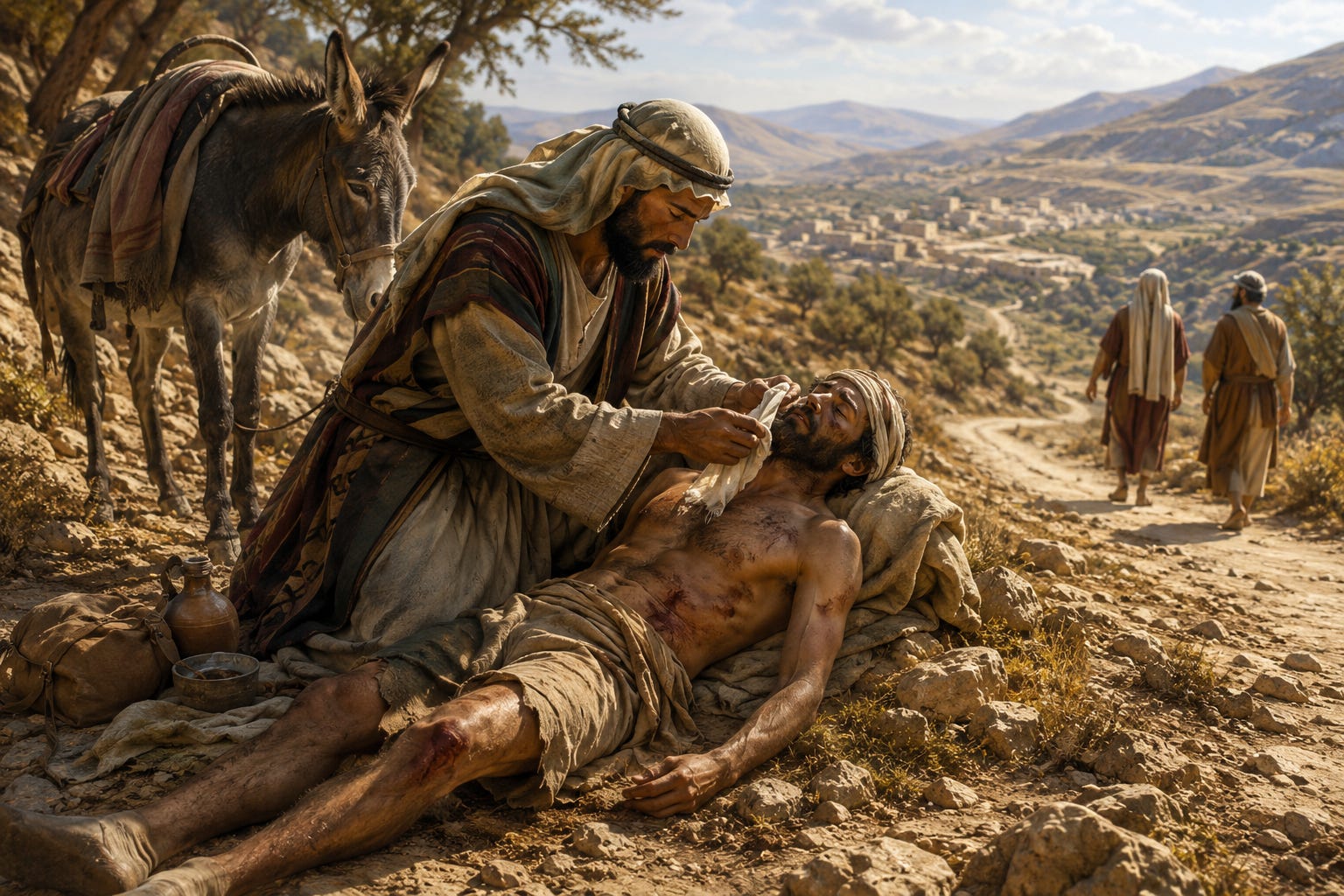
In the previous part, we considered Jesus’ teaching that the kingdom of God is not merely a distant place to be reached someday, but a spiritual reality waiting to be discovered within us. Yet an inner kingdom cannot remain only an idea, a private feeling, or a comforting belief. If the presence of God is truly awakening within us, it will eventually change the way we see and respond to the people around us. The parable of the Good Samaritan shows what the kingdom looks like when it moves from the heart into action. It becomes compassion. It crosses boundaries. It recognizes the divine worth of another person before asking whether that person belongs to the right group.
The story begins when an expert in the law asks Jesus, “What must I do to inherit eternal life?” Jesus directs him back to the law, and the man answers that one must love God with all one’s heart, soul, strength, and mind, and love one’s neighbor as oneself. Jesus tells him that he has answered correctly. But the man then asks another question: “And who is my neighbor?” On the surface, it sounds reasonable. Beneath it, however, is the desire to define a limit. He is not merely asking whom he should love. He is also asking whom he may exclude.
The Question Behind the Question
The human ego likes clear boundaries. It divides the world into those who belong and those who do not, those who are worthy and those who are not, those who think like us and those who threaten our way of seeing things. We may do this through religion, politics, nationality, race, social position, education, morality, or countless smaller distinctions. Once a person has been placed outside our circle, it becomes easier to ignore their suffering. We may even convince ourselves that they deserve it.
Jesus does not answer the man by giving him a list of approved neighbors. Instead, he tells a story that overturns the entire question. A man travels from Jerusalem down to Jericho and is attacked by robbers. They strip him, beat him, and leave him half dead beside the road. A priest comes by, sees him, and passes on the other side. A Levite does the same. Finally, a Samaritan approaches. He is moved with compassion, tends the man’s wounds, places him on his own animal, brings him to an inn, and pays for his care.
To Jesus’ original listeners, making a Samaritan the compassionate hero would have been unsettling. Samaritans and Jews carried generations of religious and cultural hostility toward one another. The Samaritan was the person many listeners would have expected to distrust, not imitate. Jesus deliberately places divine compassion inside the person whom society had labeled an outsider. In doing so, he reveals that love cannot be confined by our divisions.
The Road from Jerusalem to Jericho
At the symbolic level, the road from Jerusalem to Jericho can represent the human journey from spiritual awareness into the harsher conditions of ordinary life. Jerusalem was associated with the temple and the presence of God, while Jericho lay far below it geographically. The traveler is described as going “down” from Jerusalem. This descent can reflect what happens when we move away from our spiritual center and become caught in fear, competition, resentment, temptation, or the struggles of the material world.
The robbers can symbolize the forces within and around us that strip away our peace, dignity, hope, and sense of identity. Sometimes these forces come through the actions of others. Sometimes they arise through our own unresolved fears, addictions, anger, pride, shame, or self-condemnation. We may appear outwardly alive while inwardly lying wounded beside the road.
The wounded traveler has no identity in the story. We are not told his religion, occupation, social standing, or moral character. He is simply a human being in need. That absence is important. Compassion does not first demand a résumé. It does not ask whether the suffering person agrees with us or has made every correct decision. It sees the wound before the label.
Each of us has been this traveler. Life has wounded all of us in some way. We have known disappointment, rejection, grief, fear, failure, loneliness, or the feeling that something essential has been taken from us. When we remember our own wounds, we may become less eager to judge those who are still lying beside the road.
Religion That Passes By
The priest and the Levite are not presented as people who failed to notice the injured man. The story says they saw him. Their failure occurred after seeing. Whatever reasons they may have had—fear, ritual concerns, inconvenience, uncertainty, or self-protection—the result was the same: knowledge of God did not become the love of God.
This is one of the parable’s most searching lessons. Religious position, scriptural knowledge, ritual observance, and correct belief do not automatically transform the heart. They can guide us toward God, but they can also become substitutes for the inner change they were meant to produce. We may know the language of compassion while continuing to pass by the wounded. We may defend truth while forgetting mercy. We may become so concerned with being spiritually correct that we fail to be spiritually alive.
The priest and Levite can also symbolize parts of ourselves. The priest may represent our religious identity—the part that knows what it believes and wants to appear righteous. The Levite may represent our learned habits, traditions, and duties. These are not evil, but neither is sufficient by itself. When belief remains only in the mind, it can walk past suffering without being interrupted.
There are times when we all cross to the other side of the road. We may see someone’s pain but decide we are too busy. We may avoid a difficult conversation because it makes us uncomfortable. We may remain silent when someone is treated unfairly. We may withdraw compassion from a person because of something they have done or because they belong to a group we distrust. The parable does not invite us to condemn the priest and Levite as people unlike ourselves. It asks us to recognize them within ourselves.
The Compassionate Outsider
The Samaritan does more than feel sympathy. The story says he is moved with compassion, and that compassion becomes action. He approaches the injured man, binds his wounds, pours on oil and wine, places him on his animal, takes him to an inn, stays with him, and provides for his continuing care. His love costs him time, comfort, effort, and money.
This is the difference between sentiment and spiritual love. Sentiment feels concern from a safe distance. Love draws near. Sentiment says, “Someone should help.” Love asks, “What can I do?” Sentiment may be sincere, but compassion becomes real when it accepts some part of another person’s burden.
The oil and wine used on the wounds carry rich symbolic meaning. Oil often represents healing, mercy, and the presence of the Spirit. Wine can represent life, sacrifice, and inner transformation. Together they suggest that the deepest wounds of the soul require both gentleness and truth. Mercy soothes what has been injured, while truth cleanses and awakens. Genuine healing does not merely cover a wound, nor does it treat the wounded person harshly. It brings love and truth together.
The inn may symbolize a place of shelter and restoration—a spiritual community, a trustworthy relationship, or the quiet inner place where healing can continue. The Samaritan does not pretend that one compassionate moment will solve everything. He creates the conditions for ongoing care. This reminds us that some wounds cannot be healed through a single conversation, prayer, or act of kindness. They require patience, safety, and time.
There is another inner dimension to the Samaritan. He may represent the rejected or undervalued part of ourselves through which God chooses to work. We often expect spiritual help to come through the parts of us that appear respectable, educated, disciplined, and religious. Yet healing may arise through humility, vulnerability, intuition, tenderness, or even through the pain we once wished to hide. The inner “outsider” may carry the compassion that the more honored parts of our personality have neglected.
Becoming a Neighbor
After finishing the story, Jesus does not ask, “Which of these people was the wounded man’s neighbor?” He asks, “Which of these three became a neighbor to the man who fell among robbers?” The question has changed. The issue is no longer deciding who qualifies to receive our love. The issue is whether we will become loving people.
This frees us from trying to determine the boundaries of our responsibility through labels alone. A neighbor is not simply someone who lives nearby, shares our beliefs, attends our church, votes as we do, or behaves in ways we approve. A neighbor is any person whose humanity we are willing to recognize. We become a neighbor whenever we cross the distance created by fear, prejudice, indifference, or pride.
This does not mean that love has no wisdom or boundaries. Compassion does not require us to remain in dangerous situations, enable destructive behavior, or surrender all discernment. The Samaritan does not hand his life over to the wounded man. He provides what is needed and places him where care can continue. Spiritual love is not blind. It sees clearly, acts wisely, and refuses to use another person’s imperfection as an excuse for indifference.
The parable also turns inward. We cannot fully love our neighbor as ourselves if we have never learned to treat our own wounded places with mercy. Many people speak harshly to themselves in ways they would never speak to another person. They condemn their failures, hide their grief, and abandon parts of themselves that most need healing. The inner priest and Levite may pass by our own wounded soul while we continue performing our outward responsibilities.
To love our neighbor as ourselves therefore contains two movements that belong together. We learn to recognize the wounded humanity in others, and we learn to receive the compassion of God within ourselves. This is not selfishness. A person who has honestly faced and tended their own wounds is often less threatened by the wounds of others. They no longer need to feel superior in order to feel safe.
The Kingdom Made Visible
The Good Samaritan is not merely a lesson about being nice. It is a revelation of what happens when the kingdom of God becomes active within a human being. The Samaritan sees differently. He does not see an inconvenience, an enemy, or an unworthy stranger. He sees a person. That change in vision is the beginning of spiritual transformation.
The kingdom within us becomes visible whenever love overcomes separation. It appears when mercy becomes stronger than judgment, when compassion becomes stronger than prejudice, and when another person’s suffering becomes more important than preserving our comfort. It appears in quiet acts that may never be noticed by the world: listening without interrupting, forgiving without demanding humiliation, helping without seeking recognition, speaking for someone who has no voice, or simply refusing to reduce a human being to a label.
We are all, at different moments, every character in this story. We have been wounded and left beside the road. We have taken from others through selfishness or carelessness. We have seen suffering and passed by. We have also felt compassion and stopped to help. The purpose of the parable is not to assign us permanently to one role. It is to awaken us so that, more and more, the Samaritan within us becomes the one who responds.
Jesus concludes with the words, “Go and do likewise.” He does not ask the lawyer merely to admire the story or agree with its theology. He calls him to live it. The path into eternal life is not found only in what we believe about God, but in allowing the life of God to flow through us. Love is not the reward at the end of the spiritual journey. Love is the journey.
A Question for Reflection
When I encounter someone who is wounded, different, difficult, or outside my familiar circle, which part of me responds first—the part that judges, the part that passes by, or the part that draws near with compassion?
Coming Next
Part 28: The Prodigal Son—Coming Home to Ourselves
Jesus’ parable of the prodigal son is often understood as a story about a sinner returning to God. Yet it also reveals the journey of the soul that leaves its true home, searches for fulfillment in the outer world, and finally awakens to the presence of the Father that was never truly lost. We will also look at the elder brother, whose outward obedience conceals a different kind of separation, and discover why both sons must find their way home.