


The story of Jonah showed us how difficult it can be to surrender to a direction that challenges the will of the ego. Jonah ran, resisted, descended into darkness, and finally emerged ready to do what he had been called to do. John the Baptist appears much later in the biblical story, yet he carries a similar message of turning. Before something new can begin, the old direction must be faced. Before the Christ can be recognized, the road within us must be cleared.
John stands at the edge of two worlds. He is the final great prophetic voice of the old order, yet he points beyond himself toward something greater. He does not ask people merely to believe a new doctrine. He calls them to prepare.
A Voice in the Wilderness
John does not begin his ministry in the temple, the palace, or the center of religious authority. He appears in the wilderness.
The wilderness has appeared many times in our journey through Scripture. It is the place where familiar supports fall away. Moses encountered God in the wilderness. Israel wandered there for forty years. Elijah heard the still, small voice there. Jesus would soon be led there after His baptism.
Symbolically, the wilderness is that inner place where the noise of the world grows quiet enough for us to hear what we have been avoiding. It may feel barren, lonely, or uncertain, yet it is often where spiritual clarity begins.
John’s voice cries out from that place:
“Prepare ye the way of the Lord, make his paths straight.”
We often think of this as a prediction that Jesus was about to arrive historically, and certainly it was. But the words also speak to every generation and every individual. What within us is crooked? What has become cluttered, hardened, or divided? What inner road must be made straight before the spirit of Christ can move freely through our lives?
John’s clothing of camel’s hair and his simple food place him outside the comforts and approval of society. He is not polished, respectable, or easily controlled. His authority does not come from position. It comes from alignment with truth.
The real prophetic voice within us often speaks in the same way. It may not flatter us. It may not fit comfortably with what everyone else believes. It may disturb the life we have carefully arranged. Yet something in us recognizes that it is true.
Repentance as Turning
John’s central message is usually translated:
“Repent, for the kingdom of heaven is at hand.”
For many people, the word repentance carries the feeling of shame, punishment, or religious fear. But its deeper meaning is a turning of the mind and heart. It is a change in direction. John is not saying that the divine presence comes through our effort, but we can remove some of what blocks our awareness of it. We all have blocks, some more than others. It’s when we confront those blocks and let them wash away that more of our spiritual eyes are opened.
The kingdom John announced is “at hand.” It is near. It is not merely a reward waiting after death or a political order imposed from outside. It begins wherever the rule of love, truth, mercy, and spiritual awareness is allowed to take root.
John’s task is therefore still alive within us. There are moments when we must become the voice in our own wilderness. We must call ourselves back from distraction. We must tell the truth about the direction we are traveling. We must enter the waters of surrender and allow the old road to end.
Only then are we prepared to hear the deeper message Jesus will bring.
John does not ask us to worship the wilderness. He asks us to pass through it. He does not ask us to remain forever in repentance. He asks us to turn so that we can recognize what is coming. He does not claim to be the light. He bears witness to the light.
And perhaps that is the question this story leaves with us:
What within me must decrease so that the spirit of Christ may increase?
Coming Next: Born Again — What Was Jesus Really Talking About?
John prepared people through water, but Jesus would speak of a birth from above—a transformation so deep that it could not be explained by outward religion alone. What does it truly mean to be born again, and where does that birth take place? Simply telling people to feel bad about themselves. He is telling them that the way they have been living and seeing must change because something greater is near.
Repentance is not self-condemnation. It is recognition that we need to make a change.
We suddenly see that resentment has been shaping our thoughts. We recognize that fear has been making our decisions. We notice that pride has kept us from admitting where we were wrong. We realize that outward religion has sometimes taken the place of inward transformation. This is the reason why a simple prayer without a heart change may not be doing what many think it is accomplishing.
This is the road John asks us to clear.
The kingdom cannot be received merely by adding a new belief on top of the old self. Something must be released. The valleys must be lifted, the mountains brought low, and the crooked places made straight. The low places of worthlessness must be raised. The mountains of pride must be humbled. The twisted ways in which we justify ourselves must be exposed.
John’s message is severe only because awakening requires honesty. A physician who refuses to name the illness cannot help bring healing. John names the condition, but he also announces hope: the kingdom is near.
The Meaning of Baptism
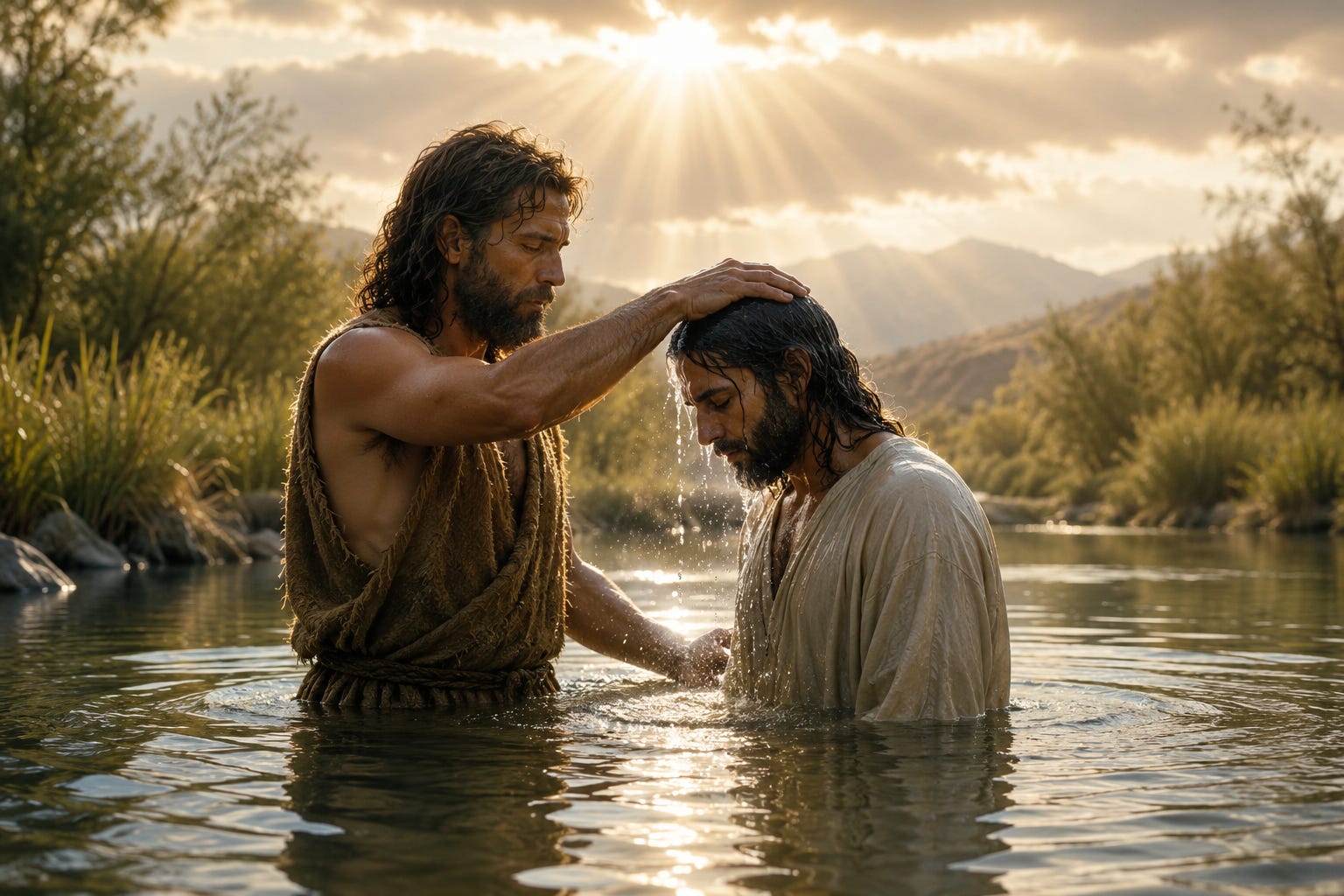
People came to John at the Jordan River, confessed their sins, and were baptized.
Water has symbolized cleansing, chaos, death, renewal, and spiritual rebirth throughout the biblical story. Noah passed through the flood into a new world. Israel passed through the Red Sea and left slavery behind. Naaman washed in the Jordan and was healed. John now calls people into the water as a sign that an old way of life is being surrendered.
The outer act matters because it expresses an inner decision. Yet water alone cannot transform the heart. John himself makes this clear when he says that another is coming who will baptize with the Holy Spirit and with fire.
Water washes the surface. Spirit reaches the depths. Fire transforms what it touches.
John’s baptism represents our willingness to begin. We admit that the old direction is no longer enough. We step into the water and allow an identity, a grievance, a habit, or a false certainty to be loosened. We rise with the possibility of living differently.
But John knows that preparation is not completion. He can lead people to the threshold, but he cannot take the next step for them. The deeper transformation must come from the Spirit awakening within.
Recognizing What Is Greater
When Jesus comes to be baptized, John hesitates. He senses that the one standing before him carries something greater than his own ministry. Yet Jesus enters the water anyway.
This moment reveals something important. The higher does not reject the lower stages of the journey. Jesus does not condemn John’s work as unnecessary. He fulfills it. Every honest act of repentance, every effort to become more truthful, and every sincere attempt to clear the inner road has value. But none of these is the destination.
John later says:
“He must increase, but I must decrease.”
This may be one of the clearest descriptions of the spiritual journey in the New Testament.
The smaller self must gradually decrease so that the Christ nature can increase. The need to be admired decreases. The need to control every outcome decreases. The need to defend our image decreases. The need to be right at all costs decreases. In their place, compassion, courage, humility, truthfulness, and inner freedom begin to grow.
John does not say that he must disappear because he has no value. He understands that his purpose is to point beyond himself. A true spiritual teacher does not make followers dependent upon the teacher. A true prophet does not seek to become the center of the message. John finds joy in recognizing that what he prepared for has arrived.
There is a lesson here for every one of us. Even our spiritual identity may eventually have to decrease. We can become proud of being awakened, informed, chosen, or more perceptive than others. We can make an idol out of our own search for truth. John reminds us that the messenger’s purpose is to make room for the message.
When Truth Confronts Power
John’s courage eventually brings him into conflict with Herod. He publicly challenges the corruption of the ruler and is imprisoned. Herod is troubled by John, yet he is also strangely drawn to him. He recognizes something true in John but lacks the courage to obey it.
This is another picture of the divided human heart.
Part of us knows the truth. Another part fears what the truth will cost. We may admire honesty while still protecting the very habits honesty threatens. We may listen to the inner voice and even feel moved by it, yet keep it imprisoned so it cannot change the structure of our life.
Herodias represents the resentment that wants the troubling voice silenced. Her daughter’s dance appeals to impulse and desire, and Herod makes a foolish promise because he is more concerned with appearances than wisdom. John is beheaded because a ruler who senses the truth still chooses pride, appetite, and public image over conscience.
The prophetic voice within us can also be silenced. Each time we ignore conscience, it becomes a little easier to ignore it again. Each time we trade truth for approval, the inner voice grows fainter. Yet the death of John is not the death of truth. What he announced has already entered the world.
The old prophetic voice gives way to the living presence of Christ.
Preparing the Way in Us
John the Baptist asks us a very direct question:
What are we preparing ourselves to receive?
We prepare constantly, though often without realizing it. Repeated anger prepares the heart for bitterness. Repeated fear prepares the mind for suspicion. Repeated self-justification prepares us to remain unchanged. But prayer, honest self-examination, forgiveness, humility, and acts of compassion prepare a different road.
We do not create the divine presence through our efforts, but we can remove some of the things that block our awareness of it. We all have blocks, some more than others. It’s when we confront those blocks and let them wash away that more of our spiritual eyes are opened.
The kingdom John announced is “at hand.” It is near. It is not merely a reward waiting after death or a political order imposed from outside. It begins wherever the rule of love, truth, mercy, and spiritual awareness is allowed to take root.
John’s task is therefore still alive within us. There are moments when we must become the voice in our own wilderness. We must call ourselves back from distraction. We must tell the truth about the direction we are traveling. We must enter the waters of surrender and allow the old road to end.
Only then are we prepared to hear the deeper message Jesus will bring.
John does not ask us to worship the wilderness. He asks us to pass through it. He does not ask us to remain forever in repentance. He asks us to turn so that we can recognize what is coming. He does not claim to be the light. He bears witness to the light.
And perhaps that is the question this story leaves with us:
What within me must decrease so that the spirit of Christ may increase?
Coming Next: Born Again — What Was Jesus Really Talking About?
John prepared people through water, but Jesus would speak of a birth from above—a transformation so deep that it could not be explained by outward religion alone. What does it truly mean to be born again, and where does that birth take place?