

One of the most powerful symbolic passages in all of Scripture.
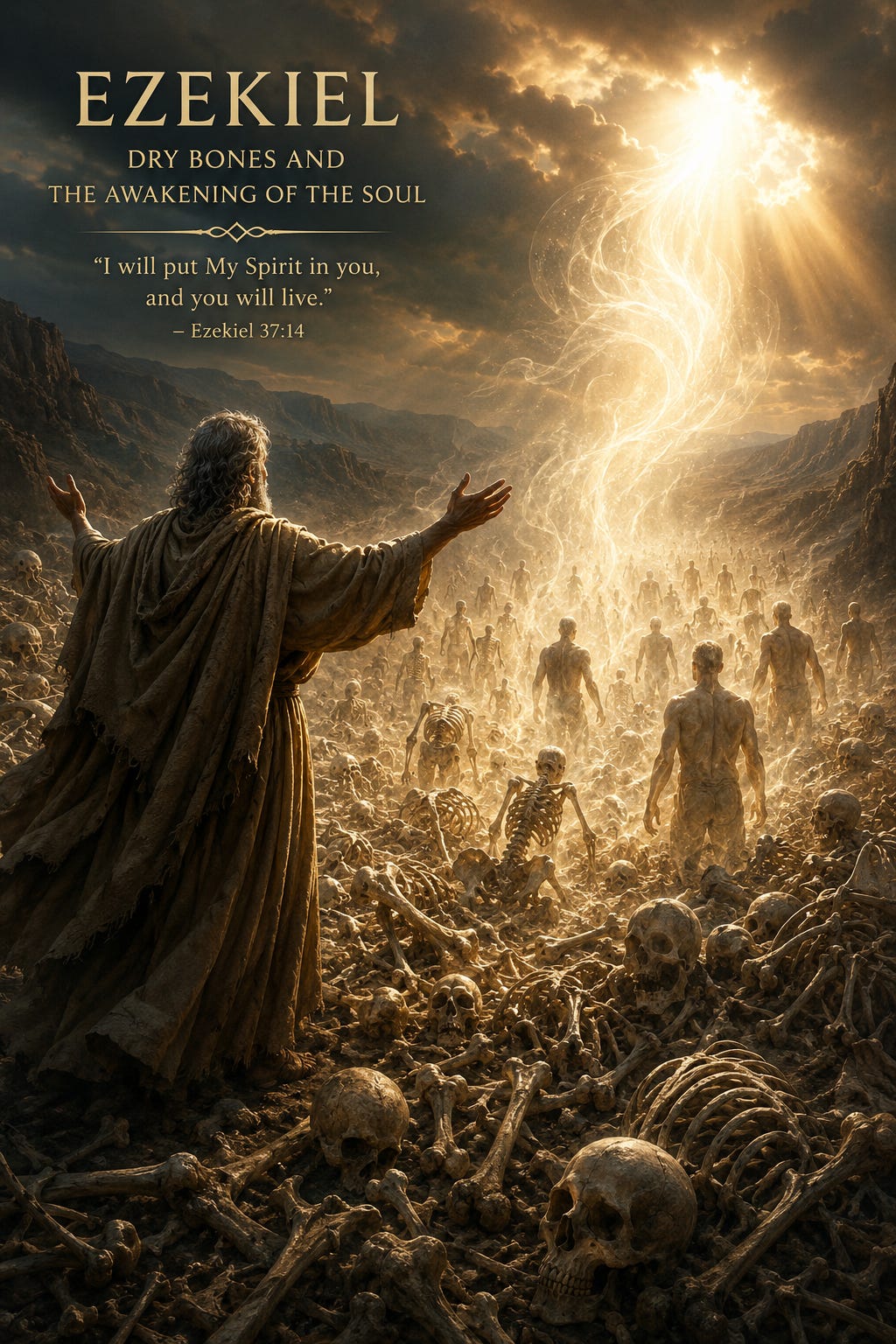
There is a haunting image found in the book of Ezekiel that has inspired believers for thousands of years. The prophet is led into a valley filled with dry bones. They are not merely scattered bones, but the remains of what was once alive. Every trace of vitality has disappeared. Hope itself seems to have died.
At first glance, this appears to be a prophecy about the restoration of Israel after exile. Historically, that is certainly part of its meaning. Yet, as with so much of Scripture, the story invites us to look beyond history and into our own lives.
One of the beautiful truths that continues to emerge throughout this series is that the Bible is not only revealing God’s work in nations and civilizations; it is also revealing God’s work within every human soul. These stories continually invite us to ask a deeper question:
“Where is this story unfolding within me?”
The valley of dry bones is not simply an ancient place. At various moments in life, it becomes the landscape of our own hearts.
Most of us experience seasons when something within us seems to have died. Our enthusiasm fades. Our compassion grows cold. Dreams that once inspired us become buried beneath disappointment. We may continue functioning outwardly, yet inwardly we feel disconnected from the very life that once animated us.
Ezekiel is not shown a valley of wicked people. He is shown a valley of lifeless people. There is an important difference. Spiritual growth is not always hindered by rebellion. Sometimes it is hindered simply because we have forgotten who we truly are.
Then God asks an astonishing question.
“Son of man, can these bones live?”
It is a question that echoes through every generation.
Can a broken marriage live again?
Can a discouraged heart recover hope?
Can a fearful person become courageous?
Can someone who has spent decades trapped by bitterness discover forgiveness?
Can humanity itself awaken from division, fear, violence, and separation?
Ezekiel wisely answers,
“Lord, You know.”
Perhaps that is the beginning of wisdom—not pretending we already know the answer, but remaining open to what God can accomplish.
God then tells Ezekiel to speak to the bones.
This may seem strange until we realize that transformation often begins with a new word, a new understanding, or a new truth entering our consciousness. Before life changes outwardly, something changes inwardly. A forgotten possibility begins to awaken.
The bones begin to rattle.
One by one, they come together.
Tendons appear.
Muscles form.
Skin covers them.
Yet they still do not live.
This is one of the most profound moments in the vision.
The outer form has returned, but the breath has not yet entered.
How often is this true in our own lives? We may repair our circumstances, improve our habits, attend church, study Scripture, and rebuild the structure of our lives, yet still feel something essential is missing.
The missing element is the breath.
Throughout Scripture, breath represents the very life of God. The same divine breath that animated Adam in Genesis now returns to these lifeless bodies. The Hebrew word ruach carries a beautiful richness, meaning breath, wind, and spirit all at once. It reminds us that genuine transformation is not merely self-improvement. It is participation in the life of God flowing through us.
When the breath enters, the bones become living people once again.
Perhaps this is one of the greatest hopes found anywhere in the Bible. Nothing is beyond renewal. No life is too broken. No heart is too hardened. No soul is too far from awakening.
Many of us spend years trying to rearrange the dry bones of our lives, hoping that better circumstances alone will restore joy. Ezekiel gently reminds us that real renewal comes when we allow God’s Spirit to breathe into the deepest parts of our being. The outward rebuilding matters, but it is the inward awakening that finally brings life.
Seen symbolically, the valley of dry bones also speaks to humanity as a whole. Our world often appears fractured by fear, conflict, loneliness, and division. Yet Ezekiel’s vision offers a remarkable hope: what appears lifeless today need not remain so. The same divine breath that awakens an individual heart can also awaken an entire people. Spiritual evolution is not merely personal; it gradually transforms families, communities, nations, and ultimately humanity itself.
This vision reminds us that God has never abandoned creation. The work of awakening continues wherever people become willing to receive that divine breath and live from a deeper consciousness of love, compassion, and unity.
The valley of dry bones is, in the end, not a story about death.
It is a story about what God sees when all we can see are bones.
It is the promise that no matter how dry our lives may become, the breath of God is still able to awaken us into the people we were always created to be.
Coming Next
In our next article, we will journey with Daniel into Babylon and discover how remaining faithful amid a foreign culture symbolizes the soul’s ability to remain centered in truth while living in a world filled with competing voices and distractions.