


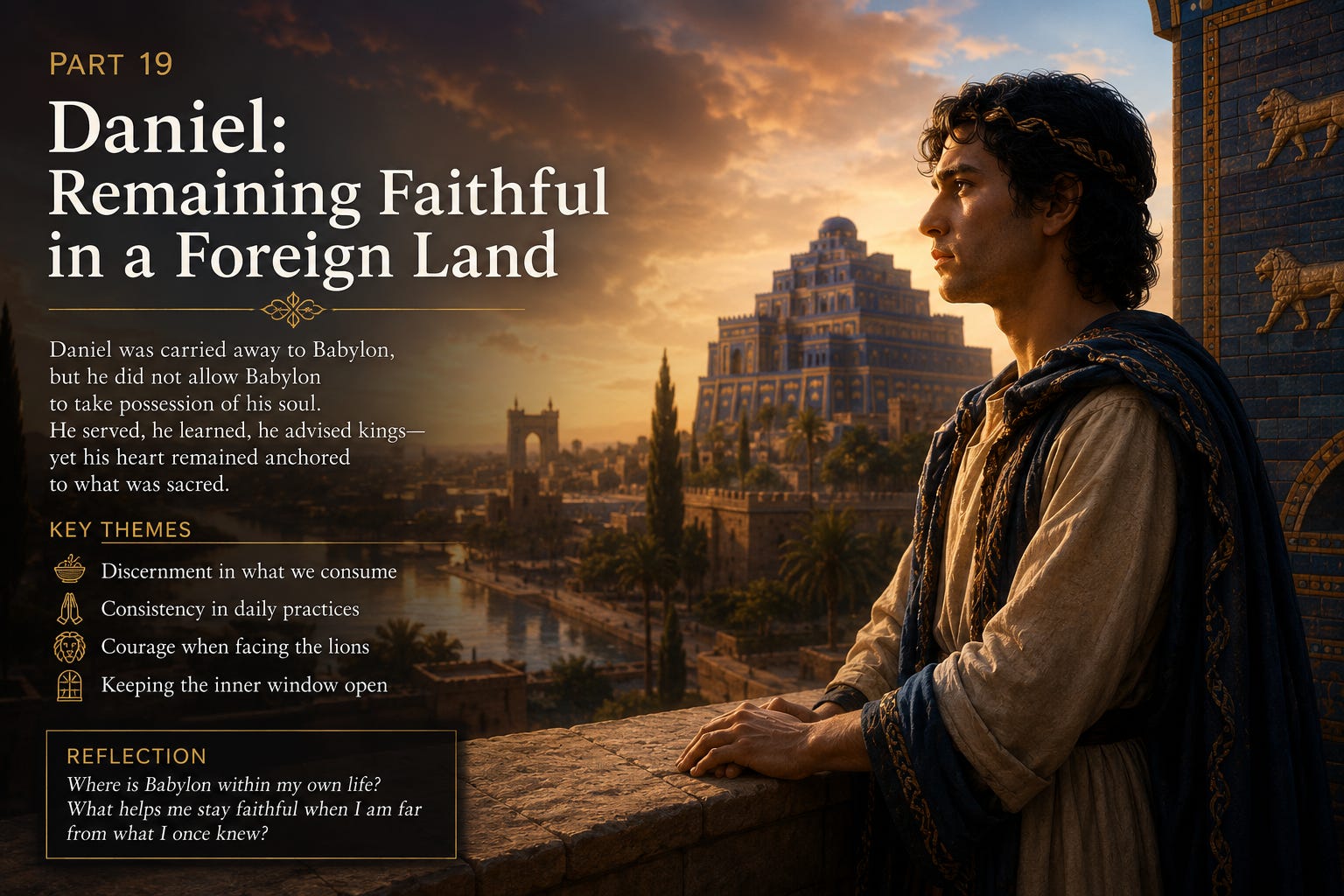
The story of Daniel begins with loss. Jerusalem had been conquered, the Temple had been plundered, and Daniel was carried away into Babylon with other young people from Judah. Everything familiar had been taken from him: his homeland, his community, his language, and the religious world that had shaped his identity.
Daniel was not simply traveling to another country. He had been placed within an empire determined to reshape him. This empire was not only to make him a captive but to also strip him of all that he cherished.
The Babylonian court selected intelligent and promising young captives and trained them in its own language, literature, customs, and way of thinking. Daniel and his companions were given new names. They were offered food from the king’s table and prepared for service within the government of Babylon.
This was more than education. It was an attempt to give them a new identity. It was kind of like what happened to the American Indian children or the Australian aborigini.
Babylon wanted them to forget who they had been and become useful servants of the empire. Their outward surroundings had changed, and now the pressure was upon them to change inwardly as well.
This is where Daniel’s story becomes more than ancient history. Most of us will never be carried away by a conquering army, but we may still find ourselves living in a kind of foreign land. We may enter circumstances where the values surrounding us do not reflect what we hold sacred. We may experience pressure to conform, remain silent, compromise our convictions, or become someone we are not in order to be accepted.
A foreign land can be a workplace, a school, a social group, a religious institution, or even a family system in which we no longer feel free to speak honestly. It can also be an inward condition. We may awaken one day and realize that we have become strangers to ourselves. The expectations of others, the desire for approval, or the demands of daily life may have carried us far from the person we once hoped to become. It not only shocks the bodies system but it rips away all the social programing one is raised with including family traditions.
Daniel asks us a difficult question: How do we live within a world that may not share our deepest values without allowing that world to take possession of our soul?
Daniel did not refuse to learn the language of Babylon. He did not reject all responsibility or withdraw from society. He studied, served, advised rulers, and became trusted within the government. Yet he maintained an inner boundary. He participated in the life of Babylon without allowing Babylon to determine who he was.
This is one of the most important lessons in the story. Spiritual faithfulness does not always require escaping the world around us. Sometimes it requires remaining present within it while refusing to surrender our deepest allegiance.
Daniel’s first test involved the food and wine from the king’s table. He quietly requested a simpler diet rather than consuming what had been provided. On the surface, this may appear to be merely a question of dietary law, but symbolically it speaks to something much deeper. Rich food has a tendency to make ones mind foggy and the body weak. Daniel did not want to loose his spiritual connection.
Food represents what we take into ourselves. We are nourished not only by what we eat, but also by the ideas, attitudes, fears, ambitions, and desires we repeatedly consume. Every day, the world places something before us and invites us to make it part of ourselves.
Some things strengthen us. Other things gradually weaken our inner clarity.
The king’s table can symbolize the values of the empire: power, status, luxury, competition, fear, and the promise of advancement in exchange for conformity. Daniel’s refusal was not loud or hostile. He did not insult those who ate differently. He simply recognized that not everything placed before him belonged within him.
This is a form of discernment we all need. What are we consuming emotionally and spiritually? What messages are we allowing to shape our understanding of success, security, beauty, faith, and human worth? What enters our mind each day through conversation, entertainment, news, social media, religious teaching, or our own repeated thoughts?
We cannot prevent every influence from reaching us, but we can become more conscious of what we allow to nourish our inner life.
Daniel remained faithful through small decisions before he was ever tested by lions. This is often how character is formed. We may imagine that courage appears suddenly during a great crisis, but it is usually developed quietly through ordinary choices. Each time we remain truthful when dishonesty would be convenient, each time we choose kindness over contempt, and each time we listen to conscience rather than pressure, we strengthen something within ourselves.
The lions’ den did not create Daniel’s faithfulness. It revealed the faithfulness he had been practicing for years. Fear is not a dominant force when strong faith is present.
Daniel’s wisdom soon became recognized by the rulers of Babylon. When King Nebuchadnezzar had a troubling dream, he demanded not only that his wise men interpret it but that they first tell him what he had dreamed. None of them could do this.
Daniel did not claim the answer came from his own brilliance. He prayed, and the mystery was revealed to him. When he stood before the king, he gave credit to God rather than presenting himself as the source of the wisdom.
This humility is central to Daniel’s character. He possessed unusual insight, but he did not use it to glorify himself. He understood that wisdom is something received, not owned.
That distinction is easily lost. Knowledge can tempt us to feel superior. Spiritual insight can become another form of pride. We may begin with a sincere desire to seek truth and gradually become convinced that we alone possess it.
Daniel offers a different model. True wisdom does not inflate the ego. It makes us more aware of how much remains beyond our understanding. It encourages reverence rather than self-importance.
Nebuchadnezzar’s dream involved a great statue made of different materials: a head of gold, chest and arms of silver, belly and thighs of bronze, legs of iron, and feet partly of iron and partly of clay. A stone not cut by human hands struck the statue, and the entire structure collapsed.
The dream has traditionally been interpreted as representing a succession of earthly kingdoms. Yet it also speaks symbolically to the structures we build within ourselves.
The statue appeared powerful and impressive, but its foundation was unstable. Its feet were a mixture of iron and clay, strength combined with weakness. No matter how magnificent the upper part appeared, the entire image could not endure because its foundation was divided.
We may build our identity in a similar way. We may construct an impressive outer life through achievement, reputation, possessions, religious knowledge, or the approval of others. Yet if the foundation rests upon fear, insecurity, pride, or the need to control, the structure remains fragile.
The stone that brought down the statue was not shaped by human hands. It represents something arising from beyond the ego and beyond the systems of worldly power. It is truth entering the structures we have created and revealing what cannot last.
The spiritual journey often includes such moments. Something happens that strikes the foundation of our carefully constructed identity. A loss, failure, illness, disappointment, or unexpected awakening causes what once seemed permanent to begin crumbling.
This can feel like destruction, but it may also be liberation. The collapse of a false structure creates room for something more authentic to emerge.
Daniel lived through the reigns of several kings. Governments changed, rulers rose and fell, and empires shifted, yet Daniel remained inwardly steady. His security did not depend entirely upon who occupied the throne.
This may be one of the most necessary lessons for any generation. Human leadership matters, and the decisions of governments can deeply affect people’s lives. Yet no earthly ruler should become the center of our spiritual identity.
When our peace depends entirely upon who holds power, we have placed too much of our inner life in the hands of the empire. Daniel respected rulers, advised them honestly, and served the public good, but he never confused political power with ultimate authority.
His faithfulness did not make him rebellious for the sake of rebellion, nor did it make him blindly obedient. He cooperated when cooperation did not violate conscience, and he resisted when obedience would require him to betray what was sacred.
This balance requires wisdom. It is much easier to divide the world into simple categories of complete submission or total opposition. Daniel shows another way: participating without being possessed, respecting authority without worshiping it, and remaining peaceful without becoming passive.
Daniel’s companions faced this same test when they were commanded to bow before the golden image erected by Nebuchadnezzar. They refused, even though the penalty was death in a furnace.
The golden image represents more than an ancient idol. Every age creates images before which people are expected to bow. They may be images of wealth, nationalism, religious certainty, social approval, celebrity, political ideology, or personal success. The image changes, but the demand remains the same: surrender your conscience and prove your loyalty.
Shadrach, Meshach, and Abednego did not know whether they would be rescued. Their faith was not based upon a guarantee that everything would turn out as they wished. They believed God could deliver them, but they also declared that even if deliverance did not come, they would not bow.
This is a mature faith. It does not say, “I will remain faithful only if I receive the outcome I want.” It says, “I will remain true because truth is worthy, even when the outcome is uncertain.”
The furnace was heated, and the three men were thrown into the flames. Yet when the king looked inside, he saw not three figures but four. The men emerged without being consumed.
Symbolically, the story does not promise that faithfulness will prevent us from entering the fire. It suggests that the divine presence may meet us within it.
There are fires we cannot avoid. Grief, rejection, uncertainty, betrayal, and change may surround us despite our sincerity. Faith does not always remove the flames, but it can prevent the flames from destroying what is deepest within us.
The fire may burn away what bound us while leaving our true self unharmed.
Years later, Daniel faced his own life-threatening test. Other officials became jealous of his influence and searched for a way to accuse him. Unable to find corruption in his public service, they persuaded King Darius to issue a decree forbidding prayer to anyone except the king for thirty days.
Daniel knew the decree had been signed, but he continued his practice of prayer.
He did not make a dramatic public display. He did not begin praying merely to provoke the government. He simply continued doing what he had always done.
This quiet consistency is perhaps more powerful than open defiance. Daniel’s spiritual life was not a performance created for the crisis. Prayer had already become the rhythm of his life. When pressure came, he did not need to invent courage. He returned to the sacred center he had visited every day.
The open window through which Daniel prayed toward Jerusalem symbolizes his refusal to forget where his deepest belonging rested. His body was in Babylon, but his heart remained oriented toward the sacred.
All of us need such an inner window.
We need a practice that repeatedly turns us away from the noise of the empire and back toward what is eternal. That practice may include prayer, meditation, silence, time in nature, reflective reading, journaling, or simply becoming still enough to listen.
Without such a window, the foreign land gradually becomes the only world we know. Its anxieties become our anxieties. Its ambitions become our ambitions. Its fears become our fears.
Prayer reorients us. It reminds us that the loudest voice is not necessarily the truest voice and that the most powerful system is not the highest authority.
Daniel was arrested and thrown into the lions’ den. The lions can symbolize the forces that threaten to devour our peace: fear, accusation, anger, shame, resentment, and the hostility of others. Once trapped among them, it may appear that survival is impossible.
Yet Daniel was not alone in the den. The mouths of the lions were shut, and he emerged unharmed.
This does not mean that faithful people will never suffer. Many courageous and compassionate individuals have faced terrible consequences for following their conscience. The deeper message is that the lions do not have to possess our spirit, even when they surround us.
Fear may roar, but it does not have to rule.
Accusation may come, but it does not have to define us.
The anger of others may threaten us, but it does not have to turn us into angry people.
Daniel survived because his inner identity had been rooted somewhere the empire could not reach.
This is the heart of remaining faithful in a foreign land. Faithfulness is not merely holding tightly to a set of beliefs. It is remembering who we are beneath the identities the world places upon us. It is refusing to allow fear, pressure, success, or rejection to sever us from the sacred center within.
The biblical narratives invite us to ask where these stories are happening inside us. Where is Babylon within our own consciousness? What voices are attempting to rename us? What tables are offering us nourishment that does not truly sustain us? What golden images demand our allegiance? What lions roar whenever we attempt to follow conscience?
We may also ask where Daniel lives within us.
Daniel is the part of us that remembers. He is the quiet inner witness that remains connected to truth even when everything familiar has been removed. He does not need to condemn the foreign land, but neither does he allow it to determine his soul.
Daniel teaches us that we can learn from the world without surrendering to it. We can serve within imperfect systems without allowing those systems to become our gods. We can remain open-minded without becoming ungrounded, and faithful without becoming rigid or hostile.
The goal is not to fear every outside influence. Fear itself can become another form of captivity. The goal is to develop such a deep connection with the divine that we can move through changing circumstances without losing ourselves.
Daniel remained in Babylon for many years. He did not receive an immediate return to the life he had known. His faithfulness was therefore not a brief moment of courage but a lifelong practice.
This may be the most realistic part of his story. Many of our challenges are not resolved quickly. We may live for years within circumstances we did not choose. We may continue serving, learning, growing, and praying while waiting for a change that seems slow to arrive.
Faithfulness in such times is rarely dramatic. It is found in getting up each morning and choosing once again not to become what the foreign land expects us to be.
It is found in keeping the inner window open.
It is found in remembering that even in Babylon, the sacred presence has not abandoned us.
Coming Next: The Babylonian Exile
In the next article, we will step back and look more deeply at the Babylonian exile itself—what it meant to lose the Temple, the homeland, and nearly everything that once gave the people a sense of security. Spiritually, exile may represent those seasons when the familiar structures of our lives collapse, forcing us to discover whether the presence of God can still be found far from everything we once depended upon.