

For forty years, the Israelites wandered through the wilderness. It was a place of uncertainty, testing, learning, and transformation. There they learned dependence upon God, discovered the limits of their own strength, and slowly confronted the mindset of slavery they had carried with them out of Egypt. Yet the wilderness was never intended to be their final destination. It was preparation for something beyond itself.
One of the most striking details in the story is that, apart from Joshua and Caleb, the adult generation that came out of Egypt did not become the generation that entered the Promised Land. Their children would cross the Jordan and begin the next stage of Israel’s story. Historically, the biblical account connects this with the older generation’s unbelief and refusal to enter the land when the opportunity first came. But symbolically, there may also be something profound for us to consider. Perhaps the generation that dies in the wilderness represents those parts of our old identity that simply cannot accompany us into a new way of living.
The Israelites had physically left Egypt, but as we saw in the previous story, Egypt had not immediately left them. They still carried fear, insecurity, habits of dependence, and a longing for what was familiar. They could be standing in the wilderness as free people while still thinking like slaves. Perhaps we do something similar. We can leave an old situation without leaving behind the person we became while living within it. We can change our circumstances while continuing to carry the same fear. We can adopt new beliefs while continuing to react from old wounds. We can talk about forgiveness while still feeding resentment. We can speak about trusting God while quietly attempting to control everything around us.
Perhaps this is why the wilderness takes so long. Something old has to loosen its grip before something new can truly begin. Symbolically, the old generation can represent the old consciousness—the fears, habits, attachments, assumptions, and identities shaped during our years in Egypt. Before a new life can fully emerge, some of those things must be allowed to die. Not the person, but the old way of being.
That can sound frightening until we realize how often it has already happened in our lives. The person we were as a child had to give way to the adolescent. The adolescent gave way to the adult. The young adult gradually became someone else through work, marriage, parenthood, disappointment, success, failure, aging, and experience. We did not cease to be ourselves, yet many earlier versions of ourselves could not have lived the life we eventually came to live. Something was continually being carried forward while something else was continually being left behind.
Perhaps spiritual growth works in much the same way.
Eventually Israel arrives again at water. Years earlier, the Red Sea had marked the departure from Egypt. Now the Jordan River stands between the wilderness and the Promised Land. There is something beautiful about those two crossings. Water stands at both ends of the wilderness. One crossing represents leaving bondage; the other represents entering a new way of life.
Maybe we have many such rivers during a lifetime.
We cross one when we finally recognize something about ourselves that we can no longer deny. We cross another when we forgive someone we thought we could never forgive. We cross another when we admit that a belief we defended for years needs to be reconsidered. We cross another when we stop allowing fear to make a decision for us. We cross another when we finally accept something about life that we have spent years fighting.
The river is the point where understanding requires movement.
You cannot cross a river merely by studying the opposite shore.
That may be one of the great lessons of Joshua.
Throughout this series, we have watched a progression unfolding within the human soul. Adam and Eve introduced the awakening of self-consciousness and the experience of separation. Cain and Abel revealed what happens when inner division enters our relationships. Noah showed us what can remain when the familiar world is washed away. Jacob wrestled through the darkness until he emerged changed. Joseph learned that the pit and the prison need not have the final word over the dream. Moses confronted Pharaoh and led the people out of bondage. The wilderness then became the long classroom in which former slaves slowly learned what freedom required.
Now Joshua represents something different.
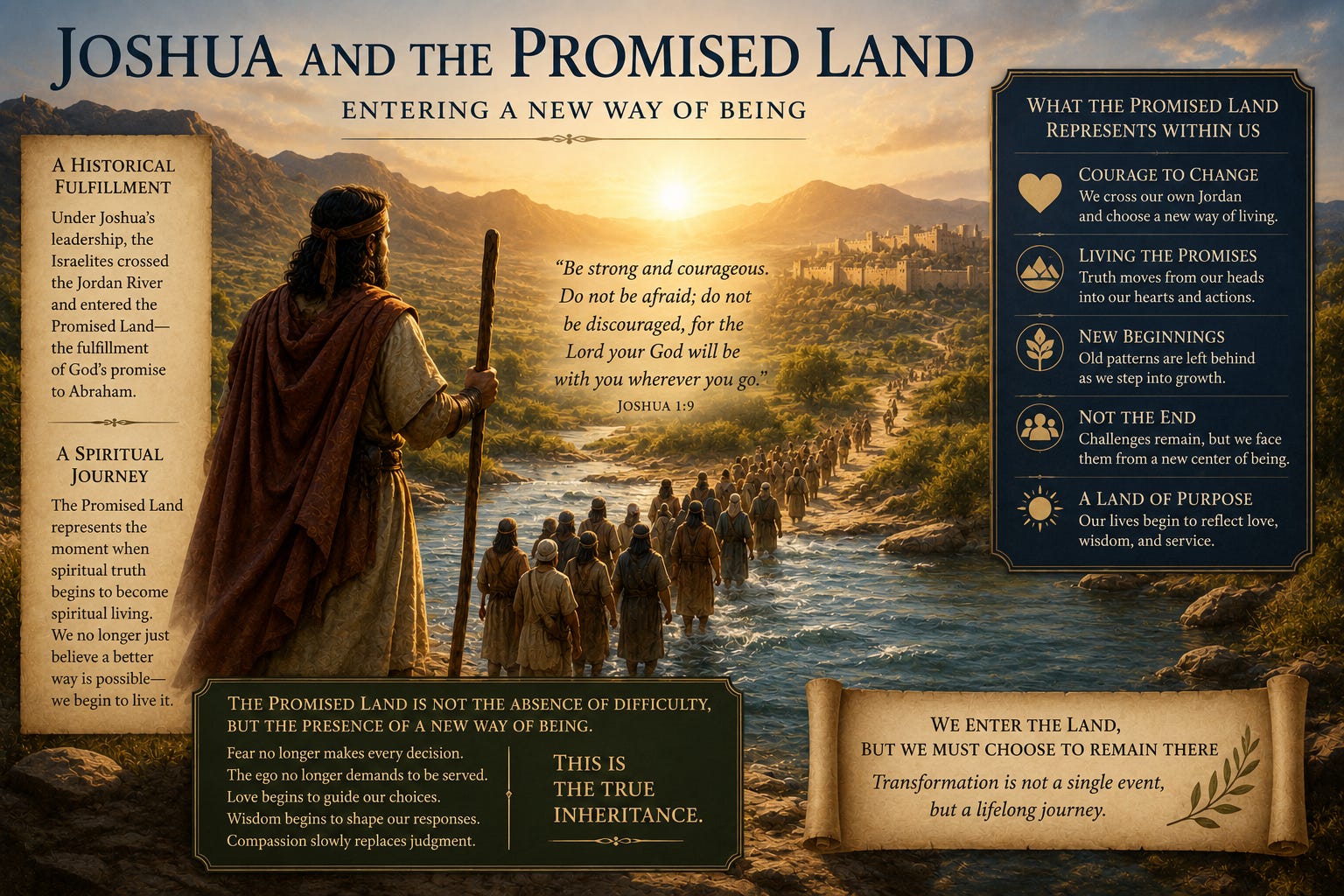
Joshua represents the courage to live what has been learned.
There comes a point in every spiritual journey when learning must become living. We can spend years reading books, studying Scripture, praying, meditating, attending meetings, discussing spiritual ideas, and searching for truth. All of these things can be tremendously valuable. I have certainly spent much of my own life asking questions and exploring ideas in an effort to understand God, ourselves, and why we are here.
But eventually another question appears.
What difference is any of this making in the way I live?
It is one thing to understand forgiveness.
It is another thing to forgive.
It is one thing to believe that love is the higher way.
It is another thing to choose love when someone has just offended us.
It is one thing to recognize that fear should not control us.
It is another thing to take the next step while we are afraid.
It is one thing to talk about humility.
It is another thing to admit that we were wrong.
Perhaps the Jordan River represents the distance between knowing and becoming.
That distance may be only a few feet, but sometimes it takes years to cross.
This may be why Joshua repeatedly hears the words, “Be strong and courageous.” He is not being told that there is nothing to fear. There is plenty to fear. The people are entering unfamiliar territory. There are fortified cities, powerful inhabitants, uncertain outcomes, and challenges they have never faced before.
Courage is necessary precisely because fear is present.
Perhaps we sometimes misunderstand courage by imagining that courageous people simply don’t experience fear. But courage is not the absence of fear. It is the refusal to allow fear to make the final decision.
That distinction matters in ordinary life.
There may be a conversation we know we need to have but would rather avoid. There may be an apology we need to make. There may be a truth about ourselves that we have begun to recognize but do not want to admit. There may be something we know we need to release even though we cannot yet see what will replace it.
Fear says, “Stay where you are.”
Courage says, “Take the next step.”
Perhaps that is our Jordan.
The Promised Land itself is also worth reconsidering. We sometimes imagine it as the place where all difficulties disappear. We have crossed the river, learned the lessons, and finally arrived. Surely now life should become easy.
But Scripture doesn’t tell the story that way.
The Israelites cross the Jordan and immediately discover that there is still work to do. There are cities to confront, decisions to make, conflicts to resolve, and lessons still to learn. Entering the Promised Land does not mean that every struggle has ended.
Perhaps it means we now meet those struggles differently.
That may be one of the most important insights in this entire journey. Spiritual growth may not necessarily change every circumstance around us. It changes the place within us from which we meet those circumstances.
The same difficult person may still be difficult.
The same uncertainty may remain.
Our bodies may still age.
People may still misunderstand us.
Plans may still fail.
Loss will still come.
We will still have days when things simply do not go as expected.
But perhaps something within us has shifted.
Fear no longer has to make every decision. The ego no longer has to win every argument. We do not have to respond to every irritation. We become more capable of listening before preparing our reply. We can notice anger without immediately becoming the anger. We can recognize the desire to defend ourselves without automatically obeying it. We can begin asking whether love, truth, humility, and compassion might offer another response.
The outer world may look very much the same.
The person meeting it is changing.
Perhaps that is the Promised Land.
Not a life without problems, but a different way of living within life.
This may also help us understand what an inheritance really is. Israel is repeatedly told that the land is being given to them, yet they still have to enter it. They have to cross the river. They have to walk upon the ground. They have to establish themselves there.
A gift can be offered and still remain unlived.
Perhaps the same is true spiritually. We can believe that love is available to us and still live from fear. We can believe in forgiveness and remain imprisoned by resentment. We can speak about the peace of God while allowing every irritation to steal our peace.
Maybe the spiritual inheritance is not something we merely possess because we believe certain things.
Perhaps it is something we gradually learn to inhabit.
That gives another meaning to Jesus’ teaching about the Kingdom of God. The Kingdom need not be understood only as something waiting for us after death. Jesus repeatedly spoke about the Kingdom as something drawing near and as a reality that changes how people live now. Perhaps every time love replaces hatred, forgiveness replaces resentment, truth replaces deception, humility replaces pride, and service replaces self-centeredness, we take another step into that Kingdom.
The Kingdom becomes not merely something we believe in.
It becomes something we practice.
Perhaps that is what Joshua represents: the moment when spiritual understanding acquires feet.
There is also an important danger here. Once we begin experiencing some degree of inner freedom, the false king can quietly return in another form. Instead of being proud of our possessions or accomplishments, we can become proud of our spirituality. We can begin thinking we understand things other people don’t. We can judge those who appear less awakened. We can become attached to being the person who has found the deeper meaning.
Pharaoh can apparently travel.
He may even cross the Jordan wearing religious clothing.
That is why self-observation remains important even in the Promised Land. Perhaps there is never a point in this life when we can simply announce that the work is finished. The moment we believe we have completely conquered the ego may be the very moment it has found a new throne.
Scripture is wonderfully realistic about this. Israel enters the land, but the story does not become a tale of perfect people living perfectly ever afterward. They continue to make mistakes. They forget. They become distracted. They follow other gods. They experience consequences. They return. The cycle continues.
Perhaps that should encourage rather than discourage us.
Transformation is not a single event.
Neither is awakening.
Neither is freedom.
We may cross the Jordan and still occasionally find ourselves thinking about Egypt. We may discover a better way of responding and still slip into an old reaction tomorrow. We may experience genuine peace and lose it over something remarkably trivial later in the day.
The question is not whether we ever stumble again.
The question is whether we are learning to recognize where we are.
Maybe the Promised Land is something we can enter, leave inwardly, and rediscover many times throughout a lifetime.
There may be mornings when we awaken in the Promised Land and afternoons when we discover that Pharaoh somehow has us making bricks again.
That is part of being human.
The important thing is becoming increasingly able to recognize the difference.
What does Egypt feel like within me?
What does the wilderness feel like?
What does the Promised Land feel like?
Perhaps Egypt feels like fear, control, resentment, and bondage. The wilderness feels like uncertainty, questioning, learning, and transformation. The Promised Land feels like increasing freedom to respond from love, truth, awareness, compassion, and trust.
Not perfection.
Freedom.
And perhaps that is the true inheritance.
As we continue following the symbolic journey through Scripture, the questions themselves seem to be leading us forward. The Garden asked, “Where are you?” Cain asked, “Where is your brother?” Noah asked what remains when the familiar world disappears. Jacob asked what we are willing to wrestle with in order to become someone new. Joseph asked whether we can trust the journey when we cannot understand the chapter we are living. Egypt asked what within us is holding us captive. The wilderness asked what still needs to change within us before we can live freely.
Joshua now asks something very practical:
Are you willing to live what you have learned?
Perhaps we can spend our entire lives standing on the bank of that river.
We can study the water.
We can discuss the Promised Land.
We can read what others have written about it.
We can believe with all our hearts that something wonderful exists on the other side.
But eventually faith asks for a step.
Perhaps the Promised Land has been waiting all along, not as a reward for becoming perfect, but as an invitation to begin living differently.
The old generation has passed.
Egypt is behind us.
The wilderness has taught what it could teach.
The river is before us.
Now comes the question Joshua had to answer.
Will we cross?
And the journey home goes on.
Coming Next
David and Goliath: Facing the Giants Within
The Book of Judges reminds us that growth is rarely a straight path. Yet there comes a moment when we must stop repeating old patterns and confront the fears that keep us from moving forward. In our next article, we’ll explore David and Goliath as one of the Bible’s greatest symbols of finding the courage to face the giants within ourselves.