


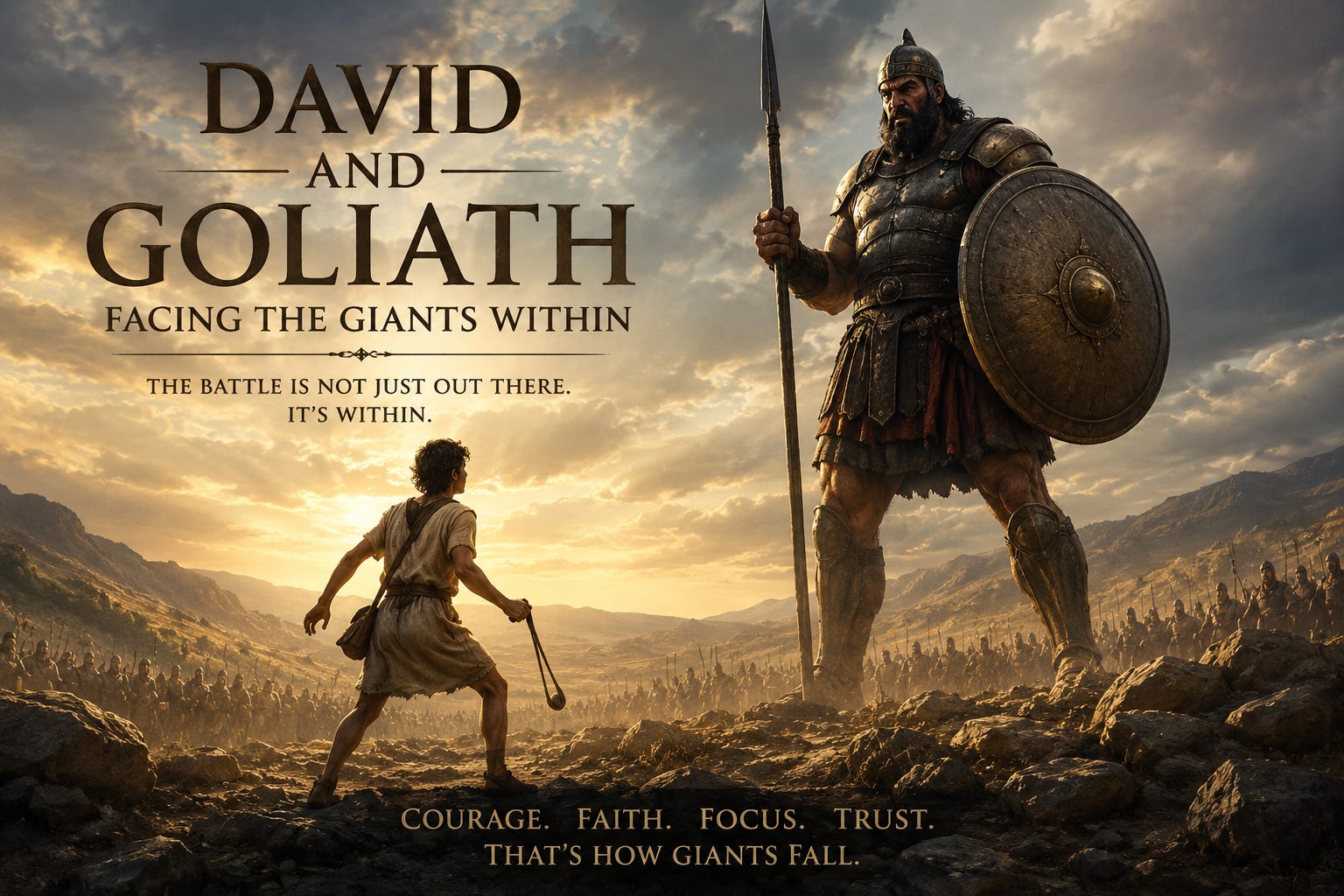
Few stories in the Bible are more familiar than that of David and Goliath. It is often told as the story of an unlikely victory, where a young shepherd defeats a giant warrior with nothing more than a sling and a stone. Children learn it early, and even people who rarely read the Bible understand what we mean when we describe some unequal contest as “David against Goliath.” Yet beneath the familiar story lies something deeply personal, because each of us eventually encounters giants that no one else can see.
Goliath stood before the armies of Israel day after day, challenging them and filling them with fear. Israel had soldiers. They had weapons. They had a king. They had experienced God’s deliverance in their history. Yet when they looked across the valley, all they could see was the size of the giant. Before Goliath ever struck anyone with his sword, he had already accomplished something much more important: he had convinced Israel that he could not be defeated. The physical battle had not yet begun, but the battle within their minds was already being lost.
How often is the same thing true in our own lives? The giants we face are seldom warriors standing across a valley dressed in armor. More often they are anxiety, resentment, shame, grief, pride, addiction, insecurity, loneliness, regret, or fear of failure. Sometimes the greatest giants are not external circumstances at all but the voices within us that continually whisper that we are too weak, too old, too damaged, too insignificant, or simply not capable of overcoming whatever stands before us.
Perhaps that is one of fear’s greatest powers. It does not always have to defeat us physically. It merely has to convince us not to try. How many things have we avoided because we decided beforehand that we could not do them? How many conversations have we postponed because we were afraid of what might happen? How many opportunities have we allowed to pass because we imagined all the ways they could go wrong? Sometimes we can spend more time suffering from what might happen than from anything that actually does happen.
I can relate to this from my own adolescent years. I remember feeling as though I was constantly facing bullies at school. For a long time, I tried to avoid them and hoped they would simply leave me alone. But fear and avoidance did not seem to make the problem disappear. It was not until I finally stood up to them that things began to change.
Looking back now, I wonder whether those experiences taught me something about giants long before I ever thought about the story of David in this way. Sometimes a giant grows larger because we keep backing away from it. Each retreat seems to confirm the message that the giant has power over us. Then something changes when we finally turn around and face what we have been afraid of. We may discover that much of the giant’s power came not only from what it could actually do to us, but from the fear it had created within us.
Of course, standing up does not always mean physically fighting someone. In many of the situations we face as adults, courage takes a very different form. It may mean speaking honestly when remaining silent would be easier. It may mean setting a boundary. It may mean admitting that we were wrong. It may mean saying no when we have spent a lifetime trying to please everyone. It may simply mean deciding that fear will no longer be allowed to make our decisions.
Perhaps courage begins at the moment we stop running.
In that sense, Goliath had been fighting Israel long before anyone entered the valley. He was fighting them through intimidation and imagination. Every day that the Israelites listened to his challenge without responding, he became larger in their minds.
Perhaps we should pay more attention to that. Our minds possess an extraordinary ability to create futures that have not happened and then respond emotionally as though they already have. We imagine failure, rejection, embarrassment, illness, loss, or disappointment, and our bodies can begin reacting to something that exists only as a possibility. Before long, the giant has grown even larger because we have been feeding it with our attention.
Then David arrives. He is not even there primarily to fight. He has been sent by his father to bring provisions and check on his brothers. He walks into a situation that everyone else has already accepted as hopeless and somehow sees it differently.
Goliath is the same size when David sees him. The circumstances have not changed. The difference is the person looking at them.
Perhaps spiritual growth does not always remove the giant. Sometimes it changes the eyes with which we see it.
David had no impressive military position, no great armor, and no outward advantage. Yet he possessed something far more important. He had learned trust. Long before he faced Goliath publicly, he had spent years tending sheep in lonely places. Those hidden years had formed something within him. He had faced danger before. He had protected the flock from predators. He had learned responsibility when no crowd was watching and no applause followed.
Perhaps the battle with Goliath was not really David’s first battle at all. It was simply the first one everyone noticed.
There is a lesson in that for us. The battles we face publicly are often won or lost during the quiet periods when no one is watching. Character is formed long before the giant appears. Patience develops through hundreds of ordinary frustrations. Courage grows through smaller moments when we act despite fear. Compassion grows through our own experiences of pain. Wisdom develops through mistakes we would rather not have made.
We may think nothing important is happening during those ordinary years, but perhaps something is being prepared.
This connects naturally with the wilderness we have already explored. We may believe the wilderness is merely delaying us from getting somewhere important, only to discover later that the wilderness was where we acquired what we needed when the important moment finally arrived. David’s years with the sheep may have looked insignificant compared with life in the king’s court, but when Goliath appeared, it was what David had learned away from the palace that mattered.
Perhaps we should be careful about judging the importance of a season while we are still living through it.
Then Saul tries to help David by giving him his armor. It makes perfect sense. If David is going to face a heavily armed warrior, surely he needs the best armor available. But David tries it and realizes that he cannot fight this way. The armor belongs to Saul. It may have worked for Saul, but it does not fit David.
So David takes it off.
There is something wonderfully symbolic in that moment. How much of our lives do we spend wearing someone else’s armor? We inherit beliefs, expectations, traditions, definitions of success, and ideas about who we are supposed to be. Some of them serve us well. Others may fit the person who gave them to us but not the person we are becoming. We can spend years trying to live according to someone else’s understanding of what our life should look like.
Perhaps there eventually comes a moment when we have to ask whether the armor actually fits.
That doesn’t mean rejecting everything we inherited or assuming that our own way is automatically better. It means becoming honest enough to recognize that another person’s path cannot simply be copied and made our own. We can learn from others, respect their wisdom, and benefit from their experience, but eventually we must stand before our own giants.
David could not become Saul in order to defeat Goliath.
He had to become more fully David.
Perhaps the same is true for us. Our spiritual journey is not about becoming someone else. We are not called to imitate another person’s personality, experiences, gifts, or understanding. We are called to discover what has been quietly forming within our own lives and then learn how to use it.
David leaves the armor behind and returns to what he knows: a staff, a sling, and stones gathered from the stream. They are simple things, familiar things, things everyone else might easily overlook. Perhaps that too is worth considering. We often imagine that overcoming a great problem requires something equally great. We look for the dramatic solution, the perfect insight, the extraordinary experience, or the person who possesses the answer we lack.
But perhaps some of the most powerful things we possess are remarkably simple.
The five smooth stones David gathers have sometimes been given various symbolic meanings, and Scripture itself does not tell us that each stone represents a particular spiritual quality. But as a reflection upon our own inner battles, I like the image. What if we gathered five stones of our own: faith when fear tells us to retreat, humility when pride demands control, patience when frustration demands an immediate answer, love when resentment invites us to harden our hearts, and trust when uncertainty clouds the future?
None of those qualities appears particularly dramatic, yet perhaps neither did David’s stones. The power was not in looking impressive. It was in being properly used.
The giant within us often appears overwhelming because the ego thrives on fear and separation. It tells us that we stand alone. It exaggerates threats. It reminds us repeatedly of previous failures and conveniently forgets the times we succeeded. It tells us that our worth depends upon winning, being recognized, appearing strong, or remaining in control.
In that sense, Goliath may be another expression of the false king we have been following throughout these stories. Pharaoh ruled through control. Goliath rules through intimidation. Both depend upon fear, and both lose much of their power when they are finally seen clearly.
This is where self-observation becomes so important. Sometimes the first step in facing a giant is simply recognizing it. What exactly am I afraid of? What story am I telling myself? What outcome have I already decided will happen? Is the giant really as large as I believe, or has my imagination been feeding it every day?
Perhaps we should occasionally ask ourselves whether we are facing the actual situation or the Goliath our mind has constructed around it.
There is also something important about David’s response to the giant. He does not become another Goliath. He does not defeat intimidation by becoming more intimidating. He does not try to out-armor the armored man. He remains David.
Perhaps that carries an important lesson for the spiritual life. Giants are not defeated by becoming giants ourselves. If someone is angry, we don’t have to become angrier. If someone is insulting, we don’t have to become more insulting. If someone operates from fear, we don’t have to answer from fear. If someone needs to dominate, we don’t have to enter the same contest. Otherwise the giant may lose the battle while his spirit wins the war because we have become exactly like him.
Perhaps true victory is something different. Maybe the Kingdom of God does not advance by producing stronger versions of the same forces that oppose it. Jesus would later demonstrate this in an even more radical way. His strength was not based upon domination but upon love, truth, forgiveness, humility, and a refusal to allow the hatred of others to determine what came from within Him.
That is an entirely different kind of power.
Maybe this is why Scripture so often draws our attention toward the small, the overlooked, and the humble. A shepherd boy, a sling, a stone, a mustard seed, a child, a widow’s offering, a manger, fishermen—again and again, greatness appears in forms the world might easily overlook.
Perhaps we spend too much time waiting to become powerful enough to face life when the real invitation is to become faithful with what is already in our hands.
David had a sling.
What do we have?
Maybe we have the ability to listen. Maybe we have patience acquired through years of difficulty. Maybe we have compassion because we know what pain feels like. Maybe we have wisdom learned through mistakes. Maybe we have the ability to forgive because we know how heavy resentment becomes. Maybe we simply have the willingness to pause before reacting.
A sling does not look like much until someone knows how to use it. Perhaps the same is true of many qualities quietly developing within us.
This also changes how we might think about our past struggles. Perhaps the lion and the bear were not meaningless interruptions during David’s years as a shepherd. They became experiences he could remember when Goliath appeared. David could look backward and recognize that he had faced danger before.
We can do that too. When another difficult season arrives, perhaps we should occasionally turn around and look at the road behind us. We have already survived things we once thought we could not handle. We have walked through disappointments that seemed enormous at the time. We have made decisions without knowing how everything would turn out. We have endured losses, changes, uncertainty, and mistakes.
Yet here we are.
Maybe remembering yesterday’s lion gives us courage for today’s giant.
And perhaps our symbolic limps, which we considered in Jacob’s story, can become part of that strength as well. The things that wounded us may also have taught us something. They may have made us more compassionate, more cautious where caution is needed, less judgmental, or more aware of how little control any of us truly possesses.
Our wounds do not have to become our giants. They can become part of our wisdom.
The story of David and Goliath continues to resonate after thousands of years because every generation has its giants and every person has battles that seem impossible. Humanity itself faces enormous challenges, and progress can sometimes appear frustratingly slow. We move forward and then stumble backward. Perhaps spiritual growth within an individual looks much the same way.
Two steps forward and one step back is still progress.
We may overcome a fear and later discover another version of it. We may think we have dealt with resentment only to have an old memory awaken it again. We may learn not to react and then suddenly find ourselves reacting before we even realize what happened. That does not necessarily mean the previous growth was false. It may simply mean another giant has stepped into the valley.
The goal is not to reach a point where no giants ever appear. The goal may be to stop allowing them to decide who we are.
As we continue our journey through these biblical stories, the questions keep becoming more personal. The Garden asked, “Where are you?” Cain asked, “Where is your brother?” Noah asked what remains when the familiar world disappears. Jacob asked what we are willing to wrestle with in order to become someone new. Joseph asked whether we can trust the journey when we cannot understand the chapter we are living. Egypt asked what within us still holds us captive. The wilderness asked what must change before we can live freely. Joshua asked whether we are willing to live what we have learned.
Now Goliath asks:
What fear have you allowed to become larger than it really is?
Perhaps the giant has been standing across the valley for years. Perhaps we have listened to its voice so often that we no longer question what it tells us. Maybe we have even mistaken its voice for our own.
But perhaps something else has also been growing quietly within us during all those years: a little more courage, a little more wisdom, a little more patience, a little more faith, and a little more awareness.
We may not have Saul’s armor.
Maybe we don’t need it.
Perhaps we already have what the next step requires.
The battle, in the end, is not merely out there. It is also within us. And perhaps that is where the giant must first fall—not by becoming a giant ourselves, but by refusing to allow fear to remain one.
I learned something about that as a young person standing before bullies at school. I suspect we continue learning the same lesson throughout our lives, only the giants change.
And the journey home goes on.
Coming Next
The Judges: Why We Keep Repeating the Same Lessons
Entering the Promised Land was not the end of Israel’s journey. In our next article, we’ll explore why spiritual growth so often unfolds in cycles of forgetting, remembering, stumbling, and beginning again—and why each new beginning brings another opportunity to grow.