


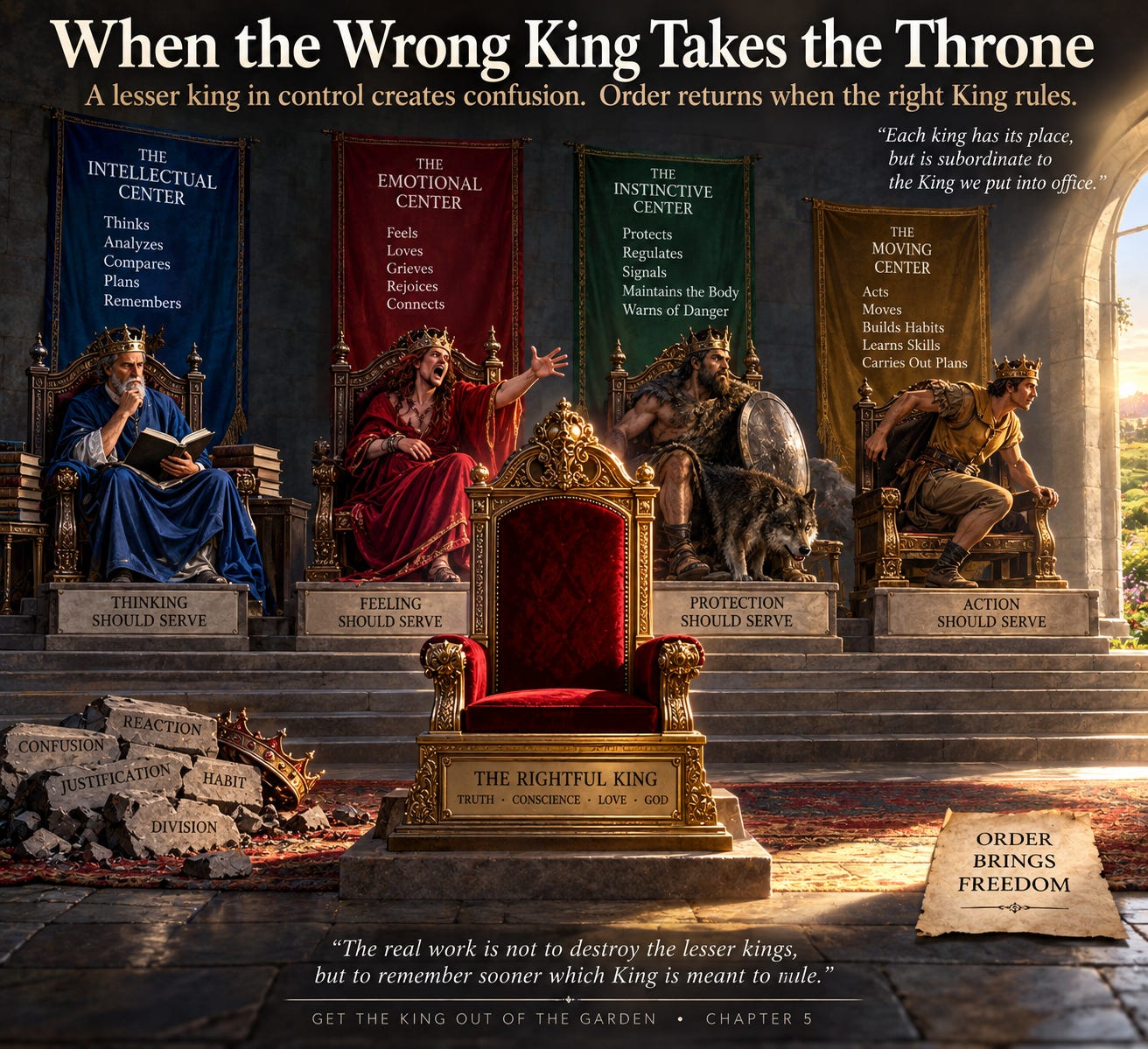
In the last chapter, we looked at the different centers within us—the intellectual, emotional, instinctive, and moving centers—and considered the possibility that each has a legitimate purpose. The intellect is meant to think, emotion to feel, instinct to protect and regulate the body, and the moving center to carry out action. None of these is an enemy. Each belongs in the garden. The difficulty begins when one of them moves beyond its proper responsibility and begins governing areas of life for which it was never intended.
This happens far more often than we realize. Because the process is usually automatic, we simply experience the result as me. I am angry. I am worried. I know that person is wrong. I need to answer. I have to defend myself. I cannot let that comment go unanswered. There is seldom any awareness that a particular part of our inner machinery has seized control and recruited the other parts to support it. We might call this an inner coup—a lesser king has taken the throne.
When Emotion Hires the Intellect
One of the easiest examples to observe occurs when emotion reacts first and then recruits the intellect to justify what has already happened. Someone says something that irritates us. Perhaps we feel dismissed, criticized, embarrassed, or misunderstood. The emotional reaction may occur almost instantly. Sometimes the body registers it even before we consciously recognize the emotion—a tightening in the abdomen, tension in the shoulders, a change in breathing, or a sudden surge of energy.
Then thought begins. But the thinking that follows may not be neutral investigation. The intellectual center has been hired by the emotional center as its attorney, and it immediately begins building a case. They always do this. They don’t respect me. I know exactly why they said that. Someone needs to straighten them out.
The mind searches its files for evidence supporting the emotion. It remembers earlier offenses while conveniently forgetting occasions that contradict the case. It invents motives, rehearses what we should say, and may even imagine future conversations in which we finally prove our point. We experience all of this as reasoning, but often the conclusion was reached before the reasoning began.
This is worth observing because intelligence does not necessarily protect us from mechanical behavior. In fact, a clever mind can sometimes make identification worse because it is extremely good at constructing convincing explanations for whatever the emotional center already wants to believe. This is one reason two intelligent people can disagree intensely, and both possess elaborate arguments proving that they are right. Neither may actually be observing the part of themselves that needs to be right.
The question therefore becomes more subtle than simply, “Is my argument correct?” We might also ask, “Who hired the lawyer?” That question can change everything.
When the Intellect Tries to Do the Impossible
The wrong king can take the throne in another direction as well. Sometimes the intellectual center tries to solve something that does not belong primarily to thought. Grief is a good example. If someone we love dies, the intellect may search endlessly for explanations. Why did this happen? Could something have been done differently? Why now? What does it mean? Some reflection may be useful, but grief itself cannot simply be reasoned away. There comes a point when the emotional center needs permission to feel what it feels.
We do something similar with uncertainty. The mind believes that if it thinks long enough, it can somehow remove uncertainty from life, so it keeps working. At two o’clock in the morning, it reviews tomorrow’s problems, rehearses conversations that have not happened, predicts what another person might do, and constructs possibilities that may never occur. Then, remarkably, we begin responding emotionally to the very possibilities our own mind has created.
The intellect has become king, but it is ruling a territory it cannot control. This can create an interesting cycle. Thought produces a frightening possibility. The instinctive center reacts physically. Emotion experiences anxiety. The intellect notices the anxiety and decides the situation must therefore be serious, so it produces even more frightening thoughts. Round and round the kingdom goes. Nothing outside us may have changed, yet inside, an entire emergency has been created.
Again, the problem is not thinking. Thinking is extraordinarily valuable when there is something useful to think about. The problem is failing to recognize when thought has completed its legitimate work and has begun running mechanically. Sometimes wisdom consists simply of recognizing: There is nothing more I can solve right now. That recognition itself may be an act of consciousness.
When Instinct Treats an Opinion Like a Tiger
The instinctive center presents another fascinating example because its reactions can be extremely fast. Its responsibility includes survival, bodily protection, comfort, pain avoidance, and countless automatic functions. When genuine danger appears, we are grateful that the body does not wait for a committee meeting before responding. But this same protective machinery can become attached to psychological threats as well.
Someone challenges our opinion, questions our competence, disagrees with our religious belief, or criticizes something we have done. There may be no physical danger whatsoever, yet the body responds as though something important is under attack. The stomach tightens, the pulse changes, and the muscles prepare for action. Why? Because the personality may experience threats to identity almost as though they were threats to survival.
This is especially interesting to observe around beliefs with which we strongly identify. If someone disagrees with an idea we merely hold, we can usually discuss it calmly. But when an idea has become part of who we believe ourselves to be, disagreement can produce an entirely different reaction. The instinctive center sounds the alarm, the emotional center becomes irritated or fearful, the intellectual center begins defending the belief, and the moving center may already be preparing the words. All four centers can become involved within seconds.
Somewhere in the confusion, the original question—Is what this person is saying true?—may disappear entirely.
This is why self-observation requires a certain willingness to be surprised by ourselves. We begin discovering that some things we thought were principles may partly be defenses. Some things we called discernment may contain fear. Some things we called righteous anger may contain wounded pride. That does not mean every conviction is false or every anger unjustified. It simply means we are learning to look underneath the label.
The Moving Center and the Power of Habit
The moving center can also occupy the throne, although we may notice it less because its kingdom is habit. Consider how many actions happen without conscious decision. We reach for the phone, interrupt someone, finish another person’s sentence, open the refrigerator without being hungry, or begin talking before we have decided whether anything actually needs to be said.
These actions may seem small, but they reveal something important about human machinery: much of life runs through established pathways. This is necessary. We would be helpless if every action required complete conscious attention. But habits become a problem when the moving center continues carrying out old programs after they have stopped serving us.
An emotional button gets pushed, and the familiar response begins automatically—the same facial expression, the same tone, the same argument, the same withdrawal, the same need to explain. We may have performed the sequence hundreds of times. The moving center knows the routine very well.
This is one reason genuine change can feel strangely uncomfortable. We are asking the machinery not to follow the familiar path. For a brief moment, there is no script. And that uncomfortable little gap may be precisely where freedom begins.
Catching the Coronation
The purpose of this work is not to spend the day analyzing ourselves endlessly. That would simply give the intellectual center another throne to sit on. The practice is much simpler: we learn to catch the coronation.
Something happens and a reaction begins. Instead of immediately trying to stop it, fix it, justify it, or condemn it, we watch. Perhaps the first thing we notice is the body: There is that tightening. Then emotion: I feel irritated. Then thought: My mind is beginning to explain why I should be irritated. Finally comes the impulse toward action: I want to answer immediately.
For once, the whole sequence is visible. We have not eliminated the reaction, but we are no longer entirely inside it. That distinction is enormous.
The Fourth Way sometimes speaks of self-remembering—a state in which we are not merely aware of the object before us but are also aware of ourselves experiencing it. We remember that something is happening to and within us. I hear the person’s words, and I am also aware of myself hearing them. I notice the reaction, and I am also aware that I am observing the reaction.
That additional awareness may last only a few seconds at first, but those few seconds can change the direction of an entire conversation. Perhaps we still respond. Perhaps we decide the situation genuinely requires a firm answer. Self-observation does not mean becoming passive. The difference is that our response is no longer completely dictated by the first king who rushed toward the throne. We have received the impression first. Then we choose.
This Is Not About Destroying the Lesser Kings
There is an important safeguard here. When we discover these mechanical parts of ourselves, it can be tempting to turn self-observation into another form of judgment. I shouldn’t feel this. I shouldn’t think that. I need to get rid of my ego. But that simply creates another divided kingdom.
The goal is not to execute the lesser kings. Each king has its place. Fear may warn us of genuine danger. Anger may reveal that a boundary has been violated. Thought may expose deception. Emotion may tell us something matters deeply. Habit can make useful actions effortless. Ambition can help us accomplish something worthwhile, and caution can keep us from doing something foolish.
The problem is not their existence. The problem is authority. Who gets the final word?
This is where the garden image becomes increasingly meaningful. A healthy garden contains many different forms of life. We do not create order by destroying everything except one plant. We cultivate, prune, guide, and place things where they belong. Our inner life may require something similar.
The intellect does not need to disappear; it needs proper work. Emotion does not need to disappear; it needs proper work. Instinct does not need to disappear; it needs proper work. The moving center does not need to disappear; it needs proper work. They become servants of something deeper rather than competing rulers.
The question we have been carrying through this series therefore becomes more precise: Which king is ruling right now—and is that the king I truly want to serve?
A Simple Practice for the Week
For the next several days, don’t attempt to observe everything. Instead, pay particular attention to moments when you notice a stronger-than-normal reaction. It might happen when someone says something irritating, a news story pushes one of your buttons, an email creates frustration, a family member disagrees with you, or a plan suddenly changes.
Instead of immediately following the reaction, become curious about the order in which things happened. Did the body react first? Did emotion appear first? Did thought begin producing a story? Did you feel an almost physical urge to speak or act? Then ask one simple question: Who is on the throne?
There is no need to force anything else. Even if you react exactly as you always have, this time you see what happened, and something has changed. Perhaps you recognize it ten minutes afterward. Good. Next time it may be five minutes. Eventually it may be thirty seconds. Then perhaps you see it while it is happening.
And one day, in that tiny interval between impression and reaction, you may discover something that was not available before: choice.
The real work is not becoming perfect. It is remembering sooner.
Every time we remember, the rightful King has another opportunity to return to the throne.
Coming Next — Chapter 6: A Deck of Cards for Seeing Ourselves
In the next chapter, we will introduce a simple tool that can help us recognize these centers and the different ways they operate. We will use the four suits of an ordinary deck of playing cards as a temporary map—not as another belief system, but as a practical aid for learning to see ourselves more clearly. Eventually we will want to put the cards aside. But first, they can help us learn the landscape.
If you are joining us here, you may wish to start with chapter 1 or return to chapter 4.
A Note About This Series: During this series, it may seem that there is some repetition. This is intentional. These ideas are not meant simply to be understood intellectually, but gradually integrated into our everyday awareness. Repetition and reminders can help bring patterns that normally remain beneath conscious awareness into the surface mind, until observation becomes more natural and less something we have to strive to remember. Also, throughout these chapters, references to the lesser “king” or the king attempting to take the throne are generally referring to the ego and our mechanical reactions—not to Christ or the true spiritual King.
If these articles are useful to you, feel free to share them with someone who may also be discovering that the hardest kingdom to understand is often the one within us.