

In the last chapter, we looked at what happens when one of our inner centers takes the throne and begins ruling the whole person. The intellect may decide that everything must be analyzed. Emotion may become offended and demand a response. Instinct may sense danger and immediately prepare us to defend ourselves. The moving center may simply begin doing what it has always done before we have consciously decided anything at all. None of these centers is bad. Each has an important place in our inner life. The problem begins when a servant becomes the king.
But knowing that we have different centers is one thing. Actually recognizing them while they are operating is quite another.
That is where a simple deck of playing cards can become surprisingly useful.
The cards are not magical, and there is nothing sacred about the symbols themselves. We are going to use them as a temporary language—a way of putting names and pictures around inner movements that usually happen too quickly for us to notice. Eventually we may no longer need the cards at all. The goal is not to become an expert at labeling ourselves. The goal is to become better at seeing ourselves.
Four Suits, Four Ways of Responding
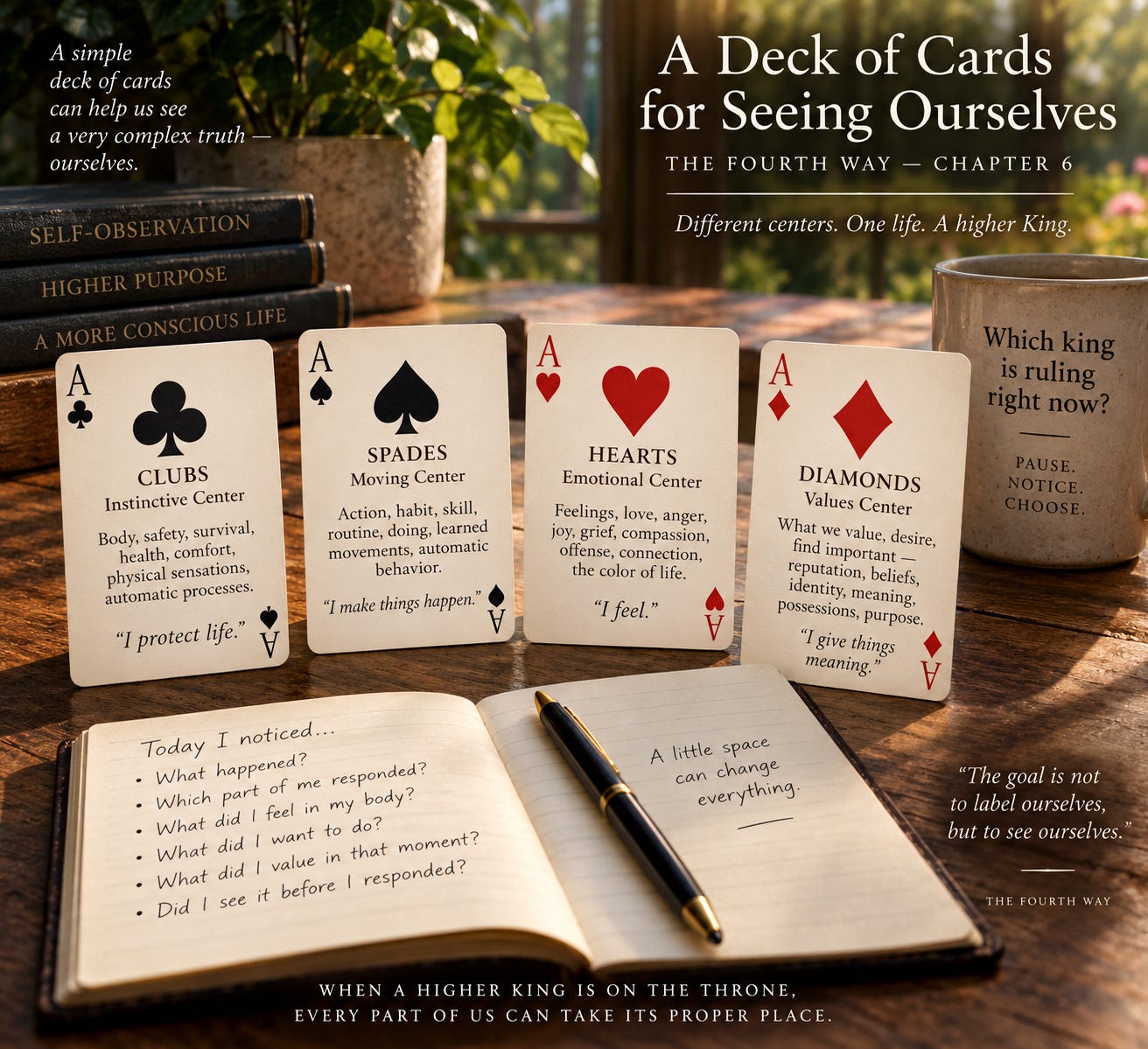
Imagine that four suits represent four broad ways through which we meet life.
Clubs represent the instinctive or autonomic part of us. This is the part concerned with the body, comfort, safety, survival, health, physical sensations, appetite, tension, and many of the automatic processes that keep us alive. You touch a hot stove and withdraw your hand before thinking about it. You hear an unexpected crash in the night, and your body becomes alert. Someone confronts you aggressively, and you may feel your stomach tighten before a single thought has formed. The Club has already responded.
There is nothing wrong with this. We need this center. Without it, we could not survive. But imagine what happens when the Club becomes king. Ordinary uncertainty may begin to look like danger. A bodily sensation may dominate our attention. The desire for comfort may make our decisions for us. We may resist something simply because it feels unfamiliar. The servant who was designed to protect the organism begins deciding how the whole person should live.
Spades represent the moving or doing part of us. This is the part that knows how to act, build, walk, drive, work, type, mow the lawn, operate machinery, play an instrument, or perform the thousands of learned movements we rarely think about. It is wonderfully efficient. Imagine having to consciously decide which muscles to move every time you walk across a room. We would accomplish very little.
But the same ability that makes movement efficient also allows us to live much of life on autopilot. We may begin talking before we know what we want to say. We reach for the phone without deciding to. We follow the same routine because it is what we have always done. We respond to a familiar situation with a familiar behavior simply because the pathway has been traveled so many times before. The Spade is an excellent worker, but it should not determine the direction of our lives simply because it knows the road.
Hearts represent the emotional center. Through this center we experience affection, anger, joy, disappointment, compassion, resentment, excitement, embarrassment, grief, tenderness, jealousy, gratitude, and the enormous range of human feeling. Emotion gives color and depth to life. It allows us to connect with another person’s suffering, delight in beauty, love our family, and feel the presence of something larger than ourselves.
Emotion can also sweep us away.
Someone makes a comment, and suddenly we are offended. A person disagrees with something we deeply believe, and we feel an immediate need to correct them. Someone praises us and our entire mood changes. Someone ignores us, and another mood appears. In these moments, the emotional center may not merely be informing us about what we feel. It may be climbing onto the throne and announcing, “Because I feel this strongly, it must be true.”
Yet a strong feeling and truth are not necessarily the same thing.
Finally, Diamonds represent what we value—what seems important, significant, desirable, meaningful, or special to us. This can include money and possessions, but it reaches much deeper than that. Reputation can be a Diamond. Our beliefs can become Diamonds. Being respected can be a Diamond. Our family, position, accomplishments, knowledge, identity, or spiritual understanding can all carry special value.
This may be the trickiest suit of all because we often do not recognize how strongly our sense of value shapes what we see. Suppose someone questions something we believe. The words themselves may be harmless, yet if that belief has become part of our identity, the Diamond feels threatened. Almost instantly, the Heart may become emotional, the Club may tighten the body, the intellect may begin constructing a defense, and the Spade may prepare the mouth to answer.
Within seconds, the whole inner government can be mobilized.
And we may call all of it “me.”
Which Part of Me Is Answering?
This is where the cards begin to become useful.
Suppose someone says something that irritates me. Instead of immediately following the irritation, I might quietly ask, Which part of me is answering right now?
Is this primarily a Heart reaction? Am I hurt, offended, angry, or defensive?
Is a Diamond involved? Has something I value—perhaps my reputation, opinion, belief, or need to be right—been challenged?
Do I feel a Club reaction in the body? Is my stomach tightening? Are my shoulders becoming tense? Has my breathing changed?
Is the Spade already preparing to act—to interrupt, walk away, fire off an email, raise my voice, or explain myself?
Nothing has to be suppressed. In fact, suppression would defeat the purpose. We are not trying to stop ourselves from feeling. We are trying to see what is happening before it completely becomes us.
There is a remarkable difference between saying, “I am angry,” and observing, “Anger is arising in me.”
The first statement easily becomes an identity. The second leaves a little space.
And that little space is where the real work begins.
The Cards Are Not Boxes
There is an important caution here. Human beings are far too complicated to fit neatly into four suits. Most reactions involve several centers operating together. The cards are not intended to turn people into personality types, and they certainly should not become another system for labeling everyone around us.
That would miss the entire point.
It would be very easy to learn this material and begin thinking, “ My wife is acting from Hearts. My neighbor is obviously a Diamond. That fellow on television is nothing but Clubs.
And suddenly we have created an elaborate new method of judging everyone except ourselves.
The Fourth Way continually turns our attention back toward the one person we can actually observe from the inside.
Me.
The question is not, Which card is that person?
The question is, Which card is operating in me right now?
This is why the system works best as a temporary teaching aid. At first we may need the labels. Eventually we begin recognizing the movements directly. We feel the tightening in the abdomen. We notice the emotional surge. We hear the internal argument beginning. We sense the urge to speak before we have consciously chosen to speak.
The card has done its job.
We have seen ourselves.
Creating a Space Between Impression and Response
Most of the time, life comes at us in the form of impressions. Someone speaks. A headline appears. A car pulls out in front of us. An unexpected bill arrives. Someone criticizes our work. A family member says something in the wrong tone.
The impression enters, and almost immediately something inside us reacts.
For most of our lives, those two events—impression and reaction—can seem like one thing.
Something happens.
We respond.
But self-observation begins to reveal a tiny interval between them.
At first we may recognize that interval only afterward. There I went again.
That is not failure. It is actually progress because yesterday we may not have seen it at all.
With practice, recognition begins arriving sooner. Instead of seeing the reaction an hour later, we see it ten minutes later. Eventually we may notice it thirty seconds later. Then perhaps while it is happening.
And occasionally something remarkable occurs.
We see it before we act.
The Heart rises.
The Club tightens.
The Diamond feels threatened.
The Spade prepares to respond.
And something deeper within us quietly notices the entire process.
For a moment, no servant has taken the throne.
There is simply awareness.
This is where our recurring question becomes powerful:
Which king is ruling right now—and is that the King I truly want to serve?
The purpose is not to destroy the other kings within us. Each has its place. Intellect should think. Emotion should feel. Instinct should protect. The moving center should act. Values should help orient our lives. But each must remain subordinate to the King we consciously put into office.
For me, that highest authority points toward truth, conscience, love, and ultimately God.
When that King is on the throne, the other parts of us do not disappear. They begin taking their proper places.
Emotion can still feel anger without anger deciding what happens next. Instinct can warn us without fear ruling the entire garden. Intellect can examine a problem without believing every thought it produces. The moving center can act without automatically repeating yesterday. Our values can guide us without demanding that everyone else value exactly what we do.
Perhaps this is one way of understanding what it means to return to the Garden—not by becoming innocent through ignorance, but by becoming conscious through understanding.
We are beginning to see what grows there.
A Simple Practice for This Week
Over the next several days, don’t worry about remembering every detail of the card system. Simply notice yourself during ordinary life.
When something produces a noticeable reaction, become curious.
What happened first?
Did you feel something in your body?
Did an emotion suddenly appear?
Did a thought begin explaining what the situation meant?
Did something you value feel threatened?
Did you immediately want to do or say something?
You do not have to correct any of it.
Just observe.
If you remember only after the reaction has passed, observe it afterward. If you recognize it halfway through, observe it then. If someday you see it just before responding, notice that too.
The goal is not perfection.
The goal is remembering sooner.
Because every time we remember, even briefly, the automatic king loses a little of its unquestioned authority.
And somewhere within the Garden, the rightful King begins to stir.
If you are joining us here you may with to go to chapter 1 or the previous chapter 5.
Coming Next — Chapter 7: The Jacks, Queens, and Kings Within Us
The four suits show us where a reaction may be coming from, but there is another dimension to the cards. A Jack, Queen, and King do not operate in the same way. In the next chapter, we will look at three different levels through which each center can express itself—from mechanical reaction, through powerful raw energy, toward attention and conscious response. This is where the card system begins to reveal something much deeper about the inner government of the Garden.
During this series, it may seem that there is some repetition. This is on purpose so we can integrate this a little better, as constant reminders help our subconscious come to the surface mind and become a habit rather than a striving. The king references will refer to our ego.
If this series speaks to something you have been noticing within yourself, please consider sharing it with someone who may be asking the same questions. Sometimes one small observation can open a very large door.