


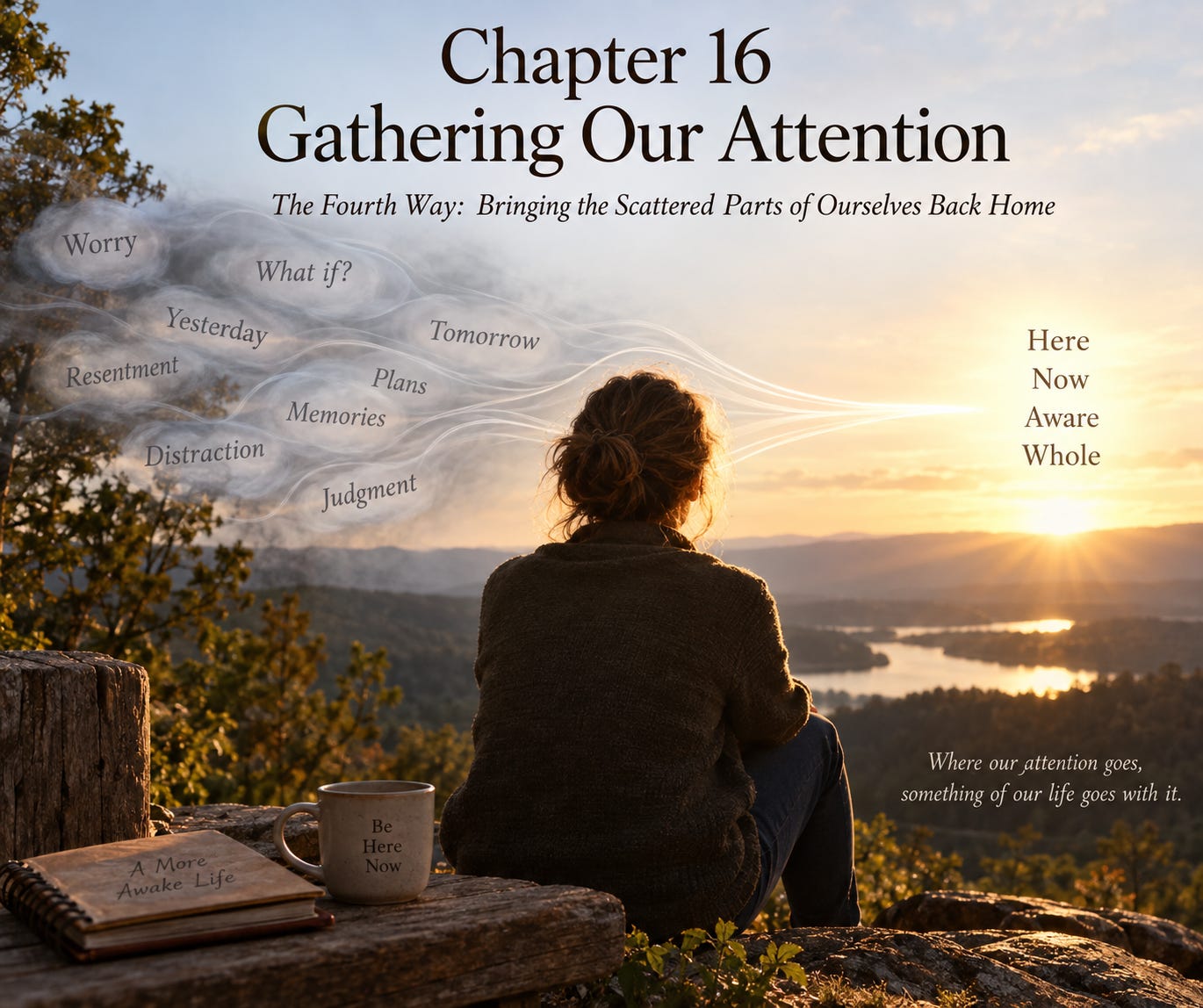
The Fourth Way: Bringing the Scattered Parts of Ourselves Back Home
New to the series? Start at Chapter 1
In the last chapter, we looked at the energy we give away—through worry, resentment, imagined conversations, irritation, fear, and the endless replaying of things that have already happened. Once we begin to notice how much energy escapes through these small openings, another question naturally arises: What happens to that energy when we stop giving it away?
Perhaps we begin to gather ourselves.
Most of us assume that our attention belongs to us. We say, “I am paying attention,” as though there is one unified “I” sitting inside us deciding where attention will go. But self-observation reveals something very different. Our attention is constantly being captured. A sound catches it. A memory pulls it backward. A worry carries it into tomorrow. Someone makes a remark, and suddenly our attention belongs to that person for the next two hours. We may be washing dishes, driving down the road, working in the shop, or sitting with someone we love, while inwardly we are somewhere else entirely.
The body is here, but much of us is absent.
This may be one of the simplest ways of understanding what the Fourth Way means when it says that we are often asleep. It does not mean that our eyes are closed or that we cannot function. We can accomplish remarkable things while in this condition. We can drive, work, talk, argue, cook, plan, and even pray while barely being present to what we are actually doing. Our attention jumps from one thing to another, and we follow along, believing that wherever it goes must be where we chose to go.
But did we choose?
That question alone can become a powerful practice.
During an ordinary day, we might suddenly notice that we have been thinking about something for ten minutes. Instead of continuing the thought automatically, we can ask, “Did I choose to think about this?” Often the answer is no. The thought arrived, captured our attention, and carried us away. The same thing can happen with emotion. Something irritates us, and irritation becomes the entire landscape of consciousness. For a time, we do not simply experience irritation—we become irritation.
Then perhaps something happens.
We remember ourselves.
For just a moment, awareness returns. We notice the room. We feel our feet on the floor. We become aware of the breath moving through the body. We see the thought or emotion rather than being completely swallowed by it. Nothing dramatic may happen outwardly, yet inwardly something important has changed.
Attention has begun to return home.
This does not mean forcing the mind to become blank. It does not mean suppressing thoughts or refusing to feel emotion. In fact, trying to force thoughts away can become another mechanical struggle. Gathering attention is gentler than that. It is more like noticing that several doors and windows have been left open and quietly beginning to close the ones through which our energy is unnecessarily escaping.
Perhaps part of our attention is worrying about tomorrow. Another part is replaying yesterday. Another part is imagining what someone thinks of us. Another is planning what we will say the next time we see them. Meanwhile, only a small portion of us is actually living the moment that is happening now.
The strange thing is that this moment is the only place where we have any power to act.
Yesterday cannot be changed from yesterday. Tomorrow cannot be lived from tomorrow. Whatever understanding, forgiveness, courage, love, or action is possible must eventually enter through the doorway of the present moment.
This is why attention is so important.
Where our attention goes, something of our life goes with it.
We might picture attention almost as sunlight passing through a magnifying glass. Scattered light warms a broad area slightly. Gathered light has power. In much the same way, scattered attention leaves us weakened and easily pulled in many directions. Gathered attention creates the possibility of conscious choice.
This also helps explain why the ordinary things of life can become such valuable exercises. We do not necessarily need to withdraw from life in order to practice. We can practice while washing a cup, repairing something, walking across the yard, listening to another person, or driving into town. We simply attempt to be a little more fully where we already are.
Feel the hands while they work.
Hear the sounds around you.
Notice the body sitting in the chair.
Receive another person’s words before preparing your reply.
Observe a reaction beginning without immediately giving it authority.
For a few seconds, remember: I am here.
These moments may seem almost too simple to matter. Yet I suspect much of the inner work takes place in exactly these ordinary moments.
The mechanical parts within us are usually in a hurry. They want to react immediately. They want to defend, explain, judge, correct, remember, anticipate, or control. The deeper King does not need to rush in quite the same way. Awareness can receive an impression first. It can allow the emotional Queen to feel what she feels and the active Jack to prepare for action without automatically handing either one the throne.
The King gathers the kingdom.
This is an important distinction. Gathering our attention is not about one part of us conquering all the others. It is about bringing the scattered parts into relationship with something deeper. The mind can think. The emotions can feel. The body can sense and act. But awareness begins to hold them together.
Perhaps this is also why silence can sometimes feel uncomfortable. When the ordinary distractions quiet down, we begin to see just how restless our attention really is. Within seconds, the mind reaches for something—an old memory, a future task, a grievance, an idea, the phone, the television, anything that will carry us away from simply being here.
There is no need to condemn this. The noticing itself is the work.
We may even begin to see humor in it. We sit down intending to be still for five minutes, and within thirty seconds we are mentally repairing the lawn mower, replaying a conversation from 1987, planning supper, and wondering what happened to someone we have not seen in twenty years.
Then something remembers.
“Oh. I was trying to be here.”
That return is not failure.
That return is the exercise.
Each time we notice that attention has wandered and gently bring it back, something within us strengthens. We begin to discover that we are not required to follow every thought simply because it appears. We do not have to enter every imaginary argument. We do not have to solve tomorrow before tomorrow arrives.
We can return.
Again and again.
This may also connect with the question we asked earlier in this series: Who is watching? If I can notice my attention wandering, then something within me is not identical with the wandering. If I can observe worry, anger, fear, pride, excitement, and imagination moving through consciousness, then perhaps the deepest “I” is not any one of those things.
Something is aware of them.
And when that awareness becomes present, even briefly, the garden begins to change.
The false kings do not disappear. Mechanical reactions still arise. Old habits still speak. But they are no longer completely invisible. And once they can be seen, they do not automatically possess the same authority they once had.
Little by little, attention returns to the rightful center.
We may discover that gathering our attention is really another way of gathering ourselves. The energy that once disappeared into endless worry, resentment, fantasy, and reaction begins to become available for something else—for understanding, compassion, creativity, prayer, service, and simply experiencing life more fully.
Perhaps that is one meaning of becoming awake.
Not escaping ordinary life.
But finally arriving in it.
Previous: Chapter 15 — The Energy We Give Away → [INSERT LINK]
Next: Chapter 17