


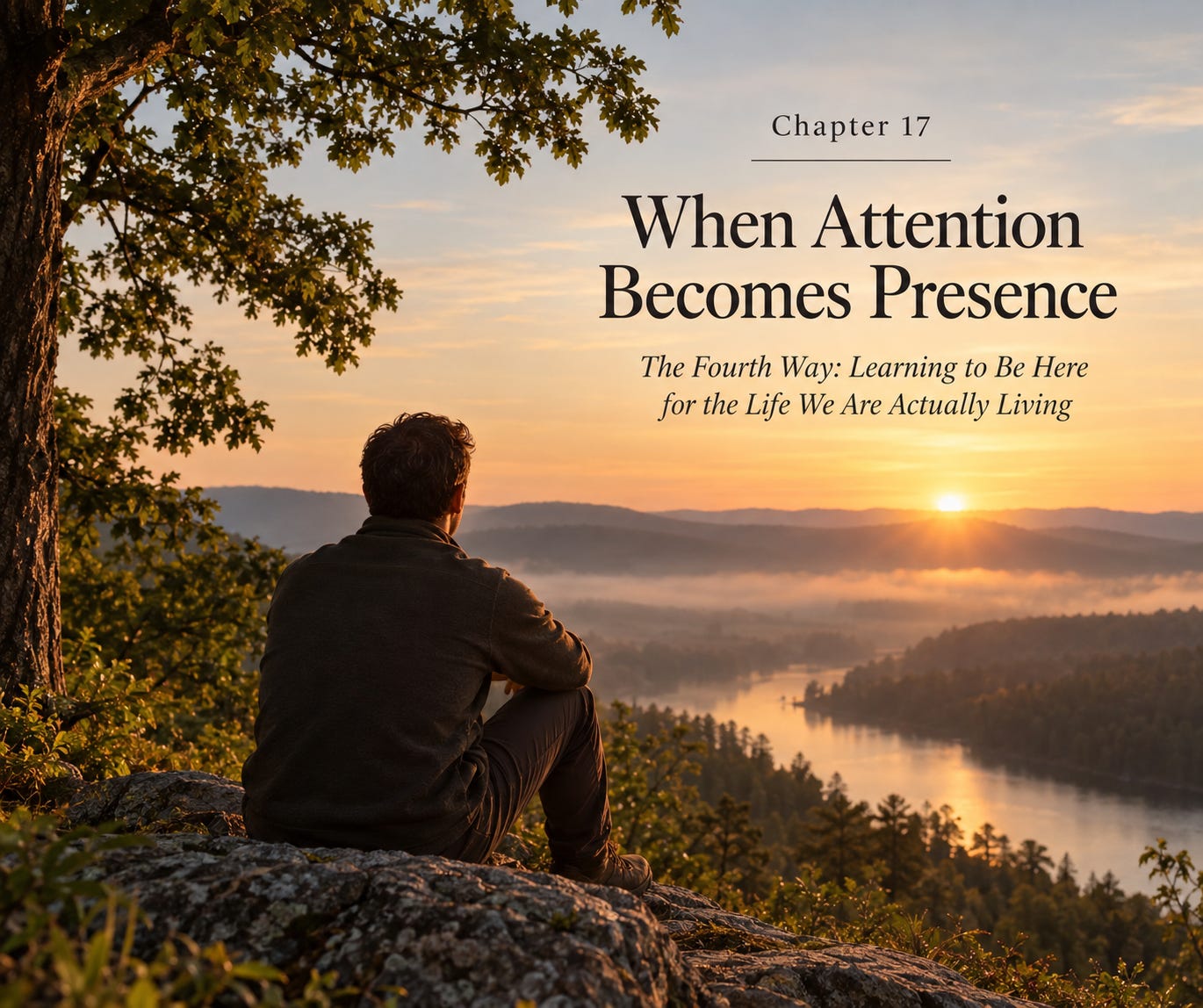
The Fourth Way: Learning to Be Here for the Life We Are Actually Living
New to the series? Start at Chapter 1
In the last chapter, we looked at how scattered our attention can become. Pieces of it are constantly being carried away into yesterday, tomorrow, worry, irritation, imaginary conversations, unfinished jobs, judgments, fears, and plans. We may be physically standing in one place while much of our attention is somewhere else entirely. Gathering our attention means calling some of that scattered energy home. But this raises another question: what happens when our attention actually returns? Something very simple, yet surprisingly profound, begins to happen. We become present.
Presence is a word that gets used so often that it can begin to sound mysterious or even spiritual in an unreachable way. Yet presence is not something exotic. It is not a trance, an altered state, or an escape from ordinary life. Presence simply means that more of us is here for what is happening now. Instead of washing the dishes while mentally arguing with someone from yesterday, we are washing the dishes. Instead of listening to another person while preparing our answer, we are actually listening. Instead of walking across the yard while thinking about ten other things, we feel our feet touching the ground, notice the air, hear the birds, and recognize that we are here.
That sounds almost too simple to matter, but try it for a moment. Notice that you are reading these words. Feel your body wherever it is sitting or standing. Notice your breathing without trying to change it. Become aware of a sound around you. Then notice something even more interesting: there is an awareness within you that is noticing all of this. The words are being read, the body is being sensed, sounds are being heard, and thoughts may be moving through the mind, yet something is aware of all of it.
The Fourth Way places enormous importance on this simple experience because much of our ordinary life takes place without it. We function remarkably well while barely being present. We can drive familiar roads, prepare meals, complete chores, answer questions, and carry on conversations while our minds are somewhere else. Habit can run a tremendous amount of our lives. There is nothing necessarily wrong with habit. We need it. Imagine having to consciously relearn how to tie our shoes every morning. The problem begins when habit becomes the master rather than the servant. When nearly everything in us runs automatically, we can begin to mistake mechanical reaction for conscious living.
Someone says something we dislike, and irritation instantly appears. Something goes wrong, and worry takes over. Someone challenges us and defensiveness rises. We receive praise, and another part of us immediately wants more. None of these reactions necessarily represents what we truly believe or how we would consciously choose to respond. They may simply be well-worn pathways that have been repeated so many times that they activate before awareness arrives.
Presence changes the order. Instead of moving directly from an event into a reaction, there can gradually appear a space between what happens and how we respond. In that space there is awareness. That little opening may be one of the most important things we ever discover. We have talked before about the moment between impression and response. Now we are seeing what makes that moment possible. Attention creates the space, but presence allows us to inhabit it.
When I am absent from myself, the strongest mechanical part usually takes control. Fear may answer. Pride may answer. Irritation may answer. The wounded child may answer. The part that wants approval may answer. The part that always needs to be right may answer. But when I am present, I have a chance to notice those parts before becoming completely identified with them.
There is a tremendous difference between saying, “I am angry,” and recognizing, “Anger is arising in me.” The first statement merges me with the emotion. The second creates a small amount of space around it. That does not mean suppressing anger or pretending we do not feel what we feel. Presence does almost the opposite. It allows us to feel an emotion more honestly because we are no longer completely swallowed by it. I can recognize irritation in my body. I can hear the thoughts it produces. I can notice the urge to speak sharply. But perhaps I do not have to immediately obey it.
This is where the question we have returned to throughout this series becomes useful: Which part of me is answering? Then we can ask another question: Can I see that part without becoming it? These questions are not intended to divide us against ourselves. They help us recognize what is already happening within us. We are not nearly as singular as we normally imagine. Different parts of us come forward under different circumstances. One part can sincerely decide something in the morning, while another part completely abandons that decision by afternoon. One part forgives, another remembers the offense. One part trusts, another worries. One part wants silence, another cannot stop talking.
Presence does not destroy these parts. It begins to bring them into the light. Perhaps this is another way of understanding what it means to get the king out of the garden. The mechanical ego does not need to be violently defeated. It needs to be seen. When it operates unnoticed, it rules almost effortlessly. Once it becomes visible, however, another possibility appears. We can begin asking what is on the throne right now. Is it fear, pride, approval, resentment, or the need to control? Or is it something quieter and deeper within us — conscience, love, humility, truth, awareness, and that inward orientation toward God?
This does not mean placing ourselves on Christ’s throne or imagining that our own consciousness replaces God. Quite the opposite. The quieter the mechanical noise becomes, the more capable we may become of hearing what is deeper than the ego. Presence can become an act of humility. I do not need to immediately defend myself. I do not need to immediately react. I can become quiet enough to see what is actually happening.
Sometimes what we see is not especially flattering, and that too is part of the Work. We may discover that an argument we thought was about truth was partly about wanting to win. We may see that what we called concern was mixed with a desire to control. We may recognize that the conversation we have replayed twenty times in our head is not helping anyone; it is merely feeding the part of us that wants to remain offended. The purpose is not condemnation. The purpose is seeing. Seeing clearly already begins to change something.
This is why self-observation and presence belong together. Self-observation without presence can easily become self-analysis. We can spend hours thinking about ourselves without actually seeing ourselves. We can create elaborate explanations for why we behave as we do and still react exactly the same way the next time something happens. Presence is different because it catches us in the act. There is irritation now. There is fear now. There is the need to impress someone now. There is the urge to interrupt now. There is tension in the stomach now. There is the mind preparing an answer instead of listening now. Suddenly the Work is no longer something we read about. Life itself becomes the classroom.
A difficult person becomes part of the exercise. A delayed appointment becomes part of the exercise. Something breaking becomes part of the exercise. A disagreement with someone we love becomes part of the exercise. Even losing something we were certain had been sitting right in front of us can become part of the exercise. Ordinary frustrations reveal us, and that may be why some of the best opportunities for inner work arrive disguised as inconveniences.
It is easy to imagine ourselves peaceful when nothing is disturbing us. It is far more revealing to watch what happens inside when the wrench slips, the computer refuses to cooperate, someone misunderstands us, traffic slows down, or a carefully made plan falls apart. In those moments we can simply remember: here, now, aware. Not perfectly whole. Not permanently awake. Simply more here than we were a moment ago.
We will lose that presence again. Of course we will. Five minutes later we may discover that we have been completely lost in thought. That is not failure. The moment we notice we were absent, awareness has already returned. This realization is important because we do not need to remain perfectly present all day. Trying to do so may simply create another demanding part within us saying, “You aren’t doing this right.”
Instead, the practice can be gentle. We return, and then return again. While walking, we return. During a conversation, we return. When irritation rises, we return. When worry begins building imaginary futures, we return. When the mind starts rehearsing yesterday, we return. We feel the body, notice the breath, see what is in front of us, and remember that we are here.
Over time, these small moments may begin to connect. What were once isolated flashes of awareness can gradually become longer periods in which we participate more consciously in our own life. And perhaps that is one of the great paradoxes of this Work. We spend much of our lives searching for something more — more knowledge, more experiences, more certainty, more accomplishment — while one of the things we may have been missing is the life already happening around us.
The conversation occurring right now, the person sitting across from us, the light coming through the window, the work our hands are doing, the breath entering our lungs, and the strange and extraordinary fact that for this moment we are here to experience it. Presence does not necessarily make life spectacular. It makes life visible. And once life becomes visible, even ordinary moments can carry a depth we had previously walked past without noticing.
Perhaps awakening does not begin somewhere far above ordinary life. Perhaps it begins right here, with this breath, this moment, and the quiet realization: I am here.
Previous: Chapter 16 — Gathering Our Attention
Start at the beginning: Chapter 1
Next: Chapter 18