


This main site now has over 8,000 views since 9/25/26. I am amazed that so many people have shown interest in my articles, and I sincerely hope this improves all of our quality of life.
In the last chapter, we looked at the idea of remembering ourselves—not simply thinking about ourselves, but becoming aware that I am here while life is happening. We may be speaking with someone, driving down the road, working with our hands, or sitting quietly, and suddenly there is a moment when we are no longer completely lost in what is taking place. We see ourselves. And when that happens, something remarkable becomes possible. There can be a pause.
It may last only a second, sometimes perhaps less than that, yet within that tiny space lies one of the greatest possibilities for change. Most of our reactions happen very quickly. Someone says something, we hear the words, interpret them, feel something in the body, experience an emotion, form a thought, and respond. The entire chain may occur so rapidly that it seems like one event. Someone criticizes us, and we become defensive. Someone disappoints us, and we become angry. Someone ignores us, and we feel hurt. Something goes wrong, and we become frustrated. Because the reaction happens so quickly, we often believe that the reaction is us. We say, “That made me angry,” as though the anger had no intermediate steps and no other response was possible.
Self-observation begins to slow the process down. Instead of merely experiencing anger, I may begin to notice, Something in me is becoming angry. Instead of immediately defending myself, I may see, Something in me wants to defend itself. Instead of returning a sharp word, I may become aware that there is a sentence forming in me right now that I may regret five minutes from now. That little bit of awareness creates space, and within that space is the sacred pause.
The pause is not suppression. It does not mean pretending that anger, fear, jealousy, irritation, or hurt are not there. In fact, the opposite is true. The pause allows us to see what is actually happening before we act upon it. Perhaps someone says something that wounds us. Our emotional center reacts immediately. Our body tightens. The mind begins gathering evidence about why the other person is wrong. The old Jack is ready to jump into action before anyone else has had a chance to speak. But now we remember ourselves. We feel the reaction. We observe it. And for perhaps three seconds, we do nothing. Those three seconds can change an entire conversation. They may even change a relationship.
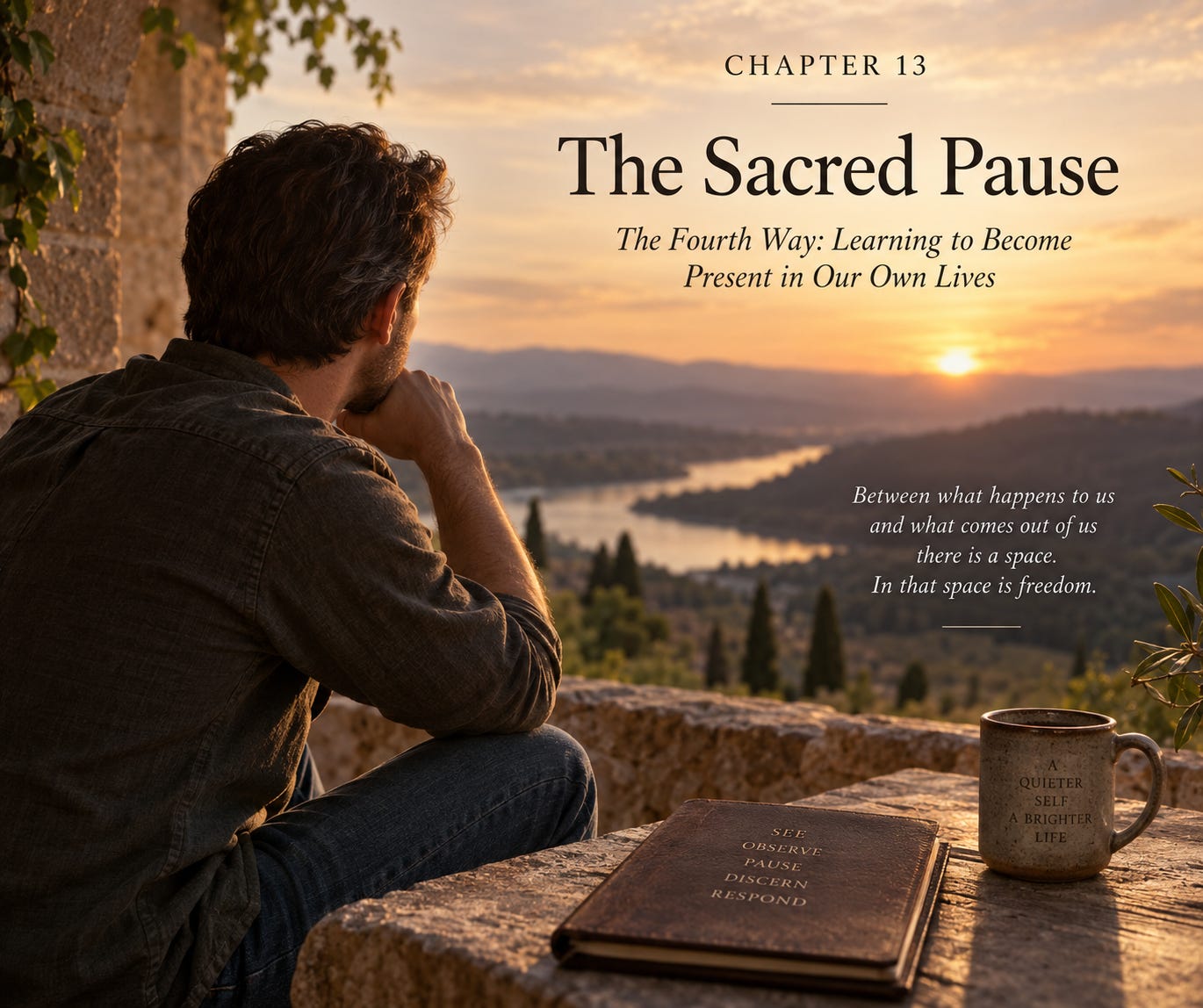
This is where the pattern we have been working with becomes practical. We see what is happening, observe it, pause, discern, and then respond. First I recognize that something has happened within me. Then I observe it without immediately becoming it. Then I pause. Only then do I ask, What should I answer? That question is very different from asking, What do I feel like saying? The first asks for discernment. The second usually gives our mechanical personality permission to take control.
This is where our earlier picture of the King becomes useful. The King we have been speaking about is not a replacement for Christ, nor is it an attempt to place the human ego upon some spiritual throne. Quite the opposite. The work is about recognizing the false kings—the pride, fear, woundedness, vanity, resentment, and mechanical reactions that continually try to rule us. The deeper King represents that attentive place within us that is capable of listening before acting, the place that can turn toward truth, conscience, humility, compassion, and ultimately toward God. The pause gives that deeper awareness time to enter the room. Without the pause, the loudest part of us usually wins.
I have begun to see how often this happens in ordinary life. It does not require some great spiritual crisis. The opportunities are everywhere. Someone interrupts us. Something breaks while we are working on it. A person misunderstands what we meant. A driver pulls out in front of us. Our spouse says something in a tone that immediately touches an old irritation. Plans do not work out. Something we were sure we had placed directly in front of us suddenly seems to have disappeared. The mechanical reaction is ready almost instantly, and that is precisely where the Work begins.
Not in some quiet room removed from life, but right there. The moment of irritation may be the classroom. The person who annoys us may unknowingly become the teacher. The lost object may become the exercise. The disagreement may become the mirror. It is easy to imagine ourselves peaceful when nothing is disturbing our peace. The more revealing question is what happens when something touches the part of us that does not want to be disturbed. That is when we discover what is sitting on the throne.
Jesus repeatedly drew attention to this inner condition. He spoke about anger, judgment, forgiveness, pride, fear, hypocrisy, and the condition of the heart. He did not merely address outward behavior. Again and again, He pointed inward. “Out of the abundance of the heart the mouth speaketh.” What comes out of us reveals something about what is occurring within us. The Fourth Way gives us a practical method for seeing that process while it is occurring.
Perhaps that is one reason the pause can become sacred. In that pause, I am no longer simply obeying the first voice that speaks inside me. I am listening. I may notice the wounded child. I may notice the frightened part. I may notice the one who wants to win. I may notice the part that desperately wants to be right. I may notice the part that wants recognition. None of these necessarily needs to be condemned. They need to be seen. We can receive the impression before deciding what to do with it, and that alone is a tremendous change.
Normally, an impression enters us and immediately becomes mixed with memory, expectation, fear, personality, and past experiences. Before long, we are no longer responding simply to what happened. We are responding to everything within us that the event awakened. Someone makes one small comment, but we hear twenty years of previous comments behind it. Someone disagrees with us today, but an older part of us remembers what it felt like years ago not to be heard. Someone questions something we did, and suddenly the issue is no longer the question itself. It has become a defense of our worth.
The sacred pause allows us to separate these things. We can ask what was actually said, what we added to it, what we are feeling in the body, which part of us wants to answer, and whether the reaction belongs entirely to this moment or whether something old has entered with it. Most importantly, we can ask, Do I have to obey it?
That may be one of the great discoveries of self-observation. A reaction can be real without being our master. An emotion can be present without becoming our identity. A thought can pass through the mind without requiring our agreement. An impulse can arise without demanding action. We begin to discover a freedom that was hidden inside the pause all along.
Sometimes the conscious response may still be firm. The Fourth Way does not teach passivity. Jesus Himself was not passive. There are times to speak plainly, times to establish boundaries, times to act, and times to confront what is wrong. But there is a great difference between a conscious response and a mechanical reaction. One comes from seeing. The other comes from sleep.
Perhaps this is part of what it means to become awake. Not that we never experience anger, not that irritation disappears, and not that fear never arises, but increasingly something within us wakes up before the reaction has completely taken over. At first we may recognize the reaction five minutes afterward. Then perhaps one minute afterward. Eventually we may catch ourselves halfway through it. And once in a while, we may see it before the words ever leave our mouth. That moment is worth noticing. That is growth.
The goal is not perfection. The goal is increasing consciousness. Each time we see ourselves clearly, something changes. Each time we pause before automatically reacting, something strengthens. Each time we choose not to hand the throne to the loudest part within us, the Garden becomes a little less chaotic.
Over time, perhaps the pause becomes less of a technique and more of a way of living. We begin receiving life before immediately judging it. We begin listening before preparing our reply. We begin observing before defending. We begin asking instead of assuming. We begin responding rather than reacting. Somewhere within that small space between what happens to us and what comes out of us, we may discover something we rarely noticed before: freedom. The freedom to choose which part of us will answer, the freedom to remain present, and the freedom to make room for a wisdom greater than the automatic self.
Previous: Chapter 12 — Remembering Yourself
Start at the Beginning: Chapter 1
Next: Chapter 14 —