


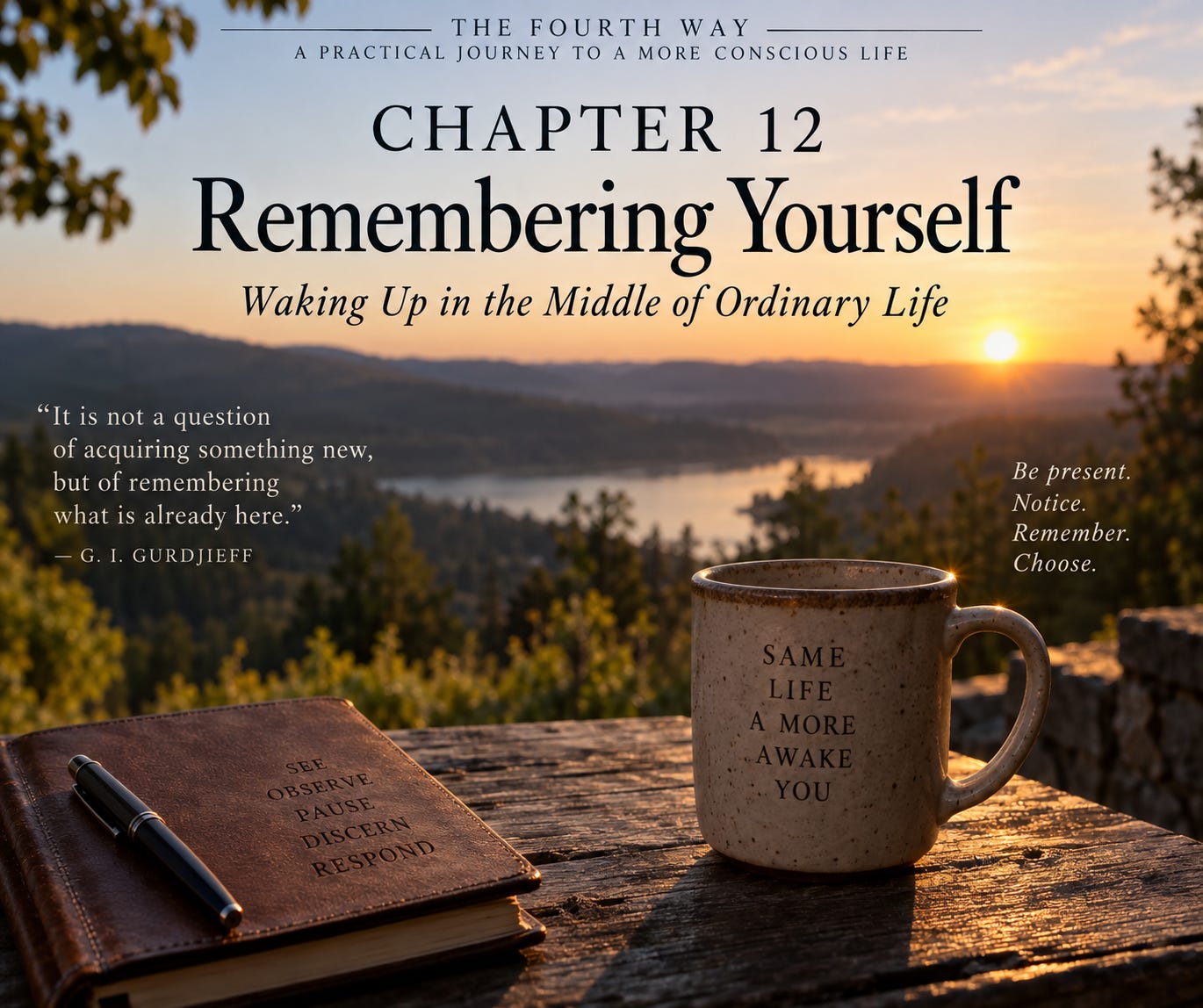
This is Chapter 12 in our series exploring the Fourth Way and the practice of becoming more conscious in everyday life.
In the last chapter, we asked a deceptively simple question: Who is watching? We discovered that thoughts can be observed, emotions can be observed, reactions can be observed, and even the different personalities that seem to move through us during the day can be observed. If something within me can notice all of these things, perhaps I am not merely the thoughts, emotions, and reactions themselves.
But recognizing this is only the beginning.
The greater challenge is remembering it while life is actually happening.
It is relatively easy to sit quietly and observe ourselves. It is much harder when someone says something that irritates us, when the phone rings at the wrong time, when something breaks, when we are hurried, criticized, disappointed, frightened, or simply tired. In those moments, we usually do not remember that we are observing anything. We become the reaction.
This is where the Fourth Way introduces the practice of self-remembering.
The term can sound complicated, but the idea is surprisingly practical. Self-remembering means becoming aware of ourselves while we are experiencing the world around us. Instead of our attention being completely swallowed by what is happening, part of our attention remains aware that I am here, experiencing this.
Suppose I am walking across the yard. Normally my body may be walking while my mind is somewhere else entirely. I may be replaying yesterday’s conversation or thinking about what I need to do tomorrow. My feet are touching the ground, the wind is blowing, birds may be calling, and the sunlight may be coming through the trees, yet I barely experience any of it.
Then suddenly I remember.
I feel my feet touching the ground. I notice my breathing. I hear the sounds around me. I become aware of my body moving through the landscape. At the same time, I recognize that I am the one experiencing it.
For a moment, I am actually there.
Nothing supernatural has happened. The world has not changed.
I have changed my relationship to it.
Perhaps this is why the word remembering is so appropriate. We are not acquiring something new. We are remembering something that was already present but forgotten.
Most of us have experienced this without giving it a name. Perhaps while watching a sunset, sitting beside someone we love, walking through the woods, standing beneath a clear night sky, or hearing music that suddenly touches something deep within us. For a brief moment, the usual stream of thought becomes quieter, and we become intensely aware of being alive.
The Fourth Way asks whether those moments must always happen accidentally.
Can we learn to invite them?
Self-remembering begins with very small things. Feel your hand on a steering wheel. Notice your feet on the floor while talking with someone. Become aware of your breathing before answering a difficult question. Feel the sensation in your abdomen when irritation begins to rise. Notice the tone of your own voice.
These practices seem almost too simple to matter.
But something important happens when we do them.
We create a tiny space between the impression coming toward us and the reaction that normally follows it.
A comment is made.
An emotion rises.
The old response prepares itself.
And then something within us remembers.
I am here.
That moment of remembering may be only a second long, but it can change what happens next.
Instead of immediately defending ourselves, we may listen. Instead of speaking sharply, we may remain silent. Instead of automatically accepting the fearful thought moving through our mind, we may recognize it simply as a thought. Instead of allowing anger to take the throne, we may notice the anger before handing it authority.
This connects directly with the practice we have been developing throughout this series:
See. Observe. Pause. Discern. Respond.
Self-remembering is what begins to hold those steps together.
Without remembering ourselves, we usually discover our reaction afterward. We think, Why did I say that? Why did I become so upset? Why did I allow that to bother me?
With increasing awareness, we begin catching the reaction sooner.
Eventually we may begin to catch the coronation itself—the moment when some temporary thought, fear, emotion, desire, or wounded part of ourselves attempts to climb onto the throne and declare itself king.
That is a very different way of living.
The goal is not to suppress emotion or become detached from life. Quite the opposite. We begin experiencing life more fully because we are actually present for it.
We can feel anger without becoming nothing but anger.
We can experience sadness without losing ourselves inside sadness.
We can feel fear without automatically allowing fear to make the decision.
We can enjoy pleasure without needing to cling to it.
We can receive an impression before immediately judging it.
The various parts of ourselves are still there. The instinctive part still protects the body. The emotional part still feels deeply. The thinking part still analyzes. The moving part still acts. Our memories, personality, experiences, wounds, hopes, and habits remain part of us.
The question is no longer whether these parts exist.
The question becomes:
Which part of me is answering?
And perhaps even more importantly:
Am I present enough to notice?
There is also a spiritual dimension to this practice that I find difficult to ignore.
Jesus repeatedly called people to wakefulness: watch, be ready, keep awake. Whatever theological meaning we may attach to those passages, there is also something profoundly practical in them. A person cannot consciously love, forgive, serve, listen, or seek truth while completely asleep inside an automatic reaction.
To be spiritually awake must involve, at least in some sense, becoming present.
This does not mean placing ourselves on God’s throne or replacing Christ with some supposedly higher version of ourselves. That has never been the purpose of this series. The “false king” we have been examining is the ego, the mechanical personality, and the lesser parts of ourselves that continually attempt to rule the inner garden.
The deeper King points toward that God-oriented center within us—the place of conscience, truth, humility, love, awareness, and conscious choice.
Perhaps self-remembering helps us become quiet enough to hear it.
There is an interesting paradox here. The more we try to force ourselves to be present every second, the more tense and artificial the practice can become. We do not need to walk around continually saying, I am observing myself. I am observing myself.
That simply creates another voice in the head.
Instead, we practice gently.
While washing dishes, feel the warm water.
While walking, feel your feet.
While listening, notice whether you are truly listening or preparing your reply.
When irritation arises, notice where it appears in the body.
When the mind races into tomorrow, notice that it has left today.
Then return.
Again and again.
There will be hundreds of times when we forget.
That is not failure.
The moment we realize we have forgotten is itself another moment of awakening.
Perhaps this is how consciousness grows—not through one dramatic transformation, but through thousands of small returns.
We forget.
We remember.
We become identified.
We observe.
We react.
We catch ourselves.
We fall asleep again.
We awaken again.
Over time, something begins to change. The space between stimulus and response becomes a little wider. The mechanical reaction loses some of its authority. We begin recognizing familiar patterns before they completely take control.
And slowly, almost unnoticed, the throne no longer changes occupants quite so easily.
That may be one of the deepest purposes of self-remembering.
It is not merely remembering who we think we are.
It is remembering that beneath all the thoughts, emotions, roles, memories, and reactions passing through us, there is an awareness capable of seeing them.
And when that awareness is present, we have a choice.
Perhaps the real work of awakening is simply learning to remember ourselves often enough that, when the important moments arrive, someone is home.
Continue the Journey
Previous: Chapter 11 — Who Is Watching?
Next: Chapter 13
If this series has caused you to stop and observe something within yourself that you had not noticed before, consider sharing it with someone who might enjoy making the same journey. Sometimes one simple question—“Which part of me is answering?”—can open a door we did not even realize was there.