


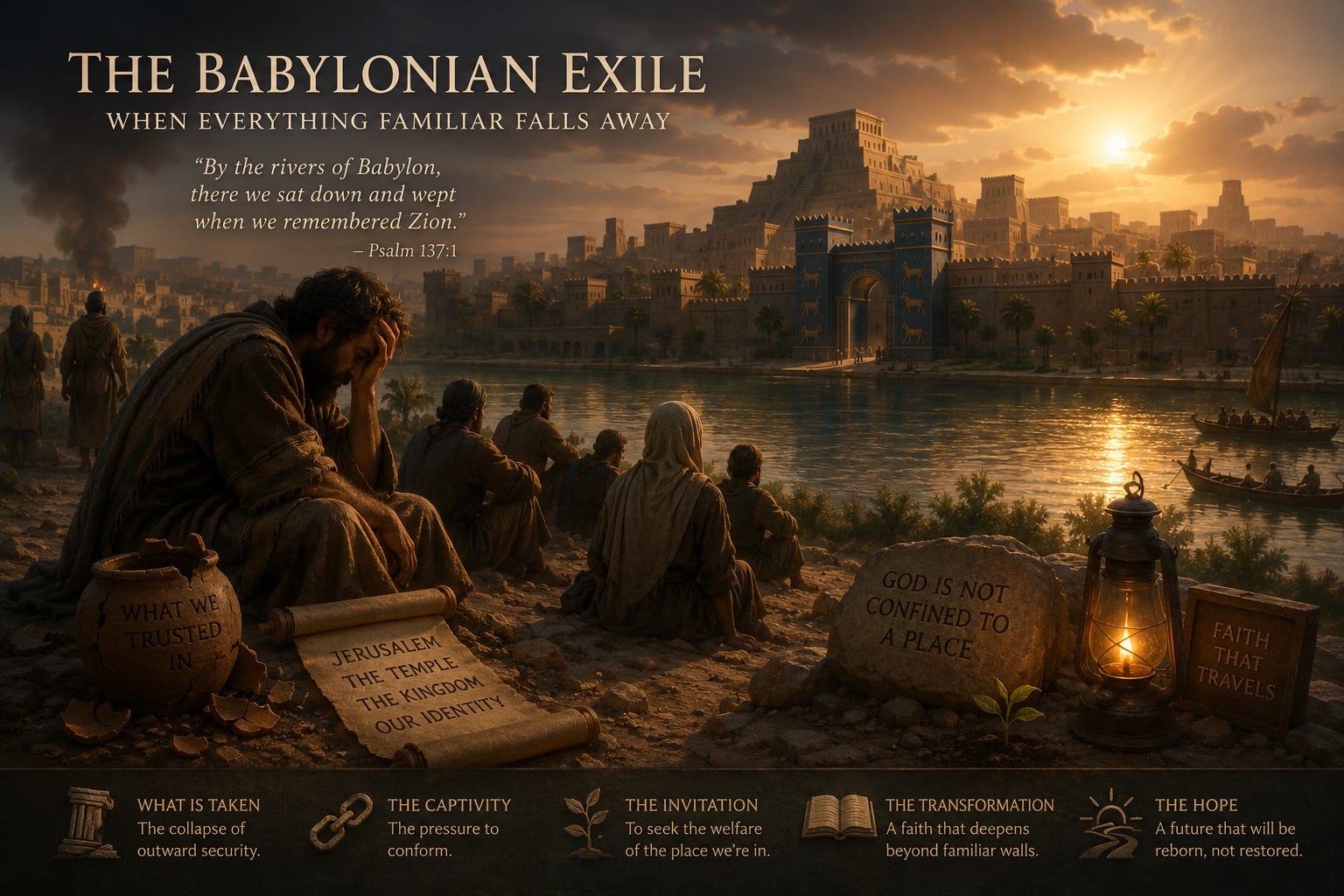
Part 20: The Babylonian Exile — When Everything Familiar Falls Away
There are moments in life when the frameworks we once depended upon begin to collapse. The beliefs that once gave us certainty no longer seem adequate. The roles that defined us begin to disappear. Relationships change, health weakens, careers end, communities shift, and the world we thought we understood no longer feels like home. The Babylonian Exile speaks powerfully to these seasons because it is not merely the story of a people being removed from their land. It is the story of what happens within us when the familiar world falls apart and we must discover whether our faith was rooted in outward security or in something deeper.
For generations, the people of Judah had centered their identity around Jerusalem, the Temple, the priesthood, the monarchy, and the land they believed God had given them. These were not unimportant things; they had shaped the people’s history and helped bind them together. Yet over time, the symbols themselves began to replace the reality they were meant to represent. The Temple became a source of false security—a religious talisman rather than a meeting place. The people assumed that because God’s house stood among them, nothing truly disastrous could happen. They continued their rituals while injustice, corruption, idolatry, and violence grew around them.
“The people wanted the reassurance of religion without the transformation religion was meant to bring.”
Jeremiah had warned them that the Temple could not protect a people whose hearts remained unchanged. Sacred buildings, religious traditions, and national identity could not substitute for justice, mercy, humility, and faithfulness. They believed the outer shell would preserve them even while the inner foundation was crumbling.
From External Security to Inner Truth
Then Babylon came.
Jerusalem was conquered. The Temple was destroyed. The monarchy came to an end. Many of the people were carried into a foreign land. Everything that had seemed permanent was taken away. The symbols through which they had understood God were gone, and they were forced to face a terrifying question: Who are we when the scaffolding that once defined us no longer exists?
This is why exile is such an important stage of the inner journey. Awakening often begins with inspiration, but transformation eventually requires the loss of old supports. We may begin by confronting a giant, crossing a wilderness, or listening for the voice of the prophets. Yet sooner or later, we encounter a season in which our old identity can no longer carry us forward. We enter an inner Babylon where we feel displaced, confused, and spiritually far from home.
Babylon, in the biblical story, was a great center of power, wealth, and human achievement. Symbolically, it represents a world organized around external status rather than inner truth. To live in Babylon is to live among forces constantly telling us who we should be, what we should desire, and what we must become in order to belong. Yet the most difficult captivity is not imposed from the outside; it occurs when Babylon takes root within us—when fear governs our choices, when ambition replaces purpose, or when the desire for approval silences the voice of conscience.
Finding God in the Unwanted Chapter
The geography changed for the people of Judah, but the challenge remained universal. We all live within systems—cultural, professional, and familial—that exert pressure upon our souls, demanding conformity. The inner work of exile is learning to remain present in the world without allowing the world to define the deepest part of who we are.
At first, the exiles longed only to return to the past. Psalm 137 remembers them sitting beside the rivers of Babylon, weeping as they remembered Zion. Their grief was real and should not be dismissed. Yet, exile cannot be survived by living entirely in memory. Jeremiah sent the exiles an unexpected message (Jeremiah 29:5–7): he told them to build houses, plant gardens, raise families, and seek the welfare of the city where they had been taken. They were not told to forget Jerusalem, but neither were they to suspend their lives until circumstances became ideal. They were being asked to discover God in the very place they had not chosen.
That may be one of exile’s deepest lessons. We often imagine that spiritual life will resume when the difficulty is over. But exile teaches that God is present even in the unwanted chapter. The foreign land may become the place where a deeper faith is born. When the Temple was gone, the people had to discover that God was not confined to a building. When the land was gone, they had to learn that their covenant could survive beyond geography. What appeared to be the destruction of their faith eventually became the purification of it.
The In-Between Place of Transition
This does not mean every loss is directly sent by God or that suffering should be romanticized. The exile involved war, violence, and grief. Yet the biblical story repeatedly shows that even when destructive forces are at work, they do not have the final word. What human beings intend for domination can become the setting for awakening. During the exile, Israel’s spiritual life did not disappear; in many ways, it deepened. The people preserved their traditions, prayer and study intensified, and their understanding of God expanded beyond the boundaries of nation and temple.
The exile becomes a severe form of spiritual transition—the “in-between” place where the old world has ended, but the new world has not yet appeared. This space can feel empty and frightening. We may no longer be who we were, yet we cannot clearly see who we are becoming.
The answer of the exile is not that God has disappeared. It is that we are being asked to recognize God beyond the boundaries where we once expected to find Him. Exile invites us to stop asking only how we can recover the past and begin asking what can be born in the present. The exiles eventually returned to Jerusalem, but they did not return as the same people. Their understanding of faith and God had been enlarged through loss.
We often want restoration to mean getting everything back exactly as it was. But true restoration is rarely a return to the old condition. It is a movement forward in which something deeper emerges from the ruins. The purpose is not merely to rebuild the same outer walls, but to become a people capable of inhabiting them differently.
The Babylonian Exile reminds us that even when the temple within seems destroyed, the divine presence has not departed. Beneath the rubble, something is still alive. The God who was once encountered in familiar places begins to reveal Himself everywhere. We may find ourselves far from the life we once knew, but we are never beyond the reach of the One who meets us in the ruins and invites us to begin again.