


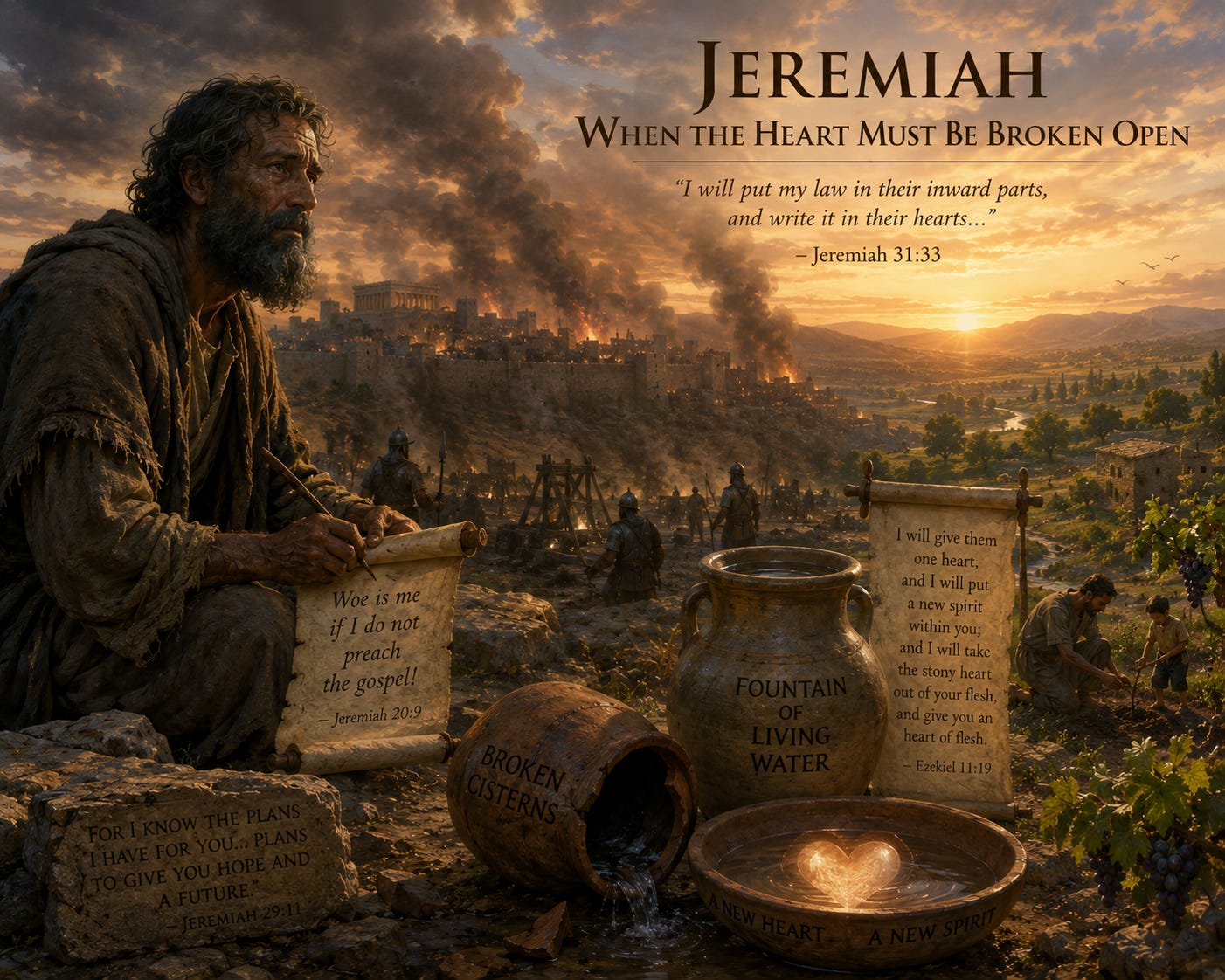
Jeremiah lived during one of the darkest periods in Israel’s history. The nation of Judah was moving steadily toward destruction, yet most of the people did not want to believe that anything was truly wrong. The Temple still stood. Religious ceremonies continued. Leaders offered reassuring words, and many assumed that because Jerusalem was the holy city, God would never allow it to fall.
Jeremiah saw beneath the appearance of security.
He recognized that a nation can preserve its religious institutions while losing the spirit that those institutions were meant to serve. People may continue repeating prayers, attending worship, and claiming the protection of God while their hearts remain governed by greed, injustice, fear, and self-deception.
The prophet’s task was not merely to predict the fall of Jerusalem. It was to reveal the inner condition that made the fall inevitable.
Jeremiah’s life reminds us that spiritual collapse rarely begins on the outside. The visible crisis is often only the final expression of something that has been deteriorating inwardly for a long time.
Jeremiah did not appear eager to become a prophet. When the call came, he responded much as Moses once had:
“Ah, Lord God! behold, I cannot speak: for I am a child.”
—Jeremiah 1:6
He felt young, inexperienced, and unprepared. Yet the divine response was that he had been known before his birth and appointed for the work ahead.
Symbolically, this suggests that the deepest calling of our lives may begin before the conscious mind understands it. There may be something within us that has always known the direction we must eventually take, even while the outward personality resists.
We often imagine a calling as something exciting or rewarding. Jeremiah’s calling was neither. He was asked to speak truths that people did not want to hear. He would be misunderstood, rejected, mocked, imprisoned, and accused of betraying his nation.
His message would cost him nearly everything.
This is one reason Jeremiah speaks so powerfully to the inner journey. Truth is not always comforting when we first encounter it. Sometimes truth dismantles the stories we have used to protect ourselves. It reveals the motives beneath our behavior, the fear beneath our anger, and the emptiness beneath our accomplishments.
The prophetic voice within does not tell us only what we want to hear.
It tells us what we need to face.
Jeremiah accused the people of committing two great evils:
“They have forsaken me the fountain of living waters, and hewed them out cisterns, broken cisterns, that can hold no water.”
—Jeremiah 2:13
This is one of the most revealing images in all the prophetic writings.
A fountain of living water continually flows from its source. A cistern, by contrast, is a container built to store water. There is nothing wrong with a cistern when it remains sound, but a broken cistern cannot preserve what is placed within it.
Symbolically, the fountain represents direct contact with the living source of truth. The broken cisterns represent the substitutes we create when we lose that contact.
We may try to satisfy the soul through possessions, recognition, achievement, entertainment, control, or the approval of others. We collect beliefs, customs, and religious language, believing these things will preserve spiritual life for us. Yet when the inner connection has been lost, the container eventually becomes empty.
The problem is not that the people had no religion. They had mistaken the container for the water.
This danger remains with us. A sacred text can become a broken cistern when its words are repeated without being allowed to transform us. A church can become a broken cistern when protecting the institution becomes more important than serving the truth. Even our personal beliefs can become broken cisterns when we cling to them so tightly that no new understanding is allowed to enter.
The living water cannot be possessed.
It must continually be received.
Jeremiah stood at the gate of the Temple and warned the people not to place their trust in the building itself. They repeated, “The temple of the Lord,” as though the sacred structure guaranteed their safety regardless of how they lived.
Jeremiah’s message was startling: the Temple could not save people who refused to practice justice, compassion, and truth.
The outer sanctuary could not compensate for an inner life that had become corrupt.
This is a difficult spiritual lesson because human beings often prefer visible signs of faith over invisible transformation. It is easier to defend a doctrine than to forgive an enemy. It is easier to participate in a ceremony than to examine our own motives. It is easier to declare that God is on our side than to ask whether our lives are truly aligned with love.
Jeremiah was not attacking worship itself. He was exposing worship that had become separated from the heart.
Religion without transformation becomes another form of self-deception.
The prophet repeatedly called the people to return, but they were unable to hear him. Their leaders promised peace even as destruction approached.
Jeremiah wrote:
“They have healed also the hurt of the daughter of my people slightly, saying, Peace, peace; when there is no peace.”
—Jeremiah 6:14
This describes the temptation to treat deep wounds with shallow remedies.
We do this inwardly whenever we cover pain without understanding it. We may distract ourselves, think positively, stay constantly busy, or tell ourselves that everything is fine. These things may offer temporary relief, but they do not heal the source of the wound.
There is a kind of peace that comes from avoidance, and there is a deeper peace that comes only after truth has been faced.
Jeremiah refused false comfort because he understood that genuine healing begins with an honest diagnosis. The wound must be uncovered before it can be cleansed. The illusion must collapse before a more truthful life can be built.
This is why Jeremiah has often been called the weeping prophet.
His tears were not merely personal sadness. He felt the suffering of his people before they were willing to recognize it themselves. He could see what their choices were producing, yet he was powerless to force them to change.
There is something deeply compassionate in his grief.
Jeremiah did not stand apart from the people with cold judgment. He suffered with them. His heart was broken by the very message he had been given to deliver.
A true prophet does not delight in being proven right.
A true prophet grieves that the warning was necessary.
Jeremiah’s sorrow also reveals something about spiritual sensitivity. The awakened heart often feels more, not less. As consciousness grows, we become more aware of suffering, injustice, and the harm human beings cause one another. Spiritual maturity does not necessarily make us emotionally untouched. It may make us more capable of feeling the pain of the world without turning away.
The challenge is learning to let the heart break open without allowing it to become hardened.
Jeremiah’s heart was wounded, but it remained alive.
At one point, overwhelmed by ridicule and rejection, Jeremiah decided that he would no longer speak in God’s name. Yet he discovered that the message had become impossible to contain:
“His word was in mine heart as a burning fire shut up in my bones.”
—Jeremiah 20:9
This inner fire represents a truth that has moved beyond intellectual belief. It has become part of the person.
Many of us have experienced a quieter form of this. There are truths we may try to ignore because accepting them would require change. We may know that a relationship has become unhealthy, that resentment is consuming us, that a habit is controlling us, or that the path we are following no longer reflects who we are becoming.
We attempt to silence the knowing, but it continues burning within.
The fire in the bones is the soul refusing to cooperate with a false life.
It may appear as restlessness, inner conflict, recurring dreams, physical tension, or the persistent sense that something must change. The conscious mind may offer countless reasons to remain where we are, while something deeper continues calling us forward.
Jeremiah reminds us that truth can be delayed, but it cannot always be silenced.
One of the central images in Jeremiah’s ministry is the potter and the clay. God instructed him to visit the house of a potter, where he watched a vessel being shaped upon the wheel. When the vessel became marred in the potter’s hands, the potter did not throw the clay away. He reshaped it into another vessel.
“And the vessel that he made of clay was marred in the hand of the potter: so he made it again another vessel.”
—Jeremiah 18:4
This image is both unsettling and hopeful.
The clay must remain soft enough to be reshaped. Once it hardens, it resists the hand of the potter. Symbolically, the hardened clay represents the ego that refuses correction. It clings to its present form, even when that form has become distorted.
To remain spiritually alive is to remain shapeable.
This does not mean becoming passive or surrendering our discernment. It means accepting that our present understanding may be incomplete. It means allowing experience, conscience, and divine guidance to reshape the beliefs and identities we have constructed.
Sometimes the life we imagined for ourselves becomes marred on the wheel. Plans fail. Relationships end. Institutions disappoint us. Beliefs that once provided security no longer seem adequate.
We may experience this as destruction.
Yet the potter does not abandon the clay.
The vessel may be broken down so that a new form can emerge.
Jeremiah understood that Judah had become too hardened to be gently corrected. The consequences could no longer be avoided. Babylon would conquer Jerusalem, the Temple would be destroyed, and the people would be carried into exile.
This was not the message anyone wanted.
False prophets contradicted Jeremiah, promising that the crisis would quickly pass. Jeremiah, however, wore a wooden yoke as a symbol that the people must submit to the reality of what was coming.
Another prophet, Hananiah, broke the wooden yoke and announced that Babylon’s power would soon be broken. Jeremiah responded that the wooden yoke would be replaced by one of iron.
The symbolic meaning is sobering. What we refuse to face gently may eventually confront us more forcefully.
Life often gives us quiet warnings before the larger crisis arrives. A strained relationship gives signs before it breaks. The body gives signals before illness becomes severe. A society reveals its divisions before they erupt openly. The soul whispers before it begins to shout.
When the wooden yoke is rejected, the iron one may follow.
Yet Jeremiah’s message was never simply one of doom. Even while announcing exile, he instructed the people to build homes, plant gardens, raise families, and seek the welfare of the city where they had been taken.
“And seek the peace of the city whither I have caused you to be carried away captives.”
—Jeremiah 29:7
This is a remarkable teaching.
The exiles were not told merely to wait helplessly for rescue. They were told to live meaningfully in the very place they did not want to be.
Symbolically, this speaks to every unwanted season of life. We may find ourselves in circumstances we never chose—grief, illness, disappointment, uncertainty, or the collapse of a former identity. Our first instinct may be to resist the entire experience, believing that life cannot begin again until the difficulty has ended.
Jeremiah suggests something different.
Plant a garden in Babylon.
Build something meaningful even within exile. Love the people who are present. Learn what the unwanted season has come to teach. Do not confuse acceptance with defeat. Acceptance allows us to stop wasting energy fighting what has already occurred so that we can begin discovering what remains possible.
Babylon may not be home, but God is not absent there.
Perhaps the most powerful moment in Jeremiah’s story occurred while Jerusalem was under siege. The city was about to fall, and Jeremiah himself was imprisoned. At that hopeless moment, he was instructed to purchase a field in his hometown of Anathoth.
From an ordinary point of view, this made no sense. The land was about to be occupied by the enemy. The nation was collapsing. A deed to property seemed almost worthless.
Yet Jeremiah purchased the field and preserved the documents because the act represented hope.
“Houses and fields and vineyards shall be possessed again in this land.”
—Jeremiah 32:15
Jeremiah’s hope was not based on denying the approaching disaster. He saw the destruction more clearly than anyone. His hope existed on the other side of the truth.
This is very different from shallow optimism.
Shallow optimism says nothing bad will happen. Prophetic hope says that even when something terrible happens, destruction will not have the final word.
Buying the field was an act of faith in a future Jeremiah would probably never live to see. It proclaimed that exile would not last forever, that the land would once again be cultivated, and that life would return after devastation.
Sometimes faith means purchasing a field while the city is falling.
It means planting something whose shade we may never personally enjoy. It means continuing to love when the world appears hardened. It means believing that the work of inner transformation matters even when its results are not immediately visible.
Before Jeremiah could speak of a new heart, he first had to expose the false gods that had captured the old one. Among the darkest was Molech, to whom children were offered in the Valley of Ben Hinnom. Through Jeremiah, God declares that such sacrifices were never His desire—“I did not command it, nor did it enter my mind.”
Historically, these sacrifices likely arose from fear. In a world of famine, war, and uncertainty, people came to believe that if they offered what was most precious, the gods would grant protection or prosperity. Fear created a religion of transactions: the greater the sacrifice, the greater the hoped-for reward.
Yet Jeremiah reveals a very different God. God is not seeking the destruction of innocence but its restoration. He is not asking humanity to sacrifice its children; He is asking humanity to surrender its fear, pride, and false loyalties. The deepest idols are not carved from wood or stone but formed within the human heart.
Perhaps Molech still exists whenever we sacrifice what is most innocent within us for the illusion of power, security, or acceptance. We sacrifice compassion to ambition, truth to popularity, family to success, and the quiet voice of conscience to the demands of fear. Jeremiah’s message is that these sacrifices can never bring life. Only a transformed heart can do that.
This is why the promise of the New Covenant is so revolutionary. God does not promise better rituals. He promises new hearts. The law is no longer written on stone tablets but upon the living heart, where love gradually replaces fear and inner transformation replaces outward sacrifice.
Jeremiah looked beyond the destruction toward a new covenant:
“I will put my law in their inward parts, and write it in their hearts.”
—Jeremiah 31:33
The old covenant had been written upon tablets of stone. The new covenant would be written within the human being.
This does not mean that truth itself changes. It means that humanity’s relationship with truth must mature.
An external law tells us what we are required to do. A law written upon the heart transforms what we desire to do.
A person may refrain from violence because violence is forbidden. But when the law has been written upon the heart, the person begins to recognize the sacred value of another human life. A person may give to the poor because it is commanded. But when compassion has awakened inwardly, generosity becomes a natural expression of love.
The purpose of spiritual law is not endless external control.
It is the formation of an awakened conscience.
This may be the heart of Jeremiah’s entire message. The Temple could be destroyed. The nation could collapse. The people could be carried far from home. The stone tablets could be broken, institutions could fail, and familiar forms of religion could disappear.
But the divine presence could still be encountered within.
What is written on stone can be taken away.
What is written on the heart travels with us into exile.
Jeremiah’s journey, therefore, represents the breaking down of external certainty so that an inner relationship with God can begin to emerge. The destruction of the old order was painful, but it prepared the way for a deeper understanding of faith—one that did not depend entirely upon a building, a nation, or a priesthood.
The sacred center was beginning to move inward.
This does not mean that community, tradition, and sacred places have no value. They can nourish and support us. Yet they must point beyond themselves toward the living presence they were created to serve.
The vessel must never be mistaken for the water.
The Temple must never be mistaken for God.
Jeremiah speaks to anyone whose former understanding of faith has begun to fall apart. At first, the collapse may feel like spiritual failure. We may fear that questioning inherited beliefs means we are losing God.
But sometimes what is collapsing is not God.
It is the container in which we tried to hold God.
The breaking of the container may be painful, yet it can release us into a wider and more living relationship with truth.
Jeremiah does not offer an easy path. He teaches that some things must be allowed to fall. Some illusions cannot be repaired. Some structures have become too corrupted to preserve. Some identities must be surrendered so that the potter can begin again.
Yet he also teaches that nothing surrendered to truth is finally wasted.
The clay can be reshaped.
Gardens can grow in Babylon.
A field can be purchased while the city falls.
The covenant can be written upon the heart.
Jeremiah’s tears water the ground from which a new humanity may eventually rise.
His message asks each of us to consider where we have substituted broken cisterns for living water. Where have we trusted appearances instead of truth? Where have we repeated “peace, peace” while avoiding a wound that needs honest attention? Where have we become too hardened to be reshaped?
And perhaps most importantly: what truth is burning within us that we can no longer continue to silence?
Jeremiah reminds us that the breaking of the heart is not always its destruction.
Sometimes the heart must break open so that something greater can be written there.
Coming Next
In the next article, we will explore Ezekiel and the promise of a new heart—a vision in which dry bones live again, the hardened heart becomes flesh, and the divine presence returns to what once seemed beyond restoration.