


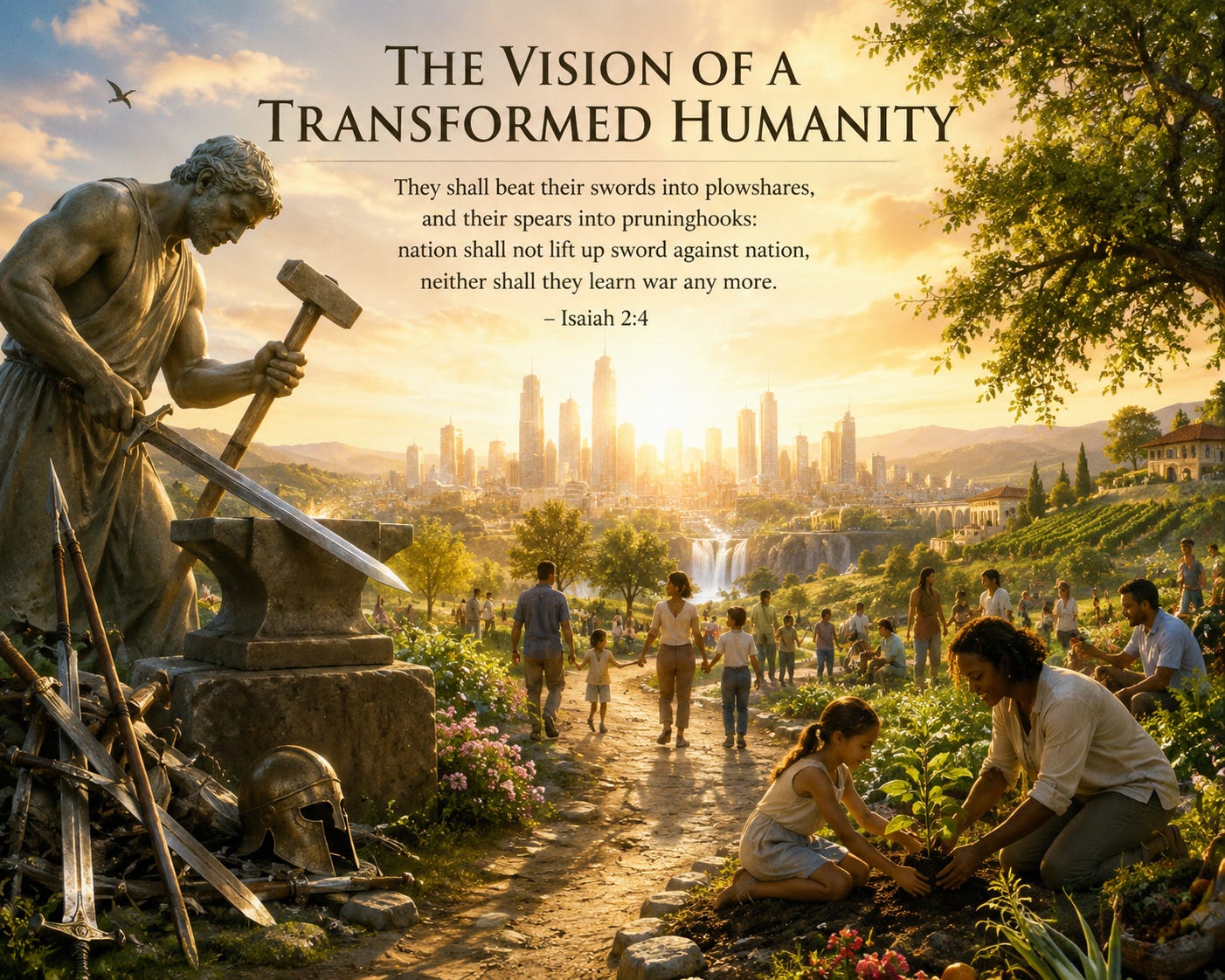
Throughout the prophetic writings of the Bible, we find words of warning, judgment, exile, and loss. Yet beneath those difficult passages runs another current—one of hope. The prophets were not merely predicting disaster. They were looking beyond the brokenness of their own time toward the possibility that humanity itself could become something different.
They saw a future in which fear would no longer rule the human heart, violence would no longer settle our differences, and people would no longer live divided from God, one another, or their own deeper nature. Their visions were not simply promises that political conditions would improve. They pointed toward a transformation of consciousness—a change in the very way human beings see, think, and live.
Isaiah expressed this vision in one of the most beautiful images found anywhere in Scripture:
“And they shall beat their swords into plowshares, and their spears into pruninghooks: nation shall not lift up sword against nation, neither shall they learn war any more.”
—Isaiah 2:4
We often read these words as a prophecy of world peace, and they certainly contain that hope. But symbolically, they may reveal something even deeper. A sword is an instrument of division. It cuts, separates, and destroys. A plowshare, by contrast, opens the earth so that something new can grow.
The same metal can become either a weapon or a tool of cultivation. The difference lies in the consciousness of the person holding it.
This may be Isaiah’s great spiritual insight. Humanity’s destructive energies do not necessarily have to be eliminated. They must be transformed. The strength once used to dominate can become the courage to protect. The intelligence once used to manipulate can become wisdom. The passion once used to conquer can become the power to create, heal, and serve.
The sword must become the plowshare within us before it can become one in the world.
Every human being carries some form of the sword. It may appear as anger, judgment, resentment, pride, or the desire to be proven right. Sometimes we wield it against others. At other times, we turn it inward and use it against ourselves. We replay our failures, condemn our weaknesses, and divide our own inner world into parts we accept and parts we reject.
The prophets imagined a time when this divided state would begin to heal.
Jeremiah spoke of a new covenant that would not merely be written upon stone tablets but placed within the human heart:
“I will put my law in their inward parts, and write it in their hearts.”
—Jeremiah 31:33
This is a profound shift. External commandments may restrain behavior, but they cannot by themselves transform desire. A person may obey a law while remaining inwardly unchanged. Jeremiah’s vision points toward something greater: a time when truth would no longer be experienced merely as a command imposed from outside, but as an inner knowing arising from within.
The law written on the heart is not blind obedience. It is awakened conscience.
It is the moment when compassion becomes more natural than cruelty, honesty more satisfying than deception, and cooperation more meaningful than domination. The transformed person does not avoid harming others only because harm is forbidden. They begin to recognize that the other person is not truly separate from themselves.
Ezekiel described this same transformation using the image of a new heart:
“A new heart also will I give you, and a new spirit will I put within you: and I will take away the stony heart out of your flesh.”
—Ezekiel 36:26
A heart of stone is hardened by fear, pain, disappointment, and self-protection. It may once have been soft, but life taught it to close. Stone cannot feel deeply. It cannot easily receive love, and it cannot freely give it.
Many of humanity’s greatest problems arise from the hardened heart. War, exploitation, cruelty, and indifference are outward expressions of an inner numbness. When we lose the ability to feel another person’s suffering, it becomes much easier to harm them. When we see people only as enemies, competitors, labels, or obstacles, the sword remains close at hand.
The promise of a heart of flesh is the promise that humanity can become sensitive again—not weak, but open. A living heart can feel pain without becoming consumed by hatred. It can recognize injustice without losing compassion. It can remain strong without becoming hard.
This transformed humanity would not be made up of perfect people. It would be made up of awakened people—men and women who have become conscious of the forces moving within them and no longer allow fear, pride, or tribal loyalty to rule unchecked.
The prophets understood that the condition of the outer world reflects the condition of the inner world. Nations fight because people remain divided within themselves. Communities fracture because individuals cling to fear and identity. Leaders dominate because the desire for power has not yet been transformed into the desire to serve.
We often imagine that peace will come once the right people are elected, the right laws are passed, or the right nation becomes powerful enough to control the rest. But the prophetic vision reaches deeper. No political system can permanently create peace among people whose hearts remain at war.
Lasting change must arise from within.
Micah described a future in which every person would sit beneath their own vine and fig tree, with no one making them afraid. This is more than an image of agricultural prosperity. It is a picture of inner security. A person who is no longer ruled by fear does not need to control everyone around them. They do not need to hoard, dominate, or attack in order to feel safe.
Fear is one of the great hidden rulers of human history. It builds walls, creates enemies, and convinces us that violence is necessary for survival. The prophetic dream of humanity is therefore not simply the absence of war. It is the healing of the fear that produces war.
This healing may happen slowly. Human consciousness rarely changes in a straight line. We often take two steps forward and one step back. At times, history appears to move toward cooperation and understanding. At other times, old hatreds return with renewed force.
Yet even this uneven journey may be part of the process. Humanity is gradually becoming aware of the consequences of living from separation. We possess greater technological power than ever before, but our moral and spiritual maturity has not always kept pace. The prophets’ warning remains urgent: power without wisdom eventually becomes destructive.
The vision of a transformed humanity asks whether we can grow inwardly before our outward power overwhelms us.
Can we learn that strength does not require domination?
Can we recognize differences without turning them into divisions?
Can we disagree without dehumanizing one another?
Can we allow truth to correct us rather than merely using it as a weapon against someone else?
These are not only questions for governments, churches, or civilizations. They are questions for each of us.
Every time we transform anger into understanding, a sword becomes a plowshare. Every time we refuse to return hatred for hatred, something of the new humanity appears. Every time we listen more deeply, forgive sincerely, or recognize the divine image within another person, the prophetic vision moves a little closer to fulfillment.
The kingdom the prophets envisioned may not descend suddenly from the sky. It may emerge gradually through transformed hearts.
Jesus would later continue this prophetic movement by teaching love of enemies, forgiveness, mercy, and the kingdom of God within and among us. His message was not disconnected from the prophets. It was the flowering of the same hope: that human beings could move beyond fear, violence, and separation into a new way of being.
The vision of transformed humanity is therefore not merely about a distant future. It is an invitation offered in the present.
The old humanity lives through fear, competition, domination, and separation. The new humanity is born through love, awareness, humility, and unity. Both possibilities exist within us.
The question is not only when the prophecy will be fulfilled.
The deeper question is: Which humanity are we helping to create?
Coming Next
In the next article, we will explore the return from exile—not only as Israel’s journey home, but as the soul’s gradual return from separation, loss, and spiritual forgetfulness.
Once again Beautifully said my friend. We find ourselves currently within this transformation of which you speak. Soon the whole planet will be flooded with goodwill and service to others. It begins with the person seen in the mirror.