


When Elijah’s earthly ministry came to an end, his mantle fell upon Elisha. Symbolically, this is more than the passing of leadership from one prophet to another. It represents the continuation of spiritual awakening. Once we learn to quiet ourselves enough to hear the still small voice, we begin to see the world through different eyes.
Elisha’s life is filled with extraordinary miracles. He purified poisoned water, multiplied oil for a desperate widow, healed leprosy, fed multitudes with a small amount of food, and even raised a child from death. Read literally, these accounts inspire faith in God’s power. Read symbolically, they reveal something equally profound: as our consciousness awakens, life itself begins to change because we are no longer seeing it through fear, separation, and limitation.
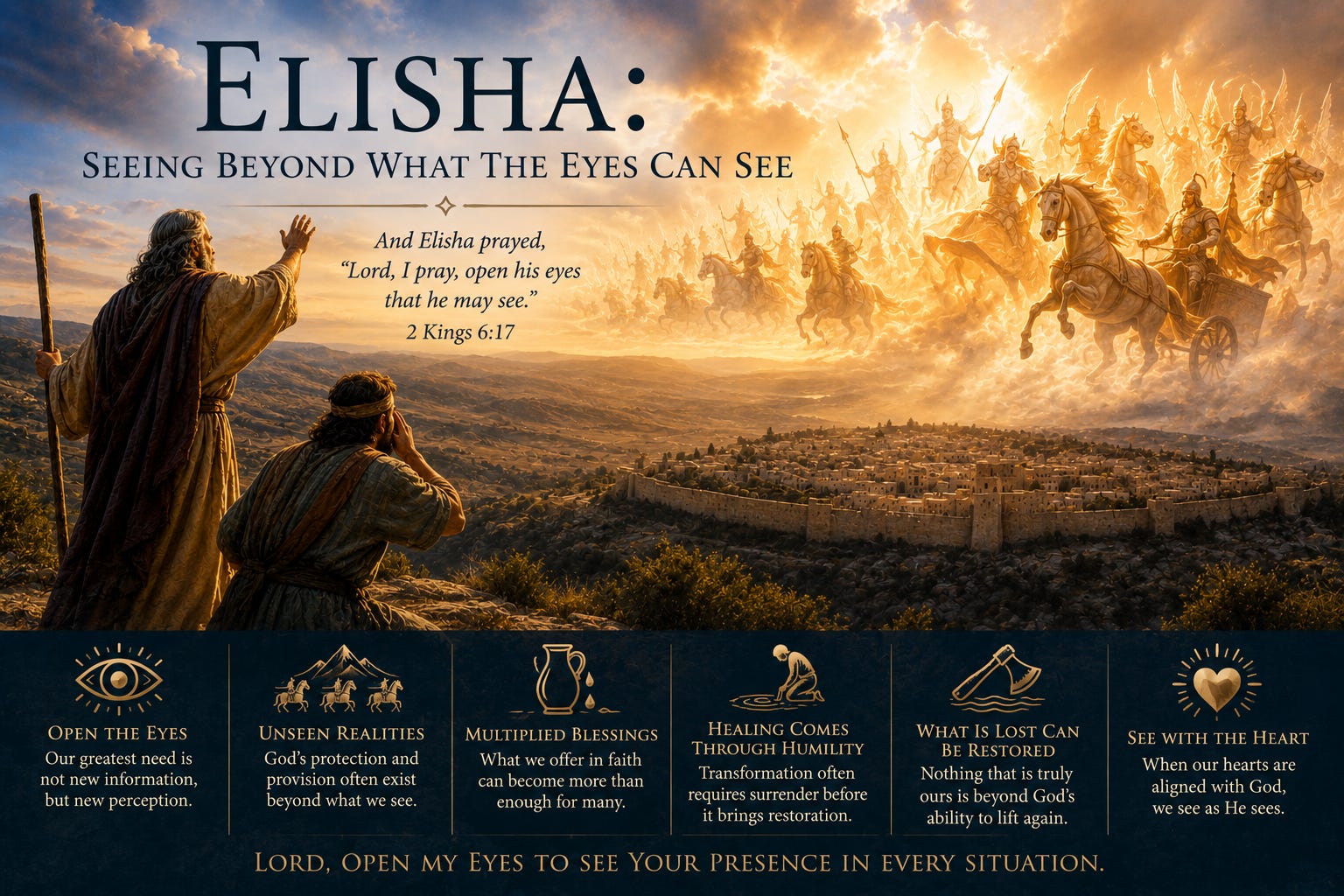
Perhaps no story illustrates this better than the moment when the city is surrounded by an enemy army. Elisha’s servant awakens in panic. From his perspective, defeat is certain. Everywhere he looks, he sees soldiers, horses, and chariots ready for battle.
Elisha, however, remains completely calm.
He prays, “Lord, open his eyes that he may see.”
Suddenly the servant’s perception changes. The mountains are filled with horses and chariots of fire surrounding Elisha. The danger has not disappeared, but the servant now realizes that reality is far greater than what his ordinary senses had revealed.
This may be one of the Bible’s greatest lessons about spiritual perception.
Much of our suffering comes not only from what is happening around us but from the limited way we interpret what is happening. Fear narrows our vision until problems appear larger than possibilities. Anger blinds us to compassion. Pride prevents us from learning. Despair convinces us that hope no longer exists.
The awakening journey is, in many ways, the gradual opening of our eyes.
We begin to recognize opportunities where we once saw obstacles. We discover lessons hidden within disappointments. We find compassion where we once held resentment. Slowly, almost imperceptibly, the world changes because the one looking at the world has changed.
This is a truth echoed throughout many wisdom traditions. We do not merely observe reality; we participate in it through our awareness. Two people can experience the same event and walk away with entirely different understandings. One sees only loss. Another discovers growth. One sees enemies. Another sees wounded people acting from fear. The external circumstances may be identical, but consciousness shapes the experience.
Elisha’s miracles beautifully illustrate this principle. The poisoned waters becoming pure remind us that healing often begins at the source. The widow’s oil multiplying suggests that what seems insufficient can become abundant when shared in faith. Naaman’s healing from leprosy comes only after he humbles himself enough to wash in the Jordan, reminding us that transformation often requires surrender before it produces restoration.
Even the floating axe head carries symbolic meaning. Something heavy and lost is made to rise again. How often do we feel that hope, joy, or purpose has sunk beneath the surface of life’s disappointments? Elisha reminds us that what seems irretrievable is never beyond God’s reach.
Perhaps the greatest miracle, however, is not found in any individual story. It is the transformation of perception itself.
The prophets continually invite humanity to look beyond appearances. They teach us that God is present even when circumstances suggest otherwise. They remind us that love remains stronger than fear, that hope survives despair, and that unseen realities often shape the visible world more profoundly than we realize.
As our own spiritual journey unfolds, we begin to understand why Jesus so often said, “He who has ears to hear, let him hear,” and “He who has eyes to see, let him see.” He was not speaking only about physical hearing or physical sight. He was inviting people into a new way of perceiving reality.
Elisha’s story encourages us to pray the same simple prayer spoken for his servant so many centuries ago:
“Lord, open my eyes.”
For once our eyes begin to awaken, we discover that God’s presence has surrounded us all along.
Coming Next
Isaiah: A Vision of a Transformed Humanity
The prophets did more than call people back to God—they also painted a breathtaking vision of what humanity could become. Next, we’ll explore Isaiah’s dream of swords beaten into plowshares and discover why it may symbolize the future evolution of human consciousness from fear and division toward peace and unity.