


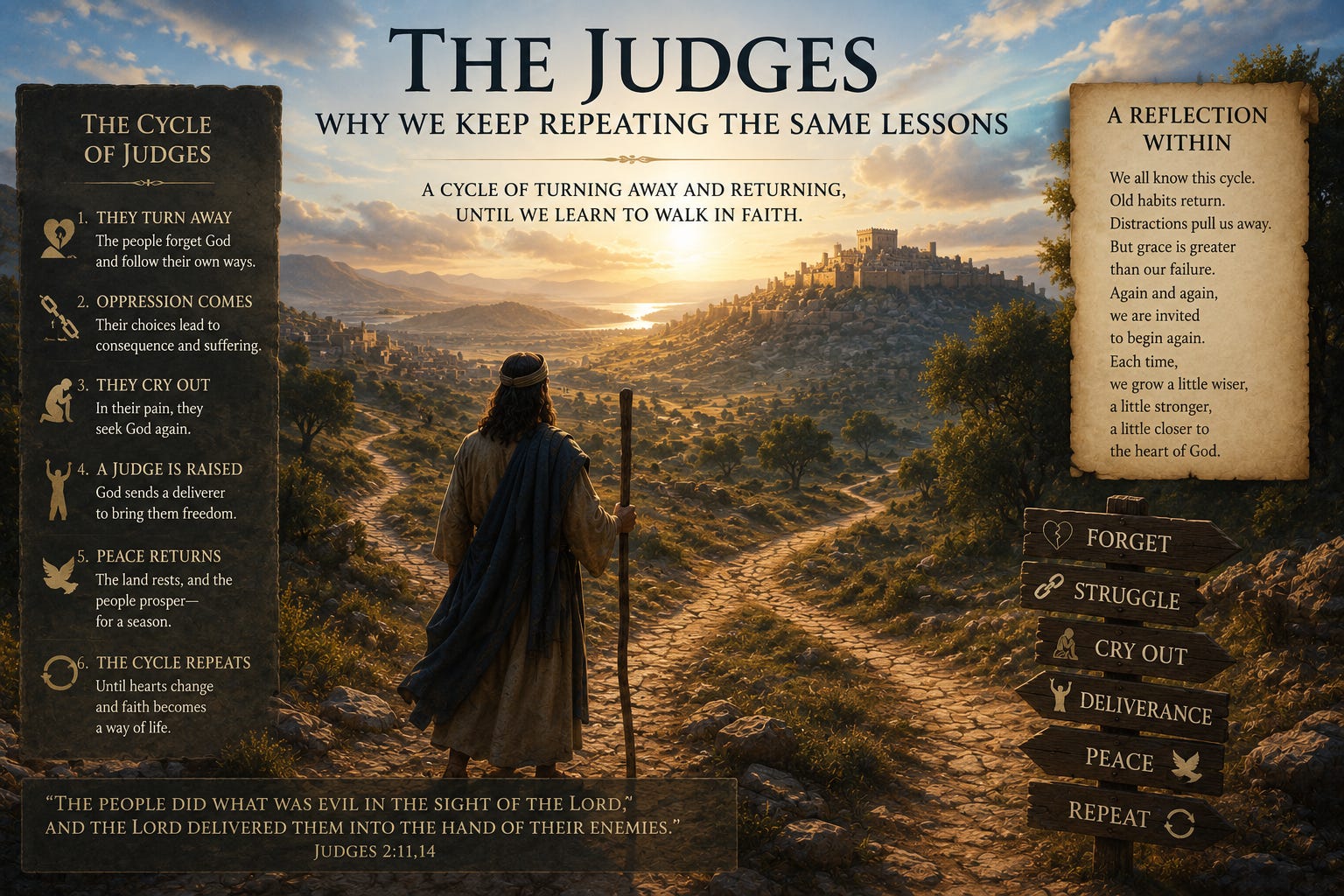
If the Promised Land represents awakening to a new way of living, then the Book of Judges asks an uncomfortable question: Why do we so often return to our old ways?
One might expect that after leaving Egypt, surviving the wilderness, crossing the Jordan, and finally entering the Promised Land, Israel’s struggles would be largely over. They had experienced deliverance, learned dependence upon God, and entered the land promised to their ancestors. Yet the story that follows is surprisingly different. The people repeatedly drift away from the principles that had brought them freedom. They forget, become comfortable, lose their way, and eventually find themselves oppressed once again. In their suffering they cry out, God raises up a judge to deliver them, peace returns for a season, and before long the cycle begins again.
At first glance, this can seem like a discouraging story. Why don’t they learn? How many times must the same lesson be repeated? Yet perhaps Judges is one of the Bible’s most honest descriptions of the human condition because, if we are willing to look closely, we may recognize ourselves in the story.
How many times have we promised ourselves that we were going to change? We overcome an unhealthy habit, forgive someone who hurt us, decide to become more patient, resolve not to react so quickly, or commit ourselves to living with greater compassion. For a while, everything seems different. We feel as though we have finally learned the lesson.
Then ordinary life returns.
We become busy. Something irritates us. Someone says exactly the wrong thing. An old memory is stirred. Fear appears. Before we quite realize what has happened, an old reaction that we thought we had left behind is sitting on the throne again.
Perhaps we have all had the experience of thinking, “I thought I was past this.”
Maybe that is the wrong way to look at it.
Perhaps spiritual growth is rarely a straight path. It is not a staircase we climb once, leaving every previous lesson permanently below us. It may be more like walking a winding mountain trail. At times we circle around and see what appears to be the same place again, but we are not necessarily standing at exactly the same elevation. We may be encountering the same issue from another level of understanding.
This is reflected throughout nature. The seasons return every year, yet no two years are exactly alike. Trees lose their leaves and grow them again. Day gives way to night before dawn returns. The moon moves through its phases and begins the cycle again. Much of life unfolds through rhythms and cycles rather than straight lines.
Perhaps our spiritual lives are no different.
This helps explain something that can otherwise become very discouraging. We may have genuinely grown and still find ourselves confronting an old problem. The return of the problem does not necessarily mean the previous growth was imaginary. Perhaps the question is whether we meet the familiar situation in exactly the same way.
Maybe the anger still appears, but we recognize it sooner.
Maybe resentment returns, but we no longer carry it for months.
Maybe fear still speaks, but we don’t automatically obey it.
Maybe we still react, but twenty minutes later we can see what happened instead of remaining convinced for three days that the other person was entirely at fault.
That is growth too.
Sometimes two steps forward and one step back really is progress.
The Book of Judges seems to understand this repetitive quality of human development remarkably well. Israel forgets, suffers, remembers, cries out, receives help, experiences peace, and eventually forgets again. The pattern repeats so often that we might almost become impatient with them.
But perhaps before judging Israel too harshly, we should look at our own lives.
How many times have we forgotten what we already knew?
We may know that worrying about tomorrow accomplishes very little, yet tomorrow’s problem can still keep us awake tonight. We may know that anger usually makes communication worse, yet find ourselves saying something we regret. We may know that possessions do not provide lasting happiness and still become excited about acquiring something new. We may understand that being right is less important than maintaining a loving relationship and then find ourselves defending a point that really doesn’t matter very much.
We know.
Then we forget.
Then something reminds us.
Perhaps that is one of the great patterns of human life.
The judges themselves become especially interesting when viewed symbolically. They were not kings who established permanent dynasties. They arose at particular times when Israel needed deliverance. Some were courageous. Some were deeply flawed. Their stories include people such as Deborah, Gideon, Jephthah, and Samson, and Scripture does not present all of them as examples of perfect spiritual maturity. In fact, some of their failures are part of the story.
Perhaps that makes them even more useful as symbols.
A judge may represent one of those moments when something awakens within us strongly enough to interrupt an unconscious pattern. Suddenly we see what we have been doing.
Sometimes that awakening comes through another person. Someone says something that stays with us. A teacher, friend, spouse, child, or even stranger makes an observation that we cannot quite dismiss. Sometimes it comes through a book or passage of Scripture we have read many times before but suddenly understand differently.
Sometimes awakening comes through something much less comfortable.
An illness can cause us to reconsider how we have been living. A loss can rearrange our priorities. A relationship problem can reveal something about ourselves that we would rather not see. A dream can leave us with an image or question that follows us for days. A failure can expose an assumption we did not know we were carrying.
Sometimes nothing dramatic happens at all.
We simply catch ourselves.
Perhaps we are halfway through an argument when suddenly we see ourselves arguing.
That is an interesting moment.
One second we are completely inside the reaction, convinced of our position and preparing the next response. Then something changes. We become aware of what we are doing.
Who noticed?
That question may be more important than it first appears.
If part of me can observe my anger, then perhaps I am not merely the anger. If I can notice my defensiveness, perhaps I do not have to remain completely identified with it. If I can see the need to be right rising within me, perhaps I have gained a small amount of freedom from it.
Maybe that moment of awareness is one of our inner judges arriving.
It does not force us to change. We can ignore it. We can continue the argument. We can allow anger to retake the throne.
But for a moment, another possibility appears.
The judge does not remove our freedom.
It simply reminds us that we have one.
This may be one of the most practical lessons in the entire Book of Judges. Deliverance does not always arrive as a dramatic miracle. Sometimes deliverance begins with awareness.
“I am doing it again.”
Those five words can change a great deal.
We are beginning to recognize the cycle.
Perhaps that is what spiritual maturity gradually gives us—not immunity from every old pattern, but increasing ability to recognize the pattern before it completely takes over.
At first we may recognize anger the next day.
Later we recognize it an hour afterward.
Eventually we notice it five minutes later.
Then perhaps while we are speaking.
And occasionally, if we are paying attention, we may recognize it before the words leave our mouth.
The problem has not disappeared.
But something within us has changed.
We have become more awake.
This is where the Book of Judges connects so naturally with the idea of the false king. Egypt taught us what it meant to live under Pharaoh. The wilderness taught us how difficult it is to remove Pharaoh’s influence after leaving his kingdom. Joshua brought us across the river into a new way of living. David showed us how fear can become a giant within us.
Judges now teaches us that the false king does not surrender his throne permanently just because we recognized him once.
He returns.
Sometimes quietly.
He may return as resentment, fear, pride, self-pity, control, jealousy, or the need for recognition. He may return disguised as certainty. He may even return through our spiritual beliefs if we begin thinking that our understanding makes us better than someone else.
Perhaps this is why self-observation cannot be something we practice once and finish.
The garden requires tending.
That thought brings us all the way back to where this series began. A garden is not planted once and then ignored forever. Weeds return. Plants need water. Branches need pruning. Conditions change. Something that was healthy last year may need attention this year.
Perhaps our inner garden works the same way.
The goal is not to become discouraged every time we discover another weed. The goal is to notice what is growing.
That changes how we might understand failure.
Many people become discouraged because they believe spiritual growth should eventually eliminate struggle altogether. If anger returns, they think they have failed. If fear reappears, they believe they have gone backward. If they fall into an old habit, they may conclude that nothing has really changed.
But perhaps maturity is not measured by never falling.
Perhaps it is measured partly by how quickly we recognize that we have wandered, how honestly we can admit it, how willing we are to humble ourselves, and how readily we begin the journey home again.
The Book of Judges gives us a God who repeatedly responds when Israel cries out. The people wander, but God does not abandon the relationship. They forget, but they are not forgotten. They fail, yet failure does not have to become the final chapter.
Again and again, another opportunity appears.
There is mercy in that.
Perhaps we should learn to extend some of that mercy toward ourselves as well. Not as an excuse to remain unconscious or to justify harmful behavior, but as permission to begin again without spending years condemning ourselves for having wandered.
We noticed.
Good.
Now what?
Perhaps that question is more useful than shame.
Every failure can become another opportunity to see ourselves more clearly. Every setback can expose something that remains unfinished. Every return to an old pattern gives us another chance to understand why that pattern has such power over us.
Instead of merely saying, “I did it again,” perhaps we can become curious.
What happened just before I reacted?
What did I feel threatened by?
What was I trying to protect?
Why did that person’s words affect me so strongly?
Which part of me was answering?
What was sitting on the throne?
Those questions turn failure into observation.
And observation can become the beginning of freedom.
One of the recurring themes throughout this series has been that humanity is unfinished. We are learning through experience. We do not become complete because we have one spiritual insight any more than a child becomes an adult after learning one lesson. Growth continues.
Perhaps this is why the cyclical pattern of Judges should not necessarily discourage us. A circle viewed from directly above appears to return endlessly to the same point. But imagine that circle gradually rising as it turns. Now it becomes a spiral.
From one angle we appear to be going around again.
From another, we are slowly rising.
Maybe spiritual growth is more like a spiral than a straight line.
We return to forgiveness, trust, fear, pride, control, love, and surrender again and again. The subjects may remain familiar, but perhaps we meet them with increasing depth.
The path may circle.
But it can still lead upward.
Eventually, however, Israel grows tired of this repeated pattern. The people begin longing for something more permanent than temporary deliverance. They ask for a king who can unite the tribes and provide continuing leadership.
Historically, this request becomes complicated. Samuel warns them about what human kingship can cost, and Israel’s desire to be like the surrounding nations carries its own problems. Yet symbolically, their longing can still point toward another stage in our inward journey.
After years of competing impulses and repeated cycles, perhaps something within us also begins longing for a center.
We become tired of being ruled by whichever emotion happens to be strongest at the moment.
One day fear is king.
The next day anger sits on the throne.
Then pride.
Then desire.
Then insecurity.
Then the need for approval.
Each rules for a while.
Perhaps eventually we begin asking whether there is something deeper within us capable of bringing these competing parts into proper relationship.
Not another Pharaoh.
Not another false king.
But a center grounded in truth, love, conscience, humility, awareness, and the Spirit of God.
That longing will take us into the next stage of Israel’s story, where the nation begins searching for a king.
And perhaps the Book of Judges leaves us with a hopeful reminder before we move on. Progress is not always measured by never revisiting an old struggle. Sometimes progress is recognizing the pattern a little sooner, remaining unconscious for a little less time, choosing love a little more often, and allowing each cycle to teach us something we did not understand before.
Maybe we have been here before.
But perhaps we are not exactly the same person who was here last time.
The path may wind.
The cycle may repeat.
The old patterns may occasionally return.
But every moment of awareness gives us another opportunity to choose.
And every time we choose consciously rather than mechanically, perhaps we take another small step toward freedom.
The journey home goes on.
Coming Next
The United Kingdom: When the Inner Self Comes Together
After the repeated cycles of the Judges, Israel begins to long for something more stable, something that can unite the people under one purpose. Symbolically, this points to our own longing for inner harmony.
In the next article, we will explore the United Kingdom as a picture of what happens when the scattered parts of ourselves begin to come together. The heart, mind, and will are not yet perfect, but they begin moving in the same direction. For a time, the kingdom within becomes whole.