

As we journey through the Bible symbolically, we begin to notice a recurring pattern. Before there is conflict, there is harmony. Before separation, there is unity. Before exile, there is home. We saw it first in the Garden, where humanity began in a state of innocence and relationship before fear, shame, and separation entered the story. Now, much later in the biblical journey, we encounter another period of unity as the scattered tribes of Israel gradually become one kingdom under one king.
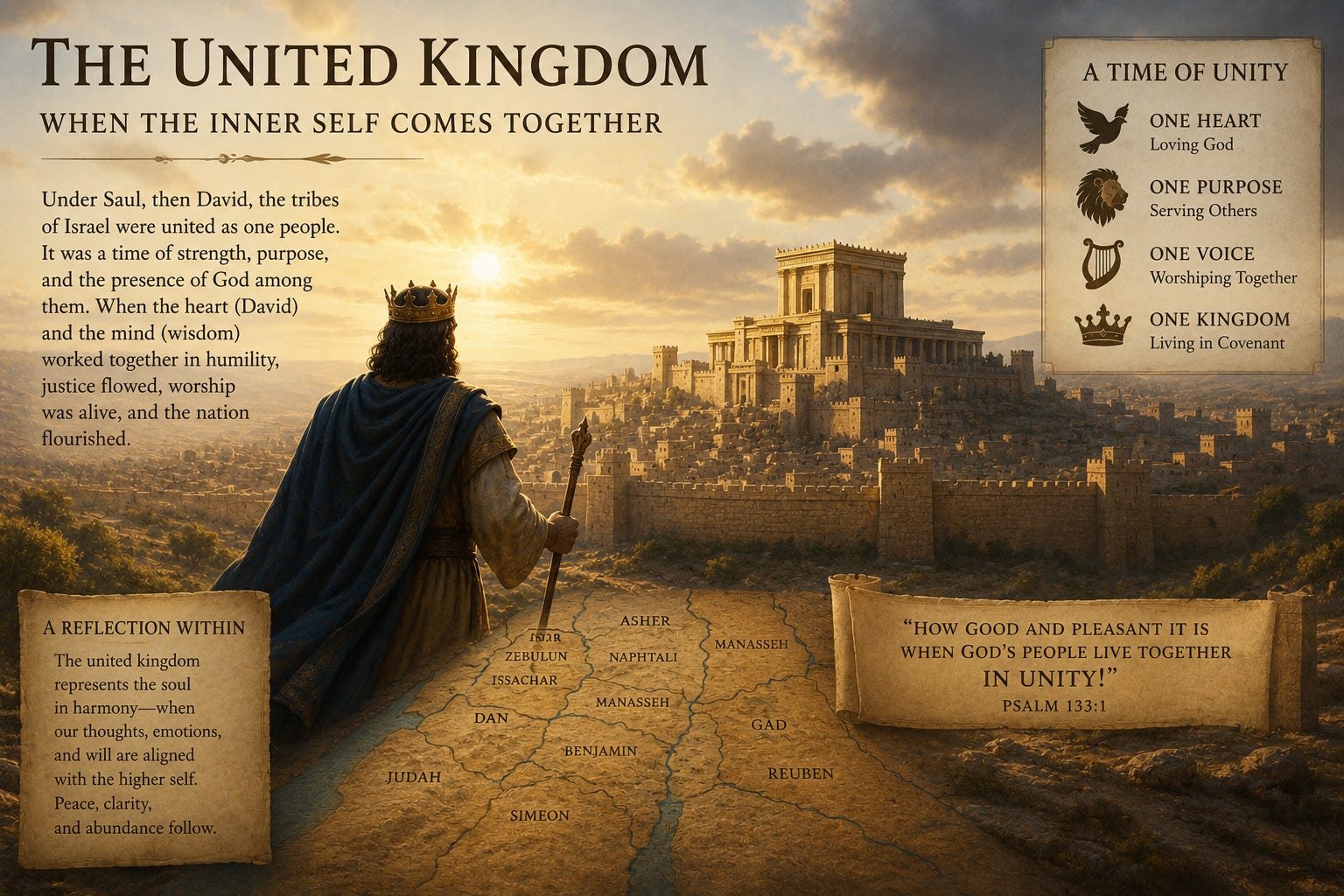
Historically, this period is remembered as the United Monarchy, associated with Saul, David, and Solomon. Symbolically, however, it offers us another way of looking at our own inner journey. After Egypt, the wilderness, the Promised Land, and the repeated cycles of the Judges, perhaps the united kingdom represents those precious periods when the many competing parts within us begin working together instead of continually struggling for control.
The Book of Judges prepared us for this. Israel repeatedly wandered, suffered, awakened, returned, and then wandered again. We compared that pattern to a spiral. We may revisit the same fear, resentment, pride, or insecurity many times, yet perhaps we meet it with a little more awareness each time. Eventually something within us begins longing for greater stability. We become tired of having one emotion rule us today and another tomorrow. We begin searching for a deeper center.
Isn’t that also our story?
There are seasons when our thoughts pull us in one direction, our emotions in another, and our desires in yet another. Part of us wants to forgive while another part wants to hold onto the offense. Part of us wants peace while another continues replaying the argument. We may genuinely want to become more compassionate while still feeling resentment toward someone who hurt us. We seek trust while carrying anxiety. We know what we believe is right and yet struggle to live it consistently.
In a sense, we can become a collection of little kingdoms within ourselves, each wanting the throne.
Fear wants to rule.
Pride wants to rule.
Anger wants to rule.
The need for approval wants to rule.
Our wounded parts want to protect themselves.
Our desires want what they want.
And somewhere beneath all of that is another longing—the desire to become whole.
Perhaps that is what the United Kingdom can represent symbolically. It is not the destruction of all these different parts of ourselves. It is their gradual reordering around a deeper center. Our thoughts, emotions, desires, conscience, and actions begin moving toward the same purpose. Instead of constantly living from fear, pride, resentment, or self-protection, we begin living from something deeper.
We become more integrated.
That does not necessarily make life easier. Problems remain. Difficult people remain. Uncertainty remains. Our own weaknesses remain. But there is less civil war within us.
Perhaps that is one of the greatest forms of peace.
Before we reach David and Solomon, however, Saul deserves our attention. Israel asks for a king, and Saul appears to be exactly what a king should look like. He is physically impressive and stands above the people. Outwardly, he fits the image.
Yet inwardly, Saul becomes increasingly troubled by insecurity, fear, jealousy, and the need to protect his position.
That contrast may carry an important symbolic lesson. Our first attempt at creating inner order may still be based largely upon outward identity. We try to become strong. We try to appear confident. We establish rules for ourselves. We attempt to control our behavior and perhaps even control the people around us.
But control is not the same thing as inner unity.
Saul increasingly fears losing his throne. When David begins receiving praise, Saul cannot simply rejoice in another person’s gifts. David’s success becomes a threat.
How often does that happen within us?
Someone else’s success can somehow make us feel smaller. Another person’s recognition can awaken insecurity. Someone disagrees with us, and suddenly we feel the need to defend not merely an idea but ourselves. We may even discover that our desire to remain in control becomes stronger precisely when we feel least secure.
Perhaps Saul represents a king who sits on the throne but has not yet found peace within himself.
That is an important distinction.
Simply having a king does not guarantee that we have the right king.
This brings us very close to the central idea behind Get the King Out of the Garden. Something is always attempting to occupy the throne of our inner life. The question is not merely whether we have order, but what kind of order we have and what is creating it.
Fear can create order.
Control can create order.
Pride can create order.
Religion itself can create outward order.
But none of these necessarily creates wholeness.
David represents something different. Scripture describes him as a man after God’s own heart, yet it certainly does not portray him as perfect. David makes serious mistakes. At times he fails dramatically. What makes his story spiritually valuable is not that he never falls, but that he remains capable of being confronted, humbled, and brought back.
Symbolically, David can represent the awakening of the heart.
There is something in David that continues turning toward God. He worships. He grieves. He rejoices. He fails. He repents. He cries out. He asks forgiveness. His Psalms reveal an extraordinary range of human emotion, yet again and again those emotions are brought into relationship with God.
Perhaps that is what a heart-centered life actually looks like. It is not a life without anger, fear, grief, or failure. It is a life in which those things are increasingly brought into the light rather than hidden.
David reminds us that spiritual maturity is not perfection.
It is humility.
The truly transformed person may not be the one who never falls, but the one who becomes increasingly willing to see why he fell, admit it honestly, learn from it, and rise with a softer heart.
That connects directly with what we discovered in Judges. Awareness allows us to recognize when an old pattern has returned. David adds another step: once we see it, can we humble ourselves enough to admit it?
That can be surprisingly difficult.
The false king would rather explain.
He would rather justify.
He would rather point toward what someone else did.
He would rather construct an entire argument proving why his reaction was reasonable.
The deeper heart simply says, “I see it.”
Perhaps those words can begin restoring the kingdom.
Then comes Solomon, and another dimension is added. When given the opportunity to ask God for what he desires, Solomon asks for understanding and discernment rather than simply riches, long life, or victory over enemies. Symbolically, Solomon represents wisdom.
This too is necessary because love by itself is not always enough to guide us wisely.
We can love someone and still enable destructive behavior. We can want to help and make matters worse. We can be compassionate yet fail to establish necessary boundaries. A loving heart needs discernment.
At the same time, wisdom without love can become cold. Intelligence can justify almost anything. Knowledge can inflate pride. A person can understand many things and still lack compassion.
Perhaps genuine spiritual maturity requires the heart of David and the wisdom of Solomon.
Love asks, “What is compassionate?”
Wisdom asks, “What is truly helpful?”
Love sees the person.
Wisdom sees the consequences.
Love keeps the heart open.
Wisdom helps us know when to speak, when to remain silent, when to act, and when to wait.
When the two begin working together, something remarkable happens. The competing voices within us gradually become quieter because our life is becoming organized around something deeper than immediate reaction.
Maybe this is what an inner united kingdom looks like.
The emotional part of us does not have to be destroyed.
The thinking part does not have to dominate.
Our desires do not have to disappear.
Our personality does not need to be erased.
Instead, each part begins finding its proper place within the whole.
The problem has never been that we have thoughts, emotions, desires, instincts, memories, fears, hopes, and ambitions. The problem arises when one of them seizes the throne and declares itself king.
Fear says, “I will decide.”
Anger says, “I will decide.”
Pride says, “I will decide.”
Resentment says, “I will decide.”
The united kingdom says something different.
“Let everything within me serve what is highest.”
Perhaps this is close to what Jesus would later express when He taught people to seek first the Kingdom of God. Whatever else the Kingdom means—and it certainly reaches beyond any single symbolic interpretation—it can also invite us to ask what governs our lives here and now. Luke records Jesus speaking of the Kingdom in language translated variously as being “within,” “among,” or “in the midst” of people. Whichever translation we prefer, the teaching turns our attention away from merely waiting for an external kingdom and toward recognizing the presence and rule of God.
What if the Kingdom begins to become visible whenever love, truth, humility, mercy, wisdom, and service govern what we do?
Perhaps then the Kingdom is not merely something we enter someday.
It is something we increasingly learn to live from today.
There may be moments when we actually experience this kind of inner unity. We know what we believe, what we value, and what we need to do, and there is surprisingly little argument within us. We act without needing recognition. We forgive without demanding that the other person first understand everything they did wrong. We help because helping is simply the right thing to do. We speak honestly without needing to dominate.
For a moment, the kingdom is united.
Perhaps we have all experienced glimpses of this.
They may not last long, but once experienced, we know something different is possible.
Yet Scripture is far too honest to allow us to remain there.
The United Kingdom does not last.
Even Solomon, the symbol of wisdom in this reflection, eventually illustrates the danger. The very gifts associated with his reign—wealth, power, influence, achievement—become entangled with excess and divided loyalties. The kingdom that reached extraordinary heights begins developing cracks.
There is another important lesson here.
The false king does not always return looking like Pharaoh.
Sometimes he returns looking successful.
Earlier in the journey, ego may appear as obvious fear, anger, insecurity, or domination. Later it can become much more subtle. It may appear as spiritual pride. We begin thinking we understand things other people don’t. We become attached to our insights. We quietly enjoy being seen as wise. We stop questioning ourselves because we believe we have finally arrived.
Perhaps success can sometimes test us more deeply than failure.
Failure often drives us to our knees.
Success can convince us we no longer need to kneel.
This may be why humility must remain at the center of the journey. We never reach a point where the garden no longer requires tending. We never become so spiritually mature that self-observation is unnecessary. The moment we announce that the false king has been permanently removed may be the moment he has quietly returned wearing a crown we failed to recognize.
The history of Israel reflects that reality with remarkable honesty. Saul’s insecurity, David’s failures, and Solomon’s later compromises remind us that no human king finally solves the problem.
Perhaps that too points beyond them.
The deeper biblical story continues searching for a different kind of King and a different kind of Kingdom.
For Christians, that search ultimately leads to Jesus—not a king who rules through intimidation, wealth, armies, or self-glorification, but one who washes feet, welcomes outsiders, forgives enemies, serves rather than demands service, and says that the greatest must become the servant.
What an extraordinary reversal of kingship.
The false king says, “Serve me.”
The higher King says, “How can I serve?”
Perhaps that is one of the clearest ways to recognize what is sitting on the throne within us.
When fear rules, everything becomes about protection.
When pride rules, everything becomes about recognition.
When ego rules, everything becomes about me.
When love rules, the question changes.
“How can I serve?”
Maybe that is what the United Kingdom ultimately invites us to consider. What would happen if the many parts of ourselves were gradually brought into harmony under a higher purpose? What if our thoughts, emotions, abilities, experiences, wounds, hopes, and desires no longer had to compete endlessly for control but could become instruments of love, truth, wisdom, and service?
Perhaps that is what becoming whole looks like.
Not becoming less human.
Becoming more fully human.
As we have followed the journey, each stage has asked another question. The Garden asked, “Where are you?” Cain asked, “Where is your brother?” Noah asked what remains when the familiar world disappears. Jacob asked what we are willing to wrestle with in order to become someone new. Joseph asked whether we can trust the journey when we cannot understand the chapter we are living. Egypt asked what within us still holds us captive. The wilderness asked what must change before we can live freely. Joshua asked whether we are willing to live what we have learned. Goliath asked what fear we have allowed to become larger than it really is. Judges asked how quickly we can recognize when we have wandered back into an old pattern.
Now the United Kingdom asks:
What is sitting on the throne within me?
Perhaps there are moments when the answer is love.
Moments when wisdom and compassion work together.
Moments when mind, heart, and action move in the same direction.
Moments when we are no longer fighting ourselves.
Those moments may be brief.
But they show us what is possible.
The Bible will next show us how easily that unity can fracture. The kingdom will divide, just as our inner world can divide when pride, fear, desire, and self-interest again begin competing for the throne.
But division will not have the final word.
The invitation to become whole remains.
The garden can still be tended.
The kingdom can still be restored.
And the journey home goes on.
Coming Next
Solomon’s Temple: Building the Dwelling Place Within
What if the temple Solomon built was more than a magnificent structure of stone and cedar? In our next article, we’ll explore the deeper symbolism of the temple as a reflection of the human heart becoming a dwelling place for the presence of God.