


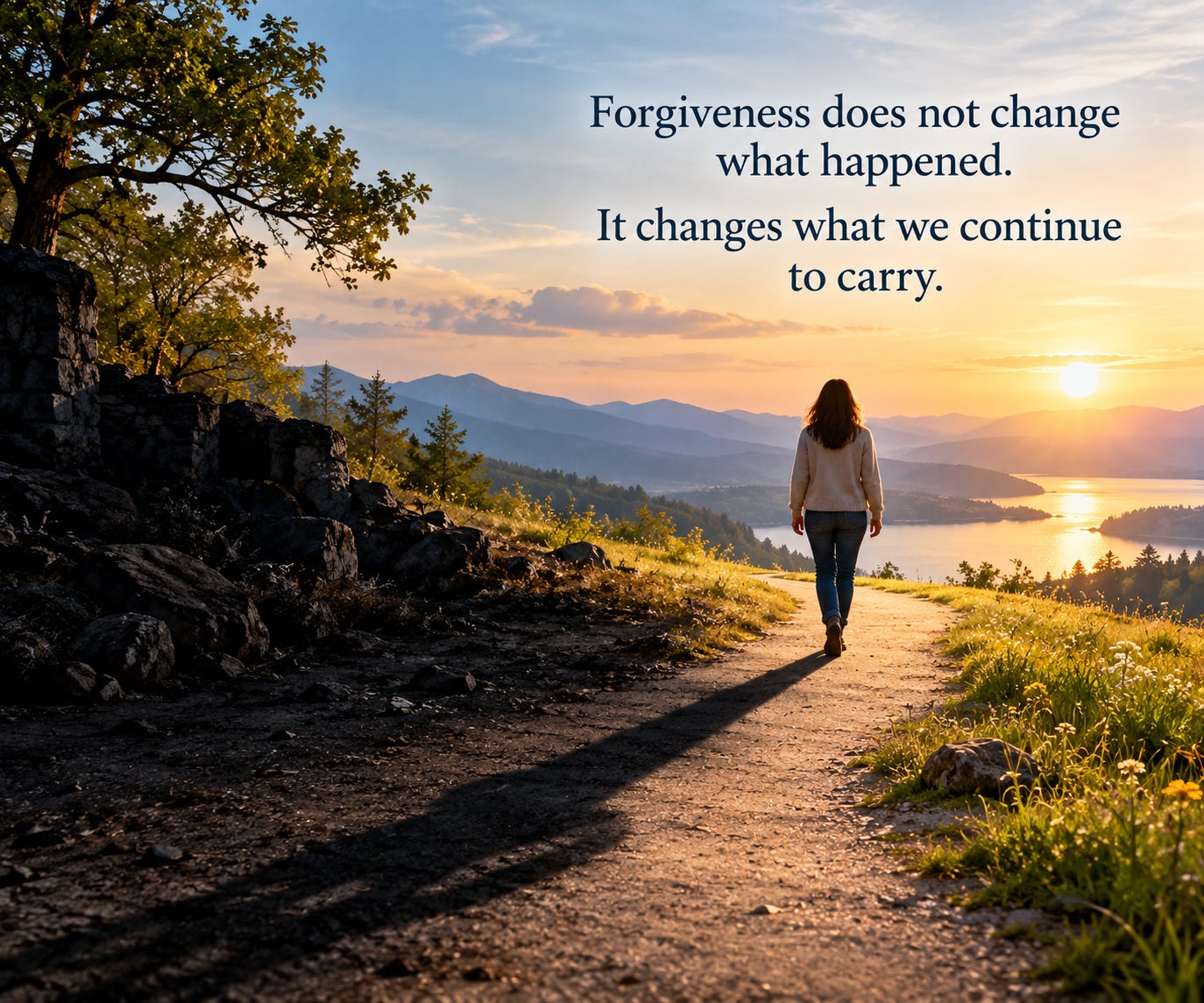
What Letting Go Does and Does Not Mean
In the previous article, we explored how comparison can quietly become a measure of our worth. This time, we turn to something more difficult: what happens when we have been hurt by another person, and someone tells us that the answer is to forgive? The advice may be offered with good intentions, yet the word forgiveness carries so many expectations that it can leave a wounded person feeling even more alone.
We hear that we should forgive and forget, that holding anger only hurts us, or that a truly spiritual person would have moved beyond the injury by now. Sometimes those words are spoken by people who have never understood what happened. At other times, they come from the very person who caused the harm. Forgiveness can become less an invitation to freedom than a demand to stop talking about something uncomfortable.
Before we can understand forgiveness, we need to separate it from several things that are often confused with it. Forgiveness is not pretending that an injury did not occur. It is not calling a wrong action right. It does not erase consequences, require us to trust someone again, or obligate us to return to a relationship that remains harmful. And it is not the same as forgetting. Memory may be precisely what helps us recognize a pattern and protect ourselves from its repetition.
Acceptance is different. To accept what happened is to stop arguing with the fact that it happened. We may wish the past were otherwise, and we may still feel grief or anger about it, but we begin to face the reality of our experience rather than the reality we wanted. Acceptance does not mean approval. It is simply the ground on which an honest response can begin.
Reconciliation is different again. Reconciliation involves a relationship, and a relationship cannot be repaired by one person alone. It may require truthfulness, responsibility, changed behavior, and the slow rebuilding of trust. An apology can be meaningful, but an apology by itself does not restore trust. Where there is ongoing mistreatment, distance may be wiser than renewed closeness. We can work toward inner peace without placing ourselves back in the path of further harm.
So what might forgiveness mean? One useful way to understand it is as a gradual loosening of the hold an injury has over our inner life. We may no longer want the event, or the person responsible, to occupy so much of our attention. We may wish to stop replaying the argument, preparing the defense we never got to offer, or imagining the moment when the other person finally admits what they did. But this loosening cannot simply be ordered into existence. Sometimes it comes slowly, and sometimes the more immediate task is safety, grief, or finding someone who will listen.
Anger is often treated as the enemy of forgiveness. Yet anger may initially be the part of us that recognizes a boundary has been crossed. It tells us that something mattered, that something was unfair, or that something precious was lost. If we rush to silence it, we may also silence information we need. The question is not whether anger is allowed, but what happens when it becomes the only voice through which we understand the experience. An emotion can carry a message without having to govern the rest of our lives.
Often the deepest pain is not limited to the original event. A betrayal may also destroy our confidence in our judgment. A harsh parent may leave us grieving the encouragement we never received. A broken friendship may leave us wondering whether we were ever truly known. We may say that we need to forgive a person when part of what we actually need is to acknowledge a loss. There can be no honest letting go of a grief we have not allowed ourselves to recognize.
For people raised with strong religious expectations, the confusion can become even greater. Forgiveness may have been presented as an obligation that must be completed immediately, regardless of the injury. But a spiritual ideal can be misused when it pressures the injured person to conceal pain while the one who caused it escapes responsibility. Mercy does not require denial. Compassion does not require access. A person can desire another’s well-being and still say, clearly, “You cannot continue treating me this way.”
There is another difficulty. We sometimes imagine that forgiveness should feel like a dramatic moment of release. Perhaps it does for some people. More often, an old hurt returns unexpectedly: a remark, a familiar tone of voice, or a situation resembling the past brings the feelings back. This does not necessarily mean that no healing has occurred. The mind and body can respond to reminders long after we have made a thoughtful decision about the relationship. We can notice those reactions without turning them into proof of failure.
The inward work may begin with questions more precise than “Have I forgiven?” What exactly happened? What did I lose? What responsibility belongs to the other person, and what choices belong to me now? Am I asking for an apology that may never come? Am I keeping an old argument alive because some part of me still hopes that, if I rehearse it enough, the past will finally change? These are not questions meant to shame us. They help us see where our attention remains bound to an event we cannot undo.
Sometimes what we call resentment is a continuing demand for justice. That demand may be understandable, and practical justice or accountability may still be worth pursuing. Inner freedom does not mean giving up a legitimate claim or pretending that consequences do not matter. It means recognizing that our entire future cannot depend on another person’s willingness to understand us. We can act where action is possible and gradually release the impossible task of making someone else become who we needed them to be.
Then there is the matter of forgiving ourselves. We may look back on decisions made from fear, ignorance, pride, or the desperate need to belong. Genuine self-forgiveness is not an excuse to avoid responsibility. If we harmed someone, repair may still be possible through acknowledgment, apology, changed behavior, or restitution. Yet endless self-condemnation does not undo the harm either. We can take responsibility for an earlier version of ourselves without insisting that we must remain that person forever.
Not everyone finds the word forgiveness helpful, especially when it has been used to minimize what they endured. That does not prevent growth. Some people begin instead with truth, boundaries, mourning, or the decision to stop allowing an old wound to determine every new relationship. The language matters less than the direction of the work. Healing is not a performance we owe to observers, and it does not follow a schedule set by the person who hurt us.
Perhaps one sign of change is that the story becomes something we can remember without having to enter it completely each time. We still know what happened. We may still regard it as wrong. But our attention is increasingly available for the life in front of us. The past remains part of our history without being given authority over every present moment.
As with so much of this journey inward, the useful question is not simply, “What should I do?” but “Where is this happening within me?” Is there a hurt I have been pressured to dismiss? An apology I am still waiting for? A boundary I have been afraid to set? Or an old judgment of myself that no longer serves any honest purpose? We do not need to force an answer. Seeing clearly is already a different way of relating to what happened.
Forgiveness, when it comes, need not erase the truth. It may be the point at which we can carry the truth without having to carry the struggle in quite the same way.
Coming Next
The Slow Work of Integration — When Insight Begins to Change How We Live
We have spent much of this series learning to recognize hidden patterns. Next we will explore what happens after recognition: how insight becomes a different response in ordinary moments, and why understanding ourselves is only the beginning.
Note: This series is intended for personal reflection and is not a substitute for mental-health care. Experiences of abuse, trauma, or ongoing harm may call for professional support and practical steps to establish safety.