

If you are starting here you may wish to go back to chapter 1
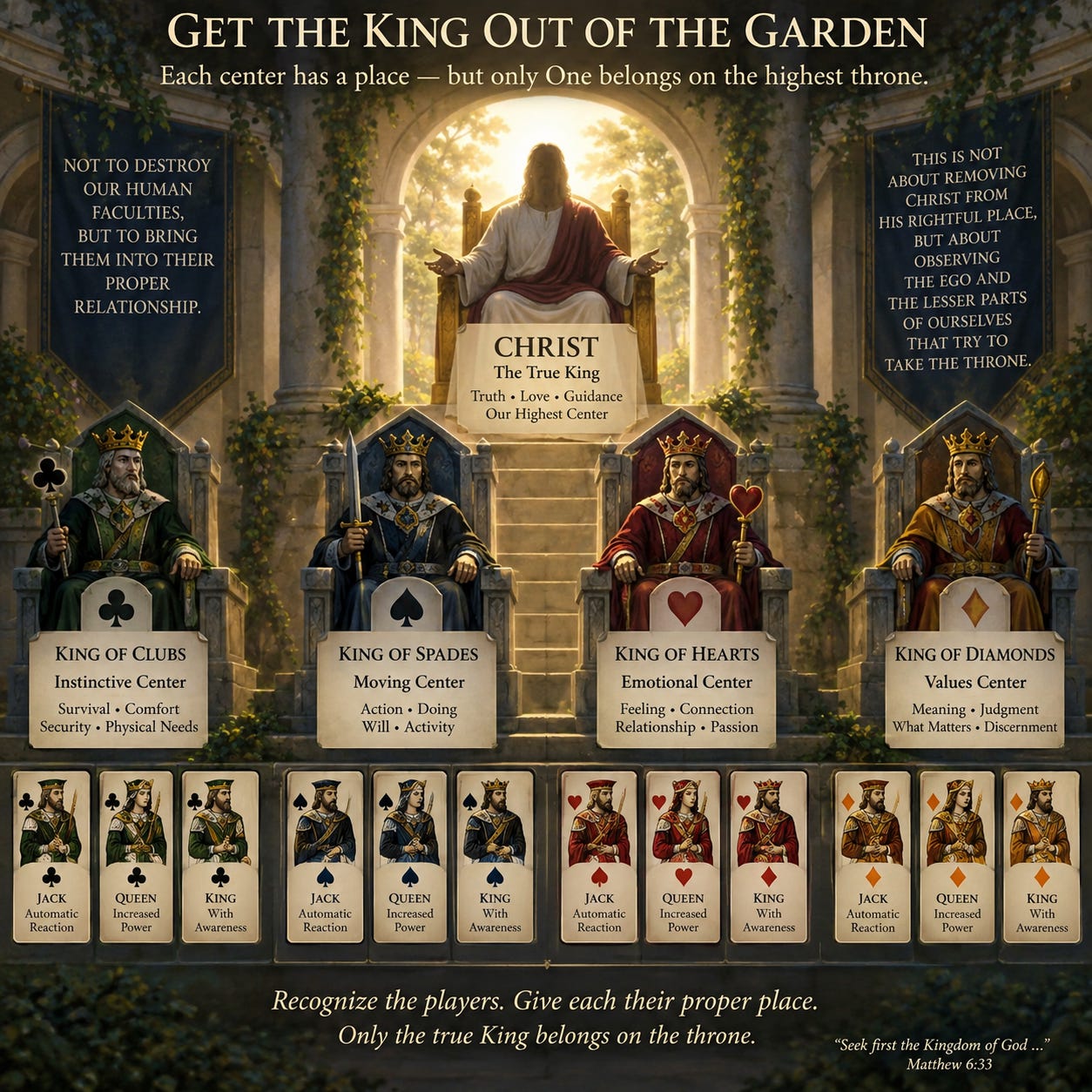
In the last chapter, we introduced an ordinary deck of playing cards as a simple way of recognizing some of the different parts operating within us. Clubs represented the instinctive center, Spades the moving or doing center, Hearts the emotional center, and Diamonds the part of us concerned with values, meaning, judgment, and what we consider important. The purpose was never to give ourselves another system to memorize. The cards are only a temporary map—a way of making something normally invisible a little easier to see. Eventually, we should be able to put the cards aside and simply recognize what is happening within ourselves as it happens.
But recognizing the center that is operating is only part of the picture. The same center can operate very differently depending upon our level of awareness. An emotion can explode instantly, overwhelm us completely, or be experienced with enough attention that we can choose what to do with it. An instinct can produce an automatic reaction, become a powerful fear or desire, or provide useful information without taking control of us. Thought itself can chatter mechanically, become absorbed in an idea, or quietly examine something with genuine attention. This brings us to another useful part of our playing-card picture: the Jack, Queen, and King.
The Jack — Life on Automatic
Think of the Jack as the most mechanical expression of a center. Something happens, and the Jack responds almost immediately. There is very little space between the impression and the reaction. Someone criticizes us, and we defend ourselves. Someone cuts us off in traffic and irritation appears. The telephone rings and our hand reaches for it almost before we have consciously decided to answer. We hear an opinion we disagree with and begin forming our rebuttal before the other person has finished speaking.
There is nothing inherently bad about the Jack. In fact, much of life requires automatic functioning. We could hardly drive a car if we had to consciously think through every movement of our hands and feet. Our instinctive center constantly regulates processes that would be impossible to manage consciously. Habits make ordinary life possible. The problem begins when an automatic response takes charge in a situation that requires awareness.
Imagine hearing something that challenges one of your long-held beliefs. Before you have really examined what was said, an inner voice announces, That cannot be right. That may be the intellectual Jack protecting an established idea. Or perhaps someone speaks sharply to you, and you immediately feel the need to strike back. The emotional Jack has already drawn its sword. The response may occur so quickly that we experience it simply as me. We do not say, “A reaction has arisen within me.” We say, “I am angry,” “I am offended,” or “I know this is wrong.”
Self-observation begins to change that.
Instead of immediately becoming the reaction, we begin to notice it. Something in me wants to answer right now. That tiny recognition is enormously important. For perhaps the first time, the Jack has been seen.
The Queen — When the Center Gains Power
The Queen represents something different. Here the energy of the center has become stronger and more developed. The experience is not merely an automatic flicker; it can fill our inner world. In the emotional center, for example, the Jack may snap at someone almost automatically, while the Queen may become deeply absorbed in anger, excitement, sorrow, affection, fear, or enthusiasm. The emotion has gathered force.
Again, this is not necessarily bad. Imagine trying to live without powerful emotion. There would be no deep compassion, no profound appreciation of beauty, no passionate love, no exhilaration, and very little of what gives human life richness. The Queen has tremendous energy.
But tremendous energy can also capture us.
We have all experienced moments when an emotion became so strong that it seemed unquestionably true simply because we felt it intensely. Fear can make danger appear greater than it is. Anger can convince us that another person deserves whatever judgment we place upon them. Excitement can make an idea seem far better than careful examination later reveals. The Queen does not merely react; she can become identified with the experience.
The same principle can appear in the other centers. The moving center may become absorbed in constant activity, unable to sit still because doing has become its identity. The instinctive center may magnify discomfort, security, appetite, or self-preservation until those concerns dominate everything else. Even our values can become intensified until something we genuinely treasure turns into rigidity: This is important to me, therefore everyone else should see it the same way.
The Fourth Way asks us to do something unusual here. We do not suppress the Queen, and we do not surrender the throne to her. We observe her.
That may mean feeling an emotion fully without immediately acting upon it. It may mean allowing discomfort to be present without automatically escaping it. It may mean noticing our enthusiasm for an idea while still asking whether the idea is actually true.
We receive the impression first.
Then we respond.
The King — Attention Enters the Picture
The King represents a center functioning with greater balance and attention. The emotion is still there. The instinct is still there. Thought is still operating. Action is still possible. But something has changed: we are present with it.
Suppose someone says something that angers us. The Jack may immediately retaliate. The Queen may become consumed by the anger. But the King of Hearts can feel the anger without immediately becoming its servant. He might notice the tightening in the abdomen, the change in breathing, the desire to answer sharply, and the thoughts beginning to assemble a defense. None of those things have to disappear. The difference is that attention has entered the experience.
Now there is space.
That space does not guarantee that we will make the perfect decision. Conscious living is not about becoming infallible. It simply gives us something mechanical living does not: choice.
Perhaps we still decide that something needs to be said. But now the response can come from discernment rather than reflex. Perhaps we realize that no response is necessary at all. Sometimes one of the most conscious things we can do is allow another person’s words to pass through the moment without giving them additional energy.
This is why progress in self-observation may be far less dramatic than we imagine. At first, we recognize the reaction an hour later: I really became identified with that. Eventually we recognize it five minutes later. Then perhaps while it is happening. Finally, there may be moments when we see it arising before it takes possession of us.
That is genuine change.
We are remembering ourselves sooner.
But Even the Kings Are Not the King
Here we arrive at an important distinction, especially considering the title of this series.
There can be a King of Hearts, a King of Clubs, a King of Spades, and a King of Diamonds. Each represents a center functioning intelligently and with greater awareness. Yet none of these lesser kings should occupy the supreme throne.
The intellect has an important job, but intellect alone should not rule our entire life. Emotion is essential, but emotion should not become the absolute monarch. Instinct protects the organism, but survival and comfort cannot determine every choice. The moving center allows us to act in the world, but endless activity is not the same as meaningful living. Even our values must remain open to deeper truth, because we can sincerely value something and still be mistaken.
Each king has his place, but each is subordinate to the King we ultimately place into office.
For the purposes of this journey, that higher King points toward the deepest God-oriented center within us—the place where truth, conscience, love, humility, and awareness begin to come together. Christians may recognize an echo of Jesus’ teaching about seeking first the Kingdom of God. The image is not of destroying our human faculties but of bringing them into their proper relationship. This is not meant to remove Christ from His rightful place in our lives. For the purpose of this teaching, our focus is on the ego—the lesser parts of ourselves that so easily take the throne—and learning how to observe them.
The intellect should think.
Emotion should feel.
Instinct should protect.
The moving center should act.
But none should seize the throne and declare itself the whole of who we are.
Perhaps this gives new meaning to the question that has been following us through this series:
Which king is ruling right now—and is that the king I truly want to serve?
Try Watching the Court
During the coming week, we can experiment with this without trying to analyze every moment of the day. Simply choose occasions when something within you becomes noticeable. Maybe someone disagrees with you. Maybe plans suddenly change. Perhaps you feel anxious, excited, irritated, impatient, or unusually determined to accomplish something.
First ask: Which suit is active?
Is this primarily instinctive? Moving? Emotional? Is it connected with values or something I consider especially important?
Then ask another question: Is this the Jack, Queen, or King?
Am I reacting automatically? Am I becoming swept up in the energy of the center? Or can I remain present enough to experience what is happening without immediately becoming it?
Do not worry about getting the classification exactly right. The purpose is not to become an expert card player of the psyche. The purpose is to catch that remarkable moment when we realize:
This is happening within me, but I do not have to become it.
That realization creates a small opening between stimulus and response. And in that opening, another possibility appears.
The King may enter the Garden.
Not by force. Not by defeating every other part of ourselves. Not by banishing the Jack or dethroning every Queen. They all have functions, and they all belong within the kingdom.
The work is simply to recognize them, give them their proper place, and stop allowing whichever one happens to shout the loudest to automatically sit upon the throne.
Perhaps that is where freedom begins—not when nothing inside us reacts, but when we finally become conscious enough to notice who is reacting before we hand them the crown.
Coming Next
Chapter 8 — The Moment Between Impression and Response
We will look more closely at that tiny inner space where self-observation can interrupt a mechanical reaction—and where genuine choice first becomes possible.
If you are joning here you may wish to start at chapter 1 or the previous chapter 6.
During this series, it may seem that there is some repetition. This is on purpose so we can integrate this a little better, as constant reminders help our subconscious come to the surface mind and become a habit rather than a striving. The king references will refer to our ego.