


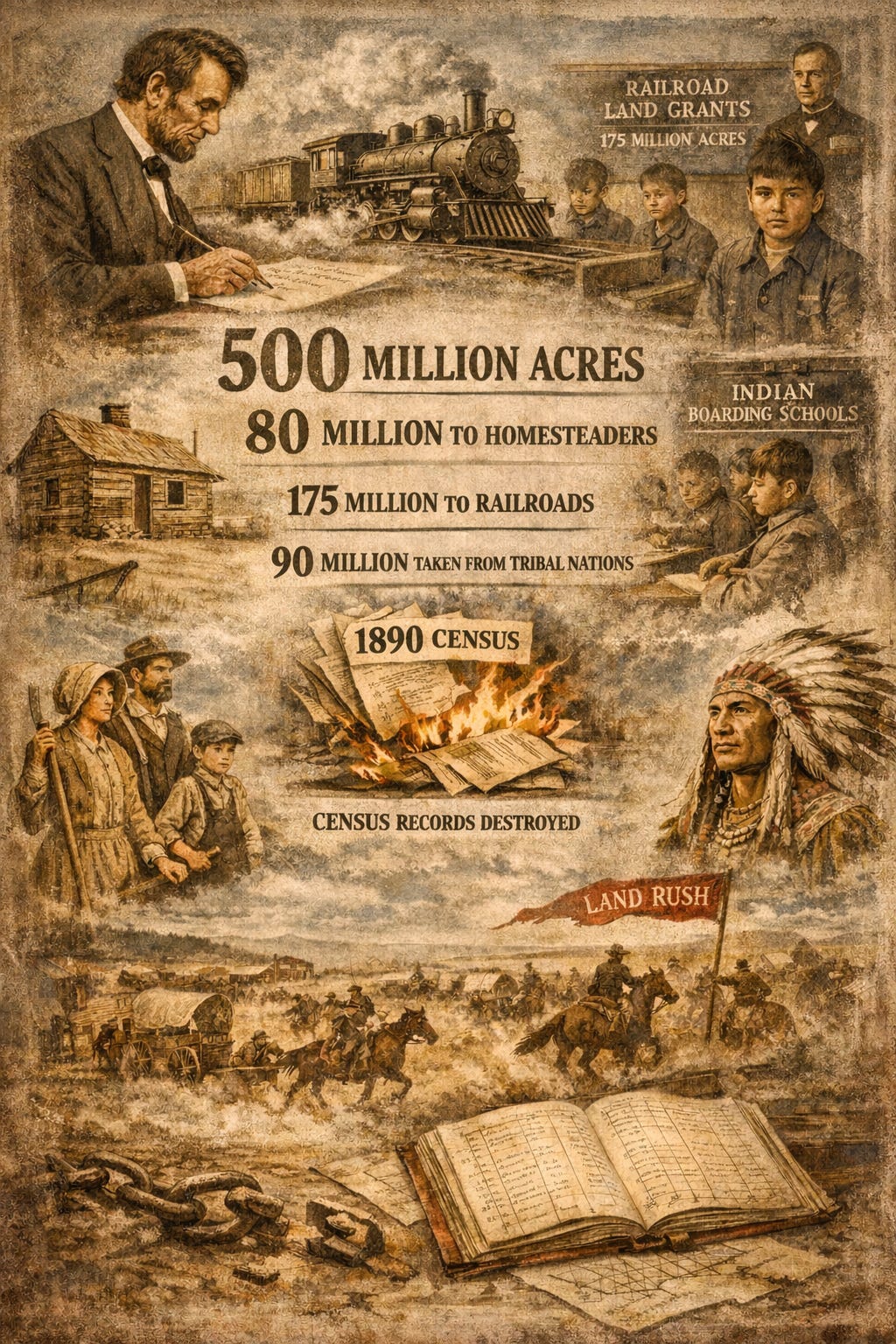
The National Archives—the U.S. government’s own official record—states that of the 500 million acres distributed between 1862 and 1904, only 80 million went to homesteaders.
Do the math.
That means 420 million acres went somewhere else.
The Homestead Act of 1862 is often told as a foundational American promise. Lincoln signs the law. Any citizen can claim 160 acres of public land, work it for five years, and own it for an $18 filing fee. The first claim is filed at midnight on January 1, 1863. Former slaves, immigrants, and women heading households could apply. More than 25,000 Black Americans moved to Kansas under its promise. Today, roughly 93 million Americans descend from homesteaders.
The farms were real. The work was real. The opportunity felt real.
But the government’s own numbers raise a harder question: if 500 million acres were distributed, and only 80 million went to families, where did the rest go?
A Law “Framed So Ambiguously”
The National Archives describes the Homestead Act as “framed so ambiguously that it seemed to invite fraud.”
It required a 12 by 14 dwelling, but never specified feet or inches. Speculators built 12-inch by 14-inch shacks to qualify.
The General Land Office was underfunded and unable to police widespread abuse. Officials were, in the Archives’ words, “often susceptible to bribery.”
Another loophole allowed claimants to “commute” their homestead—skipping the five-year residency requirement by paying $1.25 per acre after just six months. Speculators used this constantly: file, wait six months, pay $200, flip the land.
Historian Paul Wallace Gates documented how the act fueled fierce competition for resale, with influential speculators coming out on top.
But fraud alone doesn’t account for 420 million acres.
Three Laws. One Summer.
Within six weeks of signing the Homestead Act, Lincoln signed two more laws:
The Pacific Railroad Act (July 1, 1862)
The Morrill Land-Grant Act (July 2, 1862)
Together, they redistributed more territory than many wars.
Railroad companies received over 175 million acres of public land—more than the size of Texas. These were not loans; they were grants. The railroads then sold that land to settlers, often marketing aggressively in Europe. Much of that land never returned to public hands and remains with corporate successors.
The Morrill Act granted states 30,000 acres per congressional representative to fund colleges. Over 10.7 million acres were taken from more than 250 Indigenous nations. Some of that land is still held by states today and continues generating income.
Three acts. One summer. Homesteaders received the promise. Railroads and institutions received vast acreage.
The Land Had to Be Emptied
The Homestead Act did not distribute empty land. It distributed land that had to be emptied first.
The Dawes Act of 1887 broke up tribal lands into 160-acre allotments. “Surplus” land—everything beyond those parcels—was opened to white settlers.
In 1887, Native Americans held 138 million acres. By 1934, they held 48 million.
Ninety million acres were lost.
The mechanism was devastatingly efficient. After a 25-year trust period, allotments became subject to property taxes. Many Native families, unfamiliar with the imposed tax system and lacking cash income, could not pay. The land went to auction. Buyers were waiting.
At the same time, the federal government expanded a boarding school system—at least 408 schools across 37 states between 1819 and 1969—designed to remove Native children from their families and erase cultural ties. Land was fragmented. Governance was disrupted. Identity was attacked.
This was not one policy. It was a pattern.
Oklahoma and the Race for “Opportunity”
In 1893, a rifle shot signaled the start of the Cherokee Outlet land run. Over 100,000 people raced to claim 6 million acres in a single afternoon. Forty-two thousand homesteads were staked that day.
The Cherokee had been promised their territory “as long as the grass grows and the water runs.”
The land never came back.
The Census That Vanished
The 1890 census declared the American frontier officially closed. It documented immigration, property ownership, family structure—the most transformative decade of land transfer in U.S. history.
In 1921, a fire destroyed most of it. The remaining records were authorized for destruction in 1933.
99.99% of the records are gone.
The decade of the Dawes Act, boarding school expansion, railroad land sales, and Oklahoma land runs is the one decade genealogists cannot see.
Perhaps a coincidence.
But the numbers remain:
500 million acres distributed
80 million to homesteaders
175 million to railroads
10.7 million to universities
90 million taken through allotment
408 boarding schools
One destroyed census
That is not just a narrative. It is a ledger.
What This Means Now
This is not an attack on homesteaders. They worked hard. They built families and communities. Their inheritance is real.
But they were participants in a system larger than they understood.
The law was written with loopholes. Enforcement was underfunded. Land was declared “surplus.” Children were removed. Records disappeared. And 420 million acres—84% of the total—went not to families but to corporations, speculators, and institutions that still hold much of it today.
The question isn’t whether this happened. The government’s own archives confirm it.
The question is why we remember the Homestead Act as a simple gift to families when the numbers tell a far more complicated story.
And what else from that era have we been taught to remember as myth rather than math?