


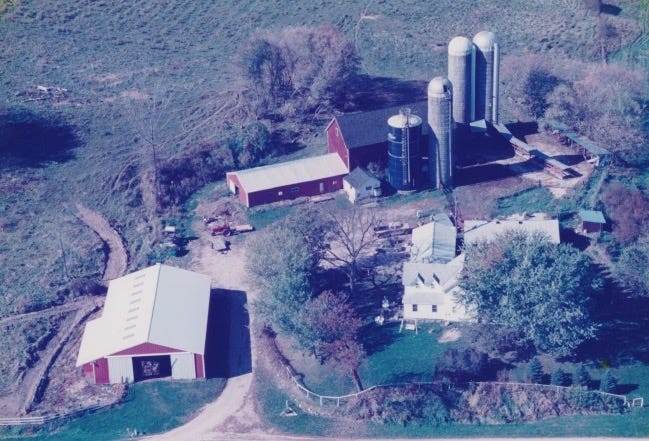
People often say the dairy years were “the good old days,” but anyone who lived through them knows better. They were good in some ways, yes, full of action and very good exercise, but they were also some of the hardest years a person can shoulder. From 1969 to 1993, dairy farming taught me lessons I didn’t fully understand until long after the last cow left the barn, which was one of my hardest days, having had cows on the farm my entire life. Due to some health issues, I made the hard decision to stop.
One of the first lessons was commitment, the kind that eats up every hour of every day. Dairy farming doesn’t give you weekends or holidays. It doesn’t care if you’re exhausted, discouraged, or dealing with life’s problems. Cows need to be milked on time, every single day, twice a day, without exception. It’s a schedule that shapes your life more than any clock ever could. We even did a stint of milking three times a day, but that soon took its toll.
People who haven’t lived it don’t understand the weight of that responsibility. When you’re tied to a dairy farm, you learn early that your time isn’t really your own. You might plan something such as a family gathering, a night out, a short trip, but all plans were tentative until the chores were done, the cows were fed, and everything was running smoothly. Even then, you half-expected something to go wrong. Cropping was done between chores because we produced the feed for the herd as well.
Those years also taught the lesson of financial pressure, the kind that creeps into your stomach. Prices swung up and down, interest rates escalated, and the cost of doing business usually did not match the money coming in. You learn to operate on thin margins, stretch every dollar as much as possible, and fix things yourself because hiring someone wasn’t in the cards. There were months when you hoped for a good milk check just to get ahead, and others where you just hoped to get by. It was a life you really had to grow into from an early age to understand fully. You had to want that way of life with the independence, the work, and the satisfaction of being as self-sufficient as possible.
But there were rewards, too. There’s something satisfying about running a dairy farm the right way, a clean barn, healthy cattle, everything in as much order as time allowed, but there were those days where order did not quite fit the schedule. There were moments when the feeling of a well-run operation felt like music with the hum of the vacuum pump, the sound of milk flowing into the tank, the steady routines that kept everything moving. It wasn’t very glamorous, but it was honest & productive work.
Winter, especially, brought its own kind of peace when everything went well, which was far and few between. Standing in a warm barn with content cows on a cold night is something only farmers understand. We had a stanchion and tie-stall barn. Each cow had her own stall, and if another cow took it, she would just wait patiently until we backed the trespasser out so she could take her rightful place.
Of course, the hardest lesson during those years was resilience, because dairy farming will test you in ways nothing else does. Equipment breaks in the middle of a job. Calves are born at inconvenient hours, with many nightly trips to the barn checking on their progress, and many hours sitting in the bedding with the barn cats on your lap, waiting for some progress so you could go back to bed. Cows get sick at the worst possible time, and calves often need help being born. Weather changes everything without warning. And through it all, you can’t quit. You keep going because quitting isn’t an option when you have a herd depending on you, just like family, and that is the way most smaller farmers see their animals.
One cold winter day, I got trapped in a silo when the bull wheel of the silo unloader got stuck. I got it freed and watched the silo unloader make several passes. I pulled the plug to crawl down and hit the breaker, planning to plug the cord back in after clearing the chute — but the chute had plugged, and I was trapped. By pure luck, there was a slip pipe on the blower chute I could remove. I broke a hole in the chute and climbed out and down about 25 feet along the unloader cable. It was 30 below that day. I tell my wife that when these things happen, they just test a person’s ingenuity and resilience.
Those years also taught something more subtle, like the value of community. Farmers helped each other because no one else understood the life the way another farmer did. When you were in a bind, someone showed up. When a neighbor was struggling, you took your turn helping them. It wasn’t formal, and it wasn’t asked for; it was just what you did. In a world that moves faster every year, that kind of unspoken support is becoming rare.
And then there were the moments that stay with you long after the hard years end: a barn full of content cows after chores, a perfect first cutting of hay, a pre-sunrise over the fields as you walked to the pasture to bring the cows in the barn for morning milking. Small things, but meaningful ones, the kind you don’t appreciate until time gives you distance. I once saw a flaming meteor in the dawn light, but heard no sound as it burned up before hitting the ground.
By 1993, the dairy years came to a close, but the lessons of the farm never did. Those decades shaped how I work, how I prioritize, and how I face challenges even now. They taught me that strength isn’t very loud, resilience isn’t very dramatic, and responsibility is built through those countless non-glamorous days
If the farm taught me where work begins, the dairy years taught me how far a person can go when the work truly depends on them.