

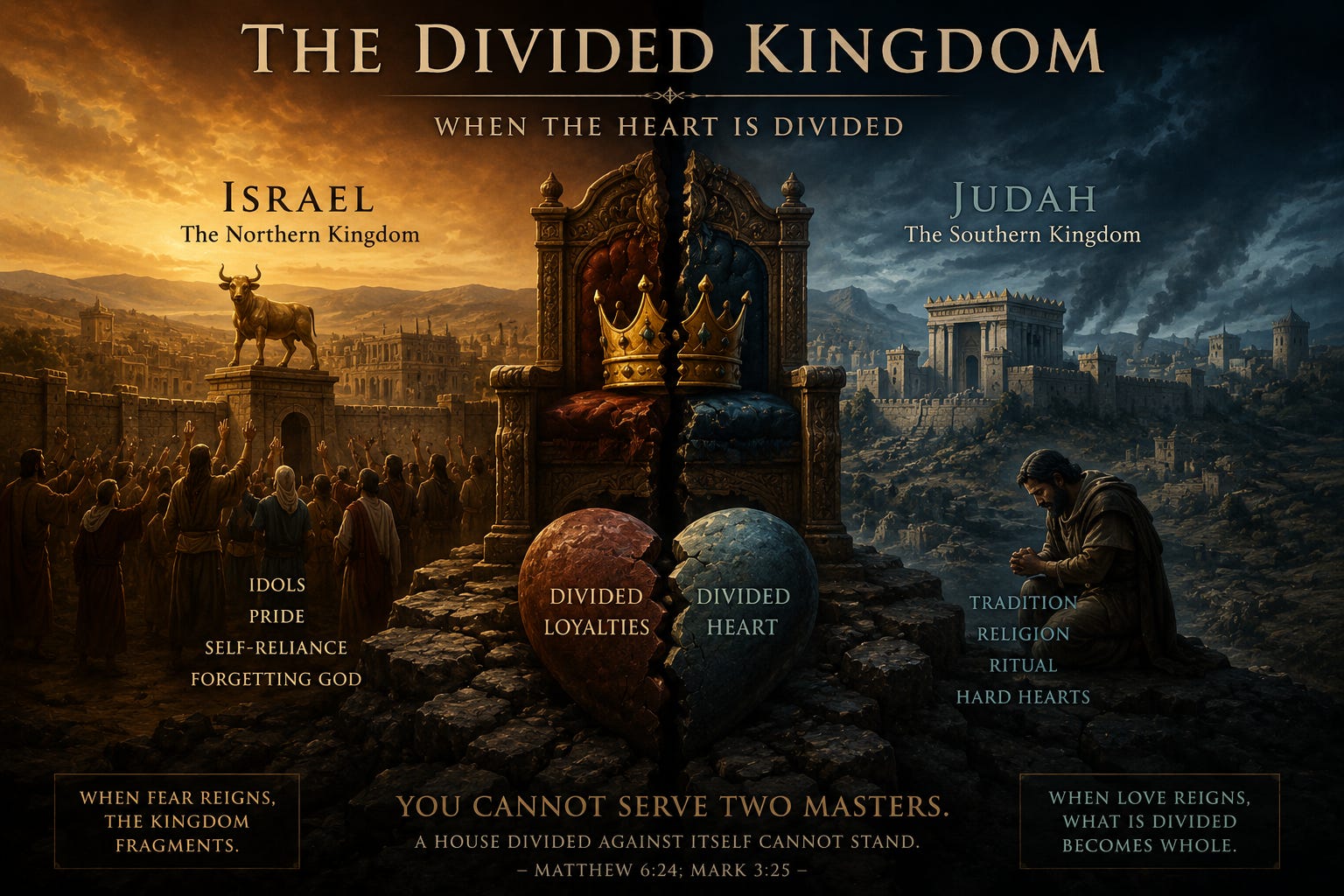
Following the reigns of David and Solomon, the united kingdom of Israel fractured into two kingdoms. The northern kingdom retained the name Israel, while the southern kingdom became Judah. Political tensions, questions of power, heavy burdens, pride, and competing loyalties tore apart what had once been united. What had reached a remarkable period of strength and prosperity under David and Solomon could not hold together. Historically, this division would have enormous consequences. The two kingdoms would follow separate paths, have different rulers, face different enemies, and eventually experience conquest and exile. Yet like so many stories in Scripture, the divided kingdom can also become a mirror held before us.
Few of us live with a completely undivided heart. Most of us know what it feels like to be pulled in opposite directions. Part of us genuinely longs to live with compassion, forgiveness, generosity, and trust, while another part seeks recognition, control, security, comfort, or the satisfaction of being right. We desire peace while continuing to feed thoughts that create anxiety. We want to forgive while another voice quietly keeps a record of the offense. We want to love unconditionally, yet our pride can be wounded by something as simple as another person’s words. Perhaps the divided kingdom is not as far away as we think. It may exist within us every day.
We saw in the previous article that the United Kingdom can symbolize those moments when the different parts of ourselves begin working together under a higher purpose. Our thoughts, emotions, conscience, desires, and actions become more aligned. We experience less inner conflict because something deeper is guiding us. But such unity requires tending. The biblical kingdom did not divide overnight. Cracks had already begun appearing during Solomon’s reign. Wealth, power, competing loyalties, heavy demands upon the people, and spiritual compromise gradually weakened what appeared outwardly strong. When Solomon died, the underlying tensions came to the surface.
Perhaps our own inner divisions develop in much the same way. We rarely wake up one morning and decide to become bitter. Resentment grows a little at a time. We rarely decide to become prideful. We simply begin enjoying recognition a little too much. We do not consciously choose fear as our ruler; we listen to it repeatedly until its voice becomes familiar. We do not announce that we are abandoning love; we simply allow smaller concerns to occupy more and more of our attention. Then one day we discover that something within us has divided.
This may be why self-observation matters so much. If we wait until the kingdom has completely fractured, restoring it becomes much more difficult. But if we begin noticing the smaller cracks—the irritation, the defensiveness, the need for approval, the desire to control, the resentment quietly forming—we may have an opportunity to respond before those things become rulers. Perhaps spiritual maturity involves learning to notice division while it is still small.
Jesus would later warn that a kingdom divided against itself cannot stand. While His words arose in a particular context, the image speaks powerfully to our inward experience. A divided life eventually becomes exhausting. Part of us says forgive, while another says, “Not yet.” Part of us says trust, while another says, “But what if?” Part of us says love, while another says, “Only if they deserve it.” Part of us says let go, while another says, “But then who will make sure they know they were wrong?” Perhaps this is why inner peace can sometimes seem so difficult. We are not merely dealing with the outside world. We are negotiating with an entire kingdom within ourselves.
The Bible’s repeated concern with idolatry also becomes especially meaningful here. Historically, Israel and Judah were repeatedly drawn toward the gods and religious practices of surrounding peoples. But symbolically, idolatry can describe something that still happens within the human heart. An idol is not necessarily a statue. An idol can be anything to which we give the devotion, identity, security, or ultimate trust that belongs to God. Money can become an idol. Reputation can become an idol. Success can become an idol. Pleasure can become an idol. Religious certainty can become an idol. Political identity can become an idol. Even our own opinions can become idols when defending them becomes more important than discovering whether they are true.
Perhaps the easiest idol to worship is the one we do not recognize as an idol. We may never bow before a carved image, yet we can bow inwardly every day. We bow whenever fear determines what we will do, whenever the approval of others becomes necessary for our sense of worth, whenever money becomes the measure of security, or whenever being right becomes more important than loving the person standing before us. Perhaps idolatry ultimately asks the same question we have been asking throughout this series: what is sitting on the throne?
The divided kingdom reminds us that we cannot serve competing masters indefinitely. We may attempt to live with one foot in love and the other in fear, one foot in service and the other in self-preservation, one foot in humility and the other in pride, but eventually the tension begins to pull us apart. Inner division produces unrest. We can even feel this within ourselves when we say something that does not agree with what we truly believe. Something feels unsettled. We may justify ourselves outwardly while inwardly recognizing that something is not right. Perhaps conscience is one of the ways we become aware that the kingdom has divided. There is a part of us that knows. The question is whether we are willing to listen.
This division is not merely an individual struggle. Humanity reflects the same pattern on a much larger scale. Nations divide. Families divide. Communities divide. Churches divide. Religions divide. Politics divides people into opposing camps. Even sincere seekers of truth can separate into groups, each becoming increasingly certain that they possess the whole picture while everyone else has somehow missed it. The internet has probably made this even easier to see. We can surround ourselves almost entirely with people who agree with us. We can hear the same ideas repeated until they begin to feel unquestionably true. People on the other side can gradually stop looking like fellow human beings and begin looking like categories.
Perhaps division becomes most dangerous when we stop seeing the person and see only the label. Christian, atheist, conservative, liberal, believer, unbeliever, right, wrong, us, them—these labels may sometimes describe genuine differences, but they can also become walls. Perhaps this takes us all the way back to the Garden. The Tree of the Knowledge of Good and Evil introduced a world increasingly experienced through division: good and evil, right and wrong, worthy and unworthy, us and them. Discernment is necessary; we cannot live wisely without recognizing real differences between truth and falsehood, kindness and cruelty, wisdom and foolishness. But discernment can quietly become judgment, and judgment can become identity. Then the question is no longer, “Is this idea true?” It becomes, “Which side are you on?”
Once identity becomes attached to the answer, changing our mind becomes increasingly difficult because we are no longer merely reconsidering an idea. We feel as though we are threatening ourselves. Perhaps this is one reason humility is so important in the search for truth. Humility does not mean believing nothing. It means remaining teachable. It means being able to say, “This is what I presently understand, but perhaps there is more for me to see.”
That has become an important prayer in my own journey: “Father, I want to know the truth even if it changes the way I believe.” There is something freeing about that prayer because it places truth above identity. It means I do not have to defend every belief I have ever held merely because I once held it. I can learn. I can change. I can discover that part of what I believed was incomplete without feeling that my entire life has been wasted. Perhaps that is one way the divided kingdom begins to heal—not through everyone becoming identical, but through everyone becoming more willing to seek truth with humility.
The prophets enter Israel’s story precisely during these periods of growing division, idolatry, injustice, and forgetfulness. They repeatedly call the people back. Their message is not simply prediction about distant future events. Much of their work is a call to remember: remember God, remember justice, remember mercy, remember the covenant, remember how you are supposed to treat one another. Symbolically, perhaps the prophetic voice represents something within us that keeps calling us back when we wander. It may be conscience. It may come through Scripture. It may come through another person. It may come through a dream. It may arise during silence. It may appear after we say something hurtful and suddenly hear ourselves. It may come through an uncomfortable realization that the problem we have been blaming entirely upon someone else also involves something within us.
The prophetic voice is not always comfortable because sometimes it says exactly what the false king does not want to hear. It tells us that we are becoming what we once opposed, that we are holding onto resentment, that we are more interested in being right than understanding, that we say we want peace while continuing to feed the conflict, or that we claim to trust God while fear is still making the decisions. Perhaps we sometimes try to silence that voice just as Israel sometimes resisted its prophets. But the voice keeps returning, calling us back to truth, to love, to humility, and to what matters most.
This is where the divided kingdom becomes more than a story about failure. Running throughout the prophets is a remarkable thread of hope. God is portrayed as gathering what has been scattered, healing what has been broken, restoring what has been lost, and bringing together what has been divided. Division is real, but division does not have the final word.
This is equally important within ourselves. Spiritual growth is not about destroying the parts of us that we dislike. We may be tempted to declare war upon our fear, anger, insecurity, or ego, but perhaps that only creates another form of inner division. Our fears may need understanding. Our wounds may need healing. Our anger may need to be listened to before it can be transformed. Our ambitions may need a higher purpose. Our personality does not need to disappear. Even the ego does not necessarily need to be hated. It simply needs to stop pretending that it is king.
Perhaps the goal is not inner destruction but inner order. Every part finds its proper place. Fear can warn us without ruling us. Emotion can enrich us without controlling us. Reason can guide us without becoming cold. Desire can motivate us without becoming master. Personality can express us without becoming our entire identity. And love can sit at the center. Perhaps that is what healing the divided kingdom looks like.
This journey is rarely quick. Like Israel itself, we move through seasons of faithfulness followed by periods of forgetfulness. We make progress and then discover ourselves slipping into an old habit. We forgive and later feel resentment returning. We become more patient and then lose our temper over something remarkably small. But perhaps, as we discovered in Judges, the path is not a circle but a spiral. We return to familiar struggles, but perhaps each time from a slightly different place. We notice them sooner. We understand them more deeply. We remain trapped for a shorter period. We become a little less certain that someone else is entirely responsible for what is happening within us. Two steps forward and one step back is still forward movement.
The divided kingdom therefore is not simply a lesson about ancient Israel and Judah. It is a mirror held before every one of us. The Garden asked, “Where are you?” Cain asked, “Where is your brother?” Noah asked what remains when the familiar world disappears. Jacob asked what we are willing to wrestle with in order to become someone new. Joseph asked whether we can trust the journey when we cannot understand the chapter we are living. Egypt asked what within us still holds us captive. The wilderness asked what must change before we can live freely. Joshua asked whether we are willing to live what we have learned. Goliath asked what fear we have allowed to become larger than it really is. Judges asked how quickly we recognize when we have wandered back into an old pattern. The United Kingdom asked what is sitting on the throne within us.
Now the Divided Kingdom asks the question even more directly: Who sits upon the throne of your heart—is it your ego, or is it Christ? That question is not answered once. We answer it in ordinary moments every day. We answer it when someone insults us, when someone disagrees with us, when another person succeeds, when we are afraid, when we are given power, when nobody is watching, and when we discover that something we believed may not be true. Whatever occupies the throne eventually shapes the kingdom.
When fear reigns, the kingdom fragments. When pride reigns, the kingdom competes. When ego reigns, everything eventually becomes about protecting the self. But when Christ reigns, the direction begins to change. Love becomes more important than winning. Truth becomes more important than protecting an identity. Forgiveness becomes more important than keeping score. Service becomes more important than recognition. Humility becomes more important than appearing certain. The scattered pieces begin coming home.
Perhaps that is the quiet hope woven throughout the entire biblical story—not merely that ancient kingdoms might someday be reunited, but that the human heart itself might become one. We have left the Garden. We have wandered. We have wrestled. We have been enslaved. We have crossed wildernesses. We have faced giants. We have experienced moments of unity and then watched the kingdom divide again. Yet through every stage, the invitation remains: return to truth, return to love, return to the One who belongs upon the throne.
The kingdom may fracture, but the invitation to become whole never disappears. And the journey home goes on.
Coming Next: The Prophets— The voice that laeds us back
Do we listen?