


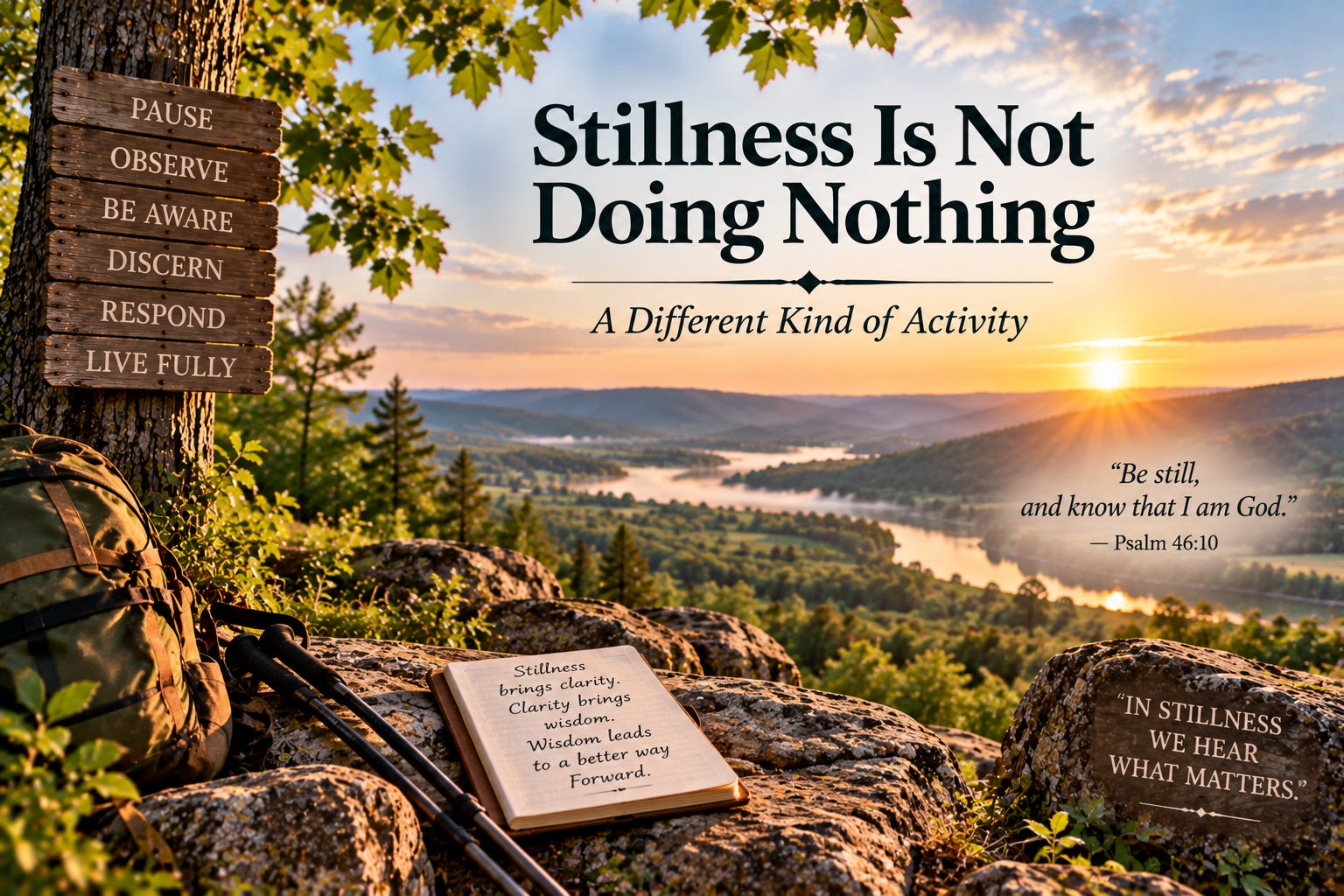
For most of my life, stillness felt like a stranger. If I wasn’t moving, fixing, or improving something, it felt like time was being wasted. There was always work to be done, something to tend, something that needed attention—and very little time to rest and ponder life. Stillness didn’t feel important; it felt more like a waste of time.
What I’ve learned—slowly—is that stillness isn’t the absence of effort. It’s a different kind of work altogether. For those who have lived most of their lives without much stillness, it can feel very much like work at first. When life is busy, motion feels good. We stay busy, so we don’t have to listen too closely. We fill the space with noise, tasks, opinions, and updates—not because they’re all necessary, but because quiet has a way of bringing forward things we’ve been avoiding.
Stillness does the opposite of distraction. It removes the cover and leaves you face-to-face with what you’ve been delaying or ignoring. And that’s exactly why it matters. When everything slows down, the truth finally has room to surface. You begin to notice what’s been nagging at you—not loudly, but persistently. You feel the places where you’ve been pushing too hard or holding too tightly. You hear the small inner signals that constant motion drowns out—signals of stress, or the quiet knowing that something you’ve been hiding from will eventually need attention.
Stillness doesn’t create clarity; it uncovers it. It brings things into view so they can be observed, evaluated, and eventually cleared in whatever way is necessary. That process can be uncomfortable at first. The mind doesn’t like to be left alone. It will replay conversations, rehearse worries, and drag unfinished business into the light. That’s normal. It isn’t failure—it’s the beginning of awareness.
If you stay with stillness long enough, something shifts. Things begin to settle. The urgency loosens its grip. You start to see your thoughts instead of being pulled around by them. This is where meditation quietly enters the picture—not as something mystical or forbidden, but as a simple and important practice that only those willing to be quiet for a little while ever really experience.
Meditation isn’t about emptying your mind or achieving some elevated state, and it certainly isn’t about doing it “right.” At its simplest, meditation is practicing stillness on purpose. You sit, you breathe, and you notice. You notice the breath moving in and out. You notice tension and restlessness—and eventually, space. You watch your thoughts come and go without judgment or dialogue, much like watching leaves float down a small stream.
What’s beneficial isn’t the calm itself, but the relationship you build with your inner world. Over time, meditation teaches you that thoughts don’t have to be obeyed and emotions don’t have to be fixed immediately. Silence no longer feels like something to escape. Physically, this kind of stillness helps settle the nervous system. Heart rate slows, stress hormones ease, and the body finally gets a chance to stand down from constant alert. Even the medical profession has come to recognize how important this is for overall well-being.
Mentally, stillness creates space between stimulus and response. That space—small at first—can change how you show up everywhere else: in conversations, in conflict, and in decision-making. Stillness trains you to respond instead of react. The goal isn’t to sit on a cushion or chair all day, but to carry that steadiness into ordinary moments—a quiet cup of a brew of your choosing before the day begins, a pause before answering a hard question, or a few slow breaths when frustration shows up.
Stillness isn’t withdrawal from life. It’s learning how to meet life head-on without being constantly thrown off balance. I’ve come to see it not as an interruption to productivity, but as a form of maintenance—like letting an engine idle long enough to cool, or sharpening a tool instead of forcing it when it’s dull. Some of the most important movement in life happens when we stop moving for a moment.
Sometimes, the clearest direction forward arrives only after we’ve been willing to sit quietly and listen. Quiet is not the enemy; it’s the friend waiting in the background—ready to meet you in a way you may not be quite used to yet.