


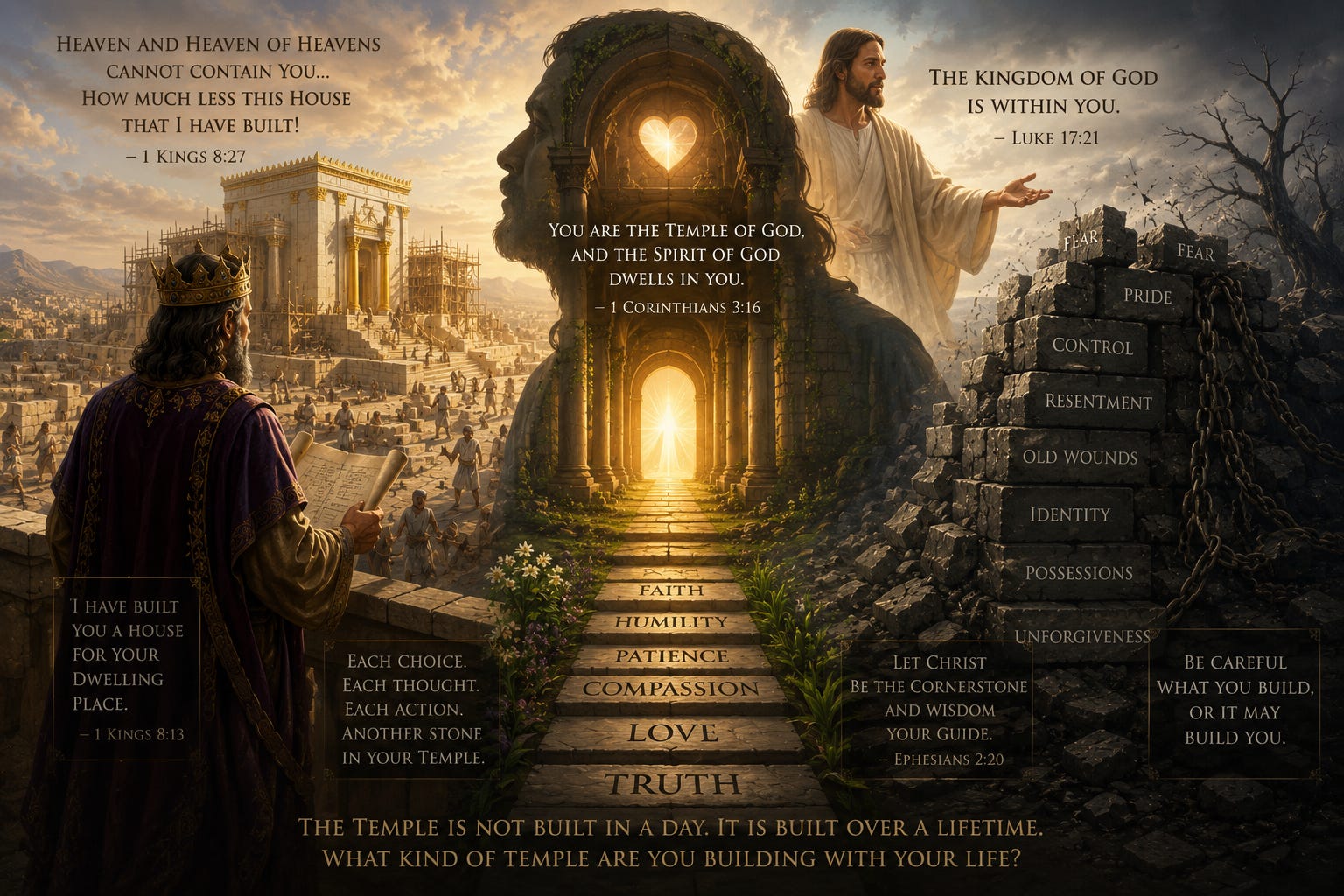
After David’s victories came an entirely different kind of task. David was remembered as a warrior, but Solomon became known as a builder. The battles that had occupied one generation gave way to a generation devoted to wisdom, peace, and creation.
Perhaps this is why Solomon follows David so naturally in the biblical story. Before we can build something lasting within ourselves, we must first confront the giants that stand in our way. Fear, resentment, pride, insecurity, and the need to control can occupy so much of our inner territory that there is little room left for anything sacred to be built. Once these forces begin to lose their grip, however, our attention can gradually shift from fighting to creating.
The first thing Solomon asked of God was not wealth, power, or long life. He asked for wisdom. That request alone speaks volumes. Wisdom is more than knowledge. Knowledge accumulates facts, but wisdom sees relationships. Knowledge explains how the world works; wisdom understands how life ought to be lived. Knowledge can make us clever, but wisdom teaches us what is worthy of our attention, what should be released, and what kind of person we are becoming.
This is an important step in the inner journey. It is not enough to defeat one giant or overcome one fear. We must eventually learn how to live differently. We need the wisdom to recognize which thoughts should be welcomed into our inner world, which desires should guide our actions, and which old patterns must no longer be permitted to rule us.
The Temple Solomon built has often been viewed simply as a magnificent structure dedicated to the worship of God. It was built of carefully prepared stone, cedar, precious metals, and gold. Yet beneath the historical account lies a powerful spiritual question: What are we building within ourselves?
A temple is a place prepared for the presence of God. Symbolically, Solomon’s Temple can represent the inner life being prepared to receive a greater awareness of the divine. It suggests that spiritual transformation is not only about removing what is harmful. It is also about deliberately building what is sacred.
We are always building something within ourselves, whether we realize it or not. Every repeated thought lays another stone. Every choice adds something to the structure. Every act of love strengthens it, while every resentment left unexamined becomes part of its walls. Over time, our inner world takes shape through the things we repeatedly think, desire, fear, and practice.
This makes the story intensely personal. As we read about Solomon constructing the Temple, we are invited to ask not only what happened long ago, but where this story is happening within us now. What kind of inner dwelling are we creating? Are we building a sanctuary of peace, truth, compassion, and wisdom, or are we filling our inner rooms with anxiety, judgment, distraction, and old grievances?
The stones used in the Temple were prepared before they were brought to the building site. According to the biblical account, the stones were shaped elsewhere so that the sound of hammers and iron tools was not heard during construction. This beautiful detail carries a deeper meaning. Much of our spiritual formation also happens quietly, away from public view.
The most important changes within us are not always dramatic. They often occur in the silence of reflection, in the moment we choose not to react in anger, in the private decision to forgive, or in the willingness to examine a belief we have held for years. These quiet choices may seem insignificant, but they are shaping the stones from which our inner temple is built.
No one may hear the sound of that construction. Others may not see the struggle taking place within us. Yet every sincere effort to become more loving, patient, truthful, or courageous prepares another stone for the sacred structure taking shape inside.
The Temple itself contained different areas, each leading deeper toward its spiritual center. There was an outer court, a Holy Place, and finally the Holy of Holies. These levels can be understood as symbols of our own inward journey.
The outer court may represent the visible part of our lives: our actions, habits, relationships, and the way we present ourselves to the world. This is where the spiritual journey often begins. We attempt to live more honestly, treat others more compassionately, and bring our outward conduct into harmony with what we believe.
Yet the journey cannot end with outward behavior. We must move inward to the realm of our thoughts, motives, and desires. This deeper space might be compared to the Holy Place. Here we begin to examine not merely what we do, but why we do it. An outwardly good action can still arise from a desire for recognition, fear of rejection, or the need to appear righteous. Wisdom teaches us to look beneath the surface.
Beyond this lies the Holy of Holies, the innermost chamber of the Temple. It was the place associated with the presence of God. Symbolically, it represents the deepest center of our being—the quiet place beneath our roles, fears, opinions, and carefully constructed identities.
Many of us spend much of our lives in the outer courts of ourselves. We remain occupied with appearances, responsibilities, disagreements, possessions, and the countless distractions of daily life. These things are not necessarily wrong, but they can keep us from entering the deeper sanctuary within.
The Holy of Holies suggests that there is a sacred center beyond the noise. It is the place where we no longer need to defend ourselves, prove ourselves, or pretend to be something we are not. It is where the false king loses his throne and the presence of God becomes the true center of the inner kingdom.
This does not mean that God is confined to a physical location inside us. Rather, the Temple symbolizes a state of inner awareness in which we become receptive to divine wisdom, love, and guidance. The Temple is not merely somewhere God once dwelled. It is the sacred space being formed within us whenever our heart becomes quiet enough to listen and open enough to love.
Solomon covered much of the Temple’s interior with gold. Gold has long symbolized what is pure, lasting, and incorruptible. Inwardly, this may point to the refining of our character. Life repeatedly places us in situations that reveal what is still unfinished within us. Conflict exposes our impatience. Loss reveals our attachments. Criticism uncovers our pride. Uncertainty brings hidden fears to the surface.
These experiences may initially feel like interruptions or misfortunes, but they can also become part of the refining process. The difficulties of life often show us which parts of our inner temple remain incomplete. They reveal where the walls are weak, where the foundation needs strengthening, and where something false has been covered over rather than transformed.
The temple is built whenever we meet those moments consciously. We add something lasting when we choose understanding instead of immediate judgment, courage instead of avoidance, humility instead of defensiveness, or forgiveness instead of carrying an injury indefinitely.
Each choice may appear small, yet every choice leads us down a road. One decision becomes a habit, one habit shapes our character, and our character gradually determines the kind of inner world in which we live. Before us are always many branching roads, and wisdom helps us recognize which one leads toward greater wholeness.
This is why Solomon’s request for wisdom was essential. Building the inner temple requires discernment. Not everything that enters our minds deserves to remain there. Not every desire should become a command. Not every wound should be given a permanent room. Not every voice speaking within us is the voice of truth.
Wisdom becomes the inner architect. It helps us recognize what belongs in the sacred space and what must be removed. It teaches us when to act and when to wait, when to speak and when silence would be more loving, when to hold on and when releasing something is the only way to move forward.
Yet Solomon’s later life also offers a warning. A magnificent outer temple cannot protect us if the inner kingdom becomes divided. We may construct something beautiful in the world, possess great knowledge, or appear spiritually successful while gradually losing contact with the sacred center within.
The Temple was never meant to become a substitute for transformation. Religious structures, teachings, traditions, and rituals can point us toward God, but they cannot do the inner work for us. We may stand inside a holy building while carrying turmoil, bitterness, or division within our own hearts.
The true temple is built through the way we live. It is constructed through patience when impatience would be easier, compassion when judgment comes naturally, honesty when concealment would be convenient, and love when fear encourages us to close ourselves off.
Perhaps this is the deeper invitation within Solomon’s story. After the battles have been fought and some of our giants have fallen, what will we build in the space they once occupied? Will we allow another fear, ambition, or false king to take their place, or will we create an inner sanctuary where wisdom and love can dwell?
The biblical narratives invite us to see more than history. They invite us to recognize the same spiritual journey unfolding within ourselves. Solomon’s Temple is not only an ancient structure of stone and cedar. It is an image of the human soul gradually becoming a dwelling place for something greater than the ego.
That temple is not completed in a single moment. It is built through one thought, one choice, and one act of love at a time. And perhaps its construction continues for a lifetime.
Coming Next: When the Heart Becomes Divided
Even after the Temple was built, the story was far from over. In our next article, we will explore how a kingdom once united became divided—and what this reveals about the subtle ways our own hearts can drift from wisdom, love, and inner harmony.