

We began this journey in a Garden. In Genesis, humanity awakens in Eden surrounded by life, abundance, innocence, and the presence of God. There is no temple because the Garden itself is the sanctuary. There is no priesthood because humanity walks directly with God. There is no complicated religious system because separation has not yet entered human consciousness. At the center of this Garden stand two trees: the Tree of the Knowledge of Good and Evil and the Tree of Life.
Then something changes. Humanity eats from the tree of divided knowledge, their eyes are opened, shame appears, hiding begins, and blame follows. The human being is driven from the Garden, and from that moment onward, the Bible becomes, in one sense, the enormous story of humanity trying to find its way home.
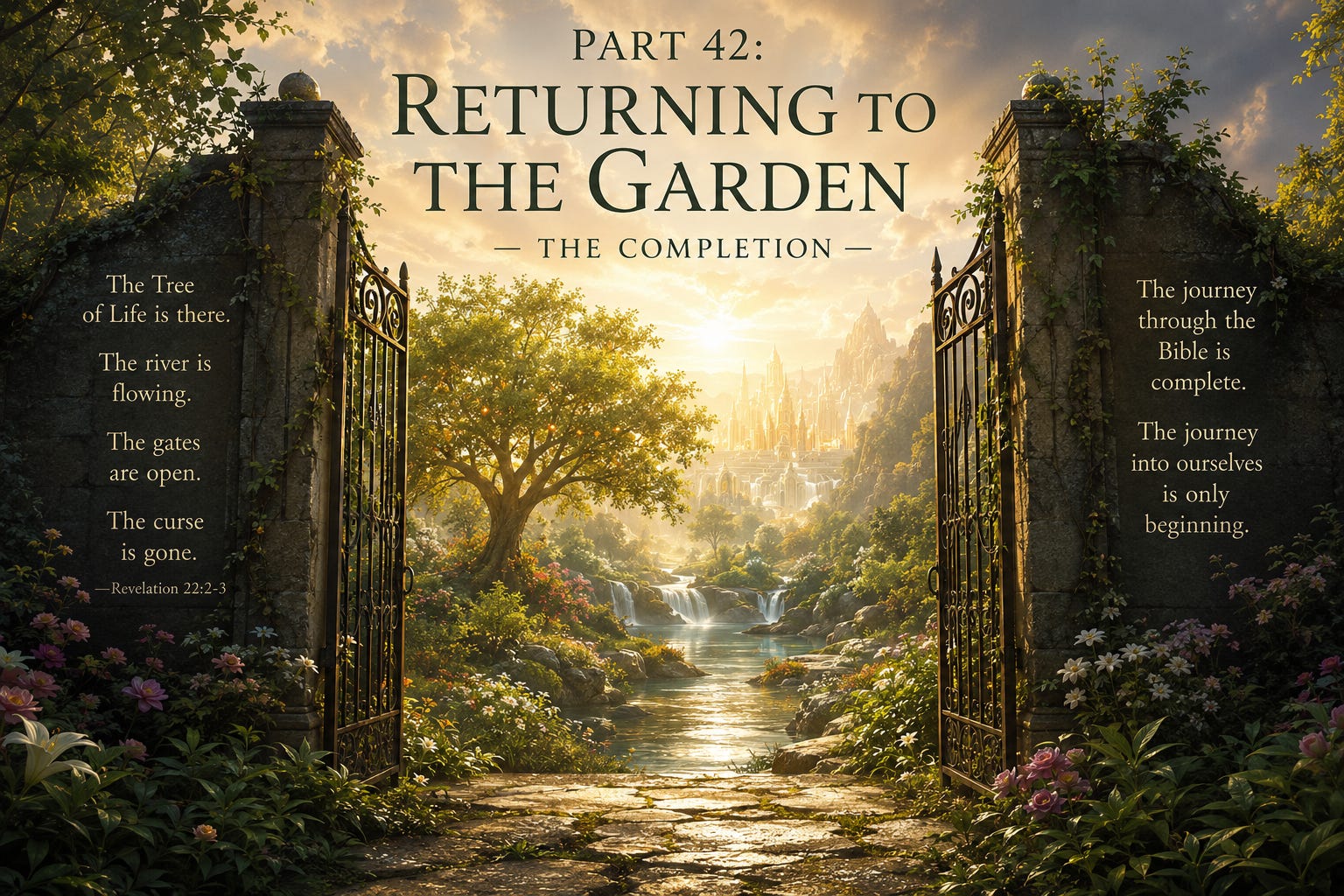
When we finally arrive at the last chapters of Revelation, something remarkable happens. The Tree of Life is there again. The river is there again. God dwells with humanity again, and the curse is gone. The Bible ends where it began, but we do not return to the Garden as the same people who left it.
The Long Journey Home
If we read the Bible only as a sequence of historical events, Genesis and Revelation can seem separated by thousands of years and dozens of books. But when we begin reading Scripture inwardly, another pattern becomes visible. Adam and Eve, Cain and Abel, Noah, Abraham, Jacob, Joseph, Moses, Pharaoh, the wilderness, the Promised Land, David, Solomon, the prophets, exile, Jesus, the Cross, Resurrection, Pentecost, Paul, the Body of Christ, the Mind of Christ, and finally Revelation can all become descriptions of movements within the human soul.
The Bible then becomes not merely the story of people who lived long ago, but a mirror held before us. There can be an Adam within us who awakens and a serpent that whispers. There can be a Cain who becomes jealous, a Pharaoh who refuses to surrender control, a wilderness where old identities die, a promised land waiting to be entered, and a David confronting Goliath. There can be a Solomon tempted by power and excess, an exile when we become separated from what is deepest within us, and prophets calling us back. There can be a Christ knocking at the door, a cross upon which something false must die, a resurrection in which something greater can awaken, and a Pentecost in which Spirit is no longer merely encountered outside us but experienced within.
Seen this way, Revelation is not simply the destruction of the world. It is an unveiling of what has been hidden, and the New Heaven and New Earth can represent not only a renewed creation but also a transformation of consciousness—a new way of seeing and therefore a new way of living.
The entire journey has been leading us back toward the Garden.
But What Was Lost in the Garden?
Perhaps what humanity lost was not primarily a geographical location. Perhaps we lost a state of consciousness.
The Garden can represent an inner condition in which the different dimensions of the human being exist in harmony under the presence of God. There is no need to hide because there is no divided self pretending to be something it is not. There is no need to dominate because there is nothing to defend. There is awareness without the constant inner commentary that interprets, judges, fears, compares, and protects.
Then another voice enters the Garden. It begins telling us who we are, what we lack, what we deserve, whom to blame, what others are thinking about us, how important we are, or how inadequate we are. Before long, that voice begins ruling the Garden.
This is what I have increasingly come to think of as the false king. The false king is not simply evil in the ordinary sense. It is the mechanical personality—the accumulated reactions, fears, desires, defenses, habits, opinions, identities, and stories that gradually take possession of the throne of consciousness. It is the part of us that responds automatically and then tells us afterward that we consciously chose the response.
We become angry and say, “I am angry.” We become afraid and say, “I am afraid.” A thought appears, and we say, “I think.” An opinion arises, and we immediately defend it as though our very existence depends upon it. But what if the thought is happening within us without being the whole of us? What if the emotion is happening within us without needing to become our master? What if there is something deeper that can watch?
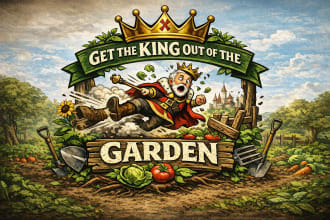
Get the King Out of the Garden
That strange phrase came to me long before I fully understood what it might mean: Get the King out of the Garden. It eventually became the title of my entire writings because I sensed that it contained something important, and over time its meaning has grown clearer.
The Garden is consciousness, and the king is whatever occupies the throne. Much of the time, the true ruler of our inner life is not the Spirit of God, love, wisdom, or conscious awareness. It is whichever mechanical part of ourselves happens to be strongest at that moment. Sometimes fear is king. Sometimes anger is king. Sometimes pride, political identity, religious certainty, the need to be right, or the approval of other people sits on the throne. Perhaps the most difficult king to recognize is the spiritual ego—the part of us that believes it has finally figured everything out.
Removing the false king does not mean destroying our personality or eliminating thought and emotion. The Garden needs all of these capacities. Thinking has a purpose. Emotion has a purpose. Instinct has a purpose. Action has a purpose. The problem arises when one part takes the throne and claims to be the whole person.
Perhaps spiritual growth is not the destruction of these parts but their restoration to their proper place. The false king must leave the throne so that something greater can occupy it.
The Sword at the Entrance
After Adam and Eve leave Eden, Genesis tells us that cherubim and a flaming sword guard the way to the Tree of Life. For years I thought of that image mainly as exclusion: humanity had sinned, so the road back was blocked. But perhaps there is another way to see it. Maybe we cannot return to the Tree of Life while remaining exactly as we were.
Something must pass through the sword. Our illusions must pass through it, along with our false identities, our certainty, our demand to control life, and our insistence that the little self remain ruler. The ego wants to return to Eden while remaining king, but that may be the one thing that cannot happen.
Jesus continually points toward this paradox. Lose your life, and you will find it. Become like a child. The greatest must become the servant. The first will be last. Take up your cross. Die so that you may live. These teachings become far more than moral commands when viewed inwardly. They can describe the dismantling of the false king.
The way back to the Garden passes through surrender.
The Tree Returns
At the end of Revelation, John sees the river of the water of life flowing from the throne of God. On either side of the river stands the Tree of Life, bearing fruit, and its leaves are for the healing of the nations. The image is astonishing because the tree humanity lost in Genesis appears once again.
Yet now the Garden has become something greater. Genesis begins with a Garden, while Revelation ends with what might be called a Garden-city. What began in innocence has now passed through struggle, suffering, knowledge, division, exile, awakening, death, and resurrection.
The destination is not simply the innocence with which we began. It is something closer to conscious union. A child may possess innocence because the child has not yet encountered much of the world’s complexity. But there is another kind of innocence that can appear after a person has encountered darkness and still chooses light, has encountered hatred and still chooses love, has encountered fear and still chooses trust, and has experienced the power of the ego without continuing to obey it.
Perhaps that is part of the consciousness represented by the New Jerusalem. We return to the Garden, but now we know what it means to leave it.
The Kingdom Was Never Far Away
Jesus said that the Kingdom of God is within—or among—you. That single teaching changes the direction of the search.
For centuries human beings have searched outwardly for the Kingdom. We have built institutions, created doctrines, fought wars, divided denominations, argued over interpretations, waited for prophetic timetables, and sometimes condemned one another in the name of the very God who commanded us to love one another. Yet Jesus continually directs attention toward transformation: blessed are the pure in heart, forgive, love your enemies, do not judge hypocritically, remove the beam from your own eye, become like a child, and seek the Kingdom.
These are not merely instructions for belonging to the correct religion. They are invitations to an entirely different quality of being. Perhaps the Garden has never been as far away as we imagined. Perhaps we have been standing in it all along while looking somewhere else.
Seeing the Serpent Without Obeying It
Returning to the Garden does not mean temptation disappears, difficult emotions vanish, or life suddenly becomes peaceful. Jesus himself experienced temptation, sorrow, frustration, opposition, and suffering. The change may not be in what appears within consciousness, but in our relationship to what appears.
A thought can arise without becoming king. Anger can arise without becoming king. Fear, desire, disappointment, pride, or even a deeply held religious belief can arise without taking possession of the throne. We can begin to see these movements rather than immediately becoming them.
The moment we see them, something remarkable happens: a small space appears between the impression and our response. In that space there is possibility. I can react, or I can observe. I can defend myself, or I can listen. I can condemn, or I can become curious. I can obey the old mechanical pattern, or I can wait long enough for another response to become possible.
Perhaps that tiny space is one of the entrances back into the Garden.
The Bible as an Inner Map
This has been the central purpose of this entire series. I have not tried to prove that the Bible is only symbolic, nor have I tried to deny its historical dimensions. My hope has simply been to recover something that can easily be overlooked: Scripture can speak about us.
The Israelites can wander through our wilderness. Pharaoh can harden his heart within us. Goliath can stand before us. Jonah can flee within us. The Prodigal Son can awaken within us. Christ can be crucified and resurrected within us. Pentecost can occur within us. Revelation can unveil what has been hidden within us, and Eden can be rediscovered within us.
Once we begin reading Scripture this way, the question changes. Instead of asking only, “Did this happen?” we begin asking another question that may be just as important: Is this happening in me?
That question cannot be answered by theology alone. It requires observation.
And That Brings Us to the Next Journey
For these many articles, we have explored the possibility that the Bible describes an inner spiritual journey. But there is an obvious problem: how do we know what is actually happening inside us?
It is easy to read about Pharaoh and recognize him in somebody else. It is easy to read about the Pharisees and think of another religious group. It is easy to recognize pride, anger, greed, fear, hypocrisy, self-deception, and stubbornness in the world around us. Seeing those same movements in ourselves is much harder, and even more difficult is observing them while they are happening.
That is where our next journey begins. I want to move now from interpretation toward observation.
Recently I have been exploring a teaching commonly called the Fourth Way, particularly its practical approach to self-observation. I do not see it as a replacement for Jesus or for the spiritual truths we have explored in this series. I am interested in it because it offers practical tools for examining something Jesus repeatedly told us to examine: ourselves.
Instead of asking only, “What does Pharaoh symbolize?” we can begin asking, “Can I notice the Pharaoh in me when it refuses to surrender control?” Instead of asking only, “What does the sleeping disciple represent?” we can ask, “Am I awake right now?” Instead of merely discussing the false king, we can learn to recognize the moment he climbs onto the throne.
The Fourth Way uses ideas such as centers of consciousness, mechanical reactions, identification, self-remembering, attention, and observing without judgment. Some of its terminology will initially sound unfamiliar, but the underlying questions are surprisingly simple: Which part of me is answering right now? Can I see that part without becoming it? What is sitting on the throne? Can I receive an impression before automatically reacting to it?
Those questions take us from philosophy into experiment. They move us away from merely believing or interpreting and toward actually observing.
The Garden Is Here
Perhaps there was never a road back to Eden because Eden was not primarily somewhere behind us. Perhaps it is something beneath the noise—beneath the identities, beneath the arguments, beneath the fear, and beneath the voice that constantly explains who we are and what everyone else is doing wrong.
There remains something within us capable of seeing, listening, and receiving the moment before judging it. There is something capable of love before asking what it will receive in return. Jesus called us toward that place again and again. The prophets pointed toward it. The Cross reveals the surrender necessary to enter it. The Resurrection reveals what can awaken when the false self no longer rules. Pentecost reveals the Spirit dwelling within, and Revelation unveils the final transformation.
At the end of the story, the Tree of Life is waiting. The river is flowing. The gates are open. The curse is gone. The Garden has returned.
Or perhaps we have finally become able to see that it was here all along.
Our short journey through the Bible is complete, but the journey into ourselves is only beginning.
Coming Next
A New Series: The Fourth Way — Learning to Observe Ourselves
We have spent this series asking what the biblical story might mean within us. Now we will begin asking a more challenging question:
Can we actually see it happening?
If these teachings make sense to you, maybe you can also share them with others. Our world needs a lot of help as we are so divided and confused. Many, especially some of our young have departed from the Bibles wisdom. Maybe these articles will spark something that can make some sense out of why we are in the pickle we are in and how to grow out of it.