

The renewal of the inner world — and the life that grows from it
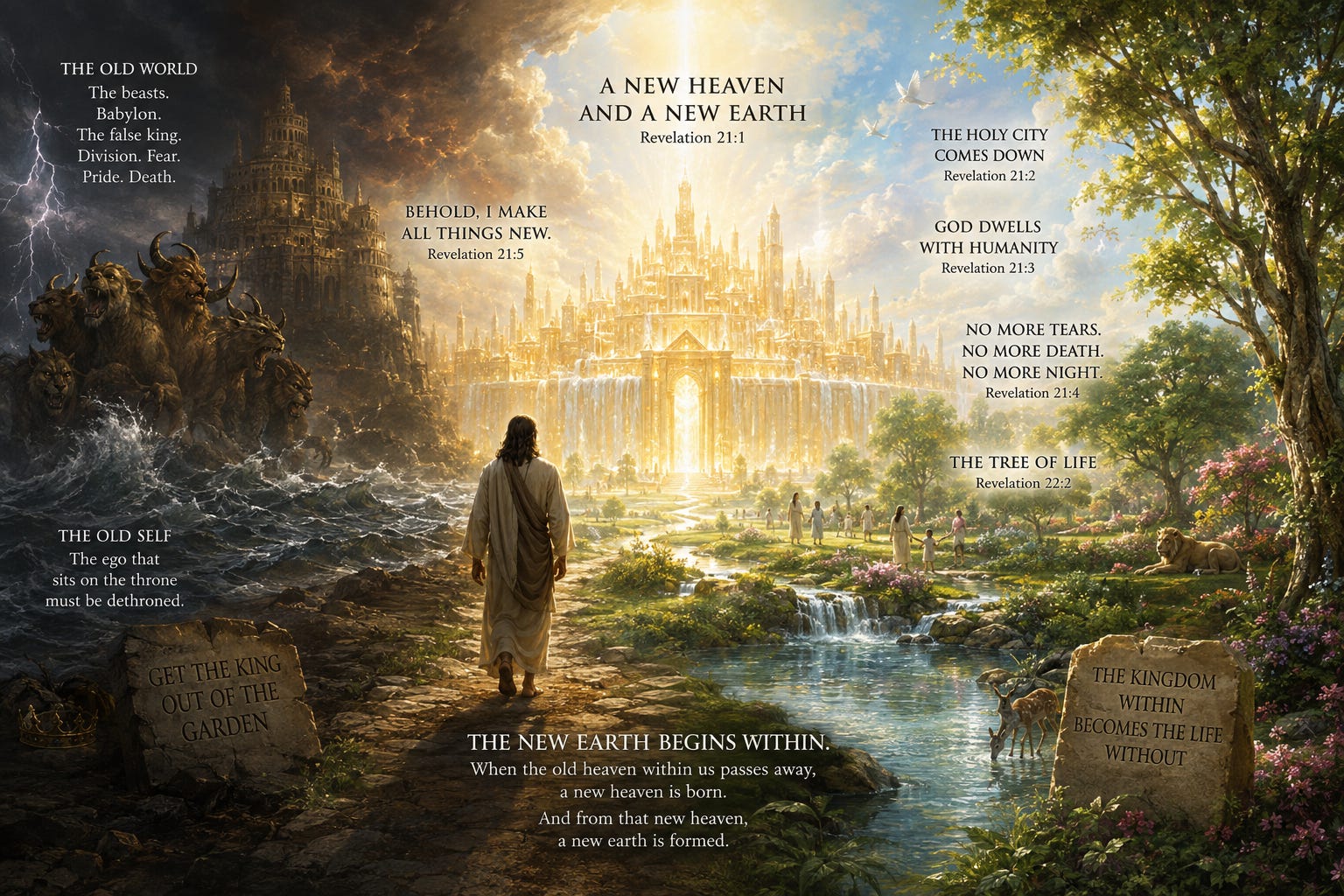
Near the end of Revelation, after the beasts, the battles, Babylon, judgment, and the collapse of everything that falsely claimed authority, John is shown something entirely different: “And I saw a new heaven and a new earth: for the first heaven and the first earth were passed away” (Revelation 21:1).
For centuries, these words have often been understood as a prediction that the present world will someday be destroyed and replaced by another. There may certainly be a cosmic dimension to John’s vision, but throughout this series we have been asking another question as well: What if Scripture is also describing something happening within us? If Revelation is an unveiling of what has been hidden within human consciousness, then the New Heaven and New Earth may describe the result of that unveiling. The old inner world passes away because the person who began the journey is no longer seeing, thinking, feeling, and living in quite the same way. The beasts have been recognized, Babylon has fallen, and the false powers that once ruled from within have begun to lose their throne. Something new can now appear.
The First Heaven and Earth
In biblical symbolism, heaven and earth can be understood as two dimensions of human existence. Heaven represents the invisible realm of spirit, consciousness, understanding, thought, meaning, and inner orientation, while earth represents the visible realm where that consciousness takes form through our actions, relationships, choices, habits, bodies, communities, and daily lives. In this sense, heaven is the inner world from which our outer world continually emerges.
Jesus repeatedly pointed toward this relationship. He taught that what proceeds outwardly from a person first arises inwardly. Anger, compassion, greed, forgiveness, hatred, love, fear, and faith are born in the unseen regions of the heart and mind before they become visible through words and actions. This means there can be no truly new earth without first having a new heaven. We can change governments, institutions, laws, economic systems, churches, organizations, and social structures, and many of those changes may be necessary and beneficial, but eventually the same human tendencies often reappear because the consciousness creating those systems has not fundamentally changed.
Jesus continually directed attention toward the source. He spoke of cleansing the inside of the cup rather than merely polishing its exterior. He warned that outward religious correctness could conceal inward corruption, and he taught that the Kingdom of God was already within and among us. Again and again, Jesus moved attention away from appearance alone and toward the condition of the inner person. If a new world is ever to emerge outwardly, something must first become new within us.
“Behold, I Make All Things New”
John then hears the one seated upon the throne declare, “Behold, I make all things new” (Revelation 21:5). There is something important in the wording. It does not merely say, I make all new things. It says, I make all things new. Spiritual transformation does not necessarily mean escaping our present lives and receiving entirely different circumstances. The same marriage, family, work, body, neighbors, difficulties, responsibilities, and world may remain around us, yet all of them can be experienced differently because the consciousness encountering them has changed.
A person who once experienced criticism only as an attack may begin to see it as an opportunity for self-observation. Someone who previously reacted immediately in anger may begin to discover a small space between the feeling and the response. A person driven by fear may gradually learn trust, while someone who once needed constant recognition may become increasingly comfortable simply doing what is right without needing others to notice. The outer circumstances may remain surprisingly similar, yet the inner world meeting those circumstances has changed dramatically.
This is one way the New Heaven begins to appear. When that changed consciousness begins affecting how we speak, forgive, work, judge, love, spend, serve, and relate to others, the New Heaven begins producing a New Earth. What begins invisibly eventually becomes visible.
The Holy City Comes Down
John then sees something remarkable: “And I John saw the holy city, new Jerusalem, coming down from God out of heaven” (Revelation 21:2). The direction is worth noticing. John does not describe humanity abandoning the earth and climbing upward into the New Jerusalem. He sees the holy city coming down from heaven to earth. The divine pattern moves from the unseen into the seen. Spirit becomes embodied.
This closely resembles the words Christians have prayed for centuries in the Lord’s Prayer: “Thy kingdom come. Thy will be done in earth, as it is in heaven.” Perhaps we have repeated those words many times without recognizing how closely they resemble Revelation’s ending. Heaven and earth are being brought together. The separation between spiritual understanding and everyday living begins to disappear.
We no longer merely believe in love; we become more loving. We no longer merely believe in forgiveness; we begin forgiving. We no longer merely speak about compassion; compassion increasingly appears in the way we respond to people who frustrate, disappoint, or disagree with us. We no longer simply discuss the Kingdom of God as a theological idea; the Kingdom begins taking form through human beings whose inner lives are being transformed. In this sense, incarnation continues wherever the invisible Spirit of God becomes visible through human life.
The Dwelling Place of God
Then comes one of Revelation’s most beautiful statements: “Behold, the tabernacle of God is with men, and he will dwell with them” (Revelation 21:3). The biblical journey has come full circle. In the beginning, humanity encounters God in a Garden. Later God is encountered on mountains, in fire and cloud, within the Tabernacle, inside the Temple, through prophets, and finally through Jesus. After Jesus comes Pentecost, when the Spirit is no longer presented merely as something encountered externally but as something dwelling within humanity.
Now, near Revelation’s conclusion, the separation seems to disappear even further. God dwells with humanity. The sacred is no longer confined to a building, priesthood, ritual, mountain, denomination, institution, or religious system. This does not make churches, worship, Scripture, or religious community meaningless. Rather, the outward forms become expressions of a reality that must also be alive within the person.
The whole person begins to become sacred ground. The spiritual life is no longer something we merely visit on certain days or in certain buildings; it becomes a way of seeing and living.
“There Was No More Sea”
John adds a curious detail when he says that “there was no more sea.” Taken completely literally, this can seem strange. Why would a renewed creation have no oceans? Symbolically, however, the sea frequently represents chaos, instability, danger, and the mysterious depths from which destructive forces can arise. Earlier in Revelation, the beast itself rises out of the sea.
If the beast represents the mechanical, fearful, ego-driven forces within human consciousness, then the disappearance of the sea can take on a deeper meaning. The unconscious chaos no longer rules the person in the same way. This does not mean that emotion, instinct, mystery, or the depths of the psyche disappear. It means those depths are increasingly brought into awareness. What once controlled us from beneath the surface can now be seen.
Many of our reactions begin long before our conscious mind knows what is happening. Someone says something, and anger immediately rises. Another person receives recognition, and jealousy appears. A situation becomes uncertain, and fear takes control. We often explain these reactions only after they have already begun directing our behavior. The work of awakening involves gradually bringing these hidden processes into the light so they no longer rule us unnoticed.
Perhaps this is part of what Revelation means when it says that the sea is gone. The beast loses its hiding place because what once operated unconsciously has been brought into conscious awareness.
No More Tears
John continues by saying that God will wipe away every tear and that there will be no more death, sorrow, crying, or pain. This does not necessarily mean that a spiritually awakened person will never again experience grief or physical suffering. Jesus himself wept, and genuine compassion may actually make us more sensitive to the suffering of others rather than less.
There is, however, another kind of suffering that can begin to diminish: the suffering created by identification, resentment, wounded pride, fear, comparison, bitterness, and our continual demand that life unfold according to our expectations. Much of human suffering comes not only from what happens to us but from the inner story we construct around what happens. We replay an insult for days, imagine what someone thinks about us, become consumed by what another person received, wish endlessly that the past had been different, or convince ourselves that peace will come only after someone else changes.
As these inner structures lose some of their authority, a certain kind of sorrow really does begin to disappear. The event itself may still be painful, but we no longer automatically add another layer of suffering through resentment, resistance, or identification. Perhaps this is one way God begins wiping away our tears—not always by immediately removing every difficult circumstance, but by transforming the consciousness through which we experience it.
The Death of the Old Self
Revelation speaks repeatedly about death, yet spiritual transformation has always involved a kind of death. Jesus said, “Whosoever will save his life shall lose it: and whosoever will lose his life for my sake shall find it” (Matthew 16:25). Paul spoke of dying to the old self, while Jesus compared spiritual transformation to a grain of wheat falling into the earth and dying so that something greater could emerge. Baptism itself symbolizes death and resurrection.
The personality we have constructed throughout life naturally wants to preserve itself. It prefers familiar reactions, familiar beliefs, familiar identities, and familiar ways of seeing. It wants to remain in control because it has spent a lifetime assuming that it is the rightful ruler of our inner kingdom. Revelation can therefore be read as the story of that false kingdom gradually being exposed. One power after another is revealed, confronted, and removed until the true throne becomes visible.
This connects directly with the strange phrase that eventually gave this entire project its name: Get the King Out of the Garden. Perhaps the king that must leave the Garden is not reason, intelligence, or individuality. It is the false ruler within us—the ego, the mechanical personality, the identified self that assumes it must occupy the throne of consciousness. When that false king begins stepping down, the Garden can begin returning.
The New Jerusalem Is Within and Among Us
John describes the New Jerusalem using extraordinary imagery: walls of precious stones, gates of pearl, streets of gold, and foundations covered with jewels. We can certainly imagine these as descriptions of heavenly beauty, yet these materials can also carry symbolic meaning. Gold must be refined. Pearls form through irritation. Precious stones are created through tremendous forces within the earth.
Perhaps the Holy City is built, in part, from transformed human experience. The experiences we once wished had never happened may eventually become material from which something beautiful is formed. Our wounds can become compassion, our failures can become humility, our disappointments can become understanding, and our mistakes can become wisdom. Even suffering can deepen our ability to recognize the suffering of others.
This does not mean that suffering itself is good or that we should seek it. It means that suffering does not have to be meaningless. What once wounded us can, through transformation, become part of the structure of a wiser and more compassionate human being. Nothing has to be wasted.
The city is therefore not necessarily built from people who never struggled. It may be built from transformed struggle.
No Temple in the City
Then John makes one of his most radical statements: “And I saw no temple therein: for the Lord God Almighty and the Lamb are the temple of it” (Revelation 21:22). For an ancient religious mind, Jerusalem without a Temple would have been almost unimaginable. Yet John’s final vision contains no religious building at the center because there is no longer any need for one particular place where humanity must go to encounter God.
The distinction between sacred and ordinary begins dissolving. The kitchen can become sacred when love is expressed there. The workshop can become sacred when work is done consciously and honestly. A field can become sacred when we recognize the life surrounding us. Caring for another person can become sacred. Sitting quietly beneath a tree can become sacred. Even a difficult conversation can become sacred when we remain present enough to observe what is arising within ourselves instead of immediately reacting.
The spiritual life is no longer something separate from life itself. It becomes the consciousness with which life is lived.
There Is No Night There
John also says that the city has no need of the sun or moon because the glory of God illuminates it, and “there shall be no night there.” Night is the time when we cannot see clearly, and perhaps that is one of Revelation’s deepest themes: learning to see.
The word revelation means unveiling. Something hidden becomes visible. We begin seeing the motives beneath our actions, the fear beneath our anger, the insecurity beneath our need for control, the pride beneath some of our beliefs, and perhaps even the selfishness that can sometimes hide beneath actions we once thought were entirely virtuous. This kind of seeing can initially be uncomfortable because the ego prefers to preserve the image it has created of itself.
Yet the purpose of seeing darkness is not condemnation. It is illumination. We cannot become free from something we are unable or unwilling to see. Once a reaction, motive, fear, or pattern becomes genuinely visible, it begins losing some of its power to operate mechanically.
The night begins ending because consciousness has entered the places where unconsciousness once ruled.
A New Earth Begins Now
It would be easy to place the New Heaven and New Earth entirely in the future and imagine that someday God will repair everything while humanity waits. Yet Jesus repeatedly brought the Kingdom into the present. He said the Kingdom was near, among us, and within us. That suggests that the New Earth does not begin only at the end of history. It begins whenever the old world within a human being starts passing away.
Every time fear loses some of its authority and love becomes stronger, something of the earth becomes new. Every time resentment gives way to forgiveness, every time judgment becomes understanding, every time someone becomes conscious of a mechanical reaction instead of automatically obeying it, and every time compassion becomes stronger than self-interest, a little more of the Kingdom becomes visible in the world.
Perhaps Revelation is therefore not merely telling us what God may someday do for humanity. It may also be revealing what God is already attempting to do within humanity. The transformation begins within individual consciousness and then moves outward through relationships, families, communities, institutions, and eventually the wider world.
The New Heaven comes first because the outer world is continually being created from the inner one.
Almost Back to the Garden
We began this long biblical journey in a Garden. Humanity lived in openness before God, but something entered consciousness that produced division, shame, fear, blame, separation, and eventually violence. From there Scripture carried us through Cain and Abel, Noah, Abraham, Egypt, Moses, the wilderness, kings, prophets, exile, return, Jesus, the Cross, Resurrection, Pentecost, Paul, the Body of Christ, and finally the strange unveiling of Revelation.
Now, as we approach the final pages of the Bible, the imagery becomes surprisingly familiar. There is water again. There is life again. God dwells with humanity again. And most importantly, there is once again a tree.
The Tree of Life that disappeared from humanity’s reach in Genesis appears again in Revelation.
We have traveled through the entire biblical story only to discover that the destination resembles the place where we began. Yet humanity is no longer quite the same. The first Garden represents an innocence that has not yet passed through the long experience of separation, suffering, knowledge, choice, failure, redemption, death, and resurrection. The final Garden may represent something different: innocence regained through consciousness.
We are not simply returning to the beginning.
We are returning to the Garden with eyes opened by the journey.
And perhaps that is what the entire biblical story has been pointing toward.
Coming Next — Part 42: Returning to the Garden: The Completion
In the final part of this series, we will follow Revelation to the River of Life and the Tree of Life, where the Bible’s ending deliberately echoes its beginning. We will return to Eden, but we will ask whether the Garden at the end represents something greater than the Garden at the beginning.
The first Garden may have been innocence without experience. The final Garden may represent innocence joined with awakened consciousness—humanity having passed through separation and returning freely to communion with God.
And there we will finally return to the words that started this entire journey:
Get the King Out of the Garden. The newly transformed king can return.