


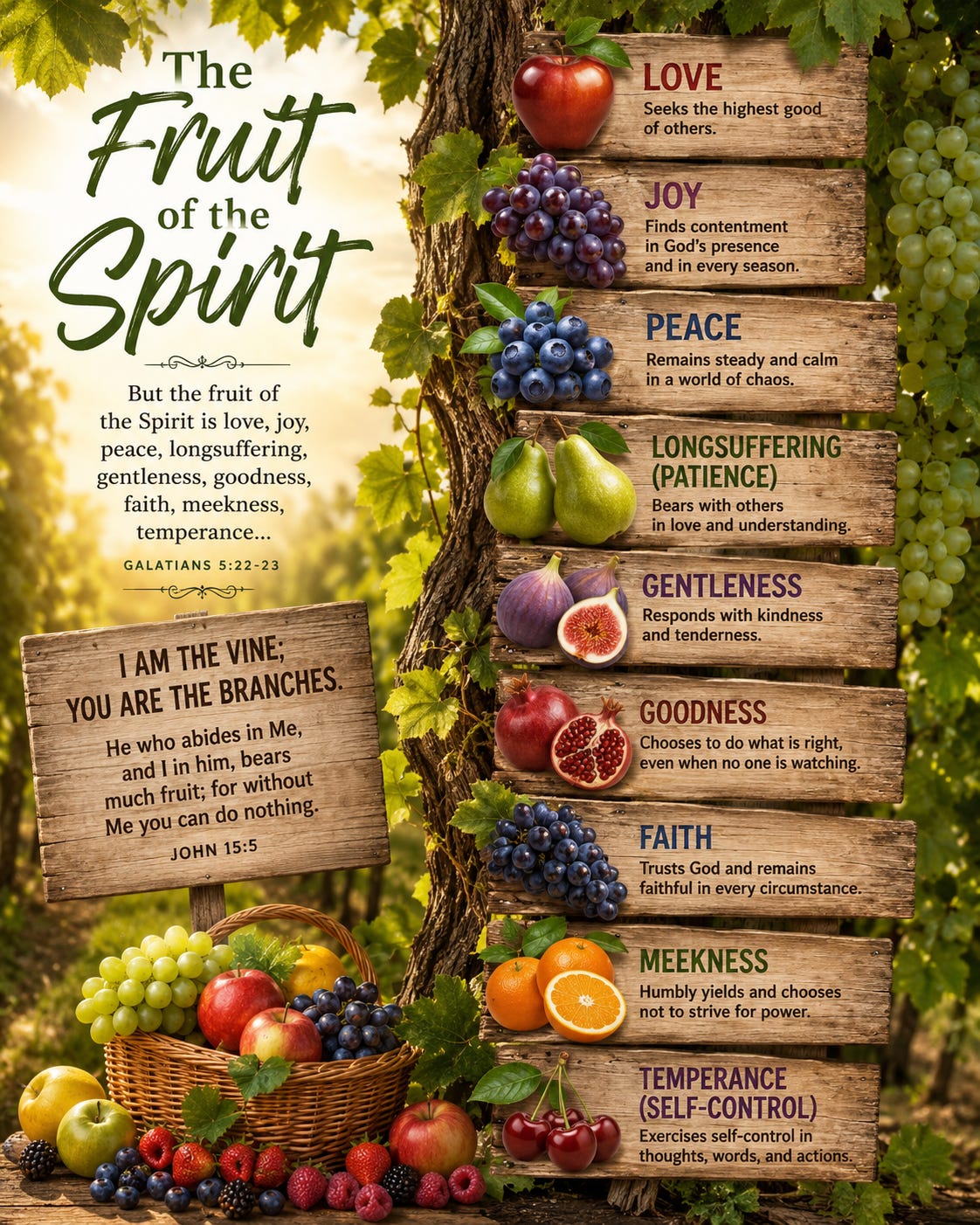
In the previous part, we looked at the Armor of God as something deeper than protection from enemies outside ourselves. The armor can be understood as the qualities of consciousness that help us remain centered when fear, anger, temptation, pride, resentment, and the pressures of life attempt to pull us away from who we are becoming. But armor is not the destination. It protects something that is growing, and Paul gives us a remarkable picture of that growth in his letter to the Galatians: “But the fruit of the Spirit is love, joy, peace, longsuffering, gentleness, goodness, faith, meekness, temperance...” (Galatians 5:22–23).
We often read these words as a list of behaviors Christians ought to practice. We should try harder to be loving, more patient, more peaceful, more self-controlled. There is certainly value in making those efforts, but Paul may be pointing toward something much deeper. He does not call these qualities the rules of the Spirit, the requirements of the Spirit, or even the achievements of the Spirit. He calls them fruit. And fruit is not manufactured. Fruit grows.
The Tree Reveals What Is Within
Imagine an apple tree in late summer. The tree does not spend its days worrying about whether it is producing enough apples, comparing itself with the tree beside it, or straining to prove what kind of tree it is. If it is alive, rooted in good soil, receiving sunlight and water, its fruit eventually appears because that fruit is the natural expression of what the tree has become. Jesus used this same imagery repeatedly, saying that a good tree brings forth good fruit and that a tree can be known by what it produces.
That gives Paul’s teaching a different meaning. Perhaps the Fruit of the Spirit is not primarily a list of virtues we are supposed to imitate from the outside. It is a description of what naturally begins appearing in a person whose inner life is being transformed. We can pretend to be patient for a while. We can force ourselves to speak kindly. We can suppress anger while outwardly appearing calm. But sooner or later life shakes the tree, and what comes out of us reveals something about what has actually been growing within.
Jesus said, “By their fruits ye shall know them.” We usually apply that statement to other people, but perhaps it becomes far more useful when we turn it inward. What comes out of me when someone criticizes me? What happens when I do not get my way? What arises when someone insults me, disappoints me, ignores me, or challenges something I believe? What happens when I am frightened or when another person is hurting? These moments reveal far more about our spiritual condition than merely saying what we believe.
A person may possess tremendous knowledge of Scripture and still live primarily through anger, fear, judgment, resentment, or hostility. Another person may have far less theological knowledge yet display compassion, patience, forgiveness, kindness, and peace. That does not mean we should begin judging everyone around us according to how spiritual we think they are. It means the teaching can become a mirror through which we examine ourselves.
Love
The first fruit Paul names is love, and perhaps all the others grow from it. Biblical love is much larger than affection or liking someone. Jesus pushed love into uncomfortable territory when he spoke of loving enemies, blessing those who curse us, and praying for those who mistreat us. That kind of love does not arise easily from the ordinary ego because the ego naturally separates the world into those who are for us and those who are against us. It remembers insults, builds defenses, wants recognition, and often wants to be proven right.
Love sees beyond the immediate personality. That does not mean allowing people to abuse us, pretending harmful behavior is acceptable, or refusing to establish boundaries. Sometimes love tells the truth. Sometimes love says no. Sometimes love walks away. Yet even in those circumstances, something changes when we no longer need to hate the person on the other side. We may begin to see the wounded, frightened, struggling human being behind the behavior without excusing what that person is doing. In doing so, we become less likely to allow another person’s behavior to determine the kind of person we become.
Joy and Peace
Joy is interesting because Paul does not simply speak of happiness. Happiness is often dependent upon circumstances. We feel happy because something pleasant happened, someone praised us, the family is getting along, the bills are paid, or life is unfolding according to our expectations. Joy seems to arise from somewhere deeper. A person can experience sorrow and still possess joy. Grief and joy can even exist together because spiritual joy may come from discovering that beneath the changing circumstances of life there is something within us that circumstances cannot completely control.
Peace may be understood in much the same way. We often imagine peace as the absence of trouble, yet Jesus lived in a world filled with political oppression, poverty, religious conflict, sickness, and violence. His own path eventually led directly toward the Cross, and still he spoke of a peace that the world could not give. Perhaps this peace is not produced by arranging the outer world perfectly. It comes from discovering a still place within ourselves that does not have to participate in every disturbance.
A thought may appear, an emotion may arise, or someone may say something that irritates us, yet there can be a moment in which we simply observe what is happening. We do not immediately have to become the anger, the fear, or the argument. We can allow something to be present within the Garden without allowing it to become king of the Garden. That ability to observe without immediately identifying may be one of the beginnings of peace.
Patience, Kindness, and Goodness
The King James Version uses the beautiful old word longsuffering, while modern translations usually say patience. True patience is not simply waiting quietly while secretly boiling inside. It is the growing ability to allow life to unfold without demanding that every person, event, and circumstance immediately conform to our expectations. Most of us have an internal picture of how things should happen. People should behave differently, traffic should move faster, our bodies should work better, family members should understand us, and our plans should succeed. When reality disagrees with those expectations, frustration appears.
Patience begins when we notice the reaction without immediately obeying it. There may be a small space between what happens and what we do next, and that space may be one of the most important places in the spiritual life because it is there that awareness can enter. Instead of responding mechanically, we may begin to choose.
Kindness and goodness bring spirituality into the ordinary details of life. It is easy to discuss theology, prophecy, consciousness, enlightenment, salvation, mystical experience, or the nature of God, but eventually someone interrupts us, someone needs help, someone is lonely, or someone makes a mistake. In those moments, all our spiritual theories are tested. Kindness may be as simple as a telephone call, an encouraging word, listening without needing to correct someone, or helping when there is nothing for us to gain. Goodness goes further into the growing desire to do what is right even when nobody is watching. These quiet actions may reveal spiritual development more accurately than dramatic religious experiences ever could.
Faithfulness and Gentleness
The word Paul uses for faith can also carry the meaning of faithfulness, trustworthiness, and steadfastness. Faith is often reduced to believing the correct doctrines, but faithfulness asks something more demanding: What kind of person am I becoming when no one is watching? Can people trust me? Do I keep my word? Do I remain faithful to what I know is right when doing so becomes inconvenient? Am I willing to follow truth even when truth forces me to reconsider something I have believed for years?
A sincere spiritual seeker may sometimes discover that faith requires changing one’s beliefs rather than defending them. If our deepest prayer is, “Father, I want to know the truth even if it changes the way I believe,” then faithfulness may mean remaining loyal to truth rather than remaining loyal to our previous understanding of it.
Gentleness is also much stronger than it first appears. Gentleness is not weakness. Anyone can strike back when wounded, shout when angry, or humiliate someone when given enough power. Gentleness requires enough inner strength that we no longer need to prove our strength. Jesus could confront hypocrisy with great force while also showing tenderness toward the sick, the poor, the outsider, the person considered unclean, and those rejected by society. Something within him seemed capable of seeing deeper than the labels placed upon people. Perhaps gentleness begins when we learn to do the same.
Self-Control and the Observer Within
The final fruit Paul mentions is temperance, usually translated today as self-control. Its placement is interesting because genuine self-control is not simply repression. There is a difference between forcing ourselves to behave and becoming inwardly free enough that impulses no longer control us. Anger may appear, but it does not have to speak. Fear may appear, but it does not have to decide. Desire may appear, but it does not have to command. A judgment may appear, but we do not automatically have to believe it.
This brings us again to the mystery of awareness. If I can observe anger arising within me, then the anger cannot be the whole of me. If I can notice a fearful thought, there must be something that is noticing the thought. If I can observe the impulse to react before I act upon it, then another level of consciousness has appeared. That small moment of observation may be where genuine self-control begins.
This also connects with the deeper question we have returned to in several parts of this series: If I can observe the emotion or reaction, what is doing the observing? Perhaps that awareness is not merely another thought among thoughts but the place within us from which transformation becomes possible.
Fruit Cannot Be Faked Forever
Religion can sometimes create pressure to appear spiritual. We learn the correct language, the correct behavior, and the outward image expected of us. We may even become skilled at looking righteous while still carrying anger, pride, resentment, judgment, or fear beneath the surface. Jesus repeatedly confronted this problem in the religious life of his day. His concern was not simply that people obey outward rules but that transformation occur from the inside outward.
Fruit eventually reveals the condition of the tree. We may fool others for a while and perhaps even fool ourselves, but life has a way of exposing what is actually inside us. The spiritual life, then, is not primarily about appearing holy. It is about becoming whole.
Christ Formed Within
This opens another way of thinking about salvation. We often think of salvation almost entirely as something that happens to us: a belief is accepted, a prayer is spoken, a theological condition is satisfied, and our eternal destination changes. Yet Jesus repeatedly used images of growth. He spoke of seeds, soil, trees, branches, vines, harvests, and fruit. Even the Kingdom of God was compared to a tiny seed that gradually grows.
Perhaps salvation also includes something profoundly developmental. Christ is not merely someone we believe something about; the life revealed in Christ is something gradually being formed within us. Paul expressed this beautifully when he wrote of his desire that “Christ be formed in you.” That is remarkable language because it points beyond merely believing in Christ toward becoming inwardly transformed by the same qualities of love, compassion, truth, courage, mercy, and awareness that Jesus embodied.
How would we know that this transformation is taking place? Paul gives us the evidence: love, joy, peace, patience, kindness, goodness, faithfulness, gentleness, and self-control. The fruit reveals the tree.
The Vine and the Branches
Jesus gave perhaps the clearest image when he said, “I am the vine, ye are the branches.” A branch does not create fruit independently. Life flows through it. The branch remains connected to the source, and fruit gradually appears. Jesus continued by saying that the one who abides in him brings forth much fruit.
This suggests that prayer, meditation, self-observation, forgiveness, contemplation, service, Scripture, silence, and sincere searching may not be ways of earning God’s favor. They may instead be ways of keeping the branch open to the Vine. Something greater than the ordinary ego can begin flowing through us, and the evidence of that connection becomes visible not primarily in extraordinary experiences but in the kind of person we are becoming.
Get the King Out of the Garden
This brings us once again to the image that has become central to this journey: Get the King Out of the Garden. The Garden can symbolize the inner field of consciousness where thoughts, emotions, memories, fears, desires, and reactions continually appear. None of them necessarily create a problem simply because they are present. The difficulty begins when one of them takes the throne.
Anger may become king. Fear may become king. Pride, resentment, the need to be right, or the need for approval may become king. Once one of these takes the throne, our actions begin producing the fruit of whichever king is ruling. Yet when we can observe what is happening without immediately becoming identified with it, something begins to change. The false king starts to lose its authority.
Perhaps what gradually emerges is not an empty throne but another kind of rule altogether: the rule of love, conscience, compassion, awareness, and the Spirit within. The false king leaves the Garden so that the true King can be discovered there.
A Different Way to Measure Spiritual Growth
Perhaps we sometimes measure spiritual progress using the wrong things. We may ask how much Scripture we know, how often we attend church, what doctrines we believe, how many spiritual books we have read, or whether we have had unusual mystical experiences. All of these things may have value, but Jesus and Paul give us a much simpler measurement: What fruit is growing?
Am I more loving than I once was? Am I more patient and less easily offended? Am I more compassionate toward people who struggle? Am I more peaceful when circumstances do not go my way? Can I notice anger without immediately becoming angry? Am I more willing to forgive, more willing to admit when I am wrong, and more capable of seeing another person’s humanity even when I strongly disagree with them?
These questions are far more demanding than theological ones because they bring spirituality into everyday life. But perhaps everyday life is exactly where spiritual transformation is supposed to occur.
The Harvest
A seed disappears beneath the soil before anything visible happens. For a time, it may appear that nothing is occurring, but eventually a shoot emerges, then a plant, then blossoms, and finally fruit. The spiritual journey may work in much the same way. Years of struggle, questioning, suffering, mistakes, prayer, searching, forgiveness, and self-observation may slowly change something within us that we cannot immediately see.
Then one day something happens that once would have caused anger, and it no longer has the same power. Someone criticizes us, and instead of immediately defending ourselves, we become curious about our reaction. Someone who once hurt us comes to mind, and instead of resentment we unexpectedly feel compassion. A circumstance we cannot control arises, and somewhere beneath the uncertainty there remains a quiet peace.
These moments may seem small, but perhaps they are the harvest. The Fruit of the Spirit is not a badge proving that we have become spiritual. It is evidence that something living has begun growing within us. The deeper question, then, may no longer be simply, “Do I believe in the Spirit?” but rather, “What is the Spirit growing in me?”
Coming Next — Part 37: The Gifts of the Spirit
If the Fruit of the Spirit describes the character that grows as the inner person is transformed, the Gifts of the Spirit raise another fascinating question. Paul describes wisdom, knowledge, faith, healing, prophecy, discernment, and other gifts, not as trophies that make one person more spiritual than another but as different expressions of one Spirit working through many members of one body.
In the next part, we can explore what those gifts may mean both literally and symbolically, and why discovering our particular gift may have much more to do with service than with spiritual status.