


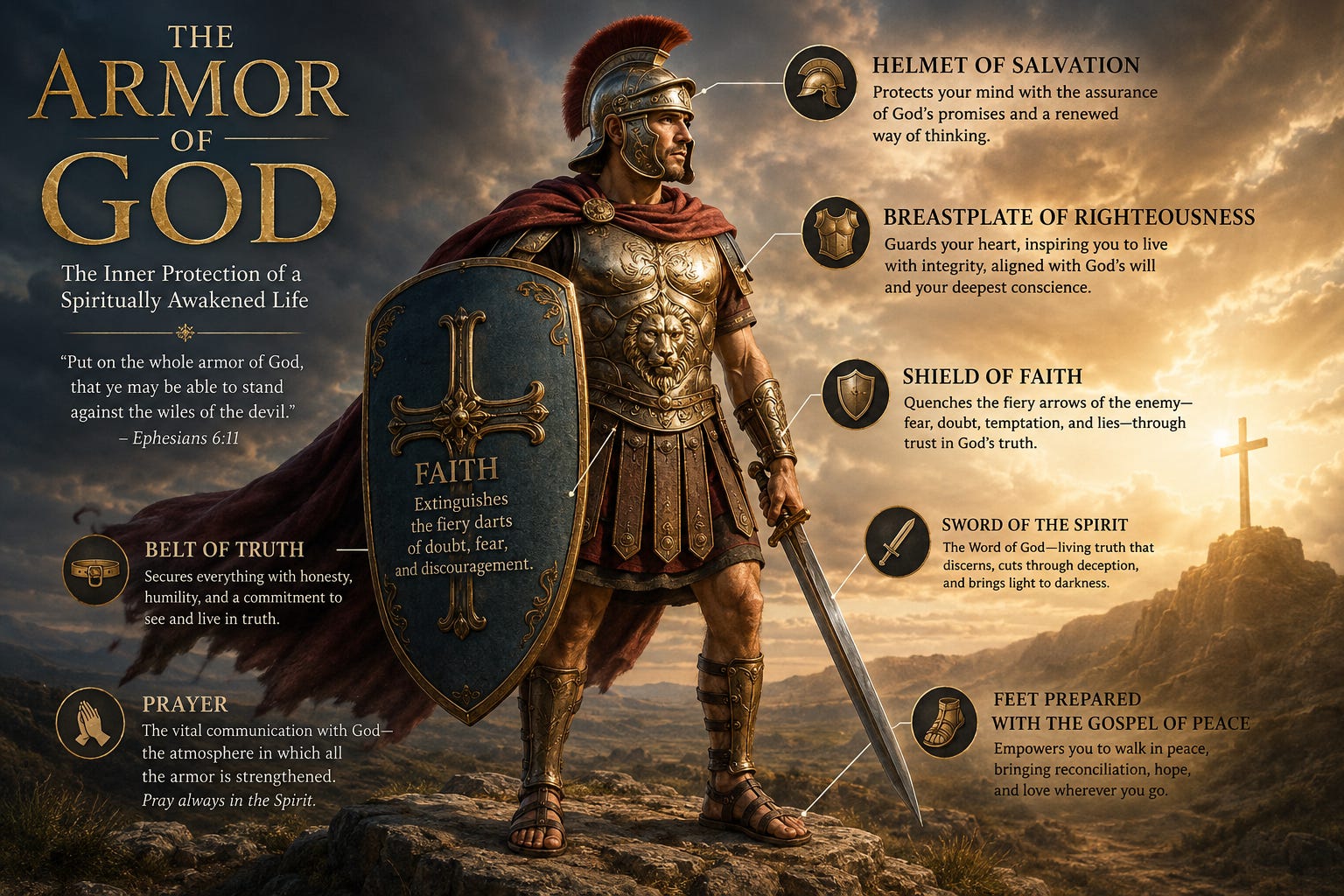
When Paul wrote about putting on the “whole armor of God,” he used an image that his readers would have immediately understood. Roman soldiers were everywhere in the first-century world, and their belts, breastplates, shields, helmets, swords, and heavy footwear were familiar sights. Paul took that outward picture and transformed it into an inward spiritual teaching. “Put on the whole armour of God,” he wrote, “that ye may be able to stand against the wiles of the devil” (Ephesians 6:11).
For many Christians, the Armor of God has been understood almost entirely as protection against an external supernatural enemy. There may certainly be realities beyond what our physical senses perceive, but Paul’s words become even more personally meaningful when we recognize that the battlefield also exists within us. Fear, resentment, pride, deception, temptation, discouragement, uncontrolled desire, and the wounded portions of our own personality can influence us long before any outside force ever does. Paul himself hints at this deeper understanding when he writes that our struggle is “not against flesh and blood.” The real enemy is not primarily the other person. It is not the neighbor who disagrees with us, the politician we dislike, the person of another religion, or even someone who has wounded us. The deeper struggle involves the invisible powers that work through fear, hatred, deception, division, domination, and spiritual blindness, and some of the easiest places for those forces to find expression are within the unexamined regions of our own hearts.
The Armor of God, then, may be understood as the qualities of consciousness that allow us to remain spiritually centered while passing through a world that constantly attempts to pull us away from truth, love, peace, courage, and faithfulness.
The Battlefield Within
Before looking at the individual pieces of armor, it may be important to reconsider what “spiritual warfare” actually means. Throughout history, people have often interpreted religious warfare outwardly. When evil is projected entirely onto other people, religion can become dangerous, because the other person can begin to be seen not simply as mistaken, but as an enemy of God. Once that happens, almost anything can be justified in the name of righteousness.
History gives us sobering examples. During the Crusades, armies marched beneath the symbol of the cross believing that killing religious enemies could somehow serve Christ. During the witch hunts, thousands were accused, tortured, or killed because communities became convinced that evil resided in particular individuals among them. Similar patterns have appeared whenever religious certainty has combined with fear, suspicion, and the conviction that darkness is always somewhere outside ourselves.
Yet Jesus repeatedly turned attention in the opposite direction. He warned about judging another while ignoring the beam in our own eye. He taught that murder begins in anger and hatred long before the physical act occurs, and that adultery begins within desire before it becomes outward behavior. Again and again, Jesus moved morality from the external action to the internal condition that produces the action. In that sense, the true battlefield is human consciousness itself. The question becomes not simply, “Who is evil out there?” but, “What within me is capable of becoming fearful, hateful, deceptive, prideful, resentful, controlling, or self-righteous?” Once we begin asking that question honestly, Paul’s Armor of God becomes remarkably practical.
The Belt of Truth
Paul begins with truth: “Stand therefore, having your loins girt about with truth.” The belt of a Roman soldier helped hold the rest of his equipment in place, and symbolically Paul may be telling us that truth holds the spiritual life together. But truth requires far more than believing that our doctrines are correct. One of the greatest spiritual dangers is confusing certainty with truth, because a person can be completely certain and still be completely mistaken.
Truth therefore requires humility. It means being willing to admit that there may be something we do not yet understand and being willing to examine beliefs inherited from family, church, culture, politics, and society rather than defending them simply because they are familiar. Truth also requires honesty about ourselves. We may deceive others occasionally, but we can deceive ourselves continually. We justify anger, rationalize pride, disguise fear as righteousness, and convince ourselves that resentment is justified because the other person deserves it. The belt of truth means becoming willing to see reality as it actually is, even when that truth challenges the ego. A genuine seeker eventually discovers that truth is not something we possess once and for all; it is something we continually move toward.
The Breastplate of Righteousness
The breastplate protected the soldier’s heart and vital organs, and Paul calls this the “breastplate of righteousness.” Righteousness is sometimes interpreted as moral perfection, but the biblical concept is richer than simply following rules. It involves being rightly aligned with God, with others, and with the deeper conscience within ourselves. The breastplate protects the heart because integrity protects the inner life.
When our outward actions contradict what we inwardly know to be right, something begins dividing within us. We may hide our actions from others, but we cannot entirely hide them from ourselves. Over time, this inner contradiction can harden the heart. Righteousness is therefore not merely about avoiding punishment from God; it is about becoming internally whole. The more our thoughts, intentions, words, and actions come into harmony, the less divided we become.
Jesus repeatedly emphasized this inward righteousness. He criticized those who appeared righteous outwardly while remaining inwardly filled with pride, greed, hypocrisy, or the desire for status. He compared them to cups cleaned on the outside while remaining dirty within. True righteousness begins inside and eventually expresses itself outwardly. The breastplate protects the heart because a heart living in integrity has fewer places where deception can gain a foothold.
Feet Prepared With the Gospel of Peace
Paul next speaks of having our feet prepared with “the gospel of peace.” It is interesting that the spiritual soldier does not march carrying a gospel of conquest, but a gospel of peace. Feet represent movement. They determine where we go and how we walk through the world, and spiritually this raises a simple but important question: What do we carry into the places we enter?
Do we carry conflict into a room, or peace? Do we increase fear, or calm it? Do we deepen division, or attempt reconciliation? Do people leave our presence more agitated, or more peaceful? Jesus said, “Blessed are the peacemakers: for they shall be called the children of God.” A peacemaker is not simply someone who avoids disagreement. Sometimes making peace requires walking directly into a difficult situation while refusing to become controlled by hostility. The spiritually mature person does not need everyone to agree with them before they can remain peaceful, because their peace comes from somewhere deeper than circumstances.
The Shield of Faith
The Roman shield was large enough to protect much of the soldier’s body, and soldiers could even interlock their shields to form a protective wall. Paul says that the shield of faith can extinguish the “fiery darts” aimed at us. Those darts may take many forms: fear, discouragement, doubt, temptation, shame, anxiety, anger, hopelessness, and despair. Anyone who has seriously pursued a spiritual path knows how quickly such thoughts can enter the mind and how convincing they can feel when we are tired, wounded, or afraid.
Faith does not necessarily mean believing that nothing difficult will ever happen. That kind of faith can be shattered the moment tragedy arrives. Deeper faith says that whatever happens, God is still present; whatever happens, something meaningful may still emerge from it; and whatever happens, I do not have to surrender my inner life to fear. Faith does not remove the storm, but it gives us something solid to stand upon while the storm passes.
There is also another beautiful image hidden within the Roman shield. Soldiers were strongest when their shields were joined together. Perhaps faith was never meant to be entirely solitary. Sometimes another person’s faith helps protect us when our own has temporarily weakened, just as at other times our faith may help carry someone else.
The Helmet of Salvation
The helmet protects the head, and symbolically salvation protects the mind. But salvation may mean far more than simply believing the correct theology so that we enter heaven after death. The biblical language of salvation often includes healing, rescue, deliverance, restoration, and becoming whole. The mind desperately needs this kind of salvation because much human suffering grows out of patterns of thought that repeat themselves endlessly.
We may tell ourselves, “I am not good enough,” “Nothing will ever change,” “That person ruined my life,” “Everyone is against me,” “I must always be right,” or “I can never forgive.” Repeated long enough, these thoughts begin shaping how we see ourselves, other people, and the world around us. The mind can become its own prison.
The helmet of salvation may therefore symbolize a transformed way of thinking. Paul expresses this elsewhere when he says, “Be ye transformed by the renewing of your mind.” Spiritual transformation requires a renewed mind because consciousness shapes how we experience reality. Two people can encounter the same event and interpret it completely differently depending upon the condition of their inner world. The helmet of salvation protects us from allowing every destructive thought that enters the mind to become part of our identity. A thought may enter the mind, but that does not mean we must believe it, feed it, or become it.
The Sword of the Spirit
The sword is the only offensive weapon Paul names, and he calls it “the sword of the Spirit, which is the word of God.” The traditional interpretation identifies this with Scripture, and Scripture can certainly function this way. Jesus himself answered temptation by recalling spiritual truth. But the deeper meaning may extend beyond simply quoting verses.
The Word of God represents truth awakened within consciousness, and a sword symbolically separates. Spiritually, truth separates illusion from reality, ego from genuine conscience, fear from wisdom, and what we have merely inherited from what we have actually discovered. The spiritual sword is therefore also discernment.
Jesus demonstrated this repeatedly. He challenged interpretations of Scripture that were technically defensible yet spiritually lifeless. He distinguished between the letter of religious law and the deeper intention behind it. His repeated pattern of saying, “You have heard that it was said … but I say unto you …” was an exercise in spiritual discernment. He was cutting through accumulated layers of tradition in order to reveal the deeper spiritual principle underneath.
Prayer — The Atmosphere Surrounding the Armor
After describing the armor, Paul immediately turns to prayer: “Praying always with all prayer and supplication in the Spirit.” Prayer is not listed as another piece of armor, and perhaps that is because it is something larger. Prayer is the atmosphere in which all the armor functions.
Truth without prayer can become intellectual pride. Righteousness without prayer can become self-righteousness. Faith without prayer can become rigid belief, and Scripture without prayer can become merely words on a page. Prayer continually reconnects the personality with the deeper Source of spiritual life.
Prayer itself may also mature. At first, we often pray primarily by speaking, asking, pleading, and explaining. Eventually we may begin learning to listen. The deeper prayer becomes, the less it is about convincing God to do what we want and the more it becomes an opening through which our own consciousness is brought into alignment with something greater than ourselves. In that sense, prayer is not simply speaking toward God; it is becoming receptive to God.
Standing Rather Than Attacking
Perhaps one of the most overlooked words in this entire passage is the word stand. Paul repeatedly says, “that ye may be able to stand,” “having done all, to stand,” and “stand therefore.” The purpose of the armor is not primarily to attack. It is to remain standing.
That changes the entire image. The spiritually mature person does not need to defeat everyone who disagrees with them. They do not need to conquer every opponent, win every argument, or prove every doctrine. They simply need to remain centered in truth, love, courage, peace, and faith when the forces around them attempt to pull them away from those qualities.
Sometimes the greatest spiritual victory is simply refusing to become what we are fighting against. If another person is angry, we do not have to become angry. If another person lies, we do not have to become deceptive. If another person hates us, we do not have to return hatred. If someone behaves unjustly toward us, we can oppose the injustice without allowing bitterness to take possession of our own hearts. That may be one of the deepest meanings of Paul’s words, “having done all, to stand.”
The Armor Must Become Part of Us
There is another important distinction. Paul does not tell us merely to admire the armor, study the armor, or talk about the armor. He tells us to put it on. Truth must become something we live. Righteousness must become character. Peace must become the way we walk. Faith must become inner stability. Salvation must become renewed consciousness, and the Word must become discernment alive within us.
Otherwise religion remains external. We can carry a Bible and still live in fear. We can attend church and still carry resentment. We can defend doctrine while refusing to forgive. We can speak constantly about spiritual warfare while never confronting the warfare occurring within our own hearts. The Armor of God is not religious decoration; it describes what a human being gradually becomes as spiritual transformation takes place.
Perhaps the Enemy Has Been Closer Than We Thought
Many of us were taught to look outward for spiritual enemies, but Jesus continually directed attention inward. The kingdom is within. The beam is in our own eye. The heart is where hatred begins, and it is also where forgiveness begins. Perhaps the deepest spiritual warfare occurs when truth begins confronting those parts of ourselves that would rather remain hidden.
Our pride resists humility. Our fear resists faith. Our resentment resists forgiveness. Our ego resists surrender. Our certainty resists deeper truth. Yet every time we choose differently, another piece of the armor becomes stronger. Every time we respond with patience instead of anger, honesty instead of self-deception, compassion instead of judgment, or faith instead of fear, the armor becomes less of an idea and more of a lived reality.
The Armor of God may therefore represent far more than supernatural protection. It may describe the gradual formation of the spiritually awakened human being: a person capable of moving through a fearful and divided world without becoming consumed by its fear and division. The greatest spiritual warrior may not be the person who sees demons everywhere, but the person who has learned to recognize darkness when it arises within themselves and refuses to allow it to govern their life.
Perhaps that is why Paul’s final instruction is so simple and yet so profound: stand. Stand in truth, righteousness, peace, faith, renewed consciousness, and the Spirit. When everything around us—or within us—attempts to pull us away from the person God is calling us to become, the task is not always to fight harder.
Sometimes the task is simply to remain standing.
Part 36 coming next— The Fruit of the Spirit: What Spiritual Transformation Looks Like
After Paul’s conversion, his thorn in the flesh, and the Armor of God, this would naturally move from how the spiritual person is strengthened and protected to what that transformed life actually produces:
“The fruit of the Spirit is love, joy, peace, longsuffering, gentleness, goodness, faith, meekness, temperance…” — Galatians 5:22–23