


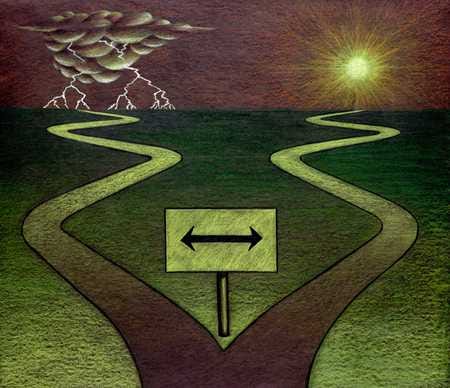
CHAPTER 15 — HOW DO I STAY IN BALANCE WHEN THE WORLD FEELS CHAOTIC?
The world can sometimes feel like a storm that never quite stops. News arrives constantly, opinions collide, fear spreads quickly, and political division, war, uncertainty, economic pressure, family concerns, and the endless stream of information can make it seem as though we are being pulled in a dozen directions at once. The question is not necessarily how we escape the storm, but how we learn to remain inwardly steady while living within it. Balance does not mean that nothing bothers us, nor does it mean becoming detached from suffering or pretending that everything is fine. Real balance is the ability to remain present without being consumed by everything that passes through our awareness.
When we are balanced, there is often a certain inner tone. We may still recognize difficulty, injustice, uncertainty, or pain, but beneath those things there can be a sense of calm clarity. We are able to see without immediately reacting, to care without being swallowed by fear, and to hold convictions without feeling that every disagreement threatens us personally. Perhaps this is part of what Jesus meant when He repeatedly told His followers not to be afraid. He did not promise them a world without turmoil. Quite the opposite. Yet He spoke of a peace that was different from the peace the world gives, an inward steadiness that does not depend entirely upon circumstances.
One of the first ways we can protect that steadiness is by intentionally stepping away from distraction. Our minds were never designed to absorb the fear, anger, tragedy, advertising, arguments, and commentary of the entire planet every waking hour, yet through our phones and televisions that is exactly what many of us attempt to do. We carry the world’s noise in our pockets. There is wisdom in occasionally turning it off. A walk outside without a phone can become almost sacred. Sitting quietly for a few minutes in the morning can change the tone of an entire day. Watching the sunrise without immediately checking messages or headlines reminds us that reality is larger than whatever crisis happens to be dominating today’s news. This is not ignorance. It is mental and spiritual hygiene. We can remain informed without allowing ourselves to become saturated.
Another important question is what we choose to amplify. Every time we speak, post, complain, argue, encourage, comfort, or react, we add something to the atmosphere around us. In a small way, each of us becomes an amplifier. It is worth asking whether we are passing along fear or helping transform it into understanding, whether we are repeating outrage simply because everyone else is outraged, whether we are reacting mechanically or responding consciously, and whether we are increasing division or bringing some measure of soundness into the conversation. This does not mean refusing to speak about difficult subjects. Truth sometimes needs to be spoken plainly, but truth does not always need anger in order to be true. There is a difference between clarity and aggression, just as there is a difference between awareness and obsession.
This is where self-observation becomes so practical. When we feel ourselves tightening inside, we can pause long enough to notice what is happening. Perhaps the emotional part of us wants to strike back. Perhaps the fearful part wants reassurance. Perhaps the proud part desperately wants to win an argument. Instead of instantly obeying that part, we can simply notice it and ask, “Which part of me is speaking right now?” That single question can create a small space between stimulus and reaction, and in that space another possibility appears.
These moments can become sacred intervals of return. They do not require an elaborate spiritual practice. Sometimes the interval is simply one breath before answering someone. Sometimes it is a quiet walk. Sometimes it is closing the laptop and sitting in silence for five minutes. Sometimes it is asking before speaking whether what we are about to say is true, necessary, and kind. The world will constantly pull our attention outward, so the practice is learning how to return again and again.
Balance also requires learning how to remain soft without becoming fragile. There is a temptation, when the world becomes harsh, to harden ourselves. We build walls, become suspicious, and decide we will never allow anyone to hurt or deceive us again. Those walls may initially feel like strength, but eventually they can prevent love from entering as well as pain. True strength does not have to become hard. A tree that refuses to bend may break in a powerful storm, while grass and reeds bend almost to the ground and then rise again when the wind passes. There is wisdom in that flexibility.
We can have boundaries without closing our hearts. We can disagree without hatred. We can recognize danger without allowing fear to become our permanent state. We can remain awake without becoming angry at everyone who appears to be asleep. That last point may be especially important on any spiritual path, because once we begin noticing things differently, the ego can quietly turn awareness into superiority. We begin thinking, “Why can’t everyone else see what I see?” Yet awareness that produces contempt is probably not complete awareness. The deeper we go, the more humility should accompany what we see.
There will always be storms in the world. History makes that clear. One crisis passes and another eventually arrives. If our peace depends upon the world finally becoming peaceful, we may wait forever. Perhaps the deeper invitation is to discover a place within ourselves that is not entirely controlled by the storm. Jesus spoke about building a house upon rock. The rain still came and the winds still blew. The difference was not the absence of the storm. The difference was the foundation.
Maybe that is what spiritual balance really is. It is not escaping the storm or pretending the storm does not exist. It is becoming rooted deeply enough that we can stand within it. A lighthouse does not calm the sea. It simply remains steady enough to help others find their way. Perhaps that is sometimes our role as well.
CHAPTER 16 — HOW DO I KNOW IF I’M ON THE RIGHT PATH?
Many people carry a quiet fear that they may somehow miss the path God intended for them. We imagine life as a maze with one correct route, and we worry that one wrong decision could send us permanently in the wrong direction. But perhaps the spiritual journey is not like that. Perhaps the path is less like a tightrope and more like a spiral. We move outward, inward, forward, and sometimes seemingly backward, yet each experience can bring us into deeper understanding.
Christ showed the way toward love, truth, forgiveness, humility, and communion with God, but within that larger way our individual lives can unfold very differently. There may not be one single earthly path that everyone is supposed to follow. One person becomes a teacher, another farms the land, another raises children, another creates music, another cares quietly for an aging spouse, and another spends much of life simply being a calm presence wherever they go. None of these paths necessarily looks more spiritual than another from the outside. The important question may be what quality of consciousness we bring into the path we are walking.
Life may be less like solving a maze and more like improvising a melody from a deeper tone within us. Each of us has particular gifts, experiences, interests, wounds, abilities, and ways of seeing. Those things become part of the instrument through which our life is expressed. We do not all need to sound alike, and our path may feel surprisingly ordinary. We tend to think that spiritual purpose should be dramatic, as though being “on the right path” means having a major calling, leading others, accomplishing something visible, or knowing with absolute certainty what God wants us to do. Yet some of the most important lives may never look impressive from the outside.
A person who quietly brings peace into a tense family may be fulfilling a profound purpose. Someone who plants a seed of kindness in another person may never live long enough to see what grows from it. A grandparent who listens patiently to a grandchild may influence that child’s life in ways no one else will ever know. Sacred does not always mean spectacular.
So how do we recognize whether our life is moving in a healthy direction? Often the answer is found less in external success and more in inner tone. There may be increasing clarity even when circumstances remain difficult. We may notice that certain choices leave us inwardly strengthened rather than depleted. We become less driven by fear, comparison, guilt, or the need for approval, and more able to be ourselves without constantly performing for others.
This does not mean the right path is always easy. Sometimes the right path is very difficult, and Jesus’ own path certainly was. Difficulty alone therefore cannot tell us whether we are aligned or misaligned. Sometimes growth requires us to walk directly into something we would rather avoid. The deeper question may be what the difficulty is producing within us. Is it calling forth courage, greater compassion, integrity, or truthfulness? Or are we continually betraying something deep within ourselves merely to satisfy expectations, fear, habit, or the approval of others?
When we feel lost, perhaps we do not need to panic. We can become quiet and ask ourselves what we are avoiding, what we are doing because we are afraid rather than because we believe it is right, where we are living from habit instead of awareness, where we are pretending to be someone we are not, and what keeps quietly calling us back. Those questions are not about condemning ourselves. They are about listening.
Sometimes we discover that we have drifted, and everyone does. But being off course is not the end of the journey. A traveler can adjust direction. In fact, one of the beautiful things about spiritual life is that returning is always possible. Again and again Scripture contains this invitation to return: return to God, return to love, return to truth, return to awareness, and return to the person beneath all the roles and expectations. Each return may actually strengthen the path because now we know what it feels like to leave it and what it feels like to come home.
Perhaps this is why failure can sometimes teach us things success cannot. We learn through contrast. We discover which roads lead to peace and which lead to fragmentation. We begin recognizing the difference between an impulse arising from fear and something quieter arising from deeper within us. That quieter voice may not shout. It may simply say, “This way.”
There will probably always be uncertainty, and we may never receive a complete map. Perhaps we are not supposed to. A map showing every turn of life would leave little room for faith, growth, discovery, or freedom. Instead, we are usually given enough light for the next few steps, and maybe that is sufficient.
The path is not strengthened because we never wander. It is strengthened because we learn how to return. Perhaps being on the right path does not mean knowing exactly where the road ends. Perhaps it simply means continuing to walk toward greater truth, greater love, greater awareness, and deeper communion with God.
CHAPTER 17 — WHAT IS THE ROLE OF SACRED RELATIONSHIPS IN AWAKENING?
We do not awaken in isolation. Much of what we learn about ourselves becomes visible only through our relationships with other people. We may think of ourselves as patient until we live with someone who repeatedly tests our patience. We may believe we have overcome jealousy until someone activates it. We may think we are spiritually peaceful until someone says exactly the wrong thing at exactly the wrong time. Relationships reveal us to ourselves, and that is part of what can make them sacred.
A sacred relationship does not have to be perfect, peaceful, romantic, or permanent. It is sacred because something important becomes visible through it. Another person may mirror our kindness, our strength, and our capacity to love, but they may also reveal our fear, pride, insecurity, need for control, or old wounds we thought had been healed. This can be uncomfortable, but sometimes discomfort is where growth begins.
We tend to think the ideal relationship is one in which two people never trigger one another, but that may not be realistic. Two human beings bring histories, expectations, fears, personalities, habits, and wounds into every relationship. Eventually something rubs against something. The question is not whether this happens, but what we do when it does. Do we immediately blame, withdraw, defend, or attack, or can we become curious enough to ask why something affected us so deeply and what exactly was touched inside us?
That does not mean every conflict is our fault. Sometimes another person’s behavior truly is unhealthy, manipulative, cruel, or destructive. Self-observation should never become an excuse for tolerating abuse. But even when another person is clearly wrong, we may still learn something about ourselves through our reaction. Relationships can become mirrors, and mirrors do not always show us what we want to see.
This is where the popular idea of the “twin flame” can sometimes become misunderstood. The term is often romanticized as though somewhere in the world exists one perfect person who completes us. But another way of understanding the idea is much less romantic. A person who acts like a flame may illuminate what has been hidden. They may bring old wounds to the surface and expose jealousy, insecurity, attachment, fear of abandonment, the need to control, or the desire to be validated. The flame burns because it reveals.
That does not automatically mean the relationship is meant to last, and it certainly does not mean harmful behavior should be tolerated because someone has been given a spiritual label. A relationship can be transformative and still need to end. Spiritual language can sometimes be used to justify situations that are clearly unhealthy. Someone may say, “We are twin flames, so this suffering must be necessary,” but suffering by itself does not prove that a relationship is sacred.
A relationship worthy of being called sacred should never require the destruction of human dignity. Growth can be difficult, love can be challenging, and truth can hurt, but genuine spiritual growth does not require us to surrender our ability to discern what is healthy and what is harmful. A sacred relationship may sometimes involve staying, while at other times its deepest lesson may be learning how to leave.
There may also be an important difference between a sacred relationship and what some call a twin-flame relationship. A sacred relationship may be deeply nurturing and may support growth through honesty, companionship, acceptance, and shared awareness. A so-called twin-flame experience, if we use that language at all, may feel much more disruptive. The person may function almost like a mirror held too close to the face, making things we normally hide from ourselves suddenly difficult to ignore. One may help us grow through support, while the other may force growth through friction. Both can teach, but neither should become an idol.
No person is our completion. That may be one of the most important truths to remember. We can love another person deeply without asking them to become the missing half of our soul. When we expect someone else to complete us, the relationship begins carrying a burden no human being can sustain. The deeper work remains our own. Another person can awaken something within us, but they cannot do the awakening for us.
Perhaps that is why some relationships last only briefly yet affect us for the rest of our lives. Someone enters our story for a year, a month, or even a single conversation, and something changes. A question is planted, a wound is revealed, or a new possibility opens. The relationship ends, but the awakening continues. Its value was not necessarily measured by its duration. Its value was measured by what became conscious.
Even difficult relationships can sometimes serve this purpose. Years later we may realize that the person who frustrated us most also revealed something about ourselves that we desperately needed to see. That does not excuse what they did. It simply means their presence became part of our growth. This is where forgiveness, which we explored earlier, connects deeply with relationships. Sometimes we can release a person while still honoring what we learned through the experience.
We do not have to turn every painful relationship into either a tragedy or a lifelong commitment. Sometimes we can simply recognize that a person was part of our journey, that we learned something through knowing them, and that now our paths move apart. That can be sacred too.
Perhaps a useful way to evaluate any relationship is to look at what happens within us while we are connected. Does the relationship deepen self-awareness? Are we becoming more honest with one another? Can we speak truth without fear? Do we respect one another’s freedom? Can we remain ourselves while loving each other? Are we growing toward greater compassion, integrity, and awareness? And perhaps most importantly, can we remain inwardly balanced while staying connected to this person?
If the answer is repeatedly no, something may need to change. Sometimes the change is communication. Sometimes it is a boundary. Sometimes it is forgiveness. Sometimes it is distance. Sometimes it is release. And sometimes the relationship itself transforms because both people become willing to see what it is revealing.
Relationships are among life’s greatest classrooms. They show us where we are free and where we are still reactive. They reveal where love flows easily and where fear still blocks it. They teach us how to forgive, how to speak truth, how to listen, how to let go, and sometimes how to remain.
Perhaps the deepest gift of a sacred relationship is not the other person themselves. It is what becomes awakened within us through meeting them. And once that awakening occurs, it becomes ours to carry forward.
Part 10 and the End of this Series