

Few stories in the Bible have generated more questions than the account of Noah and the flood. Was it a local flood or a worldwide flood? How could all the animals fit on the ark? Where did all the water come from, and where did it go? For centuries, people have debated these questions, and those discussions will undoubtedly continue.
But for our journey through the symbolic meaning of Scripture, perhaps there is another question worth asking. What if the flood story is not only about something that happened long ago? What if it is also describing something that happens within us?
Life has a way of bringing floods.
There are seasons when everything familiar seems to be swept away. A death, an illness, financial hardship, the end of a relationship, the loss of a career, a family conflict, or even a spiritual crisis can leave us feeling as though the world we once knew has disappeared beneath the waters. Sometimes the flood arrives suddenly. Other times the waters rise slowly until one day we realize that the life we knew is no longer there.
In one form or another, perhaps we have all experienced floods.
And perhaps one of the reasons the story of Noah has remained so powerful is that somewhere deep within us we recognize the experience. We know what it feels like to lose familiar ground. We know what it is like to look around and wonder what will remain when the storm finally passes.
Throughout Scripture, water carries several meanings. It gives life. It cleanses. It renews. But it can also overwhelm. In the ancient imagination, deep waters were often associated with chaos and the unknown. We cannot stand securely upon them. We cannot always see what lies beneath them. Once we are carried into deep water, we are no longer completely in control of where we are going.
Perhaps that is part of the symbolic power of the flood.
There are times in life when the structures upon which we have built our identity no longer support us. Old beliefs may begin to fail. Something we were certain about becomes uncertain. A role that once defined us ends. A relationship changes. Our bodies remind us that they will not remain young forever. An experience forces us to reconsider things we thought we understood.
Suddenly we are no longer standing on solid ground.
And that can be frightening.
We usually prefer transformation when we can control it. We like improvement when we can choose the timing, set the boundaries, and decide exactly what will change. But some of life’s greatest transformations do not ask our permission. They arrive like rain.
At first, perhaps, we believe we can simply wait it out. Then the waters rise higher.
Something has to change.
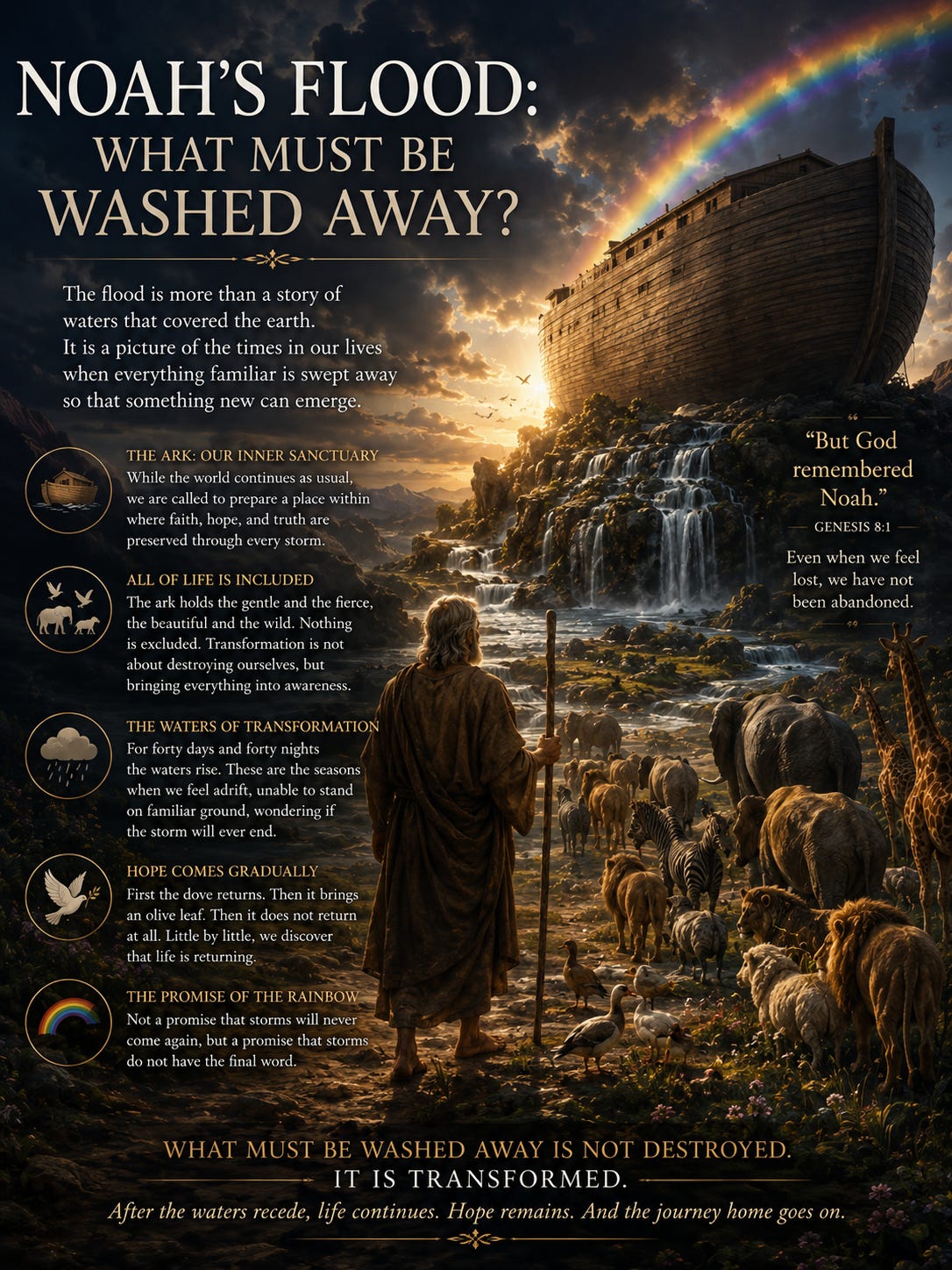
It is interesting that before the rains begin, Noah is instructed to build an ark. While the world around him continues as usual, Noah prepares for something others cannot yet see. Board by board, he constructs something that will carry life through the coming storm.
Symbolically, perhaps the ark represents that quiet place within us where what is most essential can be preserved when everything around us is changing. It may be faith. It may be our relationship with God. It may be truth, love, hope, conscience, or simply the awareness that what we are experiencing is not the whole story.
We might spend years building that ark without realizing it.
Every difficult experience through which we learn patience may add another board. Every time we choose forgiveness rather than resentment, another board is added. Every time we discover that possessions, status, and recognition cannot provide lasting security, something becomes stronger within us. Every period of prayer, reflection, self-examination, or quiet listening may be helping construct something we will someday need.
Then a storm comes, and suddenly we discover whether we have built something within ourselves that can float.
The ark does not stop the rain.
That may be one of the most important details in the story.
Faith does not always prevent the storm. Spiritual understanding does not guarantee that we will never experience loss, disappointment, sickness, or grief. Noah was faithful, yet Noah still went through the flood.
The difference was that he had something capable of carrying him through it.
Perhaps we sometimes expect God to keep us from every difficult experience, when the deeper promise may be that God can carry us through experiences that otherwise might overwhelm us.
The story also tells us that Noah brought the animals into the ark. There were gentle creatures and fierce ones, small creatures and large ones, beautiful animals and creatures we might prefer not to encounter. Symbolically, that presents an interesting possibility. Perhaps the ark contains the whole range of life—and perhaps, inwardly, it can represent the whole range of ourselves.
We all contain parts we gladly show the world and parts we would rather hide. There is kindness within us, but there can also be anger. There is courage, but also fear. There is generosity, but sometimes selfishness. There is tenderness, but also the ability to wound. There are parts of ourselves we consider noble and others we may wish simply did not exist.
Perhaps spiritual growth is not accomplished by throwing half the animals overboard.
Maybe transformation begins by bringing the whole of ourselves into awareness.
This does not mean allowing every impulse to control us. It means recognizing what is actually there. What we refuse to see within ourselves does not disappear simply because we deny it. In fact, the parts we refuse to acknowledge may exert even greater influence because they remain hidden.
Perhaps the ark is large enough to hold all of it.
Then the rain begins.
For forty days and forty nights the waters rise. The number forty appears repeatedly throughout Scripture during periods of testing, preparation, and transformation. Moses spends forty days on Mount Sinai. Israel wanders forty years in the wilderness. Jesus fasts forty days in the desert. Again and again, forty marks a period in which something old is being left behind while something new is being prepared.
Perhaps we have our own “forty days.”
Not necessarily forty literal days, of course, but periods when we simply have to remain in the ark. We cannot hurry the process. We cannot make the waters disappear. We cannot yet step onto dry ground because there is no dry ground available.
All we can do is remain.
Those may be some of the hardest periods of life because we are accustomed to solving problems. We want to fix things, make decisions, and move forward. But sometimes there is nothing to fix yet. Sometimes the only thing we can do is endure the uncertainty and trust that the waters will eventually recede.
This is where we may discover the difference between control and faith.
Control says, “I need to know what happens next.”
Faith says, “I don’t know what happens next, but I will remain present.”
Control demands dry ground.
Faith learns, for a time, to float.
And then comes one of the most beautiful statements in the flood story: “But God remembered Noah.”
Surely this does not mean that God had temporarily forgotten Noah and suddenly thought, “Oh yes, Noah is still down there somewhere.” The words communicate something deeper. In the middle of an endless expanse of water, with no visible land and no obvious evidence that the situation is changing, Noah has not been abandoned.
That may be exactly what we need to hear during our own floods.
When prayers seem unanswered, when circumstances refuse to change, when the future remains uncertain, and when we cannot see land anywhere on the horizon, it is easy to wonder whether God has forgotten us.
But perhaps the story whispers across thousands of years:
God remembered Noah.
And God remembers you.
Eventually the rain stops. Yet even then, Noah cannot immediately leave the ark. The storm may be over, but the earth is not ready.
That too resembles life.
Sometimes the event ends before its effects do. The crisis passes, but healing takes longer. The relationship ends, but grief remains. The illness improves, but confidence has not returned. The difficult season may technically be finished while something within us is still trying to find solid ground.
Noah waits.
Then he begins sending out birds.
Eventually a dove returns carrying an olive leaf.
Imagine what that small leaf must have meant.
It wasn’t a forest. It wasn’t a field. It wasn’t even dry land.
It was simply evidence that somewhere beyond what Noah could see, life had begun again.
Perhaps hope often returns that way.
Rarely do we emerge from difficult seasons all at once. We may first notice one small thing. We laugh again. We become interested in something again. A conversation encourages us. An opportunity appears. We wake one morning and realize the burden feels slightly lighter than it did yesterday.
An olive leaf.
Nothing dramatic.
But enough to tell us that somewhere beyond our present view, new life is growing.
Eventually the dove does not return at all. It has found a place to live.
And finally Noah steps out of the ark.
The world is not the same world he left.
And Noah is probably not the same Noah who entered.
That may be the deeper purpose of many of our floods. We spend so much time asking when life will return to normal that we sometimes fail to recognize that perhaps we are not supposed to return to exactly what we were before.
Some experiences change us permanently.
We may become more compassionate because we have suffered. We may become less judgmental because life has humbled us. We may discover that things we once considered terribly important are not important at all. We may appreciate ordinary moments in ways we never did before. We may become more patient with someone else’s struggle because we now understand what it feels like to be adrift ourselves.
The flood may take something from us.
But sometimes it also reveals something.
It shows us what floats.
When much of what we depended upon disappears, we begin discovering what actually matters.
Perhaps that is why Noah’s first act after leaving the ark is an act of worship. He has passed through chaos and emerged on the other side. The experience has not merely restored his old life. It has brought him into a new relationship with life itself.
And then comes the rainbow.
The rainbow does not mean there will never be another storm. Anyone who has lived very long knows that storms return. Rather, the rainbow becomes a sign of covenant, a reminder that destruction does not have the final word.
There is something beautiful about the fact that a rainbow requires both rain and light.
Without the rain, there would be no rainbow.
Without the light, there would be no rainbow either.
Perhaps that is a picture of our own lives. Some of the deepest understanding we acquire comes when light finally passes through something that once caused us pain. The experience itself may not have been good. We do not need to pretend that loss, illness, grief, or suffering are somehow pleasant things. But sometimes, after passing through them, we begin seeing colors that were invisible to us before.
Wisdom may appear where certainty once stood.
Compassion may grow where judgment once lived.
Gratitude may arise where entitlement once existed.
And perhaps a deeper trust in God can emerge where our need to control everything once ruled.
So perhaps the story of Noah is not merely asking us whether there was enough room on the ark for all the animals. Perhaps it is asking something much closer to home.
What is your ark?
What within you remains when familiar ground disappears?
What are you carrying through the storm?
What might need to be washed away?
And what is God preserving within you so that something new can eventually emerge?
We began in the Garden asking, “Where are you?” With Cain we encountered another question: “Where is your brother?” Now, with Noah, perhaps another question begins to appear:
What remains when the world you knew is washed away?
There will be floods in a human life. There will be times when we cannot see land. There will be periods when all we can do is remain inside the ark and trust.
But eventually the rain stops.
Eventually an olive leaf appears.
Eventually the door opens.
And when we step onto dry ground again, perhaps we discover that the purpose was never simply to return us to the person we were before the storm.
Perhaps the journey is slowly making us into someone new.
After the waters recede, life continues. Hope remains. The rainbow appears.
And the journey home goes on.
Coming Next
Jacob Wrestling with God: Wrestling with Ourselves
What if Jacob’s mysterious nighttime struggle is not merely the story of one man, but a picture of the inner battles that ultimately transform us?