

Back when we farmed, our wooded areas were open enough to walk almost anywhere without fighting through brush. The cattle did an amazing job of keeping things clear. Sunlight reached the ground, grass grew thick, and the woods felt alive but manageable.
When we stopped raising cattle, and I got busy elsewhere, I couldn’t believe how fast nature filled the void. Areas that had once been mostly open were swallowed up by European honeysuckle. At least they didn’t have thorns like prickly ash. We always had some prickly ash, but it never spread as the invasive species had.
By the time I realized what was happening — several years later — the woods had changed.
So I went to battle.
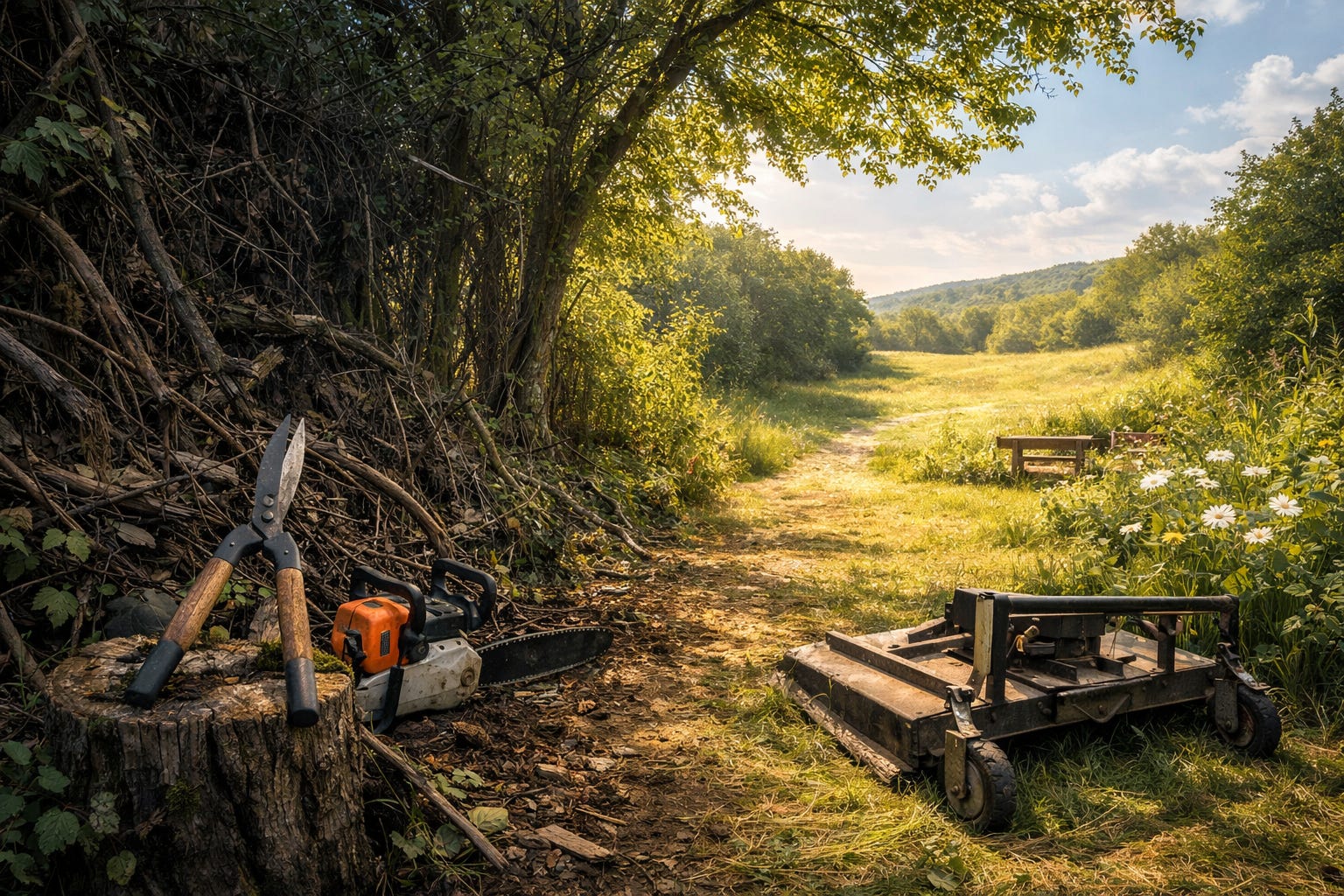
Hand cutting. Brush cutting. Mowing. I made trails first. Then, as I got more ambitious, I opened larger areas. The key lesson was simple: once you open it, you have to maintain it. On the steep hills, much of the mowing has to be done when the ground is frozen for traction. I don’t have a tracked skid steer, so frozen ground is a must.
I even converted a pull-behind Swisher brush cutter to mount on the forks of my skid steer. It works well.
But here’s the truth: if I ever stop, it will all grow back.
That’s the tension I live with.
The caretaker in me says, “Keep it up.”
The rational mind says, “Why are you doing this? If you stop, it will just return.”
It’s like mowing a lawn. There’s joy in the mowing itself, but if you walk away long enough, nature reclaims it. When I was growing up, our yard was where we lived. It wasn’t just grass — it was space to play, to imagine, to grow. Now I sometimes wonder if part of what drives me is guilt about letting things go… and part of it is simply wanting to see the woods the way they once were when I walk through them.
And then it hit me.
We’re not much different.
We go on autopilot. We don’t notice what’s creeping in. Little habits. Old stories. Lingering hurts. Beliefs that don’t serve us anymore. Like brush growing quietly at the edges of our lives.
What if, instead of repeating the same routine, we changed it a bit?
Different roads. Different foods. Different conversations. Different thoughts.
Sometimes the “brush” is an old memory. Sometimes it’s trauma. Trauma sticks like glue. Ignore it long enough, and it quietly reshapes the landscape of your mind. The rational part of us says, “It’s not that bad.” But then we go for a walk — and realize we can’t see clearly anymore.
Life is meant to be lived, not just remembered.
Most of us can recall a time when we felt secure, capable, fulfilled. There’s nothing wrong with remembering. But if memory becomes the place we live, growth stops. There is no better time than now to shift down a gear and climb the hill in front of you.
There is so much brush in people’s lives.
Brush that says:
You’re not good enough.
You’ve already failed.
You’ll fail again.
Happiness isn’t for you.
It’s all invasive growth. And most of it isn’t even true.
Clearing it out takes work. Real work.
It might mean changing your routine. It might mean quieting the monkey mind that loves to replay old lies. It might mean stepping away from distractions long enough to think your own thoughts again.
Make a plan. Get help if needed. Put it into action. Monitor your progress. There’s an old saying: if you fail to plan, you plan to fail.
Depression and discouragement make decisions harder. Distraction feels easier. But distraction is just brush with prettier leaves.
Try this: put the phone down for an hour. Then two. Reclaim that time. Reclaim your attention. Reclaim your view.
Because here’s what I know from cutting brush:
The life underneath is still there.
Sunlight still reaches the ground once the obstruction is removed. Grass grows again. Trails reopen. What felt lost was only hidden.
Nature reclaims.
But so can you.
One thing I've learned about brush is you have to plant something in its place once you cut it out. The earth wants to be covered, and will grow abundantly as long as enough water is available. So don't just cut out the honeysuckle, think of understory shrubs, like hazel nuts, juneberry, red osier dogwood, high-bush cranberry, or nannyberry. The shrub-nesting birds will appreciate these and they provide nutritious food to wildlife. Just so, in your own life, think of positive activities you can add.
The other thing I've learned is working with honeysuckle biology. That plant has enormous root stores to use for regrowth. Each time you mow it to the ground you are encouraging it to develop a larger/wider growth base. If instead you cut it back about chest height the plant will put its energy into resprouting along the stem. That new growth is easy to snap off on a monthly stroll thru your woods. Depending on how old your plant is, you may have to do this a second year, but eventually you will have drained it's energy and when the stems are truly dead you can cut them (or let them persist for a while as supports for vines).
How can you apply this to dealing with your mental overgrowth? Maybe your approach of self-examination is already doing this.
My other comment is that the examples you give of invasive thoughts focused mostly on how we see ourselves. But they can also be how we view others: "they" are slackers, "they" are sinners, "they" are uppity. We will not live in a harmonious place until we see all of us on equal footing.
This was a good thought-provoking topic, I think because you rooted it in your own experience.
Thank you. Very nicely put.