


I took out names and identification words, but those that know me and lived here will recognize and know where I am referencing.
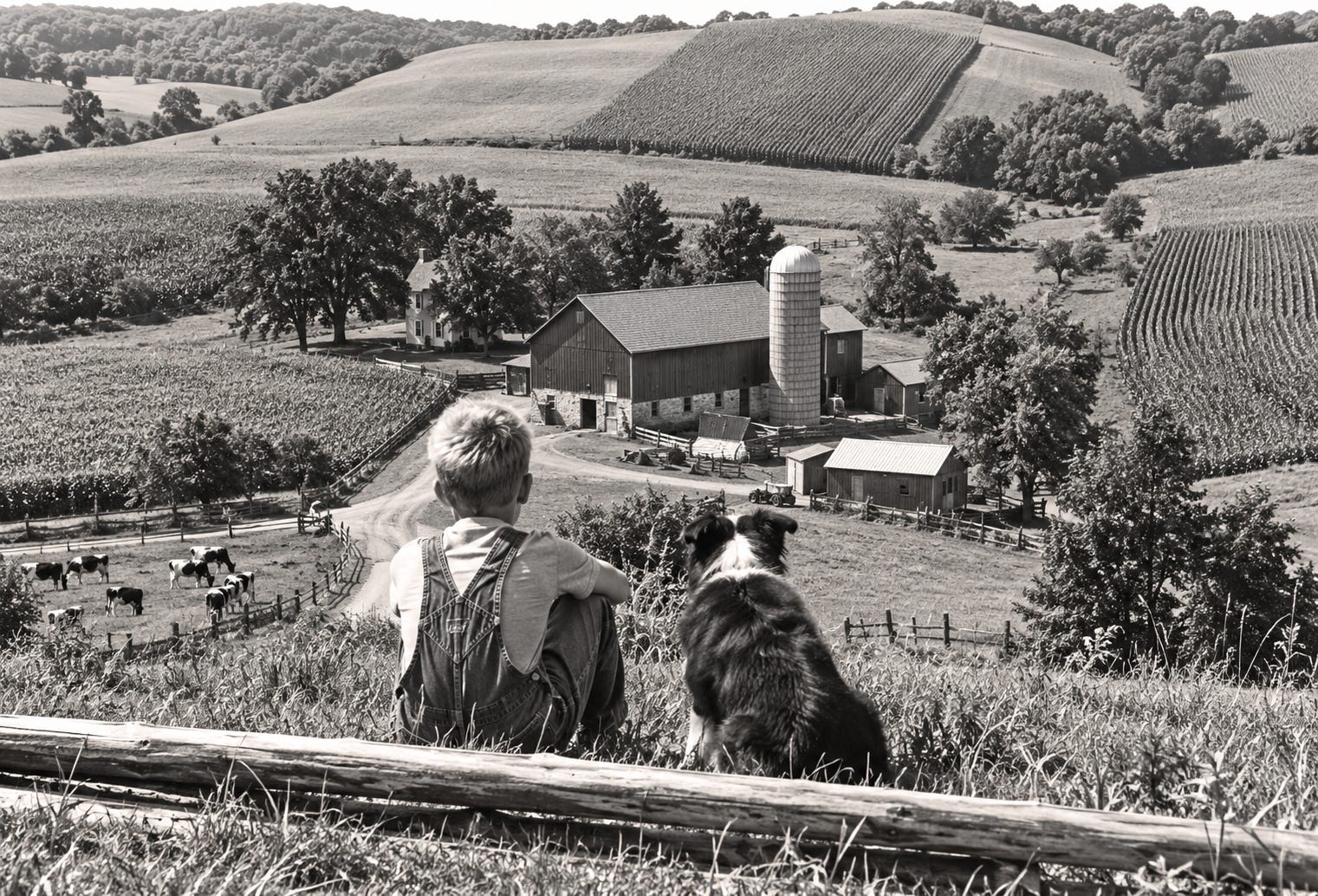
I was born and raised in my local Wisconsin Township on what was a typical dairy farm at the time. Dad milked 28 cows, as did most farmers in the 1950s; the number of cows started to slowly rise. Early mornings before daylight, you could hear the sound of vacuum pumps and almost feel the vibrations from the farms across the creek.
On Friday nights, my parents often visited neighbors because the TV was still brand-new. It seemed every family had children close to our ages, and we always found plenty to do while the parents visited. We knew each other’s homes as well as our own. For many years, my dad served on the town board, and my mother was our 4H leader until her health declined. I was still too young then, but I remember the 4H materials tucked in our closet.
Life felt much simpler back then. We had party lines for phones, and when you were talking, you could often hear someone else breathing quietly as they listened in. We usually knew exactly who it was. Our ring was two shorts and a long, and the polite thing was to leave it alone if it wasn’t meant for you. There were some long talkers on our line, and sometimes we’d have to interrupt them to ask for the phone. When we were first married, we still had a party line before finally biting the bullet and getting a private line, as when we needed the phone, we really needed it.
Early on, most farmers had only the basic equipment — a tractor, plow, disc, grain drill, corn planter, cultivator, and maybe a corn binder. Men traveled around with thrashing machines for grain or choppers for silage. Early on, there were what were called silo fillers, which were a combination blower/chopper to blow the feed up a long tube to the silo. The corn binder would cut and bind corn stocks, and the farmer would then stack them in shocks. You can still see this on some Amish farms. You would drive up to the shocks and load them onto a wagon and then haul them to the silo filler and feed them into a long hopper that fed into the unit, with neighbors helping each other during the harvest. The wives always cooked big meals for the crew, who would eat in the yard with the food on makeshift tables. I caught the tail end of this before everyone started buying their own harvesting equipment. It was similar to what the Amish still do today.
There were about five country schools, all first through eighth grade, close enough that parents could get their children there without going too far. One teacher per school, maybe twenty kids. My teacher was Miss B, who later married and became Mrs. D. G . The schools had wood or coal stoves, hand pumps for water, and two outhouses. The older students took turns with the duties — sweeping the compound on the floor, hauling water, and loading the stove. And every day we were given a potassium iodide “goiter pill,” just in case of nuclear war.
Recess was quite simple with swings, rough-and-tumble equipment, and the same rule for every hurt — “Just be careful next time.” At Christmas, we each had to recite a poem we wrote. One year, mine was about wanting a BB gun, which I did get, though Dad was not pleased when I shot out the yard light.
I remember the blizzard of “I think” 1957, when the town put a V-plow on the grader to fight the snow. The School was so drifted in that the eighth-grade boys had to dig a path for us to reach it. In warm weather, I could climb the fence at the back of the schoolyard and see our farm. I saw my mother walking by the chicken house. The overgrown trees block the view now.
In 1960, with the district now consolidated, the new School was built. My third grade was held at the Church School by with Mrs.H. B. We were divided up by age at the various schools until the School opened mid-year. Everyone adapted quickly. Before it, everyone packed their own lunches, but we had a great cafeteria with homemade cinnamon rolls regularly and great food. Much better than the schools following this one. Our cook basically had free choice on what to make, unlike today, when the menu is dictated.
Our local area had two cheese factories when I was young, with another one earlier but torn down during my time, where county I meets highway 130 meets. Our milk went to F’s. We could walk right in and grab warm curds from the vat as it was customary. T. C’s store was the local place where you could catch up on everyone’s news. Farmers would come mid-morning, sit a while, talk, and stay long enough to avoid being the first one to leave for obvious reasons.
Before the dry dams were built upstream, the Creek flood washed out our Highway. After repairs, the dry dams were added, which helped a lot, though heavy rains still occasionally flood the low areas. In the ’70s and ’80s, floods seemed almost a given. Some summer nights, we’d be out in the dark moving cattle from the bottom pasture as the water continued to rise.
I miss those days of my youth. There are very few farms left that are still milking, and many of the old families are gone as well. We went from knowing nearly everyone to really not knowing most. We still have community get-togethers, but they do not feel the same as they are larger and less personal. Back when the numbers were small, you could visit with everyone.
In the late 1970s or early ’80s, E. P. recorded “The township Interviews.” I sat with N G., D B., and, I believe D. G., Just listening to their stories alone was worth the whole thing. If anyone has copies of those tapes, we’d love to digitize them for the soon-coming Community Center webpage. I think we should do some new interviews today with anyone willing, as it’s a good way to actually get to know our neighbors agains.
The title of this blog came from a dream I had — about how easy it is to spend life doing small things while ignoring the more important ones. Like a king spending all his time admiring his garden instead of tending to the needs of the kingdom.