


I just watched this linked video If Every Nation Is in Debt, Who's It Owed To?
This is from Noel Lorenzana, CPA, and I summarized it below.
I am not an economist.
I’m an accountant who stares at numbers for a living.
And recently I started wondering: if every country on Earth is in debt… who is all that money owed to?
The United States owes over $38 trillion.
Japan owes trillions.
The European Union owes trillions.
Even wealthy nations like Saudi Arabia, Germany, and China carry massive debt.
So if everyone owes… who’s sitting at the top collecting?
The “Global Debt Illusion”
The surprising truth is this: most of the debt isn’t owed to some hidden global king on a mountain of gold.
It’s owed within the system — to governments, banks, pension funds, institutions… and often to citizens themselves.
When the U.S. government borrows money, it issues Treasury bonds — essentially IOUs. Those bonds are purchased by:
Banks
Pension funds
Insurance companies
Mutual funds
The Federal Reserve
About two-thirds of U.S. debt is owned domestically. The rest is largely held by foreign governments and institutions — Japan, China, the UK, Luxembourg, Belgium, and others.
But those countries are in debt, too.
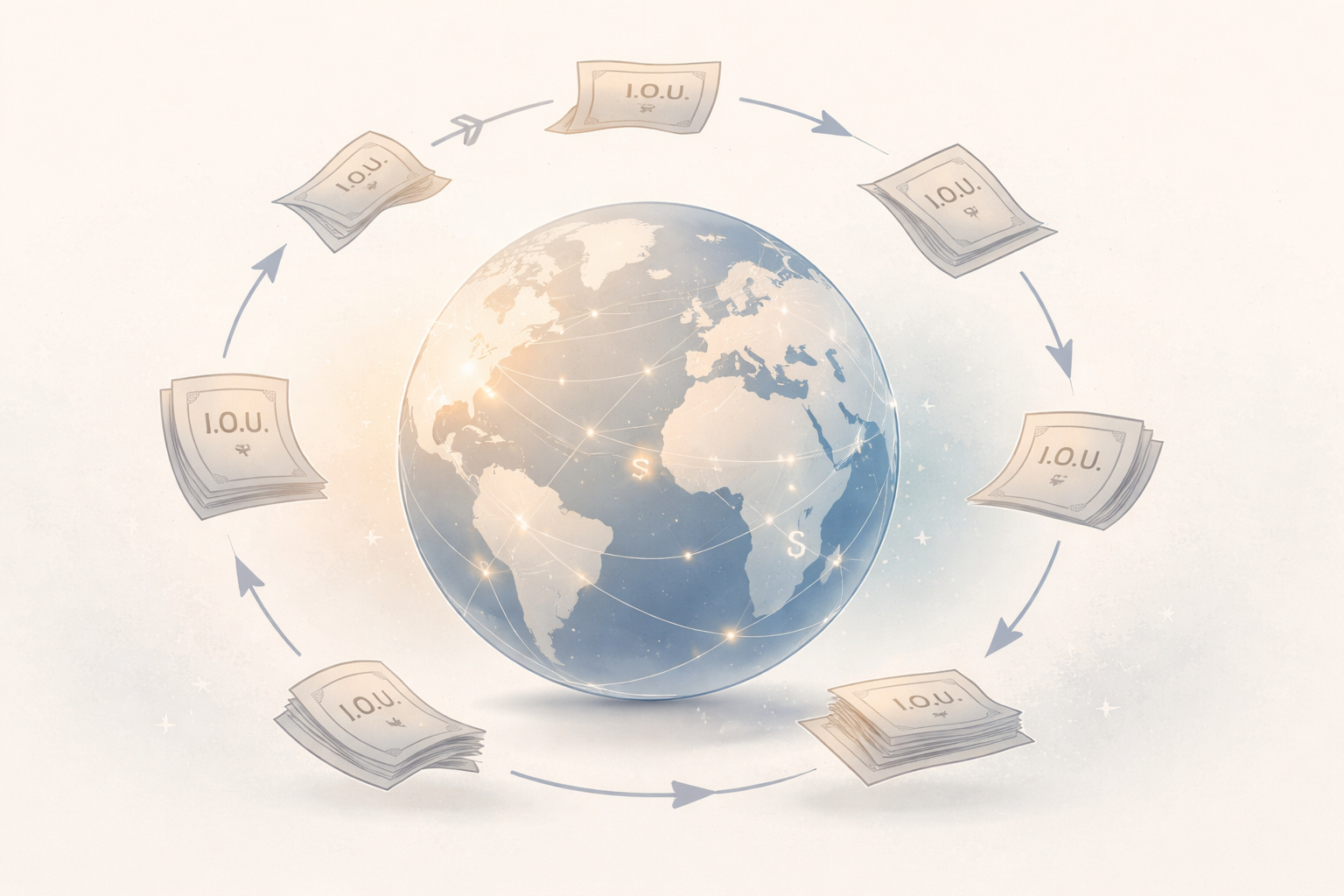
So the system becomes a loop:
The U.S. owes Japan.
Japan owes others.
Europe owes the IMF.
Developing nations owe Europe.
Those same nations hold U.S. bonds as part of their reserves.
It’s a global financial merry-go-round — everyone holding someone else’s IOU.
How This System Began
This isn’t new.
In 1694, England was at war with France and running out of gold. The king needed money. Wealthy merchants agreed to lend it — in exchange for interest, backed by future tax revenue.
To manage this, the Bank of England was created.
That moment changed everything.
Governments could now spend money they didn’t yet have, backed by their power to tax in the future. Debt became institutionalized. Bonds became the backbone of national finance.
Other nations copied the model. Debt stopped signaling failure and started signaling power. The ability to borrow became proof of strength.
Empires once took wealth by force. Modern nations borrow it — and pay interest indefinitely.
The Debt Machine
Today, debt isn’t just a financing tool. It is the engine of the financial system.
When the U.S. Treasury issues bonds:
Investors buy them.
The Federal Reserve can buy them too.
When the Fed does, it creates new dollars electronically in exchange.
That’s how modern money is created — through debt.
Every new dollar originates as someone’s liability. There is effectively no debt-free money in the system.
And governments are not expected to “pay it all off.”
Instead, they roll debt forward — refinancing old debt with new debt.
In fact, if national debt were suddenly eliminated, the financial system would seize up:
Treasuries serve as collateral for banks.
Pension funds rely on them.
Central banks treat them as core reserves.
Debt isn’t an accident. It’s structural.
The goal is not to eliminate debt — it’s to manage it at a sustainable pace.
Debt, Power, and Control
There’s a quote often attributed to Nathan Rothschild:
“The man who controls the British money supply controls the British Empire.”
Whether he said it or not, the principle is worth considering.
Power doesn’t always look like flags and presidents.
Often, it looks like monetary policy and interest rates.
Control interest rates, and you influence growth.
Control debt markets, and you shape national decisions.
The complexity of the system makes it difficult for ordinary people to follow. Central bank reports, debt ceiling debates — they often feel intentionally opaque.
But at its core, the mechanism is simple: debt structures shape economic behavior.
What Happens When Confidence Breaks?
This system works on confidence.
Governments don’t have to eliminate debt — but markets must believe they can manage it.
When confidence disappears, crisis follows.
Greece (2010): Bond markets lost faith. Interest rates spiked. Austerity measures followed. Unemployment surged. Sovereignty was compromised through bailout conditions imposed by the IMF and European institutions.
Argentina: Multiple debt collapses and restructurings. Each cycle leaves citizens bearing the cost.
Sri Lanka (2022): Ran out of foreign currency to service debt. Political and economic chaos followed.
In each case, when confidence broke, new creditors stepped in. Bailouts arrived — but often in exchange for stricter oversight, asset control, or policy influence.
The system resets, but often with fewer freedoms and more centralized control.
End of the Video summarization: “Something to think about below!
So Who Does the System Serve?
If every nation is in debt, and most of the money circulates among the same institutions, then the deeper question becomes:
What kind of system is this?
National debt is no longer something expected to be eliminated. It is something to be extended and managed indefinitely.
Politicians speak of balancing budgets. But structurally, the system depends on ongoing borrowing.
Interest payments do not circulate evenly. They flow toward institutions that hold the debt — banks, funds, and large financial entities.
As global debt rises, so does financial concentration.
Those who hold the debt earn income from it.
Taxpayers fund the interest.
This isn’t about conspiracy. It’s about understanding the framework we operate inside.
The system continues as long as belief continues.
The real vulnerability isn’t the size of the debt.
It’s confidence.
We’re told the national debt is a burden.
But what if it’s also the foundation?
We’re told the goal is to pay it down.
But what if the system depends on never paying it off?
If every dollar begins as debt…
What does that mean for the value of work?
For savings?
For future generations?
If confidence is the glue holding it together…
What happens when confidence becomes fragile?
And maybe the deeper question is not:
“Who is the debt owed to?”
But rather:
“What kind of world is built on perpetual obligation?”
Thanks for the good synopsis. It is mind boggling. And a reminder that “reality” ain’t what we think it is.