


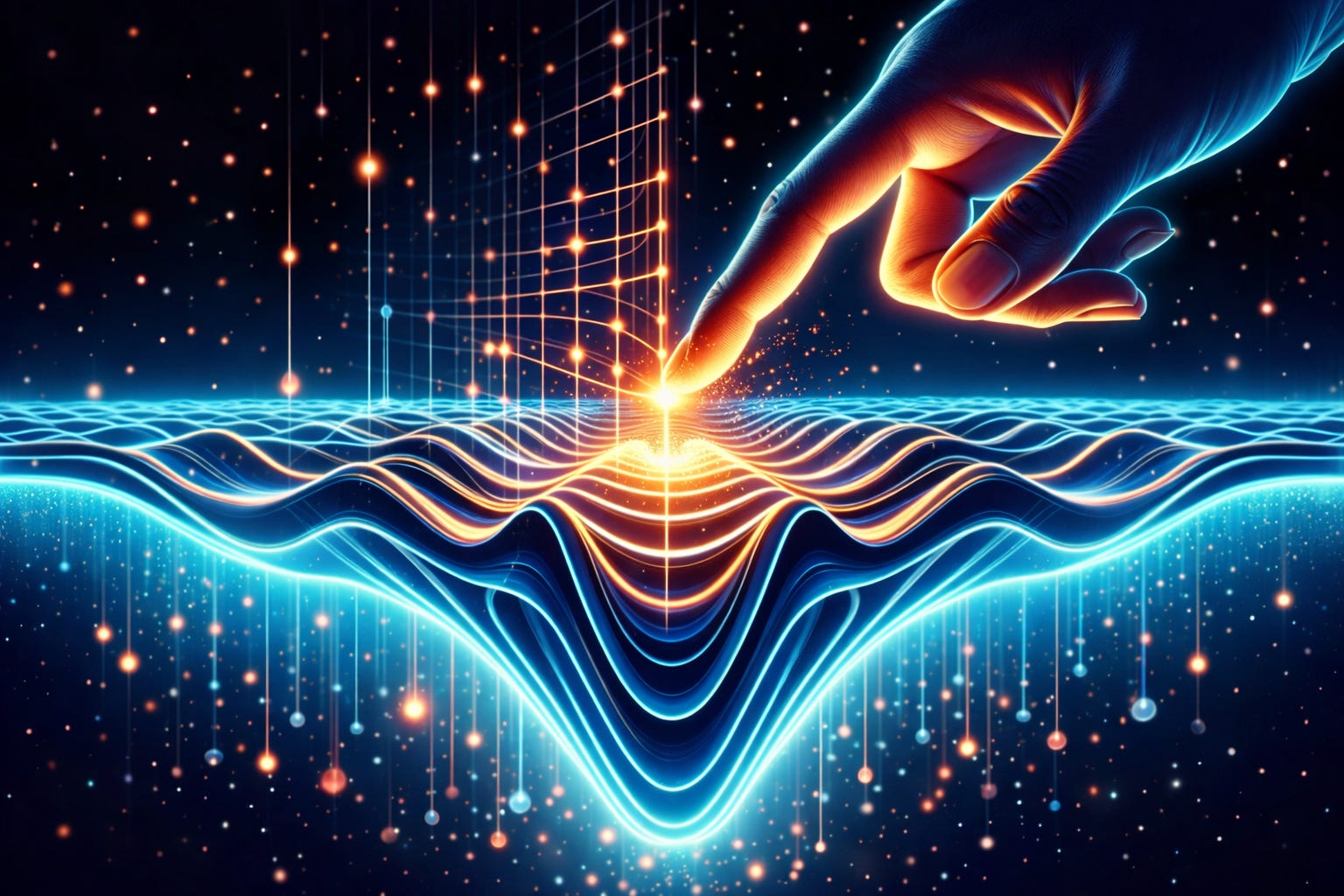
As I sit here after a night of many strong dreams, I started thinking about the world we actually live in—and how different it may be from what we assume it is.
At some point, I think I will do a short series on dreams. But for now, there’s another thread I want to bring up. It spurred me on, also from a podcast by Dr. Carolyn Leaf.
Most of us move through life assuming that what we see is what is real.
The chair you’re sitting on feels solid. The floor beneath your feet feels stable. Time seems to move forward in a straight line. Cause leads to effect. One thing happens, then another.
This is the world we experience in three dimensions. It works well enough that we rarely question it.
But over the last century, physics has been quietly telling a different story.
At the smallest levels of reality—far beneath what our senses can detect—things are not solid at all. Matter behaves more like possibility than substance. Like waves instead of objects. Like patterns that only appear solid once they interact with something else.
In other words, the world we experience may not be the world as it actually is.
It may be the world as it presents itself to us.
I’ve often wondered how God set all of this into motion—how creation was designed to function the way it does. At times, it feels almost like a kind of virtual reality, not in the sense of being false, but in the sense that what we experience is a constructed interface. Our brains receive information and organize it into a coherent picture, shaped by layers far deeper than our conscious awareness.
That distinction matters.
We tend to think of reality as something fixed and external—something we move through like pieces on a board. But modern physics suggests something more subtle: that what we experience is shaped by interaction. Observation. Relationship.
This doesn’t mean we “create” reality by thinking happy thoughts. It means that reality is not a dead machine running independently of us. We participate in it simply by being here.
Even in ordinary life, we already know this.
Two people can live through the same event and come away with completely different experiences. The facts may be identical, but the reality each person carries forward is not.
What changes is not the event, but the engagement with it.
Three-dimensional life gives us a useful picture of the world, but it may not give us the full one.
We experience outcomes, not origins. Effects, not foundations. The finished surface of something that began far deeper than we can see.
That may explain why so much of life feels both solid and uncertain at the same time. We sense that there’s more going on than meets the eye. More beneath the surface. More shaping our days than simple cause and effect.
Physics doesn’t remove that mystery. It confirms it.
This isn’t an argument. It’s an invitation.
An invitation to loosen our grip on certainty. To hold our conclusions a little more gently. To admit that we may be living inside a reality that is far richer, more layered, and more relational than our senses alone can reveal.
If that’s true, then uncertainty is not a flaw in the system.
It’s part of the design.
And learning to live well may have less to do with controlling outcomes—and more to do with how we participate in what unfolds.
To me, when you really sit with it, life begins to feel almost like a waking dream. Not something to escape, but something to experience fully—with all its ups and downs. And perhaps we are right where we need to be, in ways our souls understand long before our minds do.
More to come in a few days.
Next, I want to explore what it means to stand inside possibility before a choice is made.
I really like this: "And learning to live well may have less to do with controlling outcomes—and more to do with how we participate in what unfolds."
It is good to keep this in mind, especially when outcomes don't match our expectations.