


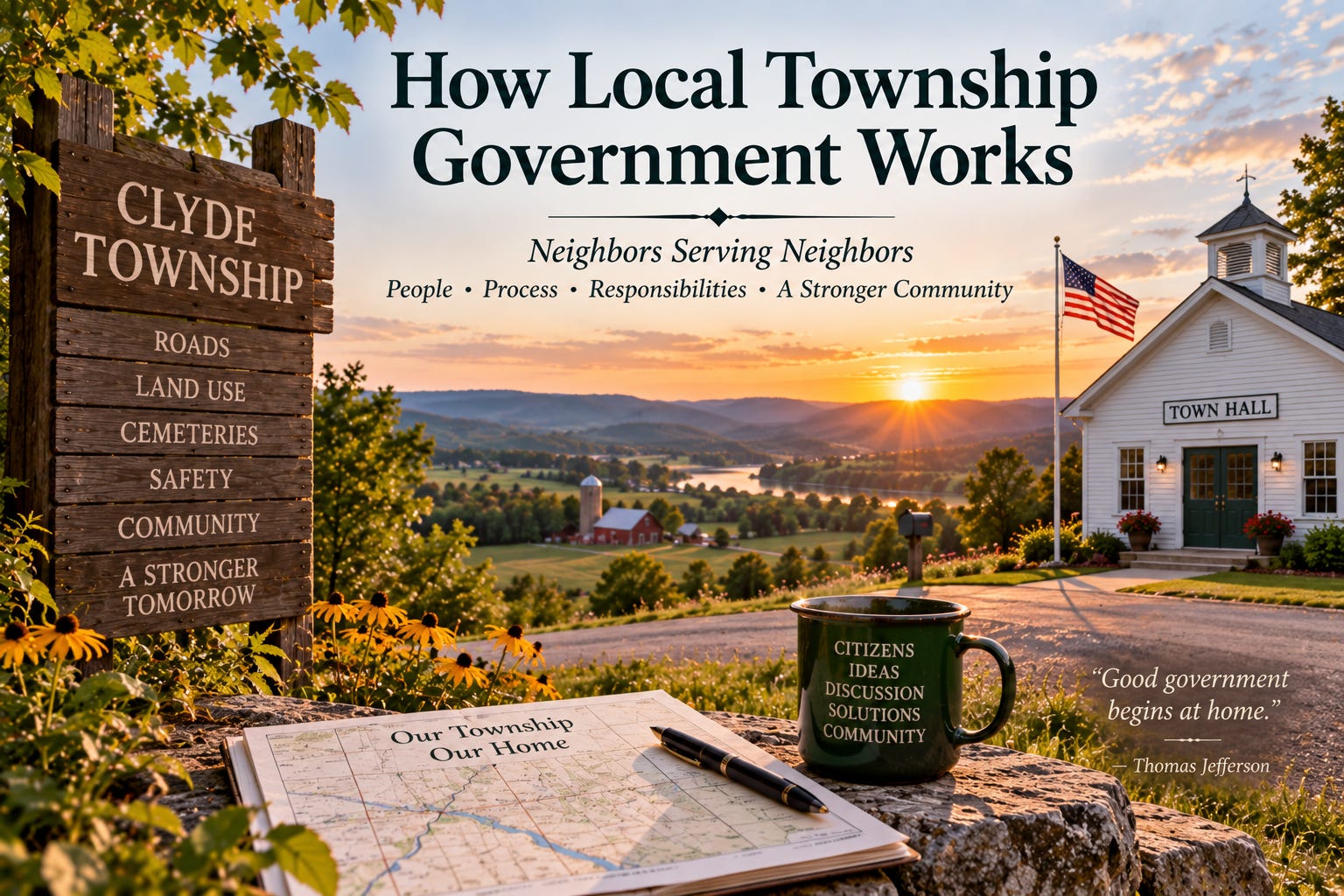
Most people have only a small understanding of local government. Since I am on a town board, I thought this would assist those not sure of how this works.
Local township government is often the closest level of government to everyday life, yet it’s also one of the most misunderstood. Many people assume a township board has broad authority, when in reality its powers are quite limited and tightly defined by state law.
Understanding what a township can do — and just as importantly, what it cannot do — helps reduce frustration and misplaced blame.
What a Township Board Is
A township board typically consists of:
A chairperson
Supervisors
A clerk
A treasurer
These are usually part-time positions filled by residents. Board members are not professional politicians. They are neighbors who step up to handle basic local governance.
The township exists primarily to manage shared local responsibilities, not to act as a miniature version of the state or federal government.
What Township Government Is Responsible For
While details vary by state, most townships are responsible for a short, practical list of duties:
Roads and bridges
Maintenance, snow removal, grading, culverts, signage, and limited improvements on township roads.Budgeting and taxes
Setting a modest annual budget, approving expenditures, and administering township levies within state-mandated limits.Local services
Cemetery care, brush disposal, community buildings, or other small services the township has historically provided.Elections and records
Maintaining records, notices, and assisting with local election administration.Meetings and transparency
Holding open meetings, posting agendas, and keeping minutes available to the public. One thing that is necessary but sometimes makes work more difficult for the supervisor board is that anytime there is a gathering of supervisors that makes a quorum, no township-related discussions that affect decision-making are allowed outside of a Town Board meeting. It is the same with reviewing roads. It is intended that all town-related business is done in an open meeting. The board meets to discuss and make decisions, as this is the only time they are allowed to do so. So the next time you are at a town board meeting, remember you are there as an observer, also with a spot in the meeting where you can make a public comment. Since there are typically 3 voting town board members, a quorum is 2.
That’s most of it. Township government is nuts-and-bolts governance, not policy-making on a grand scale.
What the Township Board Does Not Control
This is where misunderstandings often arise.
A township board generally does not have authority over:
State or county roads
School policies or funding
Law enforcement policy
Zoning laws (in many states, zoning is county-controlled)
Property values or assessments
Utility rates
Federal or state mandates
Even when residents are unhappy about an issue, the township board may have no legal power to change it, no matter how much it sympathizes.
The Limits Are Set by Law — Not Preference
Township boards don’t choose to have limited authority. Their powers are granted — and restricted — by state statutes.
That means:
They can’t spend money that hasn’t been approved.
They can’t ignore state or county regulations.
They can’t act outside their legally defined scope, even if “it seems like common sense.”
If a board exceeds its authority, it can face legal challenges, financial penalties, or personal liability.
Why This Level of Government Still Matters
Despite its limitations, township government plays an important role:
It keeps decisions local where possible.
It allows residents direct access to decision-makers.
It provides transparency that larger governments often lack.
It maintains infrastructure that no one else will.
Most township boards operate quietly, efficiently, and with very little recognition — until something goes wrong.
A Final Thought
When people understand the boundaries of township government, conversations tend to improve. Expectations become more realistic. Frustration decreases. And energy can be directed toward the level of government that actually has the authority to act.
Township boards aren’t designed to solve every problem — but when they stay within their lane, they do an important job well. This works when people are willing to step up and give of their time and expertise to do the behind-the-scenes work.
Feel free to print and refer to.