


What happens to all the wastewater you produce in your home? This water is full not only of organic matter but also of disease-causing bacteria. I once did a home inspection for a military school instructor. He taught military history. We got talking about the Civil War, and I discovered more men died of disease than by gunfire. Dysentery was one rampant form, as it was not yet known that human waste has E. coli bacteria that can make one very sick if ingested. Hand washing was not very common, especially when in battle. Men many times were standing in excrement in the battle line.
We have come a long way in our understanding, but there is still more we each need to know, such as how we now deal with waste. Human waste is not just something to dispose of any way one can, but something that needs to be treated so it no longer can cause disease.
Years ago, there were out houses. A small shed away from the home that one needed to traverse to when the urge came. Not so handy in winter or when one was ill, so the chamber pot was used as well. Not a particularly enjoyable chore to empty, plus the smell from it was not pleasant.
With the advent of indoor plumbing, bathrooms were installed. Some plumbing drain lines exited the home and just ran down a ditch. This was common in the early years. It was discovered that contamination of drinking water needed to be stopped. This brought in the idea of a septic system.
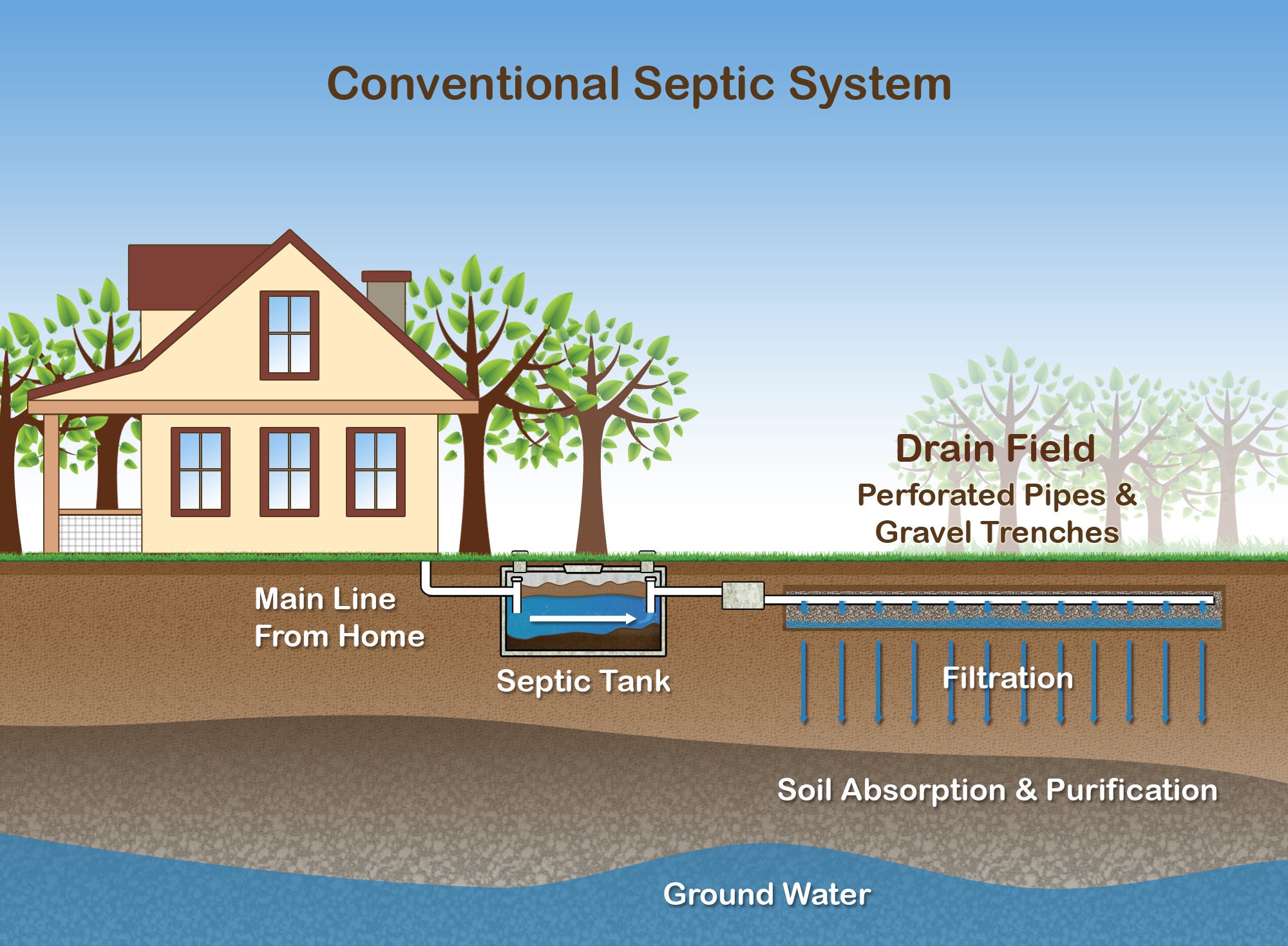
Septic systems have 2 main components,s along with several minor ones. First is the septic tank. The purpose of it is to treat the waste anaerobically. It needs to be large enough to give the waste time to be broken down. Today, a 3-bedroom rated home would require a 1250-gallon tank. This recently changed from a 1000-gallon tank. Waste breaks down in the tank, but solids that won’t break down settle to the bottom and become the sludge that pumpers pump out. You do not want this sludge to go into the drain field. Baffles help with this, plus pumping when the sludge and scum layers are at about 1/3rd the volume of the tank. If over 1/3rd, then there is the risk of some of this exiting to the drain field, which over the years can plug the soil.
The next main component is the drain field. This is called an aerobic treatment area. Oxygen goes through the soil or vents and oxidizes bacteria and non-particulate matter. There is typically a bed of gravel or synthetic material that diffuses the liquid so it can percolate through the soil while being filtered by the soil. There needs to be enough of the proper soil for at least 3’ below the drain tiles to ensure that the drainage is acceptable, plus no contamination of the aquifer.
It is required in Wisconsin to have a soil evaluation by a licensed soil tester. They will determine the type of system that can be used. There are 3 main types normally used. A conventional system with buried trenches. An at-grade, which is built on top of the ground and covered over. A mound system where special sand is brought in then the system is built on it. This is for a location that has very poor drainage type soils.
A pump tank is also a part of some components, as some drain fields are elevated above the septic tank and are not suitable for gravity feed.
There are many ways to determine if a system is functioning properly. It usually takes a trained eye to notice other subtle signs. I will add a link that may be of help.
Back to the King: The King and Sacrifice