


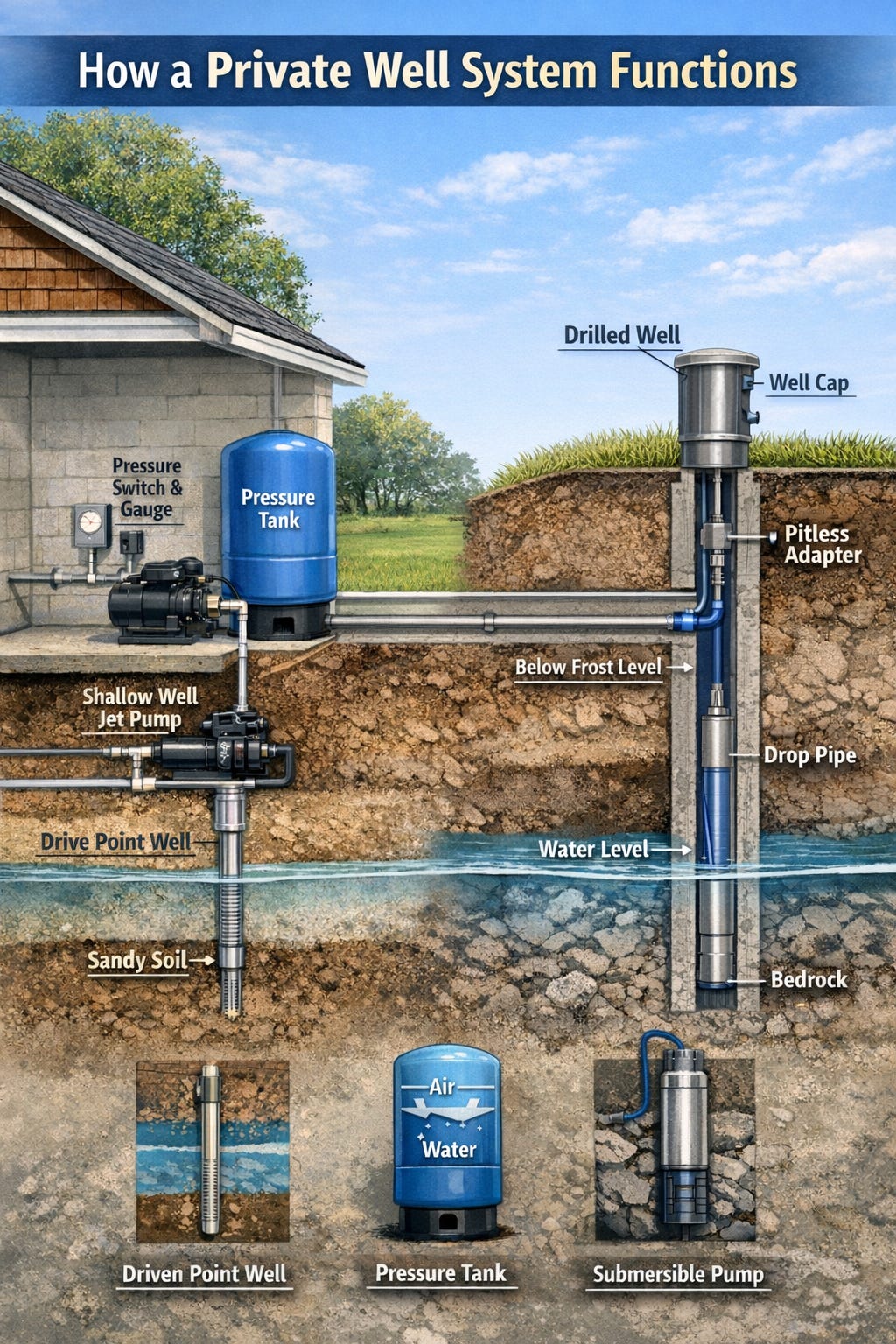
I thought I would take a little diversion from my rants to give a bit of information regarding wells and how they function. We do not only need some reminders of how we work mentally but how systems that we may use every day work as well.
For Wisconsin homeowners, information can be found here:
https://dnr.wisconsin.gov/topic/Wells/homeowners.html
The goal is simple but critical: clean, good-tasting, bacteria-free water that is also free from other forms of contamination.
I have had a well pump installer licence for over 30 years and find that most home owners do not really understand the well system. I am going to explain a bit of how the various componants function.
The Components of a Well System
A private well system consists of several key components.
The Pump
Most modern wells use a submersible pump. This pump sits several feet below the water level in the well casing at a depth where it will not draw the water level below its intake during normal use.
A pipe carries water up from the pump to what is called a pitless adapter, which allows the water line to exit the well below frost depth. This prevents freezing and allows the pump to be removed for service without excavating the well.
Submersible pumps contain multiple impeller stages. The more stages, the greater the pumping capacity and pressure potential. Some pumps contain internal capacitors; others rely on a separate control box mounted nearby.
Driven Point Wells
Driven point wells typically consist of a 1½-inch pipe with a screened point driven into shallow groundwater. Larger diameter versions offer greater capacity.
In these systems, the pump is usually located inside the home and is called a shallow well jet pump. These systems often require a secondary pressurized pipe (a two-pipe protection system) extending from the house to the well. Jet pumps are somewhat louder than submersible pumps but function adequately when installed properly.
Point systems are typically less expensive than drilled wells but are limited by depth and aquifer conditions.
The Pressure Tank
Inside the home, there is a pressure tank. This tank stores water under pressure so the pump does not need to start every time a faucet is opened.
Modern pressure tanks contain an internal diaphragm or bladder that separates water from compressed air. This allows the tank to deliver usable water volume while maintaining consistent pressure.
Over time, these bladders can fail after many pump cycles. When this happens, the tank becomes waterlogged, and the pump begins cycling on and off rapidly. This short cycling greatly increases pump wear and can significantly shorten pump life.
A simple field test is to gently rock the tank. It should feel heavy at the bottom and relatively light at the top. If it feels completely full of water, the bladder may have failed and should be evaluated.
The Pressure Switch and Gauge
Near the pressure tank is a small gray box called the pressure switch. This switch turns the pump on and off at preset pressure levels (commonly 30/50 or 40/60 PSI).
A pressure gauge nearby indicates the current system pressure and can help diagnose issues.
Property Transfer Inspections (Wisconsin)
In Wisconsin, a Property Transfer Well Inspection is required during certain real estate transactions, the ones where a well inspection is a part of the requested testing. This must be performed by a licensed pump installer, and a specific state form must be completed.
While the required form is largely a code compliance report, functional testing is not required, but in my opinion should accompany these inspections. In my opinion, simply checking boxes is not enough. Functional issues can exist even when code items pass, and buyers deserve to know how a system truly operates.
Water testing for Bacteria, Nitrates, and Arsenic is required when a well inspection is requested as a part of the sale and needs to be done by the licensed pump installer doing the inspection. If only water testing is a stand alone request, then it can be done by a non-licensed individual. Besides these 3 tests there are a multitude of other testing options too.
Final Thoughts
This is not an exhaustive explanation, but it should serve as a practical primer for most homeowners.
Water systems are often taken for granted — until something stops working.
When properly installed and maintained, a private well can provide decades of reliable, clean water. But like any mechanical system, understanding how it works is the first step in protecting it.